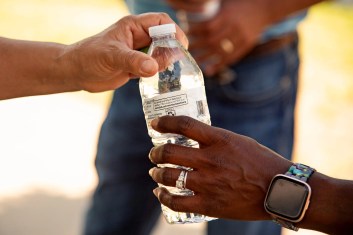
Emil Lippe for The New York Times
The waste has been our main objection to plastic water bottles. But there are other major questions.
We have reason to wonder (more on that another day) whether water in reusable glass bottles is an answer to this one:
Bottled Water Is Full of Plastic Particles. Can They Harm Your Health?
Here’s what scientists know so far about the health effects of nanoplastics, and what you can do to reduce your exposure.
A liter of bottled water contains nearly a quarter of a million pieces of nanoplastic on average, according to new research published this week in the Proceedings of the National Academy of Sciences.
Measuring less than a micron, these nanoplastics are often a tiny fraction of the size of a speck of household dust. In the new study, scientists developed a novel imaging technique which showed that the number of nanoplastic particles in bottled water was between 10 and 100 times higher than previously estimated, said Wei Min, a biophysicist at Columbia University and a co-author of the study.
“Millions of tons of plastic are produced around the world each year,” said Douglas Walker, an analytical chemist at Emory University who was not involved in the new research. Microscopic particles from those plastics can end up in food and beverages in the manufacturing process — they might be introduced through plastic tubing used in machinery, for example — or leach in from packaging such as plastic bottles.
“If you think about the potential for their presence as environmental contaminants, it’s huge,” he said…
Read the whole article here.
 Organikos