Expeditions In The Interest Of Science (Secondary Discovery, Nature’s Majesty)

p03xtfz4

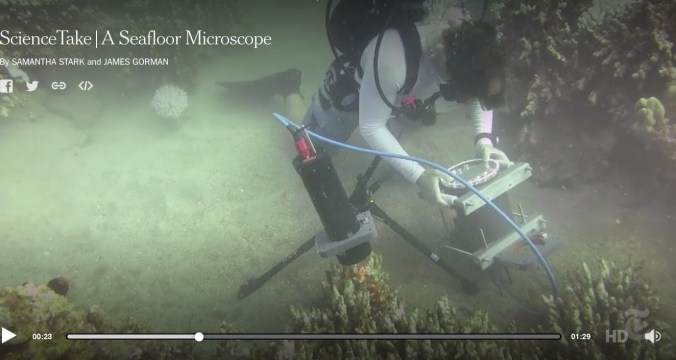
The survey crew inventories the park for butterfly habitats (Credit: John McLaughlin)

This BBC article, featuring butterfly hunters in the very northwestern-most spot in the lower 48 of the USA, reminds us of an expedition we tracked not long ago:

Equal parts academic and mountain man, wildlife biologist John McLaughlin has scaled mountains and traversed snowbound passes to identify more than 40 butterfly species.

It’s best to bring an ice axe when counting butterflies in North Cascades National Park. Located on the Canadian border in the US state of Washington, the park is renowned for its jagged peaks, limited trails and annual snow pack.

“Before my census crew could learn to identify over 40 butterfly species,” John McLaughlin recalled, “they had to know how to safely traverse snowbound, steep passes and – if necessary – to self-arrest using an ice axe.” Continue reading

Food Waste, Remarkably Grotesque

5451

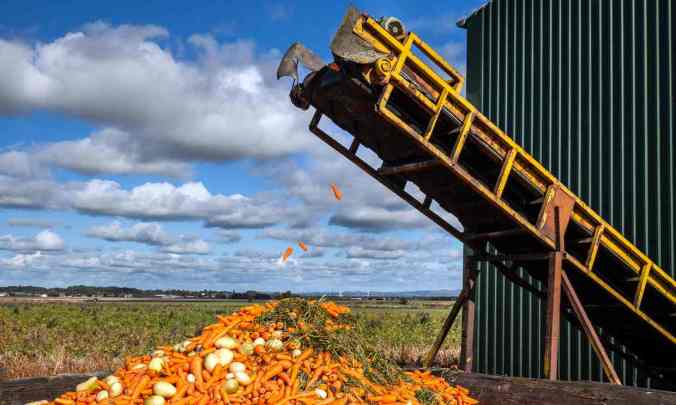
Discarded food is the biggest single component of US landfill and incinerators, according to the Environmental Protection Agency. Photograph: Alamy

We have known for some time the problem is serious, and we are always looking for counter-balancing stories that also highlight solutions. And we are constantly learning more details on just how serious the problem is getting; in short, worse rather than better. Now, new words come to mind. Grotesque is probably the most appropriate (thanks to the Guardian’s ongoing attention to this problem):

The demand for ‘perfect’ fruit and veg means much is discarded, damaging the climate and leaving people hungry

Americans throw away almost as much food as they eat because of a “cult of perfection”, deepening hunger and poverty, and inflicting a heavy toll on the environment.

Vast quantities of fresh produce grown in the US are left in the field to rot, fed to livestock or hauled directly from the field to landfill, because of unrealistic and unyielding cosmetic standards, according to official data and interviews with dozens of farmers, packers, truckers, researchers, campaigners and government officials.

Continue reading

Largest Lithium-ion Storage Battery for L.A.

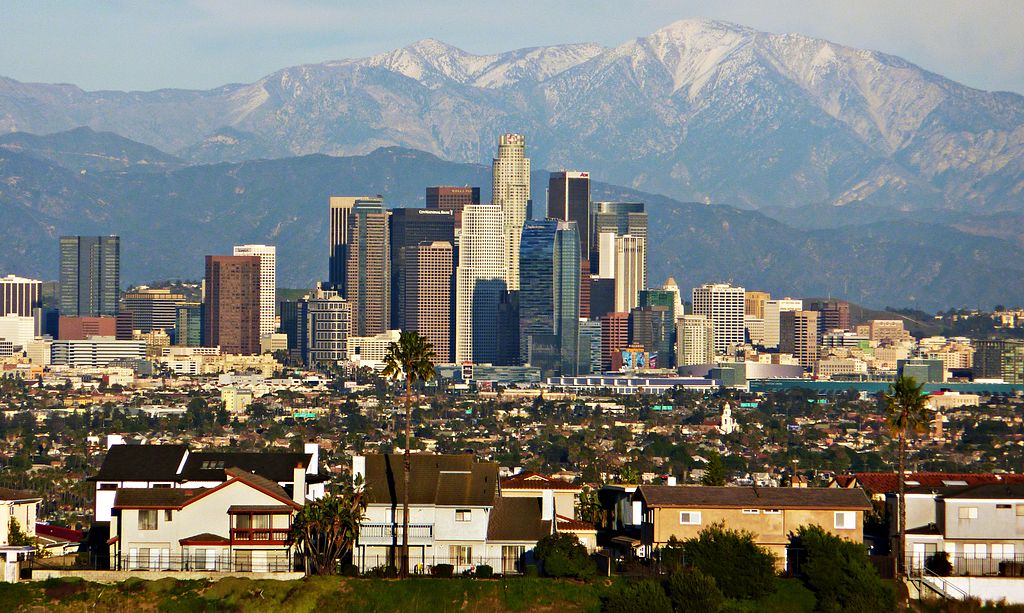
Downtown Los Angeles and the San Gabriel Mountains via Wikimedia Commons

Our posts about solar power normally include some mention of the batteries involved, since that’s where the electricity is stored for actual domestic or commercial use. Lithium-ion batteries in particular are some of the more powerful ones on the market, but sustainable options are on our radar too. This week, we learned about the proposal for a set of over 18,000 lithium-ion batteries to be put together as a super-battery in Los Angeles to meet peak demand. John Fialka reports for Scientific American:

By 2021, electricity use in the west Los Angeles area may be in for a climate change-fighting evolution.

For many years, the tradition has been that on midsummer afternoons, engineers will turn on what they call a “peaker,” a natural gas-burning power plant In Long Beach. It is needed to help the area’s other power plants meet the day’s peak electricity consumption. Thus, as air conditioners max out and people arriving home from work turn on their televisions and other appliances, the juice will be there.

Continue reading

Ginseng Memories

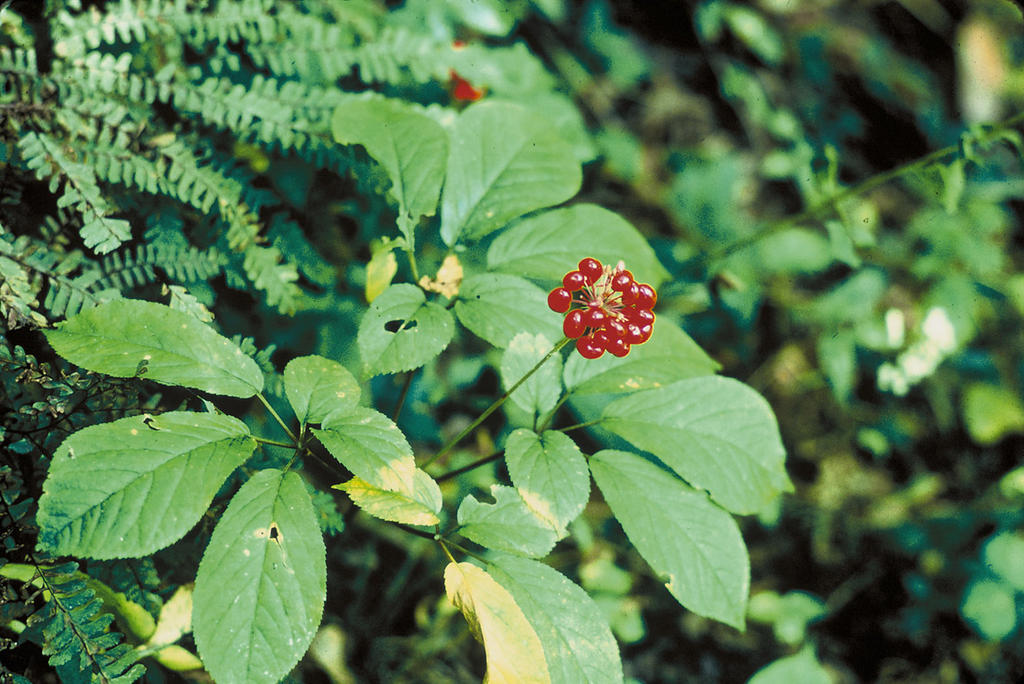
Ginseng with berries. Photo by US FWS via Wikimedia Commons

We first heard of ginseng in the New Yorker, where Burkhard Bilger wrote an article titled “Wild Sang” that explored the history of ginseng hunting and the very modern efforts to protect remaining plants from poaching in the Smoky Mountains. This week in Cool Green Science, the nature writer and conservationist Hal Herring reflects about his own personal experiences hunting ginseng in Alabama, and thinks about the future of the root:

I grew up in the flat-topped foothills of the Cumberland Mountains in north Alabama, and my mother was a student of wild herbs, wildflowers, and native medicinal plants. On my desk right now is a book called Tales of the Ginseng that my parents gave me for my twelfth birthday in 1976. It is a book of collected lore, of Manchurian folktales, of kings who become ginseng roots, of ginseng plants that withdraw, just ahead of the digger, to lure them into a deep-earth spirit-world from which they never return.

Continue reading

Biomass Reconsidered

biomass-b235a828247f79eff9f6f0d3846599d44ae6b453-s1400-c85

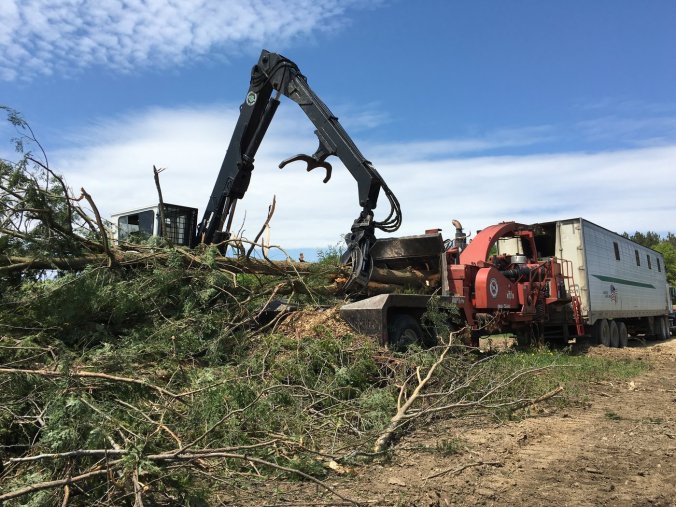
Logger Greg Hemmerich and his crew feed low-value trees into a wood chipper, before bringing the chips to ReEnergy Holdings’ biomass plant in Lyonsdale, N.Y. David Sommerstein/NCPR

Thanks to National Public Radio (USA) for this:

Is Burning Trees Still Green? Some Experts Now Question Biomass

by DAVID SOMMERSTEIN

In northern New York state, logger Greg Hemmerich and his crew are clearing out an old pasture at the edge of a forest.

“There’s a lot of balsam, lot of spruce, thorn apple trees,” Hemmerich says. “Ninety percent of this lot is low-grade wood.”

In other words, it’s no good for furniture or paper or sawmills. But he’ll make $80,000 to run the wood through a chipper and truck the chips to a nearby biomass plant.

“Everybody said that green power was supposed to be the wave of the future,” Hemmerich says. “So I went full in.” Continue reading

Art In The Name Of Environment

9778_f52b43f6e0e444510cf55c5869d8d06b

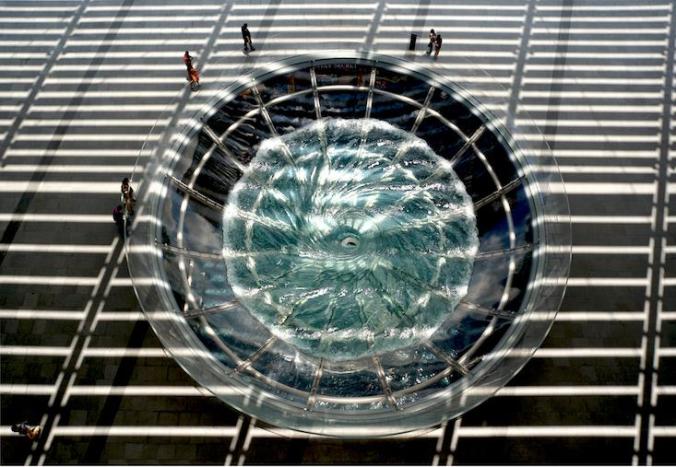
RAIN OCULUS: In Marina Bay Sands, Singapore, a large whirlpool—functioning as both a skylight and a rain collector—forms inside a 70-foot diameter acrylic bowl and falls 2 stories to a pool below. Kahn, collaborating with Moshe Safdie, completed this artwork in 2011. Photo courtesy of Ned Kahn

Nautilus has brought our attention back to a subject that, on last look made us uncomfortable, but now our fascination and wonder are back where they belong:

The environmental artist Ned Kahn, a MacArthur Foundation “genius grant” awardee, gravitates toward phenomena that lie on the edges of what science can grasp—“things,” he tells me over the phone, “that are inherently complex and difficult to predict, yet at the same time beautiful.” The weather, for example, has, because of its chaotic yet orderly nature, “fascinated me for my whole career,” he says. For almost the last 30 years in particular, he’s been creating dynamic installations that he thinks of as “observatories”: Since they frequently incorporate wind, water, fog, sand, and light, he states on his website, “they frame and enhance our perception of natural phenomena.”

Take his most recent project, the “Shimmer Wall”. Composed of over 30,000 tiles, it will be a 1,100-foot long façade of a new building, home to the “Ocean Wonders: Sharks!” exhibit, set to open this year at the New York Aquarium (over $80,000, toward a $100,000 goal, has been donated for its construction). It will house over 100 species of animals, including but not limited to a variety of crustaceans, sharks, fish, rays, and turtles. “They were struggling with the façade and someone on the design committee knew about my work and approached me,” says Kahn. “That led to the idea that we’re doing a skin for the aquarium inspired by fish skin, shark skin, scales. I’ve been doing a number of faceted, fragmented, kinetic artworks influenced by scales—that move with the wind and, when you step back, you get an idea of how the wind affects it.” Continue reading

Amazon’s Architectural Adventure

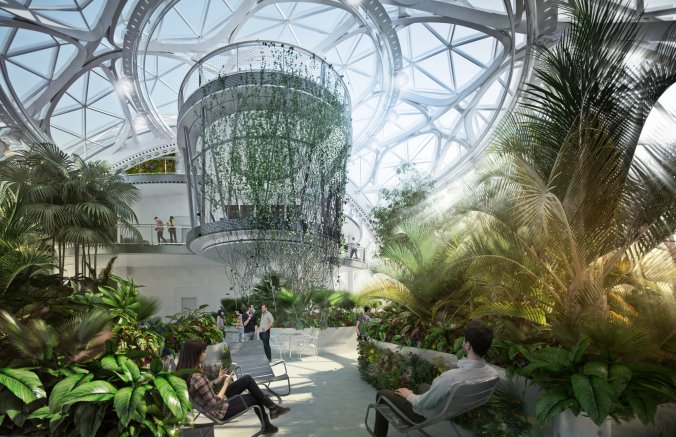
11AMAZON5-superJumbo

Renderings of the spheres at Amazon that show what the interiors are expected to look like. When they open in early 2018, the spheres will be packed with a plant collection worthy of top-notch conservatories. CreditNBBJ

An article in the New York Times helps to illuminate the logic of a company with billions of dollars to spend on its office infrastructure, a company that occupies”creative” space in the global economy, when they design the HQ of the future:

…“The whole idea was to get people to think more creatively, maybe come up with a new idea they wouldn’t have if they were just in their office,” said Dale Alberda, the lead architect on the project at NBBJ, a firm that has also worked on building projects for Samsung, Google and the Chinese internet company Tencent.

Tech companies have been eager to test ways to make workplaces more conducive to creativity. Some turn their offices into grown-up playgrounds, with beanbag chairs, ball pits and Ping-Pong tables…

Creative1.jpg

In New York City’s Chelsea neighborhood, the tech-centric creative company Barbarian Group created a fluid Superdesk to gather their employees at one endless table. Photo from The Creative Workplace

This comes not long after Apple’s own utopian creativity nest, among others in the cash-aplenty sector. A few months ago a book titled The Creative Workplace came to our attention.

We were already primed to think about office space again when we saw the book. A portion of our team was going to be transferring over to the client side at Xandari, starting July. This would give us some space to be creative with. And so we have done. Already we have welcomed the Rainforest “client-side” team into our office.  SCreative2hared office space, akin to what we saw in one of the WeWork spaces in San Francisco recently, suits our office space well.

So the images from this book have been perfectly timed to stimulate our thinking. In our first round of office creativity thinking in 2011 we had a shell that dictated constraints. One of those was economic, aka rational business logic. We needed a certain “feel” to reflect our aesthetic, and to accommodate our workflow, but did not want to go over the top because that is not how we do things.

But we like pretty shiny things as much as the next person, so Continue reading

New Hybrid Bike Concept from Schaeffler

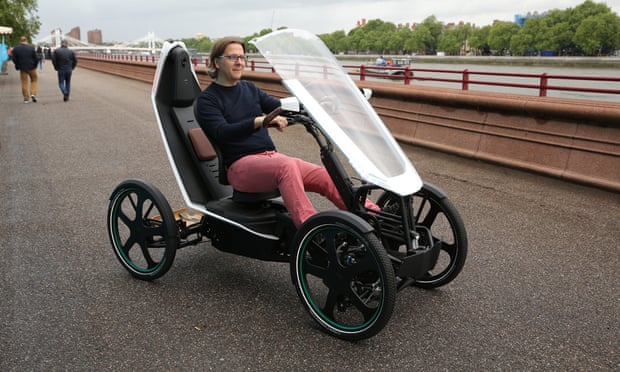
Damian Carrington testing the Schaeffler Bio-Hybrid. Photograph: Schaeffler

We like bikes, including fresh designs or materials for them, and with news from Paris that vehicles built before 1997 will no longer be allowed in the city during weekdays, having more vehicles like this concept design could be useful for commuters looking for a change. Damian Carrington reports for The Guardian:

I’m sitting in a cross between an electric-assisted bicycle and an electric car that looks like a cool golf buggy.

The model I am in is also the only one in the world and cost a lot of money to build. So no pressure as I take this concept vehicle for my first spin. The Schaeffler Bio-Hybrid looks hi-tech, but luckily it is very easy to drive. Or do I mean ride?

Continue reading

Paris Bans Pre-1997 Cars from Roads

Good news comes from the French capital in an effort to reduce smog and carbon emissions on the streets in the city of light, but the United States is stuck trying to discourage driving in much weaker fashion, Camille von Kaenel reports for Scientific American:

Cities around the world are driving vehicles off the streets by imposing strict anti-pollution measures, but the car still rules in the United States.

This week, the city of Paris launched a ban on vehicles built before 1997 during weekday daylight hours. Mayor Anne Hidalgo has been candid about her desire to expand the ban to cut back on smog from diesel cars and to “reclaim” the city for pedestrians and bikers.

Continue reading

Increasing China’s Wind Power Production

Dabancheng wind farm in China’s Xinjiang province (Source: Bob Sacha/Corbis, via Dailytech.com)

Wind power, as we’ve written before, has great potential as an alternative energy source, although there are certain issues to take into account. China is installing the most new wind turbines per year, but has yet to produce the most wind-generated electricity given barriers by the coal industry. Prachi Patel reports for Conservation Magazine:

China is the world’s top wind energy installer. The country’s wind installations have a capacity of generating 145 Gigawatts, twice that of the United States and about a third of the world’s total wind power. Yet the country produces less wind electricity than the US. Last month, researchers from Harvard University and Tsinghua University argued in the journal Nature Energy that this underperformance is due to deliberate favoring of coal over wind by grid operators, delays in connecting new wind farms to the grid, and sub-par equipment.

Continue reading

Nature, Color, Science

Screen Shot 2016-07-09 at 5.50.02 AM

If you happen to be in London, starting July 15 this exhibition at the Natural History Museum looks worth a worth a visit:

Investigate how different animals see the world, and explore your own relationship with colour, through interactive experiences and immersive films.More than 350 specimens feature, from beautiful birds to fossils of the first organisms with eyes. And British artist Liz West has produced a stunning light installation, inspired by Newton’s colour spectrum and blue morpho butterflies in the Museum’s collection.

The BBC gives it a strong review here:

_90172043_b583d8fa-da3c-4d0a-aece-83ff65cc48a5

A new exhibition exploring the relationship between colour and vision in the natural world is opening at the Natural History Museum.

Intense and vibrant natural colours will be displayed in specimens and photographs of insects, animals and plants. At the heart of the exhibition – Colour and Vision, which opens on 15 July – is the question of how we perceive colour. Continue reading

Floating Dairy Farm Planned in Netherlands

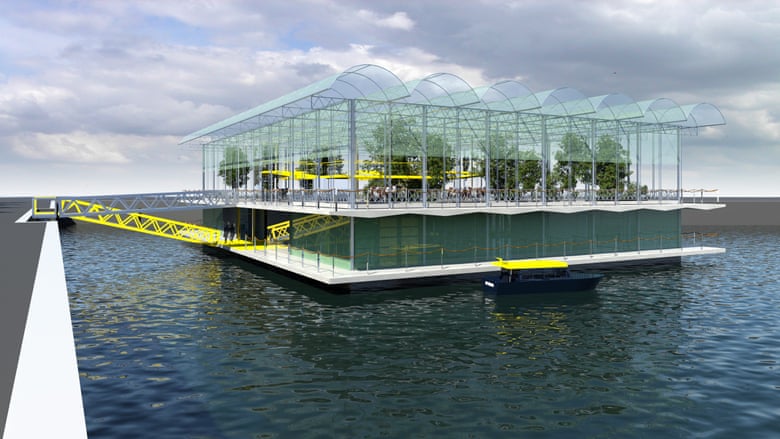
Illustration of proposed floating farm by Beladon.

We’ve written about floating solar panels before, and created a floating fence at Xandari Harbour to keep out water hyacinth, but there are plans in Rotterdam for a floating cow farm that will process milk and yogurt, according to Senay Boztas, writing for the Guardian:

Do cows get seasick? It’s not a question farmers often ask, except in the Dutch city of Rotterdam where a team of developers plans to build a floating dairy.

“They won’t here,” says Minke van Wingerden of Beladon, a company involved with water-based projects from a luxury hotel to this floating farm proposed for Rotterdam harbour. “In Friesland, where I come from, sometimes they bring cows from one place to another on a small barge,” van Wingerden recalls. “[The floating farm] will be very stable. When you are on a cruise ship, you aren’t seasick.”

Continue reading

Camouflage by Debris

Specimens preserved in amber. © Wang et al. in Science Advances, 2016.

We’ve featured posts here concerning camouflage plenty of times, whether in birds and their eggs, in beach-dwelling crabs, plant-mimicking insects, or strange caterpillars. That last example is the closest to the subject matter of Ed Yong’s latest post on Nat Geo’s Phenomenon blog, where he writes about insects that cover themselves in debris to hide from predators or prey alike:

Every year, in northern Myanmar, thousands of farmers pull tonnes of Cretaceous amber out of the ground, and send the glistening nuggets to local markets. For six years, Bo Wang from the Chinese Academy of Sciences and his colleagues have visited the markets and sifted through 300,000 of the glistening nuggets. It was a lot of work. Then again, it takes a lot of work to find animals that spent their whole lives trying not to be found.

Continue reading

Drink Maple? Sure

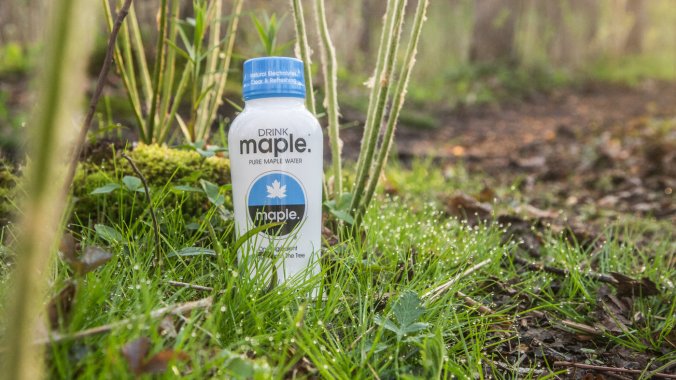
squam-swamp-run-maple--3781_wide-e793fcc0e7e7afb2f5f94466ffbbc47899d9fbae-s1400-c85

Courtesy of Drinkmaple

 Those of us who grew up in maple territory can easily relate to this, and even place palm on forehead and ask–why didn’t I think of that?–so thanks to the Salt over at National Public Radio (USA) for this:

From Tree To Tap: Maple Water Makes A Splash

Unlike syrup, which is boiled down into a thick, sticky liquid, maple water is made from unprocessed sap that is 98 percent water. Its growing popularity is a boon for local farmers. Continue reading

Libraries, Phaidon Style

ssanantonio-ricardo

Ricardo Legorreta’s San Antonio library, Texas, as illustrated by André Chiote

Phaidon has produced a book to meet our library fancy:

The world’s best libraries look even better as posters

See how architect André Chiote has illustrated buildings by Norman Foster, Oscar Niemeyer, Rem Koolhaas and co

When successful architects are tasked with designing important city or national libraries, they rise to the challenge. These practices, which often spend much of their time on overtly commercial work, seem to come to life when they put their civic-minded hats on. Continue reading

2016 Audubon Photography Awards Winners

Bald Eagle and Great Blue Herons. Photo: Bonnie Block/Audubon Photography Awards

Bald Eagle and Great Blue Herons. Photo: Bonnie Block/Audubon Photography Awards

Readers of this site have come to expect an avian presence – daily in the form of our Bird of the Day posts, as well as frequently in our applause of many citizen science programs.

We send out a hearty applause to the 2016 Audubon Photography Award winners – especially the youth and amateur contributors. We’ve posted a few of the fabulous shots here, but be sure to follow this link for the entire set and the details and story behind each shot.

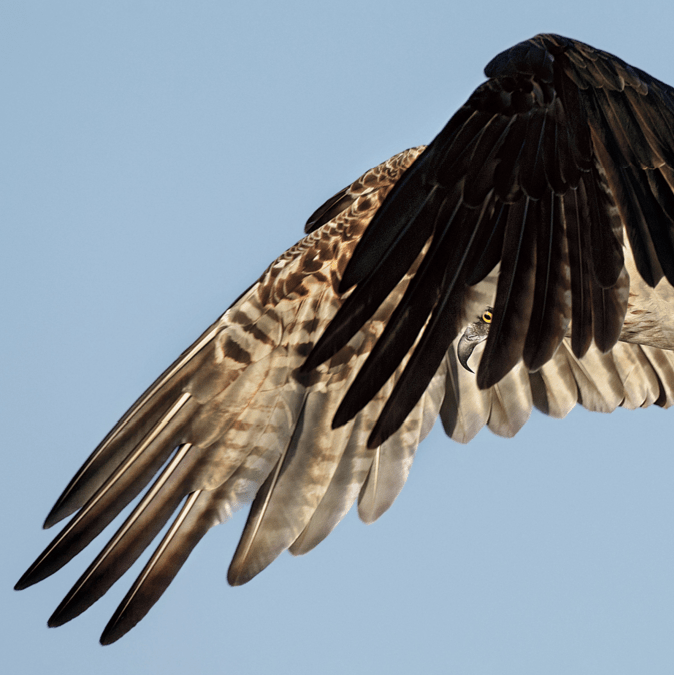
Osprey. Photo: Dick Dickinson/Audubon Photography Awards

Osprey. Photo: Dick Dickinson/Audubon Photography Awards

Quick Stats:

Participants: More than 1,700

Images entered: Nearly 7,000

Categories: Amateur, Professional, Fine Art, Youth

Entrants from: 50 states, 6 provinces, District of Columbia Continue reading

Bioluminescent Fungi

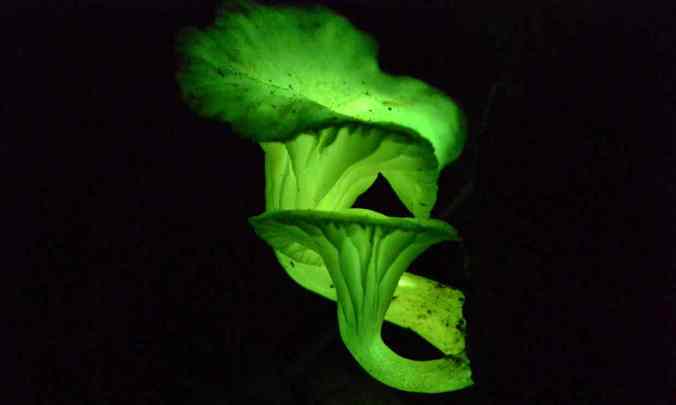
4608

Fungal luciferin could eventually allow the creation of an autonomously luminescent plant. Photograph: Cassius Stevani at the San Paulo University in Brazil

Bioluminescence has appeared in these pages so many times that people probably wonder why. The answer would be because we have contributors who see its wonder of the world quality as directly relevant to our communications mission.

And there was a time when stories about fungi, mushrooms, etc. were the domain of one key contributor. We used to leave stories like this one to our resident mycoenthusiast  Milo, but he is no longer in residence with us; instead, busy now setting up a permaculture organic farm in the rolling hills to the west of Ithaca, NY (USA). So, for lack of a better post-person, this recommendation is from the team:

How research into glowing fungi could lead to trees lighting our streets

Bioluminescence, the peculiar ability of some organisms to behave like living night-lights, could be the key to some remarkable advances

On a moonless night deep in a Brazilian rainforest the only thing you are likely to see are the tiny smears of light from flitting fireflies or the ghostly glow of mushrooms scattered around the forest floor. Both effects are the result of bioluminescence, the peculiar ability of some organisms to behave like living night-lights. Continue reading