Community Conservation in the Arnavon Islands

ACMCA ranger Dickson Motui clears a path for the hatchlings. Photo © The Nature Conservancy (Justine E. Hausheer)

We value sea turtles as an important part of the ocean ecosystem, and are always happy to hear about new conservation stories regarding them. In many coastal areas, the sea-faring reptiles are hunted for their meat and their eggs are harvested from sandy nests, quite often illegally. We report on poaching frequently here, but have good news from the Solomon Islands, where The Nature Conservancy is helping with community conservation in the Arnavons:

After a 40-year history punctuated by arson, conflict, and poaching, conservation efforts in the Arnavon Islands are yielding a glimmer of hope for hawksbill sea turtles. Now, Conservancy scientists are working with local communities to make these critical islands the first site to be registered under the Solomon Islands’ 2010 Protected Areas Act.

Continue reading

Bad News for the Night Sky

Credit: The authors of the manuscript. Prepared by Fabio Falchi

It is unsurprising to learn that light pollution has increased in the fifteen years since the first global map tracking the spread of artificial lumens, but disappointing to hear nonetheless. Last week we posted about one downside to lights in the dark, two years ago shared the idea of “dark sky parks,” and four years ago linked to an initiative to reduce light pollution. Carl Engelking writes for the Discover Magazine blog on the new atlas of the night sky:

The beauty of the night sky is rapidly fading, and an update to the first global light pollution map, created 15 years ago, makes that painfully clear.

The new atlas revealed that more than 80 percent of the world lives under light-polluted skies – that rises to 99 percent of the population in the United States and Europe. One-third of humanity can no longer see the Milky Way. As the new map shows, the night sky is slowly retreating to the glow of artificial light.

Continue reading

Migrations in the “Animal Internet”

© BBC

A couple weeks ago we shared a story about animals’ ability to travel without getting lost, and we’ve also featured pieces about migration in birds and butterflies. That eBird post from Seth is a direct example of what Alexander Pschera calls the “animal internet,” where data is accumulated in life that can be tracked, whether with devices or by people connected around the world. John Vidal reviews Pschera’s new book and covers the idea for The Guardian:

Aristotle thought the mysterious silver eel emerged from the earth fully formed. The young Sigmund Freud could not understand how it reproduced, and modern biologists puzzled for years over whether it ever returned to the Sargasso Sea, where it was known to breed.

Last year a team of Canadian scientists found conclusive proof of that extraordinary journey. They strapped tracking devices to 38 eels and followed as they migrated more than 900 miles at a depth of nearly a mile to the Sargasso, in the Atlantic near Bermuda. This year French researchers used geolocators to watch them descending European rivers and passing through the Strait of Gibraltar, heading for the same spot.

Continue reading

Arecibo Observatory at Risk, but Defended

Photo by Nadia Drake

If you’re a fan of James Bond films, then chances are you’ve seen the Arecibo Observatory in Puerto Rico on a screen at some point–it was the location for the climax of Goldeneye, where Pierce Brosnan debuted as the British spy character. The largest radio telescope in the world, and for several decades managed by Cornell University, Arecibo Observatory is now threatened with defunding in the coming year, but the community around it in Puerto Rico, as Nadia Drake (whose father once directed the Observatory) reports for NatGeo and Science Friday, is rallying around it:

SAN JUAN and ARECIBO, Puerto Rico — Francisco Cordova just started his job as director of Puerto Rico’s Arecibo Observatory, the world’s largest radio telescope. But at a public meeting on day two of his new post, he was already facing the iconic telescope’s potential demolition.

At meetings June 7 in San Juan and Arecibo, students, scientists, observatory staff and community members spoke about what would be lost in terms of science and education if the observatory were to close, an outcome that no one in attendance seemed to find acceptable in any way. As the world’s largest single-dish radio telescope, Arecibo is famous for searching for distant galaxies,  gravitational waves, and signs of extraterrestrial life.

Continue reading

Biomimicry Institute Ideas

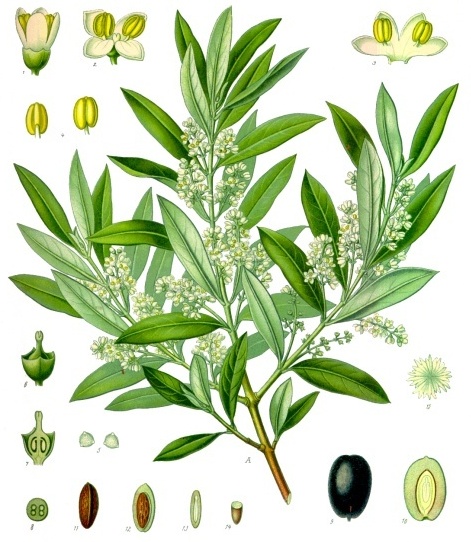
Illustration by Franz Eugen Köhler via Wikimedia

Just a few days ago we shared a piece on biomimicry, and two weeks before that, this little drone showed the advantage of copying flying animals’ ability to perch. Today, via GreenBiz.com, we heard from the Biomimicry Institute about three ways that asking nature “how do you make energy?” can potentially help industries like construction, transportation, and energy:

Humans are becoming increasingly dependent on our ability to connect via technology and easily access the energy grid. Practically every facet of our lives is somehow plugged in and powered up. Yet as our demand for power increases, so must the innovative and life-friendly ways we access and use that energy.

Here’s a light bulb idea: how does nature make energy? For the billions of species that have existed on planet earth, humans are the only ones who have placed such a premium on unsustainable and non-local sources of energy. How then, does nature balance its energy books while producing relatively little energy waste?

Continue reading

Engineering Solutions to Disease

We haven’t feature lyme disease much here, although it’s a highly problematic pathogen that will become more common with a warming climate. The exact same goes for Zika, a much newer danger in the United States. This week in the New York Times, an article by Amy Harmon covers the idea of changing the gene pool in white-footed mice in Nantucket to fight Lyme disease, and a video explains how infecting the Aedes aegypti mosquito may help stop the spread of Zika. Below, the article:

Can genetically engineered mice save Nantucket from the scourge of Lyme disease?

If the 10,000 residents of the Massachusetts island did not have such a soft spot for deer, they might not be entertaining the prospect, which could provide the groundwork for an even more exotic approach to controlling tick-borne diseases on the mainland.

Continue reading

Building Better With Bees

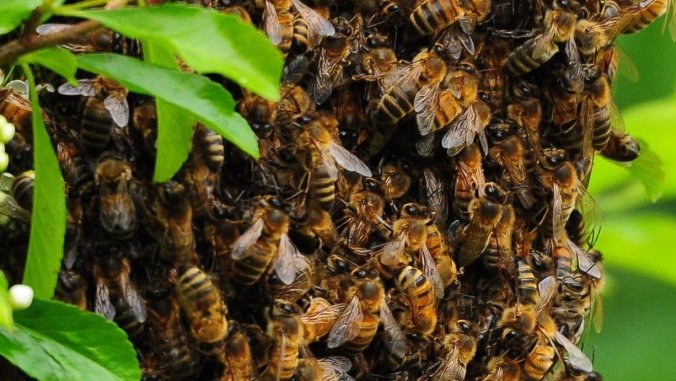
Late spring is swarm season, the time of year when bees reproduce and find new places to build hives. John Clift/Flickr

Thanks to National Public Radio (USA):

Spring Is Swarm Season, When Beekeepers Are On The Hunt For New Hives

Late spring is swarm season — the time of year when bees reproduce and find new places to build hives. Swarms of bees leave the nest and zoom through the air, hovering on trees, fences and houses, searching for a new home.

While a new neighborhood beehive can be stressful for homeowners, it’s an exciting time for beekeepers, who see it as an opportunity.

Recently, these vital pollinators have been under threat. U.S. beekeepers report losing about a third of their honeybee colonies each year in recent years. And North America’s 4,000 other species of native bees are also declining.

So, when a swarm is announced on the Bee Town Bee Club Facebook page in Bloomington, Ind., beekeepers race to call dibs. Continue reading

New Carbon Capture Method in Iceland

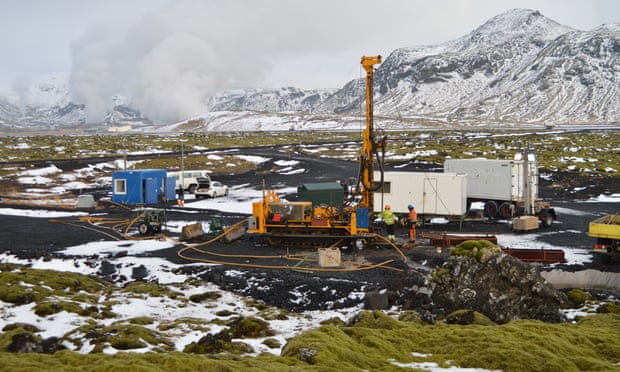
Site close to the Hellisheidi geothermal power plant, where CO2 was injected into volcanic rock. In two years it was almost completely mineralised. Photograph: Juerg Matter/Science via The Guardian

We’ve discussed carbon capture before, in the chemical sense with scrubbers at coal-plants and regarding the history of coal, but most of our posts have been concerned with lowering carbon emissions rather than sequestering it. Today we learned that a new technique tested in Iceland turned CO2 released from a geothermal plant into a limestone of sorts, where it appears to no longer contribute to global greenhouse gases. Damian Carrington reports for The Guardian:

Carbon dioxide has been pumped underground and turned rapidly into stone, demonstrating a radical new way to tackle climate change.

The unique project promises a cheaper and more secure way of burying CO2 from fossil fuel burning underground, where it cannot warm the planet. Such carbon capture and storage (CCS) is thought to be essential to halting global warming, but existing projects store the CO2 as a gas and concerns about costs and potential leakage have halted some plans.

Continue reading

Bravo, Tim Samuel

Screen Shot 2016-06-09 at 7.56.25 AM

Associate Professor Ian Tibbetts, a fish biologist at the Centre for Marine Science at the University of Queensland, says that while it’s difficult to tell from photos alone, the fish looks like it could be a juvenile trevally, which are known to seek shelter among the stingers of certain jellyfish. In this case, the situation may have taken a surprise turn for the small fish, which ended up inside the jellyfish.

Glancing at this image does not give clarity on what it is, so someone’s description is required. It is an intersection of nature’s surprises and the even greater surprise of a photographer capturing nature’s surprises. As if you needed us to remind you how awesome nature is, we send you to Tim Samuel’s portfolio, where you can also order prints and learn that he:

Continue reading

Farm-Table Symbiosis

09caviarpeas-web2-master675

Preparing tear peas at Nerua, a restaurant at the Guggenheim Museum in Bilbao. The peas are known as “green caviar” among Spain’s top chefs. Credit Samuel Aranda for The New York Times

Mr. Minder’s reporting from the field, in this case the rarified field of Michelin-starred chefs, reminds us that the foodie phenomenon (sometimes now bordering on annoyingly precious, and risking the celebrity-worshipping tendencies that will ruin all good fun) is spreading good old fashioned common sense practices far and wide:

Top Chefs and Local Farmers in Spain Regenerate Their ‘Green Caviar’

ARRIETA, Spain — Making his way down a row of pea plants, Iker Villasana Hernaez, a Basque farmer, leans down to feel each pod individually before deciding whether it is ready to pick.

If the peas inside feel slightly hard, “best to leave it for one more day,” he said. “It’s really all about the perfect timing.” Continue reading

A Downside to Lights in the Dark

Photo by homeanddecor.com

Although the titles are similar, this post and the previous one from today are not about related subjects other than light and darkness. The lights referred to in this post’s title are artificial ones on land, not bioluminescence under the sea. Lights from houses and street lamps that distract moths from pollinating plants that need their pollen transported, and often result in moth deaths (by predation or getting trapped indoors). Sarah DeWeerdt reports for Conservation Magazine on a recent UK study on the disruption of pollination by light:

Everyone knows moths are attracted to light, but scientists are just now learning that this attraction may have negative consequences for other parts of the ecosystem. Moths drawn to artificial sources of light may do less work pollinating plants, according to research published last week in the journal Global Change Biology.

Researchers sampled moths at 40 sites along hedgerows bordering agricultural fields in Oxfordshire, England. Half of the study sites were lit with streetlights and half were not. Surprisingly, no one had previously investigated how this very common source of artificial lighting affects the behavior and ecological function of moths.

Continue reading

Lights in the Dark

Galiteuthis. Credit: MBARI

In the past three days, two of the blogs we visit have shared a total of three posts concerning animals that live in the deep sea, where light is scarce. Ed Yong has written for NatGeo’s blog about a “squid that has glowing eyeshadow that acts as an invisibility cloak,” as well as the genetic branches and diversity of species exhibiting bioluminescence; Matt Miller wrote for The Nature Conservancy’s blog about a new book by photographer Danté Fenolio called Life in the Dark: Illuminating Biodiversity in the Shadowy Haunts of Planet Earth. Below, a quick excerpt from each, starting with the squid:

The oceans of the world are home to animals that render themselves invisible with glowing eyeshadow.

They’re called glass squid and, as their name suggests, they are largely transparent. They’d be impossible to see in the darkness of the open ocean were it not for their eyes—the only obviously opaque parts of their bodies.

Continue reading

Farming, Students, Sustainability

053116_organic_students_edited_custom-3ae21e3010769f3366279eb8587118e174a358ab-s1400-c85

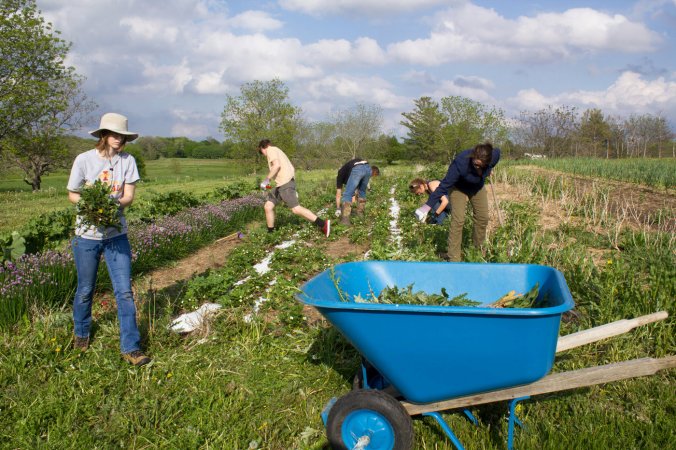
A weekday work session on the Student Organic Farm at Iowa State University has members weeding a perennial bed. Amy Mayer/Harvest Public Media

Thanks to National Public Radio (USA) for this story:

A Student-Run Farm Cultivates Passion For Sustainable Agriculture

A weathered wooden shed that holds wheelbarrows, hoes and other basic tools is the beacon of the Student Organic Farm, a two-acre swath within the larger horticultural research farm at Iowa State University.

On a warm spring evening, a half-dozen students gather here, put on work gloves and begin pulling up weeds from the perennial beds where chives, strawberries, rhubarb and sage are in various stages of growth.

“I didn’t know how passionate I [would] become for physical work,” says culinary science major Heidi Engelhardt. Continue reading

Microplastics Killing Fish

2556

Microplastics visible in a pike. Photograph: Oona Lönnstedt/Science

We’ve posted about microplastics before, since they are becoming a problem for oceans’ health. They can be found in sea salts and all over our shores, but also in fish, where the tiny particles stunt growth and alter the behavior of some species that ingest the plastics. Fiona Harvey reports for The Guardian:

Fish are being killed, and prevented from reaching maturity, by the litter of plastic particles finding their way into the world’s oceans, new research has proved.

Some young fish have been found to prefer tiny particles of plastic to their natural food sources, effectively starving them before they can reproduce.

The growing problem of microplastics – tiny particles of polymer-type materials from modern industry – has been thought for several years to be a peril for fish, but the study published on Thursday is the first to prove the damage in trials.

Continue reading

Pristine Nature?

Nijhuis-TheresNoSuchThingAsPristineNature-1200

A domesticated cat and a native tropical bird, in Papua New Guinea. Environmentalism has long been a nostalgic enterprise, but the unspoiled past that it aspires to looks increasingly like an illusion. PHOTOGRAPH BY LEONARD FREED / MAGNUM

If you have been reading our blog for any stretch of time you would be aware that we believe in pristine nature, and the importance of its conservation. We do not spend alot of time picking nits about the definition of pristine nature, but from time to time we are reminded that details, aka reality, is in need of fact-checking:

Invasive Species, Natural Disasters Of Our Own Creation

Screen Shot 2016-06-07 at 6.48.16 AM.jpg

Who needs horror movies when a story like this makes for much more compelling fear, and the realism is, well, real. Click the image above to go to the story:

Biosecurity ‘weaponry’ is helping to halt the global spread of non-native species, from rampaging caterpillars to giant hornets

The best time to annihilate oak processionary caterpillars is when they are young, just a few millimetres long and still high up in the trees. At this stage, their appetite for oak is rapacious, so dousing the leaves in a biocontrol agent like Bacillus thuringiensis (Bt) is one way to get the caterpillars to ingest it. When Bt toxins dissolve in the caterpillar gut they become active, puncturing the stomach and killing the insect in several days. Continue reading

Bionic Botanic Alchemy

The device uses solar electricity from a photovoltaic panel to power the chemistry that splits water into oxygen and hydrogen, then adds pre-starved microbes to feed on the hydrogen and convert CO2 in the air into alcohol fuels. Credit: Des_Callaghan via Wikimedia Commons

The device uses solar electricity from a photovoltaic panel to power the chemistry that splits water into oxygen and hydrogen, then adds pre-starved microbes to feed on the hydrogen and convert CO2 in the air into alcohol fuels. Credit: Des_Callaghan via Wikimedia Commons

Renewable energy is manifested in multiple forms, utilizing all the classical elements. All the better when innovation brings things full circle in this form of biomimicry.

A tree’s leaf, a blade of grass, a single algal cell: all make fuel from the simple combination of water, sunlight and carbon dioxide through the miracle of photosynthesis. Now scientists say they have replicated—and improved—that trick by combining chemistry and biology in a “bionic” leaf.

Chemist Daniel Nocera of Harvard University and his team joined forces with synthetic biologist Pamela Silver of Harvard Medical School and her team to craft a kind of living battery, which they call a bionic leaf for its melding of biology and technology. The device uses solar electricity from a photovoltaic panel to power the chemistry that splits water into oxygen and hydrogen, then adds pre-starved microbes to feed on the hydrogen and convert CO2 in the air into alcohol fuels. The team’s first artificial photosynthesis device appeared in 2015—pumping out 216 milligrams of alcohol fuel per liter of water—but the nickel-molybdenum-zinc catalyst that made its water-splitting chemistry possible had the unfortunate side effect of poisoning the microbes… Continue reading

Invisible, With Clear Vision

242_Parks-690

A forgotten portfolio, back for our viewing and reading pleasure a book offering the photography and writing of two giants, briefly reviewed here:

RALPH ELLISON AND GORDON PARKS’S JOINT HARLEM VISION

In the summer of 1947, editors from the short-lived magazine ’47, known since its shuttering in 1948 as The Magazine of the Year, contacted Ralph Ellison—then in the thick of his seven-year labor to complete “Invisible Man”—with an idea for a photo essay on the Lafargue Psychiatric Clinic in Harlem. Established a year earlier with help from Richard Wright, the clinic had become famous for its stance against segregation, not only in the clientele it served but also, perhaps more remarkably, in its all-volunteer staff. Ellison was excited by the prospect, and, after enlisting the photographer Gordon Parks—an acquaintance from Harlem artistic and intellectual circles—he accepted the assignment, though the magazine would go out of business before the photo essay could be published. Continue reading

New Species in Toxic Colorado Cave

These worms in Colorado’s Sulphur Cave are believed to live on the chemical energy in the sulfur in the cave, similar to deep-ocean tube worms. On the left are streamers—colonies of microorganisms similar to those in hot springs in Yellowstone National Park. PHOTOGRAPH BY NORMAN R. THOMPSON

We like the discovery of new species, and caves are cool too. And beneath Steamboat Springs in Colorado, USA, a cave full of noxious carbon dioxide and hydrogen sulfide gas has harbored a new species of worm, as well as weird bacteria formations called snottites. Erika Engelhaupt reports for NatGeo’s Phenomena blog:

Lurking below the quaint ski town of Steamboat Springs, Colorado, lies a cave belching deadly gases. Its ceiling is dotted with snottites, dangling blobs that look like thick mucus and drip sulfuric acid strong enough to burn holes through T-shirts. And the whole place is covered in slime.

So why would anyone want to go there?

Continue reading

Antibiotics, Even Worse than Anticipated

© Conservation Magazine

We disagree with having cows filled with antibiotics, primarily because of the problems created by bacterial resistance to drugs given without cause. But now we’re learning that there’s even more wrong with antibiotics in cattle: their dung releases more methane. Catherine Elton reports for Conservation Magazine:

Antibiotic use and overuse in livestock has long been controversial, as it has been linked to antibiotic resistance in humans. Livestock are regularly given antibiotics to keep them healthy in overcrowded or unsanitary conditions, or even to boost their growth.

Now, a study published recently in the Proceedings of the Royal Society B has documented for the first time that antibiotics given to cows also increase the emissions of the greenhouse gas methane from cow dung.

Continue reading