A Few Thoughts To Close The Year

A blog that began with two university students in far-off places is now going into its fifth calendar year. We are committed to its ongoing relevance, and notice that we were all rather quiet in recent weeks, with sparse postings as time permitted, but one thing that has been very consistent is our “bird of the day” posting. We are heartened just now reading by what may be the last guest comment of the year from one of the properties we care for, which shows that our effort with birds is bearing fruit:

…best thing for us was the dedication this resort places on bird watching…a dedicated birding guide…patient , funny, and very knowledgeable about the birds one would expect on the premises. We learned so much from him and it carried over as we continued with our CR trip…

As important as birds are, we head into a new year thinking about all the important topics we still need to give attention to. For example, there is much to be said on changing approaches to leadership of organizations we respect; from the upcoming issue of a magazine we have relied on for new ideas and deep reporting, here is some new click bait:

To the right of the stage was written a series of words that described Ford’s hoped-for future: Justice, Opportunity, Voice, Dignity, Creativity, Change, Visionaries. Walker himself was beloved for his democratic exuberance, manifested both in his vivacious clothing (his jaunty ties, his pocket squares, his pig cufflinks) and in his untiring enthusiasm.

“There is a lot going on at the Ford Foundation,” he declared. “So fasten your seat belts!”

If that is your last read of 2015, you will not regret it. We will be back in the new year, in full force with voices that have gone quiet recently to complete this year’s work, to continue linking you to the best examples we can find about community, conservation and collaboration. For now, over and out.

Pollan’s Defense, Cinematically Presented

Thanks to our friends at Ecowatch for this story:

Michael Pollan: What You Should Eat to Be Healthy

Cole Mellino

A new documentary from Kikim Media based on Michael Pollan’s bestselling book, In Defense of Food, helps consumers navigate a food system complicated by globalization and industrialization.

“I’ve been writing about the food system for a very long time,” Pollan said in the trailer for the new film. “But what I kept hearing from readers was ‘yeah yeah yeah, you told me where the food comes from and how the animals live and everything, but what I want to know is what should I eat.’”

Citizen Science & African Trees

CONGO_19893354282_50ae3e22af_o_605

Courtesy of Jungle Rhythms. Koen Hufkens and colleagues digitized the tables, but quickly realized the marks were simply too faint (image 1). “The notes are basically small pencil lines that overlay a grid on the paper, and the lack of contrast between the two makes it difficult to separate. It needs the human eye to tease them apart,” he said. Image 2 shows what the grid looked like after it was annotated.

The Harvard Gazette’s story on the citizen science project that will put dormant analog data to new use with digital assistance:

Koen Hufkens is trying to solve a scientific mystery, and he’s asking for the public’s help to do it.

Hufkens, a postdoctoral fellow working in the lab of Associate Professor of Organismic and Evolutionary Biology Andrew Richardson, this month launched Jungle Rhythms, a citizen-science project that aims to digitize thousands of pages of detailed observations on the life cycles of African trees. Continue reading

Frogs At Home

We are delighted to have Conservation, one of our longstanding go-to sources for environmental science news, back in business:

CricketFrog-330x220

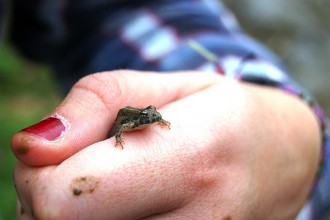
A herpetologist holds a Blanchard’s cricket frog (Acris blanchardi). Credit: The Wandering Herpetologist via Flickr.

DEGRADED HABITAT ALTERS FROG MICROBIOMES

Human-caused changes in the environment are linked to differences in the microbiome – the community of bacteria and other microbes that normally inhabit the skin – of a threatened species of frog, according to a new study.

Since the skin microbiome is essentially a major component of a frog’s immune system, the findings suggest that land use change could increase amphibians’ vulnerability to disease. In turn, this could be a clue to why some populations of frogs are more susceptible than others to a chytrid fungus, Batrachochytrium dendrobatidis, that causes a fatal skin infection and has resulted in declines and even extinctions of amphibian species worldwide.

Continue reading

Saluting The Awesomeness

download

We are aware that his work depends on well-protected geological wonders so we are automatically attracted to his activities; we cannot recommend this as a sport, but we cannot help but point out Alex Honnold’s feats as inspiring. From his website:

Alex Honnold is a professional adventure rock climber whose audacious free-solo ascents of America’s biggest cliffs have made him one of the most recognized and followed climbers in the world. A gifted but hard-working athlete, Alex “No Big Deal” Honnold is known as much for his humble, self-effacing attitude as he is for the dizzyingly tall cliffs he has climbed without a rope to protect him if he falls. Honnold has been profiled by 60 Minutes and the Continue reading

A Gift In Chile

1920

Atacama 1 concentrated solar power plant being built by Spanish firm Abengoa in Chile. Photograph: Jonathan Watts for the Guardian

Not yet guaranteed, but promising nonetheless, we will consider this one of the best pieces of news on this day of gift-giving:

Desert tower raises Chile’s solar power ambition to new heights

Towering 200 metres above the desert, the Atacama 1 will harvest the sun’s energy from a surrounding field of giant mirrors. But the completion of the $1.1bn project, the first of its kind in Latin America, has been thrown into doubt by the financial difficulties of its Spanish owner

Rising more than 200 metres above the vast, deserted plains of the Atacama desert, the second tallest building in Chile sits in such a remote location that it looks, from a distance, like the sanctuary of a reclusive prophet, a temple to ancient gods or the giant folly of a wealthy eccentric.

Instead, this extraordinary structure is a solar power tower that is being built to harvest the energy of the sun via a growing field of giant mirrors that radiate out for more than a kilometre across the ground below with a geometric precision that is reminiscent of contemporary art or the stone circles of the druids.

Continue reading

Earthships

earthships-7

Photo via ThisIsColossal

In New Mexico, a community of ecologically-conscious citizens have built homes that are almost completely made out of recycled materials, and their utilities come from the sky: solar and wind power, and rain collection gutters. We’ve featured a series on straw bale construction, a slightly similar idea, in the past, but, as you can see in the video below, these “earthships” have even more going for them.

Continue reading

The New Bread Basket

bread_basket

Image © Shutterstock via GreenBiz.com

We all enjoy eating bread, whether it is gluten- or wheat-free, whole grain, French baguette, Italian ciabatta, or any of the myriad other styles of baking. In a new book called The New Bread Basket, author Amy Halloran explores, as her subtitle explains, “How the New Crop of Grain Growers, Plant Breeders, Millers, Maltsters, Bakers, Brewers, and Local Food Activists Are Redefining Our Daily Loaf.” An excerpt, via GreenBiz.com, follows:

People will keep studying one another and drawing on their ingenuity to build sustainable farms and food systems. Alan Scott jump-started a new old-fashioned approach to bread with his oven plans, offering an alternative route to a food that had been industrialized. Other innovators are fiddling with ovens and mills, turning dairy tanks and silo bottoms into malt systems, scaling down equipment and deindustrializing processing. They are making tools to fit a future they are shaping.

Continue reading

Dory: Not so Ditzy in Real Life

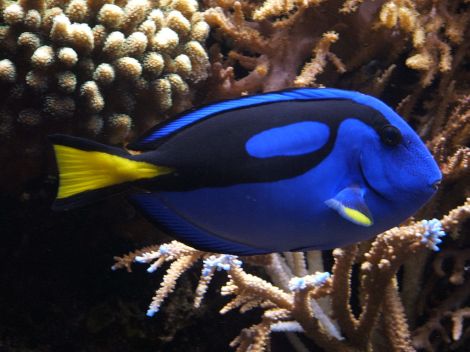
1024px-blue_tang_28paracanthurus_hepatus29_02

Blue tang (Paracanthurus hepatus) at Monterey Bay Aquarium by Wikimedia contributor Tewy.

We’ve all seen the humorously scatterbrained black-and-blue fish Dory in Pixar’s Finding Nemo, but only those who have spent some time snorkeling or diving in tropical waters have seen the real-life surgeonfish–as that class of fish is called–just keep swimming in its natural habitat. Next year, Finding Dory will act as a sequel to the immensely popular aquatic animation film from 2003. Before you watch it in cinemas, you can learn a little about the actual fish that Dory is based on, via BBC Earth:

“I suffer from short-term memory loss,” Dory tells Nemo. “I forget things almost instantly, it runs in my family.”

It’s very funny and ultimately touching, but this depiction is just a little unfair. The fish Dory is based on does not have short-term memory loss. It is rather more awesome than that.

It has several names, including royal blue tang, regal tang and surgeonfish. Its scientific name is Paracanthurus hepatus.

Continue reading

Cranberries Covered by Science Friday

cranberry6

Four mature cranberry cultivars (clockwise, from upper left): early black, a Massachusetts native; DeMoranville, a hybrid developed at Rutgers University (named for Carolyn DeMoranville’s father); Stevens, a hybrid from the first USDA cranberry breeding program, released in 1960, and the most widely planted hybrid in the U.S. today; bugle, an unusually shaped Massachusetts native (not widely planted). Photo by Carolyn DeMoranville, UMass Cranberry Station

We’ve featured a post solely dedicated to cranberry bogs in the past, and have also seen some of the classic holiday sauce as part of a Thanksgiving art celebration. Now, with Thanksgiving Day coming up in the United States on Thursday, we’re learning even more about the North American fruit from Science Friday’s Thanksgiving Science Spotlight:

There are certain things that might come to mind when thinking about cranberries: A certain shade of red, a certain small size, and a certain kind of tartness. But these characteristics can differ among cranberry varieties—of which there are more than 100, according to Carolyn DeMoranville, an associate extension professor and station director at the University of Massachusetts-Amherst Cranberry Station.

Continue reading

Speak for the Trees

img_2807_zpspgvnjiddWe have a special place for any citizen science project, no matter what kingdom of natural life it covers, or whether its accomplished at home or in the field. Now we’re learning about a new project covering trees from The Nature Conservancy’s “Cool Green Science” blog:
What Is i-Tree?

i-Tree is a Swiss army-knife collection of tools that people can use to measure the impact individual trees and forests.

In fact, the collection of tools is so comprehensive it can seem overwhelming. But don’t be daunted. Here’s the information you need to get started.

For citizen scientists, i-Tree Streets and i-Tree Pest Detection are two key instruments in the i-Tree arsenal. (Many of the other tools are designed primarily for city officials and forest managers.)

For each tree that you select to inventory, i-Tree Streets can estimate the tree’s effect on greenhouse gasses, air quality, and stormwater overflow. Find a group in your area that is conducting a tree inventory with i-Tree Streets. City governments and conservation organizations can collect the data for use at the local level.

Continue reading

Ocean Cleanup Project Tests Successfully

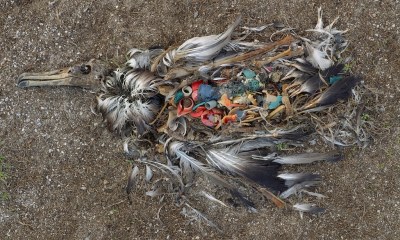
Around 90% of the world’s sea birds have eaten plastic items that they mistook for food, a study estimates. Photograph: Chris Jordan/Midway: Message from the Gyre

We’ve alluded to the Great Pacific Garbage Patch before, though we haven’t shared any stories covering it directly. Last week, The Guardian reported some good news from The Netherlands, where the prototype for a 100km-long, crowdfunded cleanup boom for the ocean was tested successfully. Arthur Nelsen reports:


Further trials off the Dutch and Japanese coasts are now slated to begin in the new year. If they are successful, the world’s largest ever ocean cleanup operation will go live in 2020, using a gigantic V-shaped array, the like of which has never been seen before.

The so-called ‘Great Pacific garbage patch’, made up largely of tiny bits of plastic trapped by ocean currents, is estimated to be bigger than Texas and reaching anything up to 5.8m sq miles (15 sq km). It is growing so fast that, like the Great Wall of China, it is beginning to be seen from outer space, according to Jacqueline McGlade, the chief scientist of the UN environmental programme (Unep).

Continue reading

A Hairy-looking Future

Scanning electron microscope image of hairs on a honeybee’s eye. Image © Georgia Tech, CC BY

Last week a pair of scientists writing for The Conversation (a news source with what they call “academic rigor, journalistic flair”) and also Discover Magazine’s science blog discussed the merits of hair in keeping animals clean. We found it pretty interesting, and hope you will too:

Watch a fly land on the kitchen table, and the first thing it does is clean itself, very, very carefully. Although we can’t see it, the animal’s surface is covered with dust, pollen and even insidious mites that could burrow into its body if not removed.

Staying clean can be a matter of life and death. All animals, including us human beings, take cleaning just as seriously. Each year, we spend an entire day bathing, and another two weeks cleaning our houses. Cleaning may be as fundamental to life as eating, breathing and mating.

Yet somehow, cleaning has gotten little attention.

In our new review article in the Journal of Experimental Biology, we discuss how cleaning happens in nature and whether animals indeed have principles for getting clean. We looked at microscope images to count the number and sizes of hairs across hundreds of animals. We read nearly a hundred articles on cleaning in nature, trying to put numbers onto the cleaning process.

Continue reading

Because Coffee is ‘Human’

For those who believe life begins after coffee, the story of its origin will definitely sound familiar. Coffee grown worldwide can trace its heritage to the ancient coffee forests on the Ethiopian plateau, where legend says the goat herder Kaldi first discovered the potential of these beloved beans. It is said that Kaldi discovered coffee after noticing that his goats, upon eating berries from a certain tree, became so energetic that they did not want to sleep at night. Kaldi reported his findings to the abbot of the local monastery who made a drink with the berries and discovered that it kept him alert for the long hours of evening prayer. The abbot shared his discovery with the other monks at the monastery, and slowly knowledge of the energizing berries began to spread.

Now photographer Sebastiao Salgado takes readers deep into that grind with his latest collection, The Scent of a Dream: Travels in the World of Coffee that looks at the landscapes and labors behind the $100-billion-a-year business in ten countries around the globe.

Continue reading

Sheepdogs Active in Wildlife Conservation Yet Again

Phillip Root with the Maremma sheepdogs of Middle Island, Australia. The dogs were introduced there in 2006 to protect the little penguin, a native species. Credit David Maurice Smith for The New York Times

A few years ago, we shared the story of an effort by the Cheetah Conservation Fund in South Africa as part of their Cheetah Outreach project that involved Anatolian shepherd dogs. The idea was to help livestock owners raise the sheepdogs to guard their herds and therefore not feel the need to kill cheetahs that might see the sheep as potential prey. This program has worked out well, and now we’re hearing from the New York Times about another success story in Australia, although in this case the sheepdogs aren’t protecting livestock: they’re guarding the Little Penguin on Middle Island, Victoria from the introduced red fox.

‘Massacred,’ read the banner headline in the local newspaper — just the single word, as if describing an act of war. Below it was a photo of dead penguins and other birds, the latest casualties in Australia’s long history of imported species’ decimating native wildlife.

Foxes killed 180 penguins in that particular episode, in October 2004. But the toll on Middle Island, off Victoria State in southern Australia, kept rising. By 2005, the small island’s penguin population, which had once numbered 800, was below 10.

Continue reading

What Warm Temperatures in the Sub-Arctic Mean

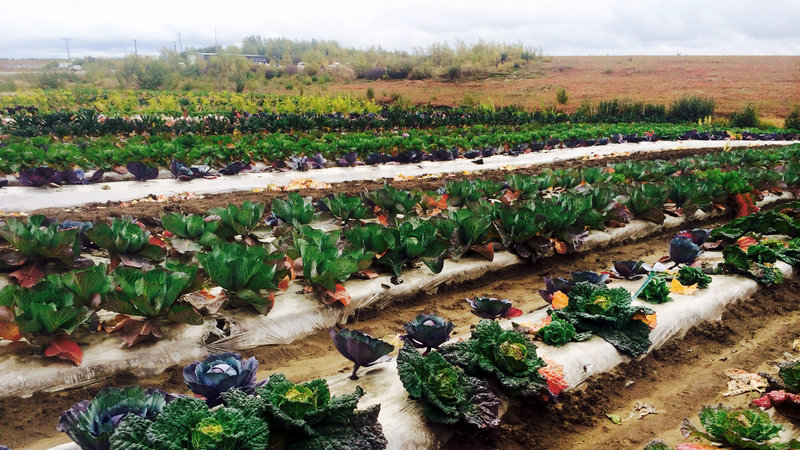
A field near harvest time at Meyers Farm in Bethel, Alaska, can now grow crops like cabbage outside in the ground, due to rising temperatures. PHOTO: Daysha Eaton/KYUK

A field near harvest time at Meyers Farm in Bethel, Alaska, can now grow crops like cabbage outside in the ground, due to rising temperatures. PHOTO: Daysha Eaton/KYUK

Farming in the Arctic? Well, it can be done. The reasons are many. For one, the climate is changing: Arctic temperatures over the past 100 years have increased at almost twice the global average.

On a misty fjord in Greenland, just miles from the planet’s second largest body of ice, Sten Pedersen is growing strawberries. Yellowknife, a Canadian city 320 miles below the Arctic Circle, hosted a farmers market this summer. And a greenhouse in Iqaluit, the capital of the vast Canadian Inuit territory of Nunavut, is producing spinach, kale, peppers and tomatoes. The frozen tundra of the Arctic is experiencing something of an agriculture boom. More

Continue reading

When A Legend Fades Away

Stories about the Yeti date back thousands of years, especially in the Himalayan nations. Legends say it can be seen only when it comes down from the high mountains to lower elevation and that it passes through the forests and into the villages where it surprises or scares people and sometimes kills a yak for food. Several climbers claim to have seen an unusual animal on their way up Mount Everest. A few have taken photographs of very large footprints in the snow, claiming they belong to the Yeti. It has another name that many people will recognize: Abominable Snowman. Think of a big human-like animal covered in white hair, with huge canine teeth and very big footprints.

But now, no one’s looking for the Yeti.

Continue reading