Laughing At, And With, Ancient Rome

romelaughThis post is about as random as we get on this blog, but still, there is a mission-driven point. Along with all our work, there must also be reflection and communication; education in the classics strikes us as an excellent preparation, as excellent as any, for our line of work. In further honor of James during the last week of his work in person at Xandari, we share a book review to help us understand laughter in the olden days:

…Even a simple comic device can land us in deep water, psychologically speaking.

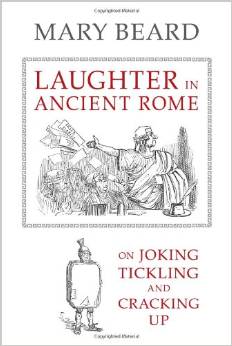
What, if anything, does Geng’s piece have in common with the movie Police Academy 2: Their First Assignment? What does either have in common with knock-knock jokes, or with Gilbert Gottfried’s famous performance of “The Aristocrats” a few weeks after September 11? These are not easy questions to answer, even for a culture we know from the inside. And the difficulties only multiply when we confront the humor of another time and language. It is that challenge that Mary Beard sets herself in Laughter in Ancient Rome, the printed version of her lectures as the 2008–2009 Sather Professor at Berkeley. Continue reading

A Sophie’s Choice Moment For Two Species, One Environment, And No Solomon In Sight

Damian Mulinix — Chinook Observer. A small portion of the cormorant colony as seen from a bird blind.

Damian Mulinix — Chinook Observer. A small portion of the cormorant colony as seen from a bird blind.

You can read about this in a major media outlet, but try another approach for this story. Local journalism is alive and well, and covering complex, important topics through the local lens:

A plan to kill 16,000 double-crested cormorants on East Sand Island has some residents on the North Coast scratching their heads. Although still in the proposal phase, the plan drew many to an open house in Astoria last week to ask questions of the federal agencies involved. “I can’t believe in this day and age we can’t come up with an alternative solution to killing things,” said Tommy Huntington of Cannon Beach. Continue reading

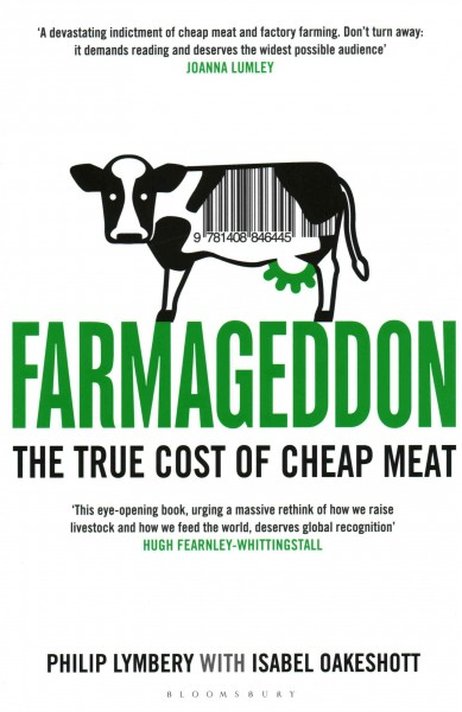
Farmageddon, Reviewed

As Kayleigh continues work begun last month, bringing our attention to all the ways we can improve our food sourcing, this book review seems timely. Barbara King, the reviewer, is a noted anthropologist but even more noted author on the topic of animal emotions. We have not read the book yet, but as always with a good book review our attention is drawn to reasons why we might, or might not, make time for this one.

9781408846445_custom-edb29a20eb514ead6c26ac932f8f904d2cffa1a4-s3-c85

Thanks to National Public Radio (USA) for sharing the review:

For Philip Lymbery, head of the U.K.-based Compassion in World Farming and his co-author Isabel Oakeshott, a visit to California’s Central Valley amounted to an encounter with suffering.

In Farmageddon: The True Cost of Cheap Meat, Lymbery and Oakeshott write that the mega-dairies of the Central Valley are “milk factories where animals are just machines that rapidly break down and are replaced.” At one huge dairy they visited, cows stood idly outdoors, some in shade and some in the sun. No grass cushioned their feet and certainly none was available to eat since, like almost all factory-farm cows, the animals were maintained on an unnatural diet of crops such as corn. The stench in the air was “a nauseous reek.” Continue reading

24/7 Birdwatch

Ezra, a red-tailed hawk, perches outside Schoellkopf Stadium. Photo credit, Christine Bogdanowicz.

Ezra, a red-tailed hawk, perches outside Schoellkopf Stadium. Photo credit, Christine Bogdanowicz.

In the interest of what we consider essential news about environmental or conservation issues we occasionally share an article in its entirety here, with the encouragement to give the source its due. The nature of blogging is to be quick but not sloppy, brief but clear, and missionary but unorthodox.

The link to this article is deeply missionary, in that our blog has more bird-related content than any other type of content; birds are both a metric for and icon of our conservation mission; quoting the article in entirety is our unorthodox way of getting the writer’s attention (and if he or the publication prefers we will be happy to reduce our republishing of this article to the normal “fair use” excerpt standard) because his article is about the topic Seth has been working on for the last several years at the Cornell Lab of Ornithology and its far reaches.  We think he might find the work Seth and James are doing at Xandari an interesting extension of this article’s focus:

Thanks to Cornell Lab of Ornithology webcams and local bird enthusiasts, anyone in the world can see into the lives of a family of red-tailed hawks that resides on a light-pole about 80 feet above an athletic field on campus.

More than five million viewers across 200 countries have been following the exploits of Ezra (father) and Big Red (mother) and their offspring since in 2012. This year three nestlings hatched.

Continue reading

A Story About Patagonia, A Company We Believe In, And Relate To

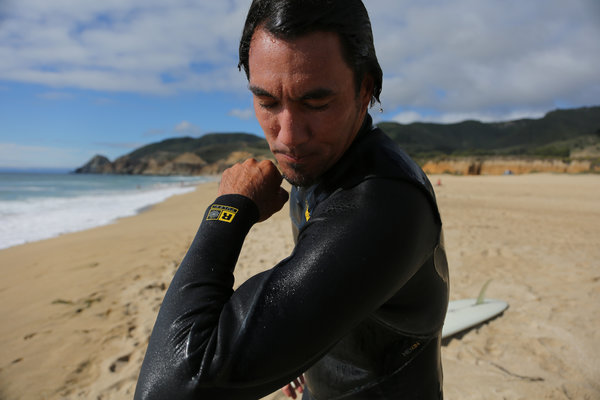
Jon Kitamura in a Patagonia wet suit at Montara State Beach, California. Credit Jim Wilson/The New York Times

Jon Kitamura in a Patagonia wet suit at Montara State Beach, California. Credit Jim Wilson/The New York Times

We hope one day to have as many participant observers like Jake, saying things like this about some of our group’s initiatives, as Patagonia has admirers. The company gets alot of good press, and for all the right reasons. We have not tired of it yet. Fans of the founder already, we also believe in his company, and (as if anyone needed to be convinced) this New York Times profile helps to understand why:

…“We had customers looking for safe alternatives for those with latex allergy, and then we had customers looking for alternatives to petroleum-based products,” Mr. Martin said, “so a number of companies had been approaching us.” Continue reading

Bicycle Zeitgeist

We love design and we love bicycles, and we’ve been writing about their innovation-intersection long before Gianluca’s collapsable model came to our attention.

But we’re grateful for the reminders of the creativity that urges us to upcycle, recycle and craft our “ride”.

Add Agrivoltaics To Your Green Vocabulary

agrivoltaics

Farming food and fuel, side by side

Thanks to Conservation, and particularly Courtney White, for this synopsis:

What is the best way to utilize sunlight—to grow food or to produce fuel?

For millennia, the answer was easy: we used solar energy to grow plants that we could eat. Then, in the 1970s, the answer became more complex as fields of photovoltaic panels (PVPs) began popping up all over the planet, sometimes on former farmland. In the 1990s, farmers began growing food crops for fuels such as corn-based ethanol. The problem is that the food-fuel equation has become a zero-sum game. Continue reading

When Monkeys Lend a Hand

The monkey shepherds of Nelliampathy, photo credit: The Hindu

While we face the “monkey-challenges” at Cardamom County other forms of agriculture (or in this case, animal husbandry) have found forms of “primate collaboration”.

Thanks to The Hindu‘s K.A. Shaji for this timely story.

The term ‘monkey shepherd’ may not sound absurd here. A female monkey, aged about eight years, and her two children shepherd a flock of 150 goats on a farm at this picturesque hill station in Palakkad. Continue reading

Nothing To Laugh About, But We Cannot Help Ourselves Every Now And Then…

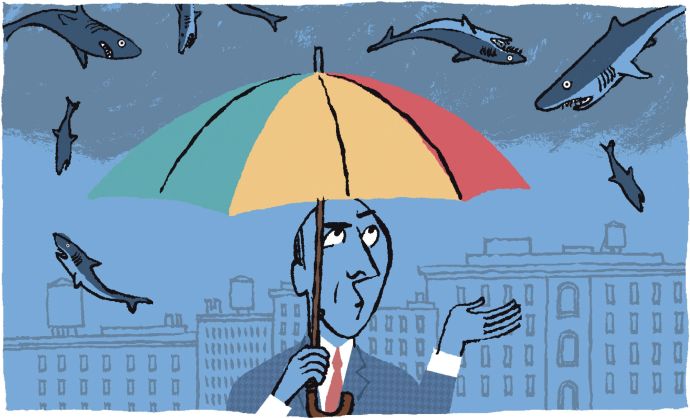
ILLUSTRATION BY MIGUEL GALLARDO.

ILLUSTRATION BY MIGUEL GALLARDO.

True, we sometimes share doom and gloom, but sparingly. We attempt here to balance it with a note on Deniers (we share full text here, but please click through to the original so the author and publication receive proper benefit):

I accept that changes in climate are causing ocean updrafts that draw killer sharks into the atmosphere and then drop them on populated areas, but I don’t believe human activity is the cause.”

“Out here in Oklahoma, we have the same problems that the rest of the country is experiencing, with wind-borne sharks crashing through billboards and attacking folks on their way to work and so on. We have yet to see a single study, however, that connects any of these shark conditions specifically to our local fossil-fuel industries.”

“Tree-ring studies done on petrified wood from Utah reveal six-inch-long fossilized teeth of the Megalodon, the largest shark in the history of the earth, embedded in the trunks of ponderosa-pine trees more than three hundred thousand years old—trees that lived a thousand miles from the nearest ocean! So tell me: did my S.U.V. cause that?” Continue reading

Community, Control, Conservation

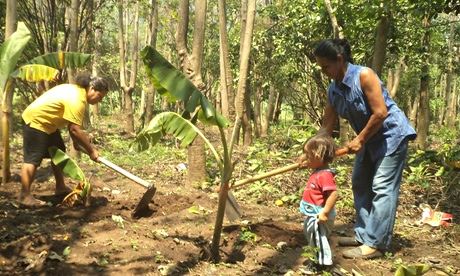
Salvadorans Elsy Álvarez and Maria Menjivar, with her young daughter, plant plantain seedlings in a clearing in the forest. Photograph: Claudia Ávalos/IPS

Salvadorans Elsy Álvarez and Maria Menjivar, with her young daughter, plant plantain seedlings in a clearing in the forest. Photograph: Claudia Ávalos/IPS

We have normally emphasized the word collaboration in conjunction with the conservation initiatives carried out by communities. This article in the Guardian points to research findings that indicates that another c-word, control, is sometimes key to understanding how communities reduce deforestation:

…Analysis suggests that in areas formally overseen by local communities, deforestation rates are dozens to hundreds of times lower than in areas overseen by governments or private entities. About 10-20% of global greenhouse gas emissions are attributed to deforestation each year.

The findings were released by the World Resources Institute (WRI), a thinktank, and the Rights and Resources Initiative (RRI), a global network that focuses on forest tenure. Continue reading

Gianluca, Come To Kerala!

sada-bike

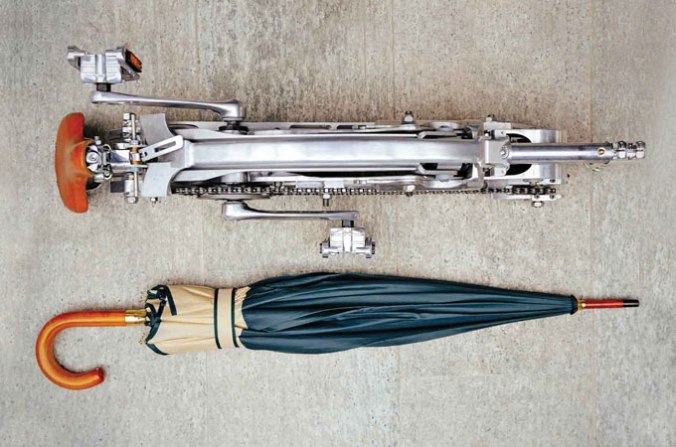
As the metropolitan area of Ernakulum, where Raxa Collective has many contributors who commute to work, completes its futuristic mass transit scheme, our thoughts reach out to a time when the collapsible bike is a necessity here. For now, we can appreciate the design for its own sake of this model that has just come to our attention.

We like everything we read about it, as much as the visual aesthetics. We even hope we might be of some service to its creator, given our history with entrepreneurial conservation. We are on the lookout, constantly, for opportunities to collaborate with creative craftsmen and to welcome them into Raxa Collective’s growing community across the globe. Conservation magazine brought Gianluca Sada onto our radar. We extend to him our usual invitation for a visit thanks to that:

COLLAPSIBLE COMMUTE

Carrying a bicycle onto a bus or subway for unrideable sections of your carless commute is less than convenient. This is where the Sada Bike fits in. Whereas other foldable bikes have shrunken frames and wheels, the Sada Bike’s full-sized frame folds down to the size of an umbrella; its spokeless, hubless, 26-inch wheels double as a backpack frame.

Continue reading

Humanity’s Diet Makes A Difference, Historically As Well As Futuristically

On the timescale of evolutionary history, paleo enthusiasts note, agriculture is a fad. Credit Illustration by Mike Ellis.

On the timescale of evolutionary history, paleo enthusiasts note, agriculture is a fad. Credit Illustration by Mike Ellis.

Since the early days of this blog we have been hungry consumers of environmental long form journalism, of which Elizabeth Kolbert’s New Yorker chronicles are best-in-category. They are also, frankly, almost always depressing.

Nonetheless, they put humanity into its natural context. This not-at-all-depressing chronicle demonstrates the value of that contextualization well:

The first day I put my family on a Paleolithic diet, I made my kids fried eggs and sausage for breakfast. If they were still hungry, I told them, they could help themselves to more sausage, but they were not allowed to grab a slice of bread, or toast an English muffin, or pour themselves a bowl of cereal.

Continue reading

Musical And Photographic Patrimony

This slideshow requires JavaScript.

We are always moved by exhibitions that intersect our interest in cultural and historical patrimony, as in the case of this event at the Foley Gallery (which comes to our attention thanks to the New Yorker‘s coverage of the arts):

Lisa Elmaleh first heard Appalachian folk music in 2010, and “it stirred something in my soul,” she told me. Since then, she has followed folk musicians from Ohio to Georgia, capturing them with her nineteen-forties Century Universal 8 x 10 camera and the hundred-and-fifty-year-old tintype process. Continue reading

Yes, We Can

Andrew Scrivani for The New York Times

Andrew Scrivani for The New York Times

Food trials at 51 are a permanent condition, thankfully, because we are on the constant search for ever-better vegetarian meals.  This definitely qualifies:

A GOOD APPETITE

The Ultimate Veggie Burger

It’s difficult to make a veggie burger with great flavor and a firm, succulent texture. This is how you do it.

If You Happen To Be In Florence, Alabama (USA)

Robert Rausch for The New York Times. Tom Hendrix at the Florence, Ala., memorial he built for his great-great grandmother, Te-lah-nay, a Yuchi Indian.

Robert Rausch for The New York Times. Tom Hendrix at the Florence, Ala., memorial he built for his great-great grandmother, Te-lah-nay, a Yuchi Indian.

Thanks to the New York Times for this coverage of a moving tribute to one man’s lineage and his peoples’ heritage:

Off Alabama’s Beaten Path, Tribute to a Native American’s Journey Home

Tom Hendrix has built a mile-long stone wall to memorialize his Native American great-great grandmother, who was displaced during the Trail of Tears.

The Gender Politics Of The Vegan Diet

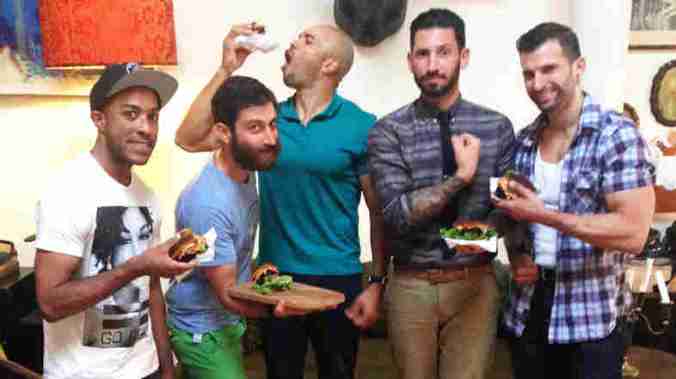
Mixed martial arts fighter Cornell Ward (from left), chef Daniel Strong, triathlete Dominic Thompson, lifestyle blogger Joshua Katcher and competitive bodybuilder Giacomo Marchese at a vegan barbecue in Brooklyn, N.Y. Courtesy of James Koroni

Mixed martial arts fighter Cornell Ward (from left), chef Daniel Strong, triathlete Dominic Thompson, lifestyle blogger Joshua Katcher and competitive bodybuilder Giacomo Marchese at a vegan barbecue in Brooklyn, N.Y. Courtesy of James Koroni

Thanks to National Public Radio (USA) for this article and accompanying podcast on the masculinity of men denying themselves animal protein:

For These Vegans, Masculinity Means Protecting The Planet

by 

…Thompson grew up in a rough Chicago housing project. He was the kind of kid who would rush in to save stray cats or dogs if he saw people picking on them.

“[There’s] nothing more cowardly to me than taking advantage of something that’s defenseless,” he says.

Today, Thompson is the kind of adult who checks clothing labels to make sure he never buys leather, wool or products tested on animals. “To me, compassion is the new cool,” he says.

Continue reading

Note To A Classicist, For The Day When He May Seek Employment

Library of Congress

Library of Congress

We are midway or more through the summer, when interns are most commonly in our midst. Normally, but not always, they are enrolled for the other nine months of the year either in undergraduate or graduate programs of just about every conceivable variety. And within a year or two of their internship they will seek employment. So we encourage them to contribute to this blog in part to practice their communication skills for when that day comes; this post in the Atlantic caught our attention for that reason, so we pass it on especially to our interns.

And to one more than the others, which seems fair in this case. As noted earlier, one of our adventurers in Costa Rica is headed soon to Cambridge, MA (USA) to enter a doctoral program in Classics. He will not likely seek employment, gainful or otherwise, for some years to come.  But when that day does come, this reference may come in handy, from one of the class classic acts of all time:

Selling yourself often feels like a grotesque act. So job applicants’ cover letters seem unlikely to contain much great prose. Instead, we tend to fill the page with false notes and empty phrases. (“I believe my skills make me the ideal candidate, and I would appreciate your consideration…”)

But it doesn’t have to be that way. When a 30-something Leonardo da Vinci sought work in the court of the duke of Milan in the 1480s, he wrote a short, bulleted list of ten skills that would have been sure to catch the eye of any Renaissance-era ruler: he could design portable, indestructible bridges; build unassailable vehicles; destroy most fortresses; and so on. (He also could “execute sculpture in marble, bronze and clay,” and wasn’t so bad with a paintbrush, either.) His letter was brisk, convincing, and a pleasure to read…

Continue reading