Eye of the Beholder

The Berlin-based florist Ruby Barber of Mary Lennox created some of her signature cloud arrangements with once-neglected weeds. A composite of individual arrangements, from left, of weeping amaranth and fresh and dried wild grasses; an abundant gathering of the once-humble smoke bush, now a fashionable challenger to traditional hothouse flowers; and Queen Anne’s lace. Credit Photograph by Guido Castagnoli. Flowers styled by Mary Lennox

Ralph Waldo Emerson may have written that a weed is just “a plant whose virtues have not yet been discovered,”  but another way of stating it is that a weed “is a plant growing in the wrong place”. The current revalorization of the “common weed”– aesthetically, culinarily and nutritionally — dovetails beautifully with much of what we highlight on this site.  Thanks to Ligaya Mishan of the NYTimes for the refocus.

How the Common Weed Has Grown on Florists (and Chefs)

From the flower arrangement to the plate, this is the era of the formerly unwanted plant.

A WEED IS UNWANTED: That is its definition. It is a plant that we have deemed to have no value because it contributes nothing to our life, neither nourishment nor beauty. Why should it help us when it doesn’t need us to survive, its seeds borne on the idlest gust, taking root and thriving in even the cruelest terrain? It stands wholly apart from human civilization, hardy and self-sustaining, mocking our hegemony, claiming the earth as its own. Worse, it is a predator, stealing resources — real estate, sunlight — from the plants we do value and rely on, crowding them out, threatening their existence and, by extension, ours.

A weed is never singular but an army. Its legions sweep across land like the Golden Horde, “always three steps ahead of the gardener, traveling underground, seeding by the million, smothering all in their path,” says the British writer and landscape designer Isabel Bannerman. Her husband and partner, Julian Bannerman, frames it slightly less savagely: The garden “is a bit like having a party. What we call weeds are the uninvited guests.” And in the Swedish writer and illustrator Elsa Beskow’s picture book “The Flowers’ Festival,” originally published in 1914 as “Blomsterfesten i Tappan,” they appear as exactly that, a rabble of thistles, chickweed, nettles and burdock, “scoundrels and beggars and ragamuffins” all, consigned to a ditch outside the garden to glower while the violets and orchids revel. “But we’re flowers, too,” the weeds roar.

But their time has come. Continue reading

Color Conservation

The hues in the Forbes Collection include the esoteric, the expensive, and the toxic. Photograph by Jason Fulford for The New Yorker

Color is such a constant in our lives that it seems odd to consider any need for it’s conservation. How it exists in nature, how we humans perceive it, and how we’ve use the technology of the time to preserve it, has been relevant for tens of thousands of years. The Forbes Collection archives in the Harvard University’s Fogg Art Museum highlights the work of it’s founder, Edward Waldo Forbes, for whom “pigment hunting and gathering was not just a matter of creating an archive of lost or languishing color. It was about the union of art and science.”

Treasures from the Color Archive

The historic pigments in the Forbes Collection include the esoteric, the expensive, and the toxic

How blue can it get? How deep can it be? Some years ago, at the Guggenheim Bilbao, I thought I’d hit on the ultimate blue, displayed on the gallery floor. Yves Klein, who died at thirty-four, was obsessed with purging color of any external associations. Gestural abstraction, he felt, was clotted with sentimental extraneousness. But, in search of chromatic purity, Klein realized that even the purest pigments’ intensity dulled when combined with a binder such as oil, egg, or acrylic. In 1960, he commissioned a synthetic binder that would resist the absorption of light waves, delivering maximum reflectiveness. Until that day in Bilbao, I’d thought Klein a bit of a monomaniacal bore, but Klein International Blue, as he named the pigment—rolled out flat or pimpled, with saturated sponges embedded in the paint surface—turned my eyeballs inside out, rods and cones jiving with joy. This is it, I thought. It can’t get any bluer.

Until YInMn came along: the fortuitous product of an experiment in the materials chemistry lab at Oregon State University in 2009. Intending to discover something useful for the electronics industry, Mas Subramanian and his team heated together oxides of manganese, yttrium, and indium at two thousand degrees Fahrenheit. What emerged was a new inorganic pigment, one that absorbed red and green light waves, leaving as reflected light the bluest blue to date. Subramanian sent a sample to the Forbes Collection in the Straus Center for Conservation and Technical Studies, at Harvard University, where it sits with twenty-five hundred other specimens that document the history of our craving for color.

Among the other blues on the Forbes’s shelves is Egyptian Blue, a modern approximation of the first synthetic pigment, engineered five millennia ago, probably from the rare mineral cuprorivaite, a soft mid-blue used for the decoration of royal tomb sculpture and the wall paintings of temples. Later, blues strong enough to render sea and sky were made from weathered copper-carbonate azurite—crystalline bright but sometimes darkening in an oil binder. In 1271, Marco Polo saw lapis lazuli quarried from a mountain at Badakhshan, in what is now Afghanistan. Laboriously prepared by removing impure specks of glinting iron pyrite, it became ultramarine—as expensive, ounce for ounce, as gold, and so precious that it was initially reserved for depictions of the costume of the Virgin. In addition to these, the Forbes Collection has a poor man’s blue—smalt made from crushed cobalt containing potassium glass, which weakens, eventually, to a thin greeny-brown gray.

The Forbes Collection owes its existence to a belief in the interdependence of art and science, but it is also an exhaustive archive of cultural passion. A display features Vantablack, which absorbs 99.96 per cent of light, and has to be grown on surfaces as a crop of microscopic nanorods. In 2016, the sculptor Anish Kapoor saw the pigment’s potential for collapsing light, turning any surface into what appears to be a fathomless black hole, and he acquired the exclusive rights to it. An outcry from artists, who objected to the copyright, prompted the Massachusetts manufacturer NanoLab to release Singularity Black, created as part of the company’s ongoing research with nasa, to the public, and the artist Stuart Semple to make the World’s Pinkest Pink available to any online buyer willing to declare himself “not Anish Kapoor.” But Kapoor obtained a sample of the pink pigment, and used it to coat his middle digit, which he photographed and posted online for Semple.

Narayan Khandekar, the head of the Straus Center for Conservation and Technical Studies, takes pleasure in such skirmishes, secure in the knowledge that he presides over something weightier: a priceless resource for understanding how works of art are made, and how they should be preserved. The Department of Conservation and Technical Research was founded, in 1928, by Edward Waldo Forbes, the director of Harvard’s Fogg Museum from 1909 to 1944. Today, the Forbes’s vast library of color and its technical laboratories are housed in the museum’s steel-and-filtered-glass rebuild, designed by Renzo Piano. Rows of pigments in tubes, jars, and bowls are visible through the doors of floor-to-ceiling cabinets. Khandekar had the winning idea of displaying them as if unspooled from a color wheel: reds at one end, blues at the other. There are the products of nineteenth-century chemical innovation—viridian green, cadmium orange, and the chrome yellow with which van Gogh was infatuated but which, over time, has begun to darken his sunflowers. But at the heart of the Forbes Collection are the natural pigments that were the staples of painters’ inventories before chemically synthesized paints replaced the impossibly esoteric, the dangerously toxic, the prohibitively expensive, and the perilously fugitive. Continue reading

Plastics Conservation Science

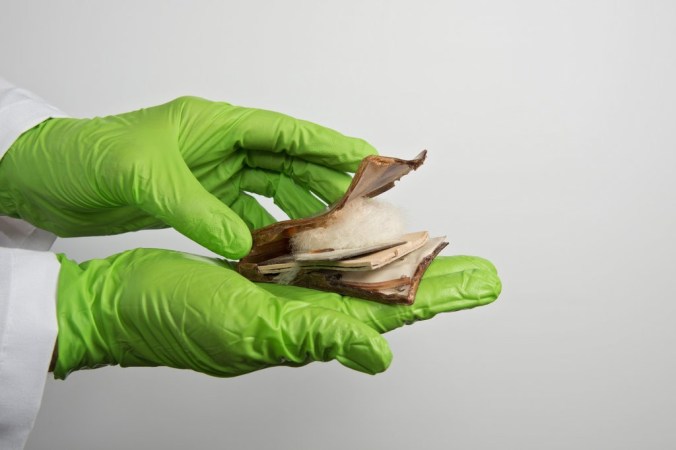
Dr. Odile Madden, of the Getty Conservation Institute in Los Angeles, holding a piece of degrading plastic for use in trying out new methods of preservation. Credit Melissa Lyttle for The New York Times

The irony of the need to conserve aging national treasures or works of art configured from plastics and other petroleum-based materials in the time of the “Pacific Vortex” and other plastic-created environmental disasters is difficult to miss. It never would have occurred to any of us that a field called “Plastics Conservation Science” has any need to exist.

And yet, it does…

These Cultural Treasures Are Made of Plastic. Now They’re Falling Apart.

Museum conservators are racing to figure out how to preserve modern artworks and historical objects that are disintegrating.

The custodians of Neil Armstrong’s spacesuit at the National Air and Space Museum saw it coming. A marvel of human engineering, the suit is made of 21 layers of various plastics: nylon, neoprene, Mylar, Dacron, Kapton and Teflon.

The rubbery neoprene layer would pose the biggest problem. Although invisible, buried deep between the other layers, the suit’s caretakers knew the neoprene would harden and become brittle with age, eventually making the suit stiff as a board. In January 2006, the Armstrong suit, a national treasure, was taken off display and stored to slow the degradation.

Of an estimated 8,300 million metric tons of plastic produced to date, roughly 60 percent is floating in the oceans or stuffed in landfills. Most of us want that plastic to disappear. But in museums, where objects are meant to last forever, plastics are failing the test of time.

“It breaks your heart,” said Malcolm Collum, chief conservator at the museum. The Armstrong suit’s deterioration was arrested in time. But in other spacesuits that are pieces of astronautical history, the neoprene became so brittle that it shattered into little pieces inside the layers, their rattling a brutal reminder of material failure.

Art is not spared either, as Georgina Rayner, a conservation scientist at Harvard Art Museums, showed at the American Chemical Society’s national meeting in Boston this month.

Claes Oldenburg’s “False Food Selection,” a wooden box containing plastic models of foods like eggs and bacon, a banana and an oatmeal cookie, now appears to be rotting. The egg whites are yellowing, while the banana has completely deflated.

In museums, the problem is becoming more apparent, Dr. Rayner said in an interview: “Plastics are reaching the end of their lifetimes kind of now.”

Of all materials, plastics are proving to be one of the most challenging for conservators. “I find plastics very frustrating,” said Mr. Collum. Because of the material’s unpredictability and the huge variation in forms of deterioration, he said, “it’s just a completely different world.”

Continue reading

A Time and Place for the Public Service Announcement

One of the many Advocacy Priorities of the National Association of Clean Water Agencies (NACWA)

While indoor plumbing is more or less taken for granted, not everything that can flush, should. Thanks to the NYTimes for clarifying the basics.

Should I Flush It? Most Often, the Answer Is No

It might seem harmless at first: a thread of dental floss tossed in the toilet, a contact lens swirling down the drain of the bathroom sink. But even the tiniest of items can contaminate waterways.

The small fragments of plastic contact lenses are believed to be contributing to the growing problem of microplastic pollution. Pharmaceuticals, which are also frequently flushed down the drain, have been found in our drinking water, and the consequences are not fully known.

Larger products like wipes and tampons are also clogging sewer systems, resulting in billions of dollars in maintenance and repair costs.

Wondering what’s safe to flush or wash down the drain? We spoke with several wastewater management experts who explained why many frequently disposed items belong in a garbage can, not the toilet. Continue reading

Immigrants Get The Job Done, And Then Some

merlin_138352845_f571bf2c-060d-424c-93b6-afdaa2d56fe8-superJumbo.jpg

Hamdi Ulukaya, the founder and chief executive of Chobani, arrived in the United States 24 years ago with $3,000 to his name. He now runs a company with annual sales of $1.5 billion.CreditCole Wilson for The New York Times

A few contributors on this platform are children of immigrants. Some are immigrants. And we love Greek yogurt. And we love a good shepherd to riches story. So, why not celebrate one of our own, so to speak?

Hamdi Ulukaya of Chobani Talks Greek Yogurt and the American Dream

A Turkish immigrant of Kurdish descent, Mr. Ulukaya brought Greek yogurt to the mainstream. Along the way, he began hiring refugees, a move that drew threats from fringe websites and far-right commentators.

Hamdi Ulukaya arrived in the United States in 1994 with $3,000 in his pocket. He was an immigrant from Turkey, hoping to learn English and find his way in a new country.

Today, Mr. Ulukaya is a billionaire. Chobani, the Greek yogurt maker he founded in 2007, has annual sales of about $1.5 billion, and Mr. Ulukaya owns most of the privately held company. Continue reading

Europe And The Race To Car Electrification

ElectricCars.jpg

Thanks to Adam Vaughan and the Guardian for this update on this race:

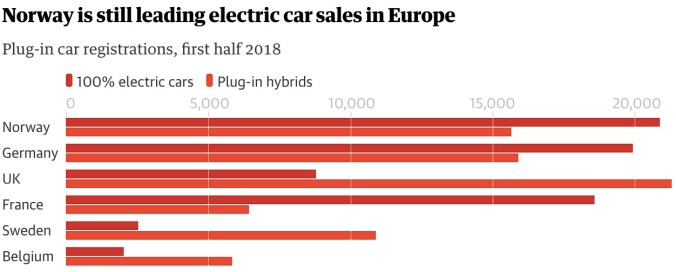
Electric cars exceed 1m in Europe as sales soar by more than 40%

Milestone reached nearly a year after China but ahead of the US

3963.jpg

Between January and June around 195,000 plug-in cars were sold across the EU, Iceland, Liechtenstein, Norway and Switzerland. Photograph: Miles Willis/Getty Images for Go Ultra Low

There are now more than a million electric cars in Europe after sales soared by more than 40% in the first half of the year, new figures reveal.

Europe hit the milestone nearly a year after China, which has a much larger car market, but ahead of the US, which is expected to reach the landmark later this year driven by the appetite for Tesla’s latest model.

Between January and June around 195,000 plug-in cars were sold across the EU, Iceland, Liechtenstein, Norway and Switzerland, a 42% increase on the same period a year before. Continue reading

Roots Of Biodiversity

052918_antonelli_0090.jpg

Alexandre Antonelli references the International Plant Names Index to identify specimens.
Rose Lincoln/Harvard Staff Photographer

Our practice was born in Costa Rica, so we sometimes may appear partisan when it comes to celebrating the sciences related to biodiversity. Costa Rica has impressive credentials in that realm, especially relative to its size as a country. But we are very clear on the fact that it would take dozens of Costa Rica-sized biodiversity hotspots to match the scale of the Amazon region, and it is no surprise that studies like those of these scholars are carried out with Amazonian data:

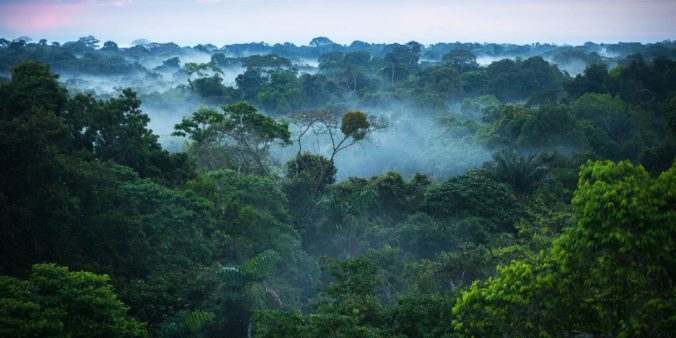
The Amazon as engine of diverse life

052918_antonelli_0233.jpg

“Most evolutionary research focuses on how new species form. But we want to understand how whole ecosystems evolve,” said Alexandre Antonelli.
 Rose Lincoln/Harvard Staff Photographer

A recent study says that many of the plants and animals that call Latin America home may have had their roots in the Amazon region.

The study, co-authored by Harvard Visiting Scholar Alexandre Antonelli and an international team of researchers, says that a dynamic process of colonization and speciation led to the formation of the American tropics, which is the most species-rich region on the planet. The study is described in a paper published in the Proceedings of the National Academy of Sciences.

“We were astonished to detect so much movement across such different environments and over such large distances,” said Antonelli, the study’s lead author. “Up until now, these natural dispersal events were assumed to be quite rare. Our results show how crucial these events have been in the formation of tropical America’s unique and outstandingly rich biodiversity.” Continue reading

Climate Change Deniers, Beware Of The Speaking Stones

A “hunger stone” exposed by the low level of water in the Elbe river is seen in Decin, Czech Republic, on Thursday. The low level of water caused by the recent drought has exposed the stones on the river bed. Petr David Josek/AP

Thanks to National Public Radio (USA) for this:

Drought In Central Europe Reveals Cautionary ‘Hunger Stones’ In Czech River

ap_18235426463887_custom-7a1b9400512fdb6edfb48925e9b2ab2c08981692-s1400-c85.jpg

People visit a famous “hunger stone” exposed by the low level of water in the Elbe river in Decin, Czech Republic, on Thursday. Petr David Josek/AP

A lengthy drought in Europe has exposed carved boulders, known as “hunger stones,” that have been used for centuries to commemorate historic droughts — and warn of their consequences.

The Associated Press reports that hunger stones are newly visible in the Elbe River, which begins in the Czech Republic and flows through Germany.

“Over a dozen of the hunger stones, chosen to record low water levels, can now be seen in and near the northern Czech town of Decin near the German border,” the AP writes. Continue reading

Off Halogen, On With LED

Switching to LEDs has been estimated to save consumers up to £112 a year. Photograph: imageBroker/Rex/Shutterstock

Arthur Neslen at the Guardian shares the news, in Europe to ban halogen lightbulbs, that we have been waiting to hear for years:

After nearly 60 years of lighting homes halogens will be replaced with more energy efficient LEDs

After nearly 60 years of brightening our homes and streets, halogen lightbulbs will finally be banned across Europe on 1 September.

The lights will dim gradually for halogen. Remaining stocks may still be sold, and capsules, linear and low voltage incandescents used in oven lights will be exempted. But a continent-wide switchover to light-emitting diodes (LEDs) is underway that will slash emissions and energy bills, according to industry, campaigners and experts.

LEDs consume five times less energy than halogen bulbs and their phase-out will prevent more than 15m tonnes of carbon emissions a year, an amount equal to Portugal’s annual electricity usage. Continue reading

Option Bee

21sci-bees-illo-superjumbo

Heidi Younger

The Blue Orchard Bee recently came to our attention thanks to Natalie Boyle. However, it seems the species has some competition as potential saviors of the farming industry.  This article by Catherine M. Allchin,  Honeybees Are Hurting. What Else Can Pollinate Our Food?, illustrates how…

…The dominant pollinator is under siege, straining the business of farming. Now growers are turning to alternative species to help their crops.

Jim Freese grows apples, pears and cherries on 45 acres in the north-central part of this state, on sagebrush-studded land his grandfather bought in 1910.

Walking among trees laden with shiny red cherries, Mr. Freese recalled that four years ago his trees were not producing well and his farm was financially struggling. Like many growers, he had been relying on rented honeybees to pollinate his cherry trees every spring, along with wild bees and other insects.

But that year, spring was expected to be cool. “Honeybees will just sit in the hive in cooler weather,” Mr. Freese said. He needed a way to ensure more flowers would develop into fruit than in the past.

At a horticulture meeting, he learned that blue orchard bees — a native species that doesn’t make honey or live in hives — could be used to supplement honeybee pollination. Blue orchard bees will fly at cooler temperatures.

Mr. Freese bought 12,000 cocoons and set them in his orchard to emerge when the trees bloomed. His investment paid off. “We doubled our cherry production from any previous record year,” he said.

His wife, Sandee Freese, said: “The little bees have been a godsend.”…
Continue reading

Local Knowledge Aids Scientific Understanding

Brazilian_amazon_rainforest_web

WIKIMEDIA COMMONS

In a perfect dovetail with yesterday’s nod to one science writer, today we nod to the contributions of ancestral ways in helping scientists better understand the life cycles of forests. Thanks to Richard Schiffman for this interview:

Lessons Learned from Centuries of Indigenous Forest Management

CMPeters_web.jpgIn an interview with Yale Environment 360, botanist Charles M. Peters discusses how, in an era of runaway destruction of tropical forests, the centuries-old ecological understanding of indigenous woodland residents can help point the way to the restoration of damaged rainforests.

Over centuries, even millennia, indigenous communities have developed interdependent systems of agriculture and forestry that are uniquely suited to the ecological requirements of the land they inhabit. Yet even today, says Charles M. Peters, the Curator of Botany at the New York Botanical Gardens, that skill and knowledge often remain unacknowledged, with some government officials and conservationists arguing that indigenous communities should sometimes be excluded from protected lands that are part of their historical territory.

Field-crews.002_web

Members of the Kenyah Dayak indigenous group conducting forest surveys in Western Borneo in the early 1990s. CHARLES PETERS

In an interview with Yale Environment 360, Peters — author of the recently published bookManaging the Wild: Stories of People and Plants and Tropical Forests — discusses what he has learned from 35 years of working with indigenous forest communities; explains how indigenous farming, even slash-and-burn agriculture, can actually improve forest health; and reflects on the need to enlist indigenous groups as allies in the struggle to preserve and restore tropical forests. Continue reading

Better Science Writing, Better Societal Decision-Making?

Zimmer Longform

9781509818532she has her mother-s laugh_11_jpg_262_400.jpgScience writing has been one of our favorite themes since we started this platform. The quality with which science is explained in clear language is good for the planet, we think. Carl Zimmer is probably the most cited science writer during these eight years, for good reason. The interview above from late 2016, if you are convinced about the importance of science writing, is about as good as it gets for hearing a master explain his craft in very personal terms. It was recorded just weeks after the most fateful (with regard to science) presidential election in recent USA history. Zimmer takes a “just the facts” approach to the interview, and neither punches, nor pulls punches, with regard to the environmental and other science policy mess-making that had just begun. He just shares his craft.

5088.jpg

Carl Zimmer: ‘Heredity is central to our existence… but it’s not what we think it is.’ Photograph: Mistina Hanscom/Lotta Studio

He has a new book out, which we have not read, but we are glad that it has brought him out on book tour. In the interview below, from just a couple weeks ago, we get a quick read on what he is saying now:

Carl Zimmer is a rarity among professional science writers in being influential among the scientists on whose work he writes and comments – to the extent that he has been appointed as professor adjunct in the department of molecular biophysics and biochemistry at Yale University. Zimmer has just published his 13th book, She Has Her Mother’s Laughsurvey of “the power, perversions and potential of heredity”. Continue reading

Bee Awesome

19mag-bees-slide-5XCH-jumbo

Will Nissen’s bees north of Bakersfield, Calif. Credit Ilona Szwarc for The New York Times

Thanks to Jaime Lowe for this:

The Aha Moment Explaining One Challenge To Recycling

15Fixes-jumbo.jpg

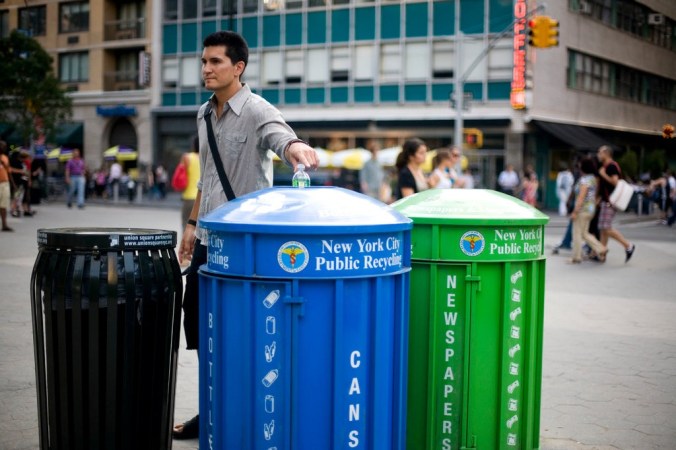
Color-coordinated waste baskets for waste recycling in New York City. Credit Ramin Talaie/Corbis, via Getty Images

Thanks for this interview full of incisive interview quetions by David Bornstein, who is co-founder of the Solutions Journalism Network, which supports rigorous reporting about responses to social problems. Thanks to Mitch Hedlund, executive director of Recycle Across America, for the explanatory answers in the interview that follows:

The Conflict of Interest That Is Killing Recycling

Some of the biggest recycling operations are owned by landfill companies whose profits improve when recycling doesn’t work well.

15fixes2-articleLarge.jpg

Mitch Hedlund, executive director of Recycle Across America. Credit Shelly Mosman/Recycle Across America

In the past few years, one of the core pillars of the environmental movement — recycling — has fallen on hard times. News dispatches reveal hundreds of cities and counties scaling back their recycling programs because of the high costs associated with processing recyclables and the lack of demand for the materials. A new conventional wisdom is gaining ground suggesting that recycling may not be worth the effort.

But is that true? And has recycling ever gotten a fair shake? After decades, less than a third of municipal solid waste is recycled — and much of that is contaminated with garbage, which diminishes or destroys its value. Almost 50 years after the first Earth Day, are we really ready to admit defeat and return to the “Mad Men”-era ethos of the “throwaway society”?

There may be another way. For most of the past decade, Recycle Across America, a nonprofit organization I covered in this column six years ago, has been demonstrating that it’s quite possible to get people to recycle properly, just as it’s possible to get most people to wear seatbelts, quit smoking and stop driving drunk. But the recycling industry has never taken the logical steps needed to create a successful societywide recycling habit — and today it may not be in the economic interest of some of the big recycling companies to build it. Recently, I spoke with Mitch Hedlund, the founder of Recycle Across America, about this dilemma and the possibility that a recycling collapse can be avoided. Continue reading

The Value Of Pollinating Bees

We love all creatures great and small, even (we try as best we can) the pesky ones. It is not because we are generous, though we hope we are. It is because we see their value. For hopefully obvious reasons, pollinators are our favorite bees. Our lives depend on them. That is why we have featured dozens of stories about them. Thanks to National Public Radio (USA) for this one:

Watch This Native Pollinator Build Her Bee-Jeweled Nest

dl_514blueorchardbees_bee_on_phacelia_tanacetifolia_wide-026b809eb16b094939e36911aa87b02aad62ddca-s1400-c85

A female blue orchard bee forages for nectar and pollen on Phacelia tanacetifolia flowers, also known as blue or purple tansy. Blue orchard bees are solitary bees that help pollinate California’s almond orchards. Josh Cassidy/KQED

While honeybees and their buzzing hives and hyper-fertile queens get all the press for pollinating our food supply, the hard-working blue orchard bee is one of 4,000 bee species native to North America that does its solitary work in relative obscurity. That is, until now.

In the video, you can see how this bee builds its nests, alternating mud and a purple nectar-pollen mixture in hollow, skinny spaces. The blue orchard bees are preparing a purple lunch box of sorts for their offspring so they have food to eat in the tunnel. The blue orchard bees’ work looks more like jewelry or even scoops of trendy ube ice cream than a nest. Continue reading

Sand Piracy Is A Thing. A Bad Thing.

9780399576423_custom-3813965e7ebb84b1f0032ce9298d929eceebe117-s500-c85.jpgBuilding hotels in Kerala, India from 2010 to 2017 we came to know about sand pirates from a very close up perspective. When their boats were speeding past the houseboats we operated, we detected the carefree sense with which they carried out their mission. Perhaps they did not know the damage they were doing? Not likely. The law was chasing them, and they knew that for sure. Thanks to Genevieve Valentine for this review titled A Day At The Beach Won’t Be The Same After ‘The World In A Grain’ about this book to the left:

The first time you see ‘sand piracy,’ it might sound surreal — a misguided Pixar villain whose lackeys race down the beach with empty buckets and sinister intent, doomed to fail in the face of a resource that spans the whole ocean.

Then you find out about someone stealing 1,300 feet of sand from a beach in Jamaica, or the many sand miners whose dredgers suck sand from the ocean floor by the ton and, suddenly, it doesn’t sound as funny — or as impossible — as it did before. Continue reading

Sending Aloha Poke A Message

Ho-AlohaPoke.jpg

Aloha Poke Co.’s corporate strong-arming has struck many observers as the most blatant kind of cultural appropriation—an effort not to celebrate another tradition but to own it. Photograph by Katie Rothstein

A few of our team members were just in the last week or so talking about poke, after a visit to a shop on Venice Beach, in California, that has some of the best-reputed poke on the mainland. Little did we know, something big was happening in the poke world, having to do with bullying tactics and cultural appropriation, a topic we have long been sensitive about considering the work we do. So, after reading this news, we pass this along and encourage all our friends and colleagues to consider where their poke dollars go:

The Chicago Poke Chain That Tried to Stop Hawaiian Businesses from Using the Word “Aloha”

On July 28th, a Hawaiian activist named Kalamaokaaina Niheu appeared in a Facebook Live video to discuss a “disturbing message” that she had received in her in-box that morning. It was about Aloha Poke Co., a restaurant chain based in Chicago that specializes in fast-casual versions of poke, a traditional Hawaiian dish made of chunks of seasoned raw fish. Niheu, who represents Hawaii in the Pacific Caucus at the United Nations and lives in Honolulu, had been hearing from Hawaiian business owners who had received cease-and-desist letters from the Chicago company, claiming that it had trademarked the phrases “Aloha” and “Aloha Poke,” and that any food business using those words in its name was infringing on its federal trademark.

To Niheu and other kanaka maoli—native Hawaiians—Aloha Poke Co.’s claim was ludicrous: How could a business, let alone a non-Hawaiian one, claim a right to something as fundamental to Hawaiian culture as the word “aloha”? The term, which can mean “hello” and “goodbye,” also signifies a spiritual connection between the Hawaiian people and the world around them, Niheu explained. Now it was being used as “a legal, blunt hammer for profit, so that Aloha Poke Co. can compete in a market that was never theirs to begin with,” she said. Several shops had already been forced to rebrand their poke businesses, and front the cost of doing so—redesigning their logos, tossing infringing merchandise and menus, and changing their social-media handles. One restaurant owner in Anchorage, Alaska, changed her business name from Aloha Poke Stop to Lei’s Poke Stop after receiving a cease-and-desist letter. “We just weren’t prepared to do that,” she told Eater. “We were already struggling as a small family business.” Continue reading

Why Care About Mosquitoes?

Mosquitoes.jpg

Thanks to Kendra Pierre-Louis for this explanatory note, which references the article in taking us a step closer to understanding the mystery of mosquitoes’ value to the planet:

The little things that run the polar world

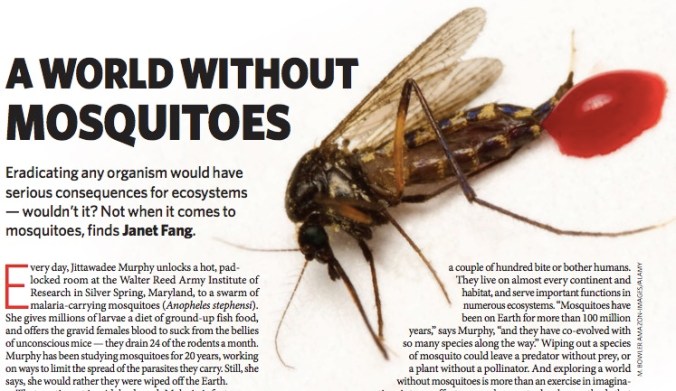
08cli-newsletter-mosquito-superJumbo.jpgAsk just about any human and they’ll tell you that mosquitoes are pests we’d be better off without, especially since some mosquitoes carry deadly diseases. Even many scientists agree: A 2010 article in the journal Nature concluded that a world without mosquitoes would be less itchy and less deadly for us, with few drawbacks for other species, outside of some ecological niches.

One of those niches is the Arctic, where mosquitoes play a bigger role in sustaining the ecosystem but may be threatened by the changing climate, said Lauren E. Culler, a research assistant professor of environmental studies at Dartmouth College.

“You can collect pollen off of mosquitoes, indicating they may have a role in pollination,” she said. “And we know that they’re also food for other organisms in the food web.” Continue reading

World Elephant Day

23 July 2018. Elephant Relocation from Venetia Limpopo Nature Reserve (South Africa) to Zinave Reserve (Mozambique). Picture: JAMES OATWAY

Our fascination with elephants is evident throughout the history of this site, and are heartened by actions taken toward increased conservation of these magnificent animals. Relocating large African mammals to new protected areas due to either habitat loss or overpopulation has successfully been done before, but the challenges continue.

Giants on the Move

Written by Patricia Sims, Co-Founder, World Elephant Day

Each year for World Elephant Day we put a lot of our elephant conservation attention toward the ivory poaching crisis threatening African elephants, and the tourism and captivity issues that the endangered Asian elephants face. Yet the larger conservation challenge of habitat loss for both African and Asian elephants is looming. Our increasing encroachment on elephant habitat throughout Africa and Asia is putting elephants at greater risk, resulting in human-elephant conflict issues, and the demise of elephant populations and the ecosystems that they, as a keystone species, maintain.

So what are the solutions? Can moving elephants – from one location where there isn’t enough space for them – to another location where there aren’t enough elephants, help solve this issue? At the heart of this critical elephant conservation conundrum is a partnership between the De Beers Group – the world’s leading diamond company – and Peace Parks Foundation, a leading not-for-profit organization focused on the preservation of large cross-border ecosystems. They have just completed the first phase of the largest and longest translocation of elephants ever recorded in South Africa. This translocation project is called “Moving Giants.

Continue reading

Model Mad, Rollback Pushback

Mary Nichols, who heads the California Air Resources Board, has vowed to fight the federal government’s proposed changes. Credit Eric Risberg/Associated Press

It’s been a while since we’ve addressed our “model mad” theme, despite there being numerous opportunities. We’re continually heartened by the strength of both the public and the private sector to pushback against the current administration’s regressive proposals.

California Strikes Back Against the Trump Administration’s Auto Pollution Rollback

California went on the offensive Tuesday against the Trump administration’s plan to weaken fuel-efficiency rules for cars, laying out a scathing rebuttal that the state’s clean-air regulator said would shape the battle with Washington in the coming months and years.

The state’s target is one of President Trump’s most consequential environmental rollbacks to date, a proposal unveiled last week to let cars pollute more while stripping California of its right to set its own air-quality rules.

The administration’s proposal “is contrary to the facts and the law,” the California document says, before refuting point by point the Trump administration’s arguments for weakening the nation’s long-term goals for making vehicles more fuel efficient and less polluting.

The clash between California and Washington threatens to throw the United States auto market into disarray. Because California has the authority under the Clean Air Act to set its own air pollution rules, and because a dozen other states follow its lead, the dispute could effectively split the nation’s market into two, one side adhering to stringent emissions rules set in Sacramento and the other to weaker federal standards.

Continue reading