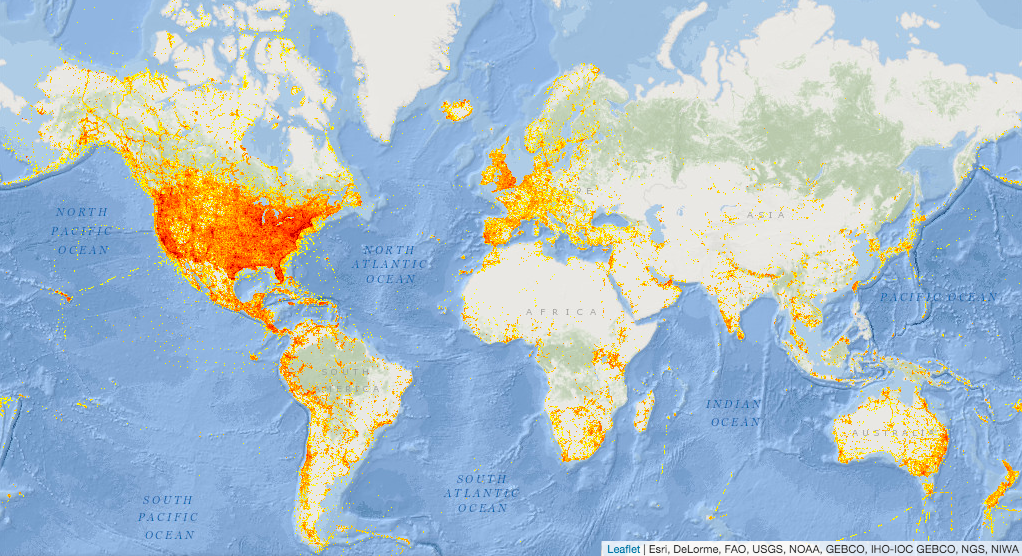
 Including historical data since 1810 and extending into checklists from December of last year, eBird’s Observational Dataset just hit a milestone of 500 million records, making eBird the largest repository of biodiversity information that is freely accessible.
Author: Seth Inman
Goats and Gallinas at Xandari
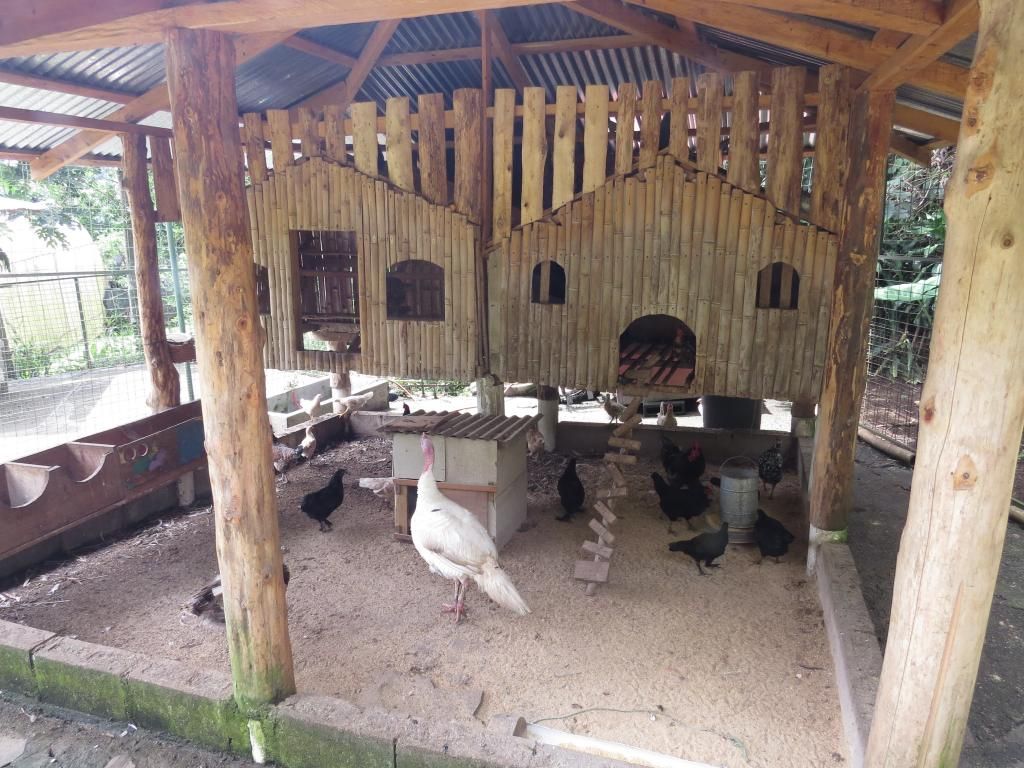
The chicken coop with two visiting turkey neighbors
At Xandari, right by the orchard and the greenhouse, you can find pens with a good thirty-something chickens, two goats, and three turkeys. Providing eggs for the restaurant every day, the chickens — or gallinas, as they’re called in Spanish — leave their pen every day to forage amongst the orchard trees, which are primarily citrus fruits. The turkeys are currently living at Xandari for aesthetic purposes, but the hope is that eventually they could also supply eggs or meat to the kitchen.
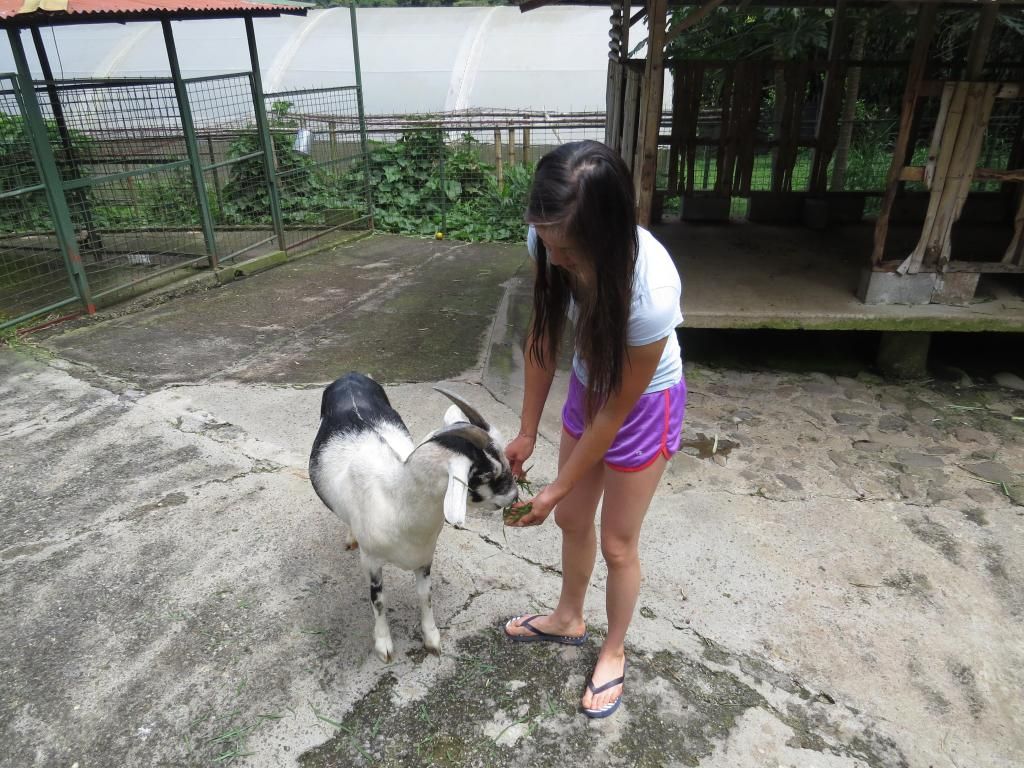
A Xandari guest feeding Sparkle some grass
Xandari’s goats, named Sparkle and Twinkle, are mother and daughter, and the plan is Continue reading
Bird of the Day: Steller’s Jay (Yosemite National Park, California)

Bird of the Day: White-tipped Dove (Xandari Resort, Costa Rica)

Winged Wildlife at Carara National Park (Part 2)
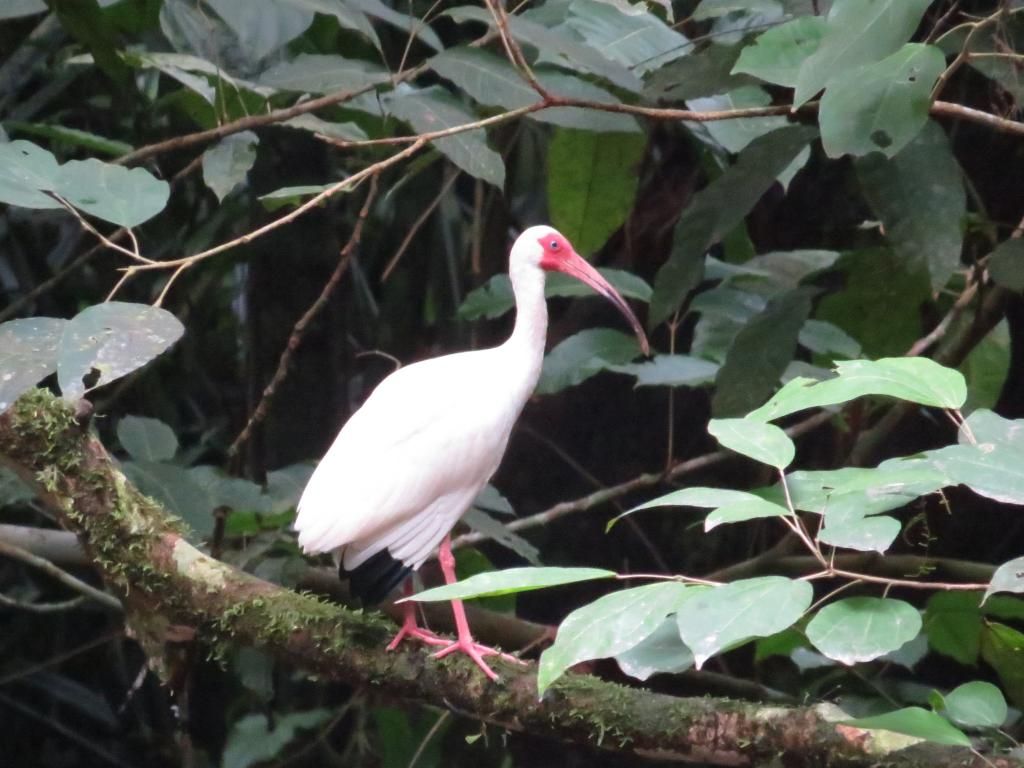
White Ibis on the banks of a river.
As I hinted in Part 1, Carara National Park is great for experiencing much of Costa Rica’s famous biodiversity. Monkeys, iguanas, poison dart frogs, and insects, together in a rich rainforest replete with all sorts of weird fungi that can look tasty and cute. Upon entering the park, James and I were greeted with the laughing calls of Black-hooded Antshrikes, birds that enjoy the columns of marching insects that commonly go by the name of “army ants.” Plenty of other birds with the word “ant” in their names made themselves known with their songs or movements in the undergrowth: male and female Dot-winged Antwrens, a Dusky Antbird, several Chestnut-backed Antbirds and Black-faced Antthrushes, and even a Streak-chested Antpitta heard from afar.
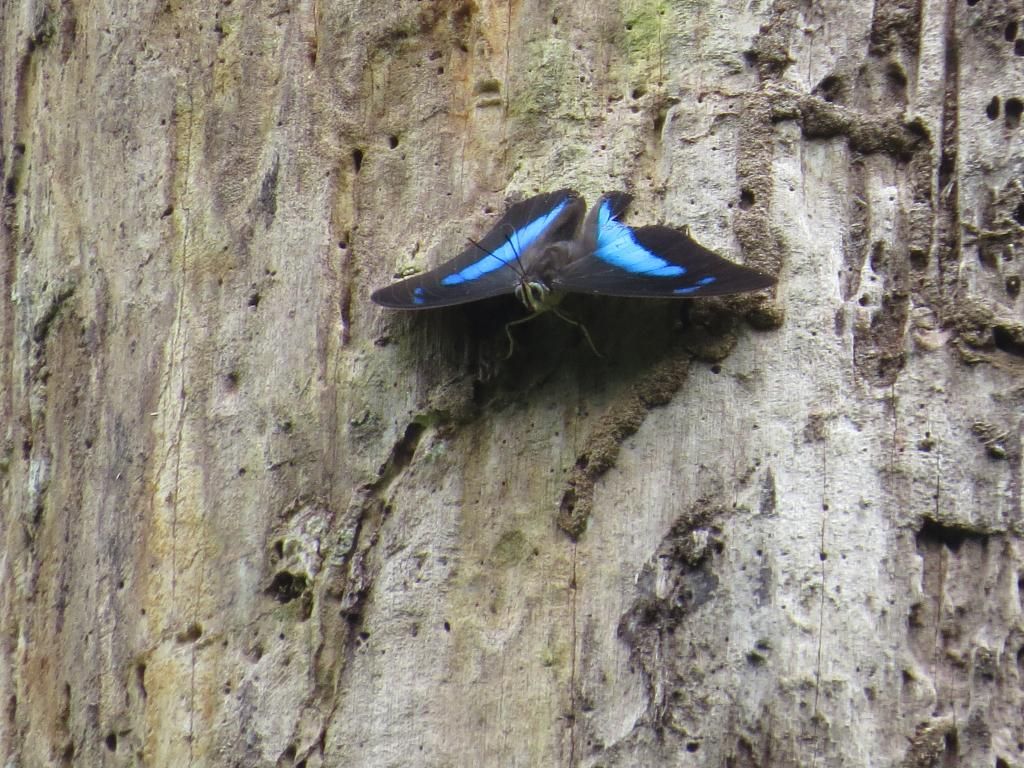 Apart from birds, we also saw several species of butterfly, including this one with the classic owl-eye pattern on its wings to startle potential predators. We also saw cicadas, but several times they had fallen prey to skillful salliers from silent perches. This female White-whiskered Puffbird, as well as this woodcreeper (Long-tailed, perhaps?), both emerged from their hidden leafy blinds to land somewhere with a juicy, shiny cicada in their beaks. There were several other woodcreepers doing their job–creeping along tree trunks–like a Streaked Woodcreeper with its powerful bill, and in general James and I struggled to Continue reading
Wildlife at Carara National Park: Part 1
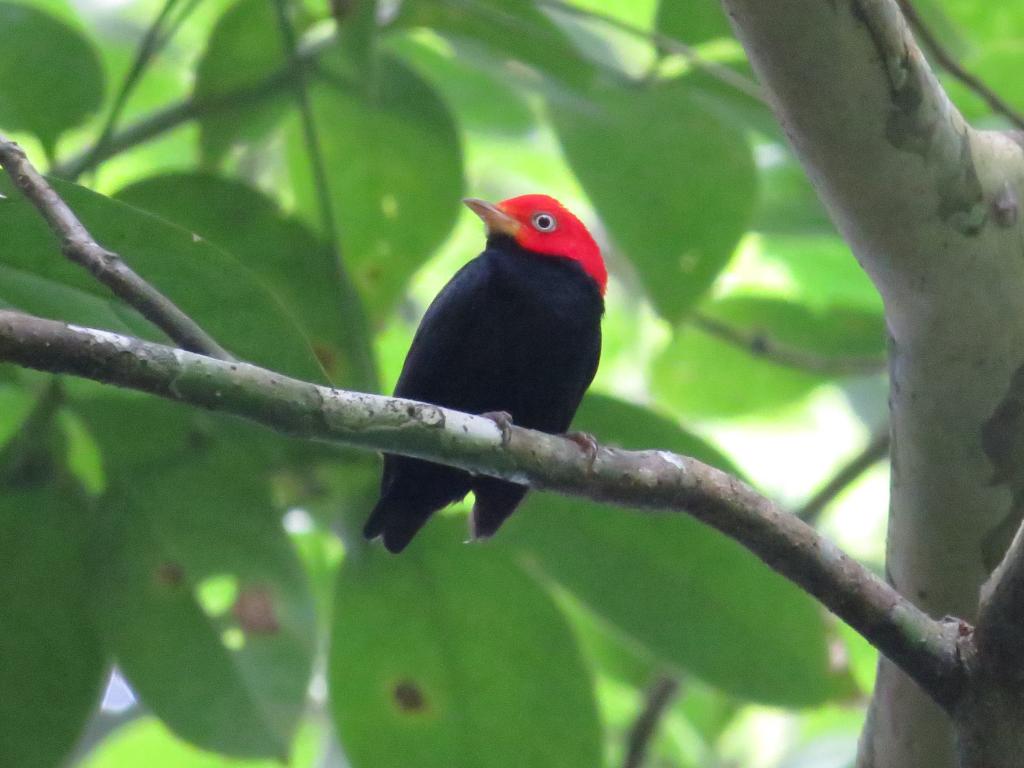
Red-capped Manakin (male). He has spiffy yellow thighs, unfortunately not visible in this picture.
A few weekends ago, James and I spent six hours at Parque Nacional Carara, on the Pacific side of Costa Rica and just about an hour and a half from Xandari. Braving the muggy, humid coastal rainforest with the intention of spotting and/or hearing at least fifty new (for us) species, we set off on the first couple miles of trail with our field guide in hand. James uses a pair of Nikon Monarch binoculars for quick spotting and following birds as they flit around, and I sport a Canon SX50 digital camera to hopefully capture still images or video for identification purposes. Sometimes I get lucky enough to take a photo that’s worth sharing!
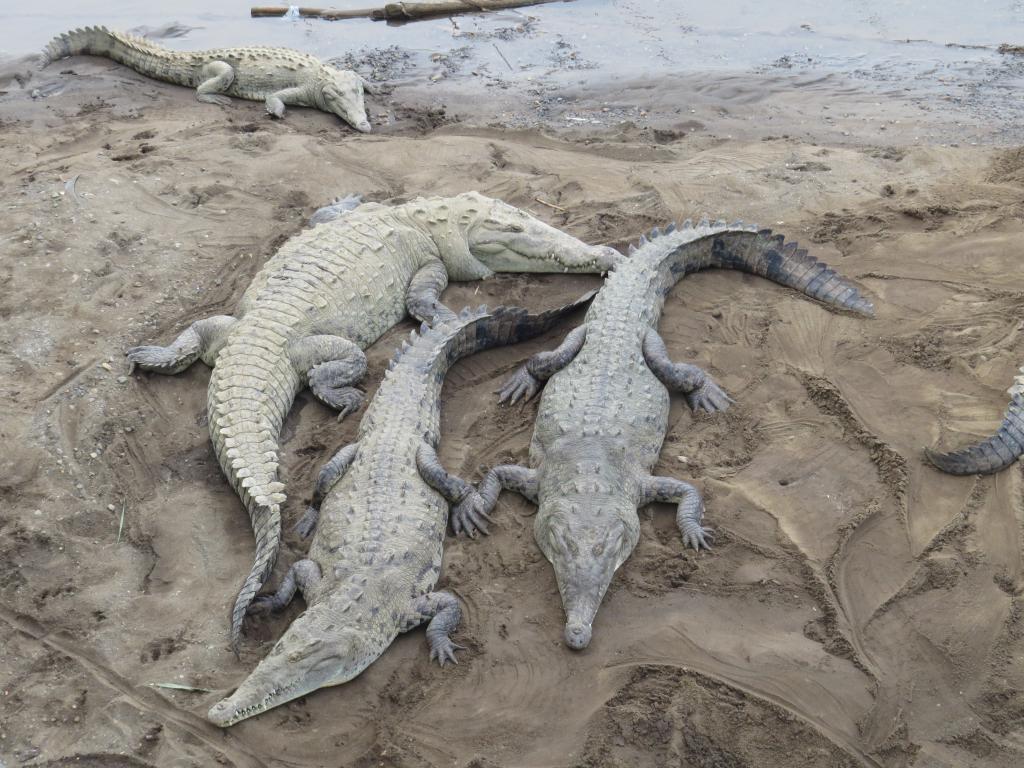 But not all the wildlife we spotted at Carara was avian. On the way to the park entrance, we crossed the famous Río Tarcoles, a river that is home to dozens of crocodiles that bask in the mud, particularly under the bridge that tourists walk over to gaze at the enormous predators hanging around. James and I saw plenty of smaller reptilian relatives skitter across the paths at the park, including iguanas and a basilisk lizard. We passed several troops of leaf-cutter ants marching Continue reading
Bird of the Day: Rufous-capped Warbler (Xandari Resort, Costa Rica)

Bird of the Day: Hoffmann’s Woodpecker – Female (Xandari Resort, Costa Rica)
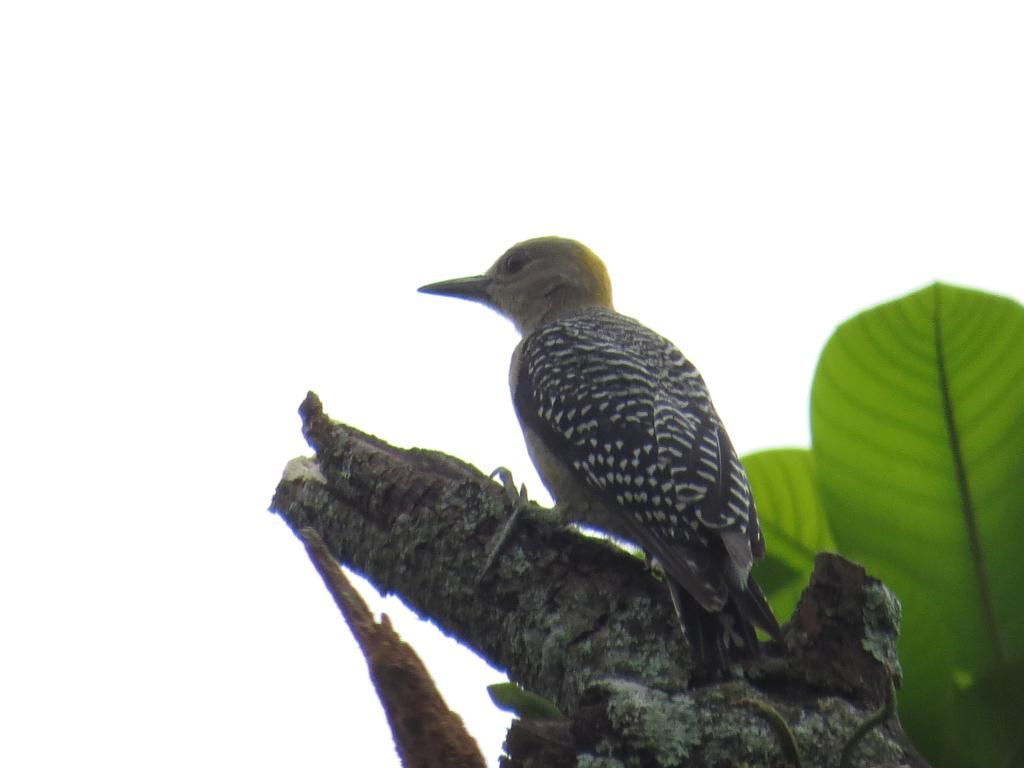
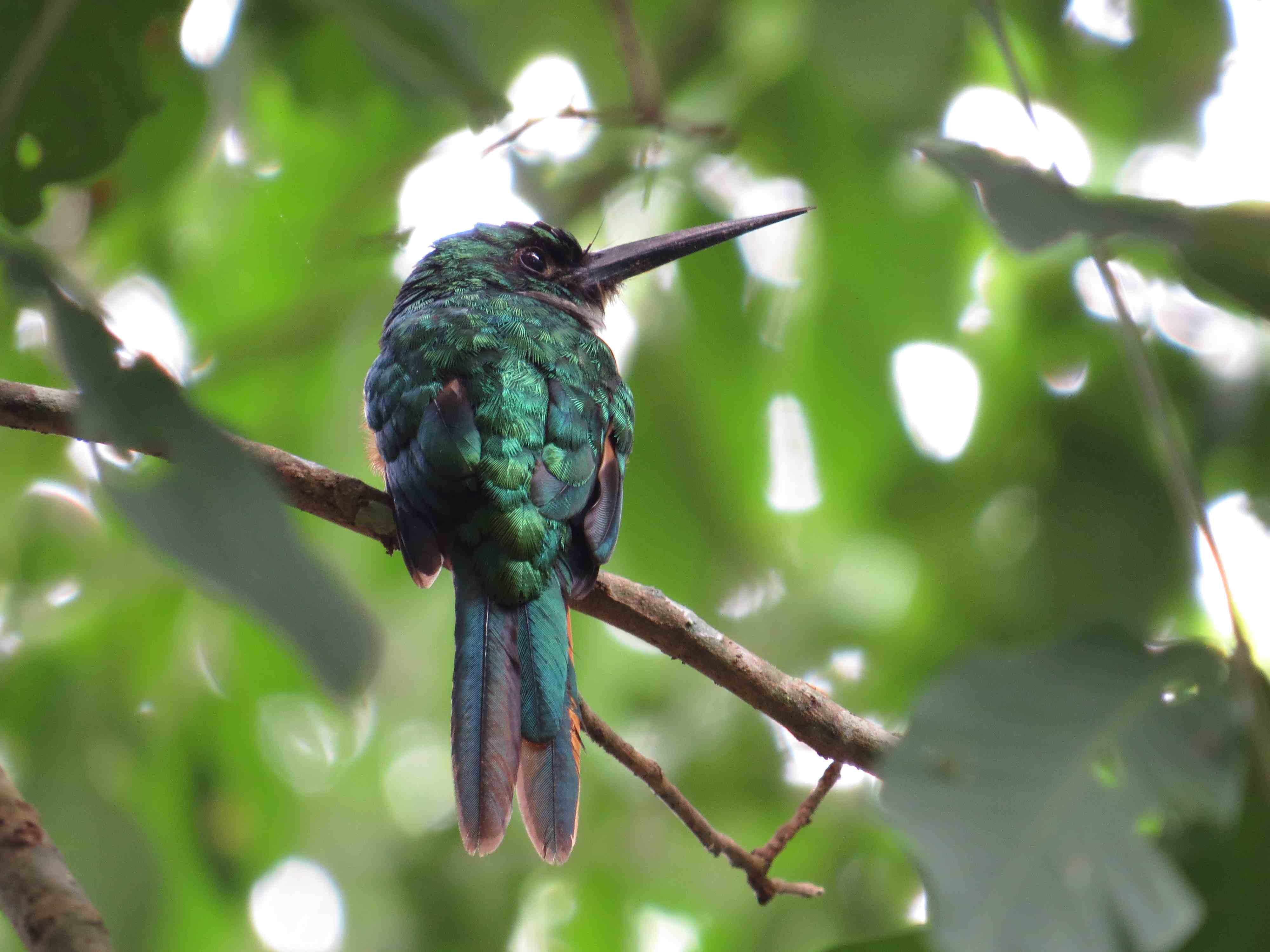
Bird of the Day: Rufous-tailed Jacamar
Carara National Park, Costa Rica
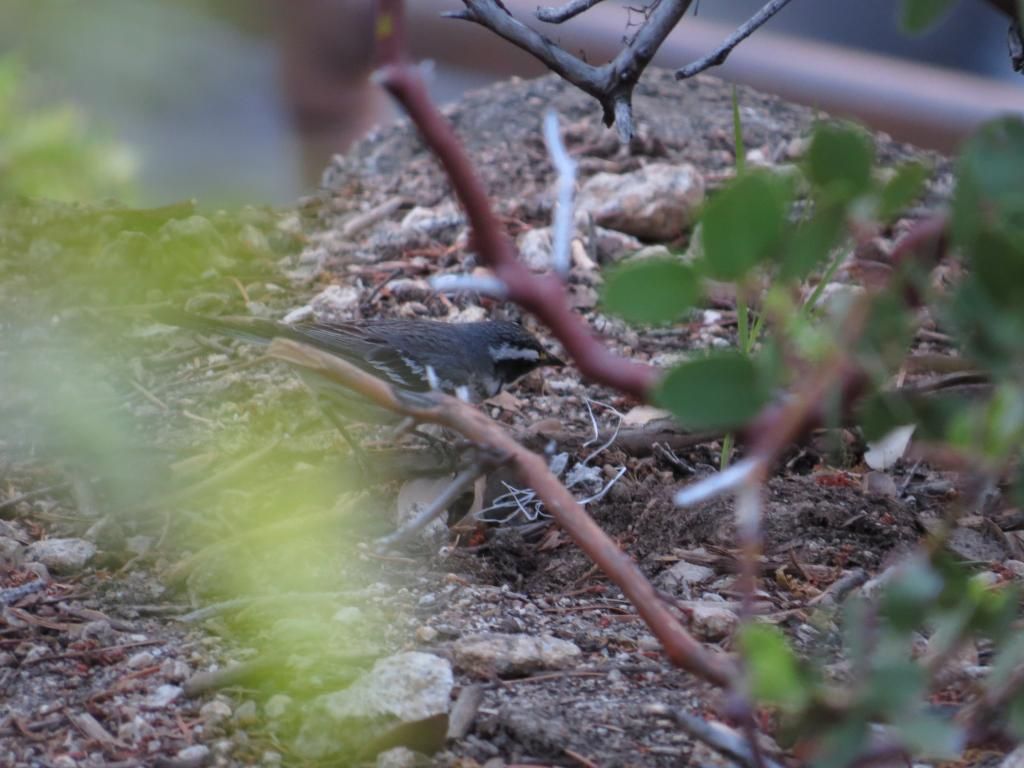
Bird of the Day: Black-throated Gray Warbler – Male (Yosemite National Park, California)
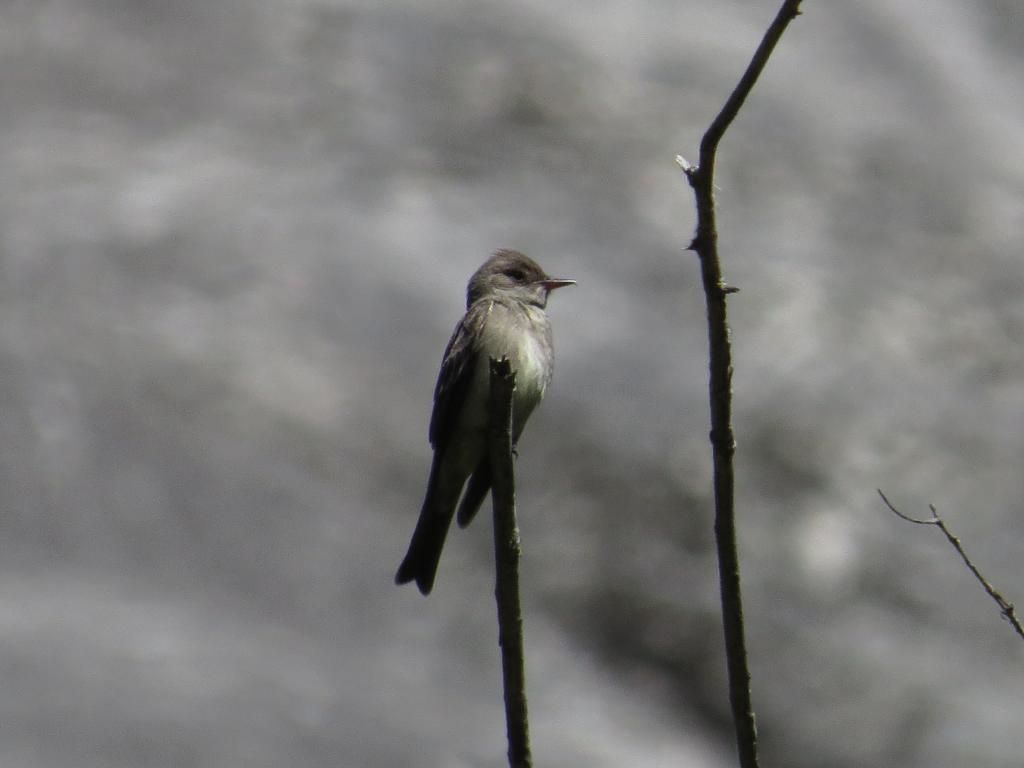
Bird of the Day: Dusky Flycatcher (Yosemite National Park, California)
Celebrating Birds with Tacacori Students
 About fifteen minutes downhill from Xandari by foot, the primary school at Tacacori serves first through sixth graders from the local community. Xandari has collaborated with the school on multiple occasions in the past, and also regularly cares for their grounds (mowing the lawn, etc.). This semester, third and fourth graders don’t have an art class in their normal schedule, so it seemed a perfect opportunity for James and me to go over and do a week-long art project with the kids.
Of course, I stuck with what I know best for art projects with young children, and decided upon papier-mâché and painting on little cardboard canvases, just like I had done in the Galápagos a couple years ago. James and I went to the third and fourth grade classes during their Spanish classes and for about an hour and twenty minutes each a day we showed them how to use newspaper, glue, and a balloon to create the body of a bird. Then, with recycled cardboard from Xandari, we gave them canvases to paint on as well as the materials to make beaks, wings, tails, and feet for the birds. Continue reading
Ferruginous Pygmy-Owl at Xandari
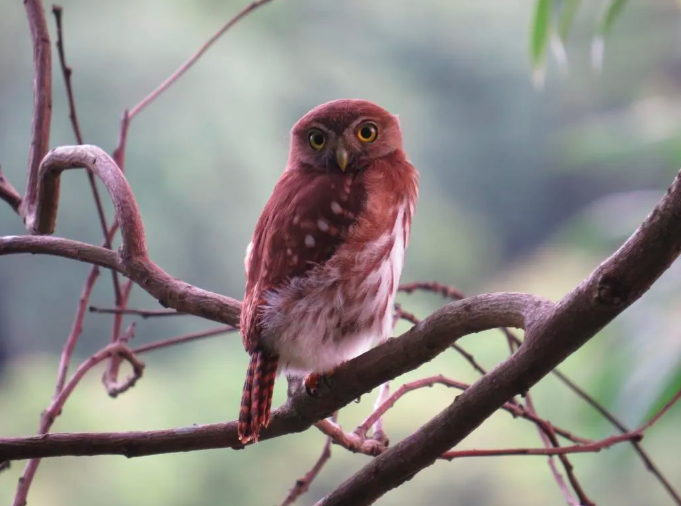 A few weeks ago, as James and I were leading a bird tour, we had quite a lucky and enjoyable sighting. From the title and the picture on the left, you already know that we saw a small species of owl, but that actually wasn’t what we had been looking for at the time.
There was a hummingbird buzzing around in front of us on the trail, and eventually it landed on a branch on our left. We all turned to look at it more closely, but, as birds are apt to do, the hummer (a Rufous-tailed) swiftly flew out of sight. On a branch in the background of where the hummingbird had perched, stoically still, was
Bird Behavior at Xandari
Over the past several weeks, I’ve had the fortune of being able to find birds sitting relatively still and have filmed them doing their stuff. All of the species in the video below are quite common here at Xandari, but I hope to eventually be able to share footage of even more rare and exciting birds that James and I sometimes see!
For more bird videos that I’ve taken in the past, you can Continue reading
Xandari’s Mandala Herb Garden
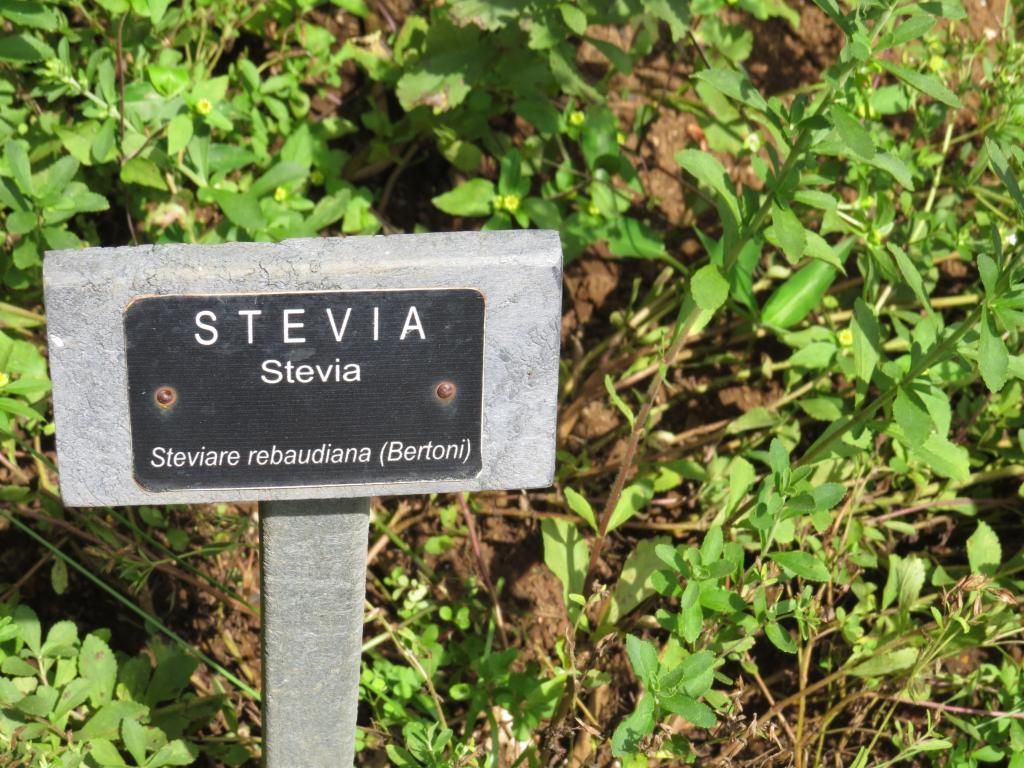 If you’ve been following some of the recent posts about Xandari’s trails, flowers, and gardens in general, then you are probably aware that the resort’s property abounds with plant life that is beneficial to visitors — both human and otherwise — in some way. One element of the gardens that James and I have not emphasized as much, though James mentioned it in his post on Aloe vera and I did in an earlier post, is the mandala, a circular garden near the spa and the entrance to Xandari that holds dozens of herbs.


“Water” or “rose” apple, an insipid fruit that grows in the tropics


Xandari’s Trails
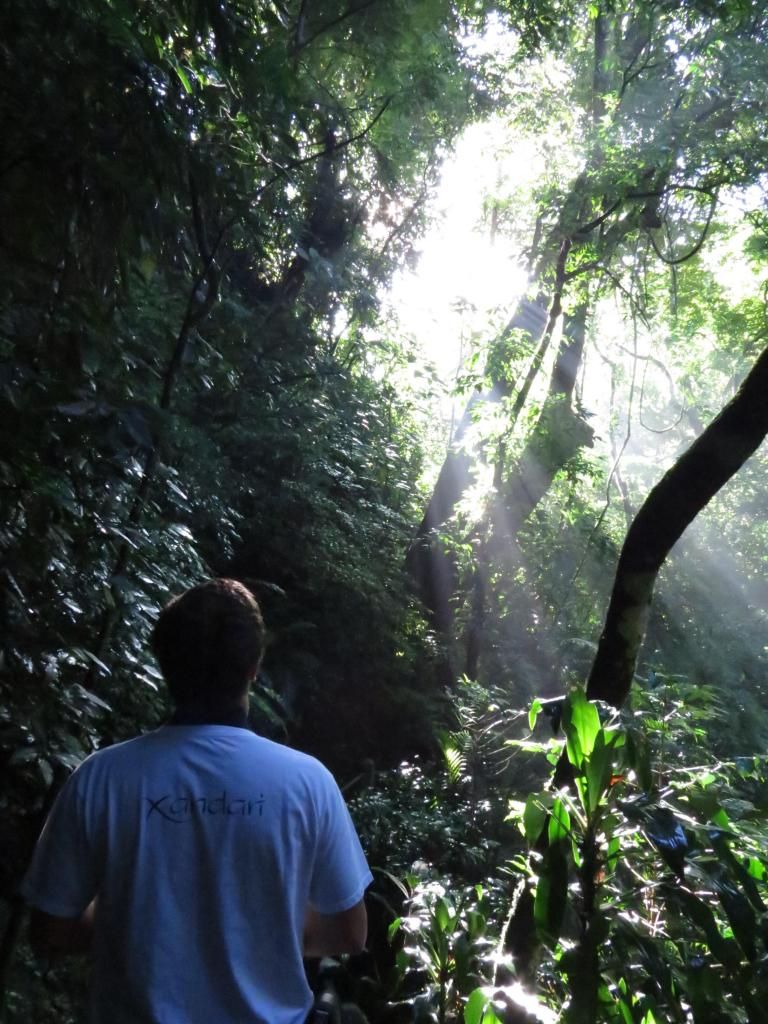 With our daily walks around Xandari to build the resort’s checklist of resident birds and take photos of as many species as possible, James and I are taking full advantage of the remarkable trail system. It allows us to travel several miles around the thirty-odd acres of private reserve in Xandari’s property without tracing back over our steps at all, which would have negative implications on the eBird data that we submit for every outing (we don’t want to increase the chances of counting a bird twice!). Descending from about ~1,150m (~3,800ft) to ~1,080m (~3,550ft), on woody switchbacks that give us vantage points over the surrounding forest and allow views into the canopies of the trees below, James and I walk through many types of bird habitat, which both in theory and in practice yields us a higher species count than if we were to simply walk around the gardens right outside any of Xandari’s villas – though I don’t mean to imply that the gardens aren’t home to quite a few species here!
Bird of the Day: Common Raven (Yosemite National Park, California)
The Footprints of Footballing Countries

© Global Footprint Network
Have the countries with the highest ecological footprints done the best in this year’s FIFA World Cup? Analysts at the Global Footprint Network asked themselves this question in this month’s newsletter addendum and the results of their calculations are interesting — and sometimes surprising!
The eight nations who made it to the quarter-finals represent vastly different lifestyles. If all people on Earth lived like residents of those countries, Continue reading
Throwback Thursday: Galápagos Coffee
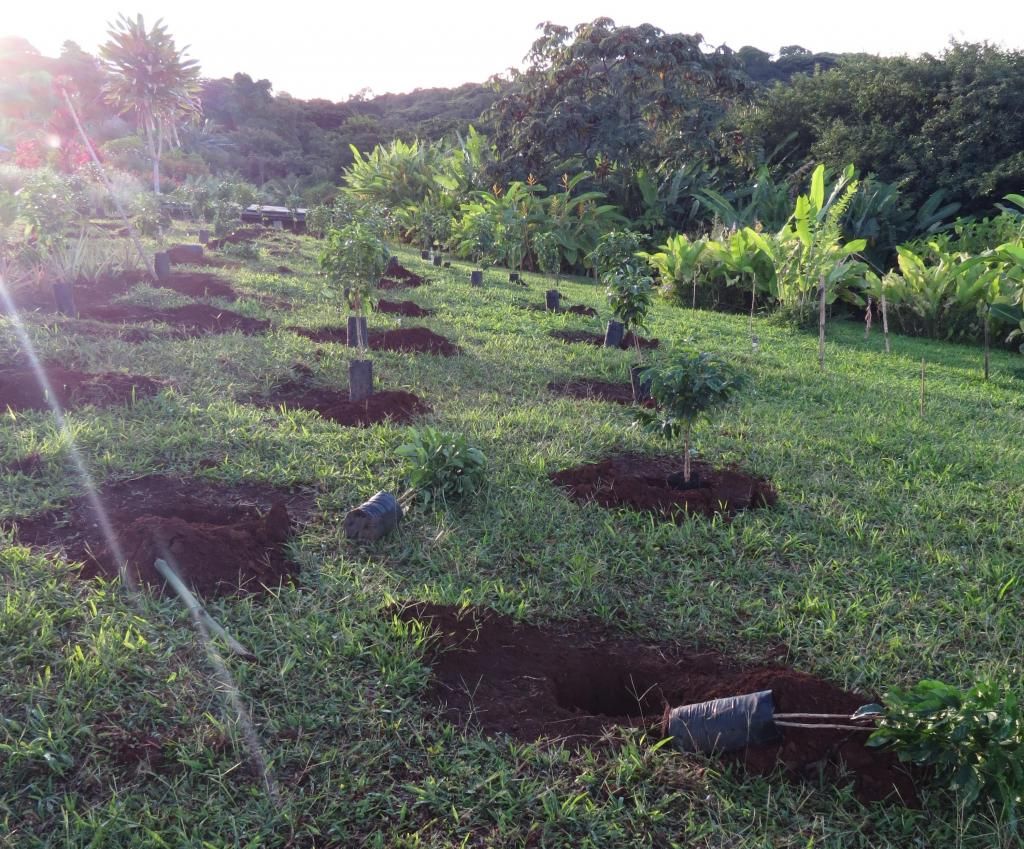 Before my recent experience with growing coffee, the last time I had been exposed to the agricultural side of the brew had been almost exactly two years ago, on the island of Santa Cruz in the Galápagos Islands of Ecuador. The plants that I had a hand in starting up there should be reaching the beginning of their prime production this year.
The scale of the farm at Santa Cruz was much greater than that at Xandari so far, and hopefully Roberto and Reyna will get a bumper crop this year and we’ll be hearing about it!
You can read a little about their coffee farm and some of the work I did there Continue reading
Coffee Seedlings
 Last week, using Borbón coffee seeds graciously given to us by the Doka estate, we started growing new seedlings to eventually plant in the ground at Xandari. José Luis showed James and me how to prepare a substrate of earth mixed with decomposing leaf litter he had put through a sort of wood-chipper to make a soil that closely mimics the forest floor where coffee often grows wild here.
In a wooden box with a corrugated tin floor (so water can drain easily), we made a bed of about an inch of soil. Then we put the two varieties of Borbón on either side of the box. Once the box was full, and we had removed all the rounded seeds that wouldn’t be as healthy as the seeds with a flat face, we added another layer of soil on top and watered the box.
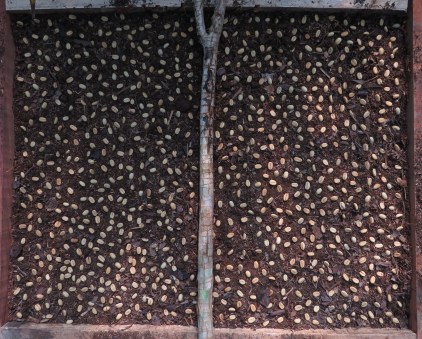 After we had gone, José Luis remembered to add a layer of dead leaves on top of the soil to help keep in the moisture and recreate natural conditions of the forest floor. Later, we went to visit his friend who had sold us the Borbón we planted earlier last month, so that James and I could see what our seedlings would eventually look like as they were transplanted into the black plastic bags we knew so well.

