Am I A WWOOFER?

WWOOF, the network of World Wide Opportunities on Organic Farms, helps link volunteers with organic farmers globally. Although their website is quite navigable and clear for those who want to learn more, I’ll briefly describe some aspects here.

The number of little organic family farms around the world is immense, and the amount of them located in beautiful natural areas is, as one might imagine, also quite staggering. Just think of the expansiveness of the French countryside, or the warm welcomes of Latin American campesinos, and project such elements (and dozens of other great characteristics) on hundreds of thousands of farms around the world that could use a helping hand. WWOOF helps put people interested in growing organic crops and farmers who like to teach or need some additional assistance together; especially those of both groups who want to experience international travel, practice another language in an immersive setting, or learn from other cultures directly. Volunteers bring their skills and labor to a farm, and the host family provides housing and food in return.

Continue reading

Participatory Workshop Introduction

Last week, thanks to the effort of very helpful contacts on the islands, I was able to attend a Participatory Monitoring workshop in Puerto Ayora. For those of you unfamiliar with the term in the workshop title, you are not alone. Participatory monitoring, community science, public participation in scientific research, volunteer data collection–these all mean practically the same thing as citizen science, which I have briefly written about before. Here is another good, and possibly the most definitive, source of information on the subject, and although the site is a part of the Cornell Lab of Ornithology, I’ve pointed out (even more briefly) that projects are by no means limited to birds.

The workshop consisted of an impressive list of international expert invitees—representing Cedar Crest College/Earth Watch, SUNY (College of Environmental Science and Forestry and at Stony Brook), Stanford University, Pepperdine University/ Scripps Institution of Oceanography, the Center for Biodiversity and Conservation/American Museum of Natural History, Colorado State University/University of Wisconsin-Madison, the United States National Park Service (Joshua Tree National Park and Acadia National Park), and the Galápagos Conservancy. Additionally, the Galápagos National Park, Charles Darwin Foundation, WWF Galápagos, Conservation International, Universidad Central Sede Galápagos, and Grupo FARO were present. A very skilled interpreter, with portable headsets, helped those who didn’t speak English or Spanish. Being in the minority of non-PhD.-holders, and practically the only person with just an undergraduate education, made walking into the room slightly unnerving, but I knew that since the Cornell Lab of Ornithology didn’t have a representative in attendance there were still constructive inputs that I could contribute, seeing as the workshop was about citizen science. Another comfort was that people commonly mistake me for being older than I am. While a freshman at Cornell two years ago, many of my TAs thought I was a senior or junior for most of the semester, and when traveling, people who I tell I’m studying at Cornell tend to assume I’m in graduate studies until I correct them.

Continue reading

A Quick Thought on George

I was at the beach with Reyna, Roberto, and their kids at Tortuga Bay on Sunday when we heard from an acquaintance that El Solitario Jorge had passed away (the news passed at a speed throughout the Galapagos Islands similar to that reserved for elder dignitaries elsewhere in the world). My first feeling was surprise, because I had always heard how old giant tortoises could live and I knew how much veterinary care the animals at the Charles Darwin Research Station received. My second and third feelings were sadness, followed by some unexplained relief (was it a queasy feeling of my good fortune for just having seen George for a second time on Friday afternoon, while walking through the tortoise breeding area? Relief provided by the mystical thought that maybe he will find his soul mate in the next dimension? Something else?  I do not know).

We were all a bit stunned by the news, wondering what the implications were for the dozens of organizations and companies that used George as “celebrity” endorser for the Galápagos and biodiversity conservation: almost every t-shirt you see on Charles Darwin Road in Puerto Ayora has Lonesome George imprinted on it, either in artwork or the logos for the National Park, the Galapagos Conservancy, and many other groups. This single tortoise was placed alone on billions of pieces of merchandise supporting (or purporting to) conservation, and his loss brings to mind what the WWF would face should the last panda pass: the extinction of the species might serve as an even more compelling, albeit less directly or personally moving, icon for protection of endangered species.

In lighter news: this week, from morning till evening, I’ll be attending and learning from a workshop titled “Development of a Participatory Environmental Monitoring Program for Galapagos,” which I think will be incredibly useful and educational for my plans with citizen science at Tomás de Berlanga!

Bird-watching Trips with Tomás de Berlanga Students

Friday morning, at 9:30, my 10th-12th graders and I took two taxis down to Puerto Ayora to look for birds. We started at the intersection between the two main streets of the town: Baltra Rd, which is the same road all the way from the other side of the island at the canal separating Santa Cruz and Baltra, and Charles Darwin Ave, which is the southernmost street in the area and is lined with tourist shops and the ocean.

We walked down Charles Darwin Ave and easily pished some Yellow Warblers from bushes and overhanging trees on the sidewalks. A little space that cut towards the water and was surrounded by artisans’ booths (closed until the afternoon and evening) had a couple cacti with nests in them, and indeed we saw a pair of Cactus Finches fly away as we approached. Looking out over the water, we could see some frigatebirds circling around the Muelle de Pescadores—Fishermen’s Pier—and Brown Pelicans flapping towards it. We returned to the sidewalk and reached a zigzagging plank pathway that wound between red mangroves and led to stairs descending towards small boats moored next to the pier, and from there we could watch the action at the pier and the surrounding water from a good vantage point. Brown Pelicans, both adults in breeding plumage and the greyer juveniles, sat in the water and trees nearby, and waddled among the feet of the fishermen cleaning their fish. A couple of Lava Gulls were also underfoot, as well as a young sea lion!

The same scene awaited us on Monday afternoon, at 12:30PM, when I went back to the Puerto with nineteen 7th-9th graders and a fellow teacher, Andrew. Continue reading

First Few Days at Tomás de Berlanga: Part 2/3

This post continues the description of my first week working at Unidad Educativa Tomás de Berlanga.

On Wednesday, I started playing soccer with the students during recess. School for these grades goes from 7:10AM to 2PM with a 25-minute break at 9:10AM and 12:15PM, and many of the boys play on the cement basketball court, which is fitted with soccer goals as well. There is actually a bigger court just a half-minute away, but it is essentially made of crushed lava-gravel (the red variety) and when I asked why they didn’t play there I was told the surface is too slippery to run on without falling relatively often. The guys normally play with teams of three or four and play to between one and three goals, rotating the losing team until recess is over.

As the youngest of the teachers here (and probably the least concerned about getting back to class all sweaty), I’m the only one to play soccer, and so far I’ve been on teams with mostly my own students. I think this helps them remember that I’m not just someone teaching them about birds in English, asking them to quiet down, or tell me what I just said, but a person they can have fun with both in and out of class.

Continue reading

Mindo Manakins Video

Here is the video I put together of the manakins in Mindo! I added it to my original post as well.

The video is all of the same branch, but there were at least four or five males in the same 10m radius calling from their own branches, often on the same tree.

Birding in Ecuador: Trogons, Toucans, and Tanagers!

Until I catch up on my school-posts, I won’t be writing much about Mindo. I do, however, have videos and photos that I took on Mari’s camera, so check them out! The round glare you often see is the lens of the camera reflecting against the scope that provided most of the zoom to capture the images—I discovered the annoying way how difficult it is to perfectly align the two device’s lenses. Thus, some of my footage has required heavy splicing to edit out the seconds spent trying to focus the scope (which in addition had a bad leg) in one hand while keeping the lenses in line with the other hand. Unfortunately, the most evasive bird, the Golden-winged Manakin, was the subject of the most troublesome equipment management.


Continue reading

First Few Days at Tomás de Berlanga: Part 1

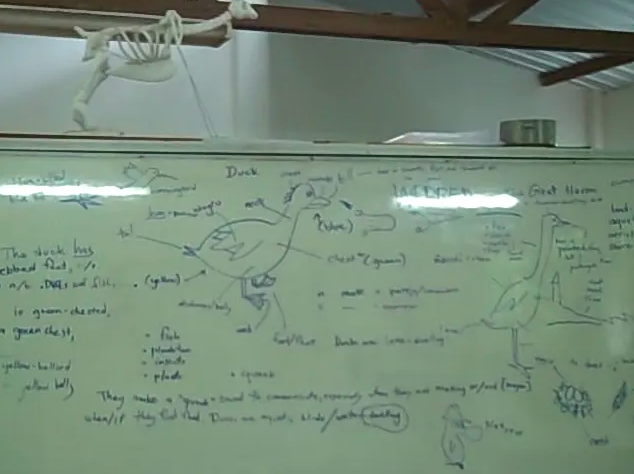
Snapshot of whiteboard on Friday afternoon

Although I have not yet posted as promised about the birds I saw in Mindo, I have to describe my week so far on Santa Cruz before I forget the details and delay the sequence of more current and relevant events too much.

I arrived at school early Monday morning to start working at the Tomás de Berlanga school (named for the man who first discovered the archipelago). I was to temporarily take the place of an English teacher who was still waiting for her visa renewal on the mainland, or “el Continente,” as Galapageños call it, and teach English to two classes.

For the upper levels of the school, classes are on a block schedule of eighty minutes periods, and my two classes were of intermediate English level 7th-9th graders and 10th-12th graders. Each group was of ten to twelve students that had all been born on one of the islands or el Continente, and some of whose parents speak English.

My goal for this first day was to spend the classes gauging the students’ English proficiency, their interest in birds, and especially their knowledge of Santa Cruz’s avifauna. One of the ways I did the former was via an exercise that one of the other English teachers, Eduardo, recommended: put a sentence on a piece of paper and cut it so each word is separated, mix them up, and give them to groups of students to put back together. I thought this was a great idea, so I took some time to think of sentences that might have several ways to be composed (both to ease the process for students but also to see if there were any trends towards certain structures).

Continue reading

Birding in Ecuador: Mindo Manakins

As I had a spare couple days on mainland Ecuador before flying to the Galápagos, I took a very brief trip to Mindo for a day and a half, where Mari Gray, a pre-kindergarten teacher at the Tomás de Berlanga school in Santa Cruz, told me I should be able to see lots of cool birds. Perhaps not too coincidentally, my host in Quito had asked me if I’d heard of Mindo just a few hours after Mari emailed me about the town, similarly informing me that the biodiversity was incredible, particularly for birding.

club

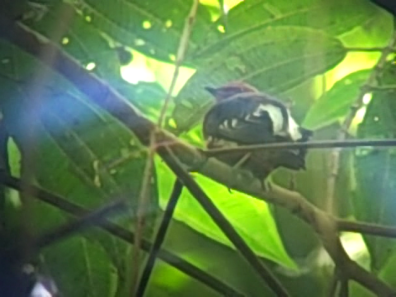
male Club-winged Manakin photographed by the author through binoculars

Even after taking a pretty intense ornithology class at Cornell University and working for the Lab of Ornithology, I don’t really consider myself a birder. When I went on a number of field trips for the class it was the first time I’d really used binoculars with the intent of just spotting birds, and I don’t even know the difference in calls of an American Robin from an Eastern Bluebird, though I can tell you their species, genus, family, and order, as well as those of 149 other common North American birds. Still, when I read that over three hundred bird species reside in the Mindo area, I knew it was an opportunity that nobody should pass up, and this was confirmed by one of my ornithology classmates who knew beforehand over half the bird families we learned. Then I read that the Club-winged Manakin, a bird I’d learned about in class, was fairly easily seen performing its lek courtship display, I knew it was an opportunity I could not pass up.

A lek, although the basic monetary unit of Albania, in this case is the Swedish-based term for a small area where males of a species communally display for females in the hopes of attracting one or more as a mate (the Manakin family, Pipridae, is polygynous, i.e. males have several female mates). Continue reading

Creating a Species List for CUBs-Galápagos

Screen Shot 2020-08-14 at 10.57.16 AMI think Puerto Ayora will be a perfect place to celebrate “(sub)urban” birds, as it is the largest urban center in an archipelago that boasts almost thirty endemic bird species—including two flightless ones (the Galápagos Penguin and the Flightless Cormorant, both seen mostly on the island of Isabella). Santa Cruz in particular hosts quite a few of the Galápagos’ fifty eight resident bird species.

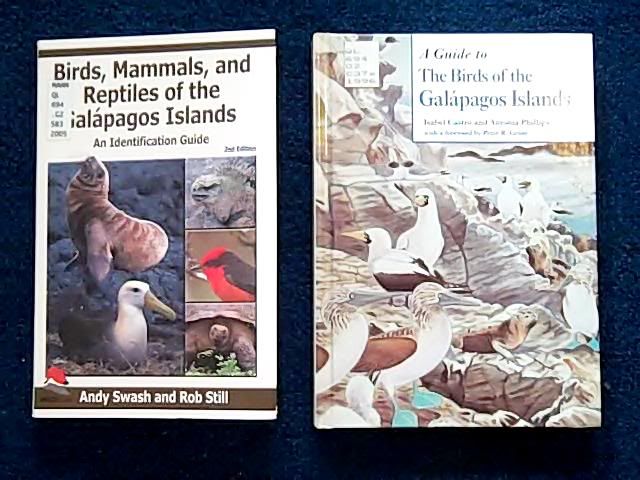
Looking through several bird guidebooks from Cornell University’s Mann Library, I have created my list of around twenty birds that should be seen on Santa Cruz and its shores. The list is biased towards land birds for now, because until I reach the island I won’t be able to determine what shorebirds are common enough migrants at this time of year.

Screen Shot 2020-08-14 at 10.58.43 AM

When creating a finalized list of birds to parallel the North American CUBs list, I’ll be trying to include species that will be frequently feasible for Santa Cruz’s youth to identify. Putting only the most common or most exciting birds in the list might lead to frustration or boredom, depending on how widely distributed certain species and the children that I have contact with are.

Once the list is finalized and I have spent more time in the Galápagos, I will also be able to write about each species in a focused, individual post, sharing where participants and I have seen the birds so far on Santa Cruz, and what unique behavior they may have exhibited around us. Continue reading

Preparing for CUBs in the Galápagos

Over the summer, I’ll be working with youth in the community of the second largest island of the Galápagos archipelago, Santa Cruz. This central island is the touristic center of the archipelago, and Puerto Ayora, its capital, is the most populated (and thus, urban) area in the islands. In particular, my goal is to engage students of the Unidad Educativa Modelo Tomás de Berlanga, a bilingual non-profit school five minutes from the center of Puerto Ayora, and create a youth-led project that focuses on habitat awareness and improvement, participatory science, and the arts, specifically through birds.

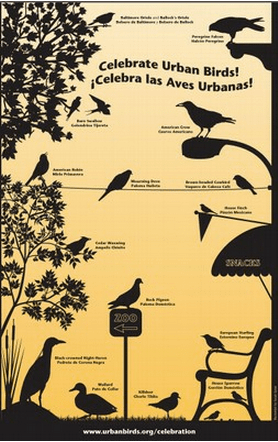
I will try to apply the framework of the Celebrate Urban Birds program to the Galápagos, using a list of around 16-20 focal species to teach those I can reach on Santa Cruz about citizen science as a tool for conservation and research while hopefully deepening an appreciation of their surroundings. I aim Continue reading

Celebrate Urban Birds

Screen Shot 2012-12-22 at 8.01.16 AMFor the past year, I have been working at the Cornell Lab of Ornithology for the project Celebrate Urban Birds. Distinct from other citizen science projects the Lab of O. is involved with, such as eBird or FeederWatch, Celebrate Urban Birds (CUBs) stays true to its name and hones in on the celebratory aspect of studying birds: artwork, festivals, education, and other activities promoting community. Of course, there is still data involved. Thousands of forms have been filed—both electronically and physically—containing information on sightings of the sixteen focal species within 10-minute observation periods. These observations, along with notes about sighting location, are the source of data for the project. Participants include the address from which they are looking for birds in the ten minutes, describe the general amount of greenery and pavement in the area (as well as the size of the area itself), and list whether they saw, did not see, or were not sure about each of the sixteen species. This information constitutes a checklist that can be compiled into a larger repository of sightings in various types of green spaces around the country; the CUBs website contains species maps according to the number of observations in the last 90 days, marking where, say, a Brown-headed Cowbird has and has not been seen.

Continue reading

Hypothetical Biology: In Conclusion

This post concludes the hypothetical discussion of my previous three posts, the first of which you can find here.

By the end of this long thought-exercise it would seem that the most feasible explanation for the barring and display is that the male turacos developed the barring to signal their quality—both to females and other males—not because the barring is expensive to produce, but because the standardized bars allow for close comparison of individuals. By relating directly with growth, bars should allow females to assess the males’ age and relative fitness; they also probably accentuate indicators such as body symmetry, foraging ability, and health. If snake and raptor predators do in fact rely on the ultraviolet pigments to hunt the male turacos, then the barring is probably not only an indicator of (or proxy for) fitness but also an honest handicap that allows males to demonstrate their higher quality (e.g. their low feather wear despite increased need for predator avoidance).

Continue reading

Hypothetical Biology: Part Three

This post continues the hypothetical situation described in my previous posts, the first of which you can find here.

What if the turaco barring and display were a different sort of quality indicator? They could be amplifiers that emphasize a trait perceived by other turacos as directly related to high fitness. For example, some birds’ feathers, such as those of the European jay, are colored in stripes that develop similarly to, or perhaps accentuate, growth bars. As the turaco’s barring correlates directly to its age, the bars must have typical widths at certain ages. These widths, along with the display, probably serve as a standard by which females can compare males, and males assess competitors. The bars are likely indicators similar to the stripes on jays and other birds—that is, they may portray the bird’s growth regularity, or accentuate flight behavior, body size, feather wear, symmetry, and other potential quality indicators. Should the turaco barring amplify any of these possible traits, then displaying the bars is not a deceptive signal, because it genuinely reflects quality. For instance, if a three-year-old male turaco has successfully avoided predators and found the best food throughout his life, his barring should reflect such facts, and portray his success through low feather wear, larger body size, or more regular bars; a one-year-old male with similar traits but different barring would presumably be less preferable to females. Continue reading

Hypothetical Biology: Part Two

This post continues the hypothetical situation described in my previous post, which you can find here. I left off claiming that the most likely explanation for the barring and display of the male turacos was sexual selection; below I try to support this hypothesis in greater detail:

We know that the male turacos limit themselves to intraspecific displays, so the pigmentation and display must be signals for other turacos. It also seems likely that some element of the barring is, or is at least perceived as, evidence of quality. Depending on how elaborate and visible the display is, it may create a handicap for male turacos. The handicap theory posits that sexually attractive traits are frequently impediments to an organism’s ability to survive, and thus that an organism’s continued survival despite such a hindrance portrays its higher quality. For example, some male birds, peacocks being an immediate example, have displays of quality reflected by an honest handicap: their conspicuous and unwieldy tail feathers. Although the turaco’s ultraviolet pigment is inexpensive to produce and invisible to mammalian predators, it may be noticeable to some reptilian predators and is probably visible to avian predators, making it possible that the turaco barring display is an honest handicap signal.

Continue reading

Hypothetical Biology

Let’s say you’ve just found out something new about a species of bird, a certain turaco that is a very dark cryptic green, in the forests of the Congo. The species hasn’t been studied much, and you’ve discovered that the male birds have a special pigmentation only visible in the ultraviolet spectrum, and this pigment is found in a barred pattern across their undersides, which they display to females and other males in their dense colonies. Based on certain test results, you can positively claim that the pigment is easy and inexpensive to produce, and you’ve also ascertained that the bars of ultravioletly-pigmented feathers are closely correlated with the bird’s growth—that is, older birds have wider bars. But apart from these few facts, you know very little about the turaco species, and your job is to wonder how and why the ultraviolet barring and its display evolved.

Continue reading

Imposing Birds

Paula Swisher, a Pennsylvania artist, creatively superimposes birds onto textbook pages through colored pencil and other media. These mixed images are great juxtapositions of wild beauty and careful order; colorful flight and monochrome data.

While visiting the state of Karnataka recently, in the Rajiv Gandhi National Park, I saw many birds (as well as countless deer, about a dozen elephants, and a couple mongooses–but these mammals are for another post). Several pieces of Swisher’s art reminded me of some of these birds:

This slideshow requires JavaScript.

Continue reading