The Sense in Sustainability

adak-fish-farm-krishnankotta-mala

Today we went to  a 68 acre fish farm in Thrissur called ‘Haya Poya’. They were using a traditional box system (the local name is petty para) to collect fish and manage the water level. We went to learn about implementing aquaculture at Kayal Villa, a newer property.

By using this traditional method, they do not have to introduce new varieties of fish in order to farm. They do this mainly because it is less costly to collect the fish naturally than to artificially introduce fish. Also, since it is all local varieties, it limits the possibility of messing up the natural ecosystem with foreign invasive species.

During our ride home, the agronomist, Mr. Deyal, and I continued the conversation about doing what’s ecologically beneficial is actually easier and more cost-efficient. He said

“Only an ecologically viable system will be economically viable. When we fight against the environment, the environment will go against us and we will have to invest more money to protect against it.”

This reminds me of a conversation I had with an oil driller recently. When I asked him what the most challenging thing about his job was, he said ‘going against nature,’ and then proceeded to tell me how rebellious nature was to the oil drilling process and how costly it is. I found it interesting that although their career choices were the antithesis of each other, the conversations I had with them had parallel messages: going against nature is costly.  Continue reading

Beach Banana Genome Project

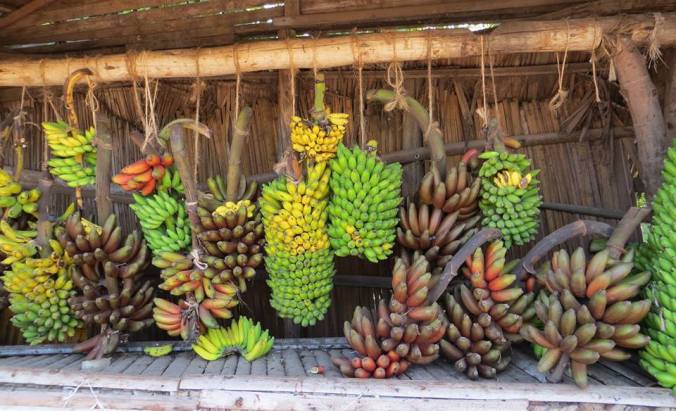
The next Xandari property that La Paz Group is developing is at Marari beach, and in my mind it could easily be called the “Beach Banana Genome Project” due to the 30 varieties of bananas being planted on site.

banana wonders

There are actually over 1000 varieties of bananas in the world, which is pretty crazy to think about since the main variety in global commerce is the Cavendish. There are red bananas, dwarf bananas, sugared-fig bananas, pregnant bananas, ice cream bananas, Popoulou bananas, the golden aromatic bananas, Macaboos, Thousand-Fingered bananas, and the list goes on. Out of the 1000+ types of bananas, grocery stores in the United States only offer one main type? Why?

That’s because our grocery stores are in a permanent global summertime, as Adam Gollner puts it in his book “The Fruit Hunters”. Because our fruits aren’t sourced locally in the United States, they must be able to endure the rigorous journey of international trade. If I hadn’t traveled to India for the summer, I would’ve probably never been offered the range of varieties I’ve gotten to taste here.

Most people in the United States won’t get exposed to a diverse range of options and therefore do not demand them. Big banana agribusiness makes is buck with monoculture. They can reliably deliver the same subpar banana. 

It’s not as reliable though in the long run because monoculture invites disease. Thats why before the Cavendish banana was the world’s top banana, there was the Gros Michel banana. It was struck by a fungus called the Panama Disease, and now a mutation of that disease is threatening the Cavendish. Biodiversity acts as a natural buffer to disease but biodiversity isn’t conducive to agrarian capitalism. Continue reading

Seed Saving as a Safeguard for Biodiversity

logo

This is a seed savers network we are looking to collaborate with on our organic farm initiatives.

The recent post here about The New Yorker article on genetically modified seeds and Vandana Shiva helped me understand more about this era we are entering of biotechnology.

Regardless of whether or not it’s healthy to consume genetically modified foods, we are at risk of losing biodiversity and heirloom varieties. In support of protecting biodiversity, having heirloom varieties of plants in the La Paz Group gardens is important. Once the plants go to seed, we can save them to plant the following season.  Continue reading

Seeds, Activism, Hope

140825_r25365_sq-320

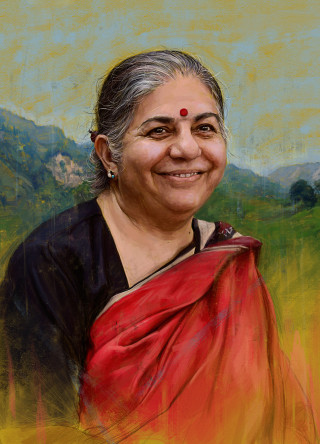
Vandana Shiva is leading the opposition to genetically modified crops. Are they a scourge or a solution to hunger

We had never heard of her before, but seeds have been on our mind lately so we immediately want to know more. So thanks to Michael Specter for his profile Against the Grain–An activist’s controversial crusade against genetically modified crops:

Early this spring, the Indian environmentalist Vandana Shiva led an unusual pilgrimage across southern Europe. Beginning in Greece, with the international Pan-Hellenic Exchange of Local Seed Varieties Festival, which celebrated the virtues of traditional agriculture, Shiva and an entourage of followers crossed the Adriatic and travelled by bus up the boot of Italy, to Florence, where she spoke at the Seed, Food and Earth Democracy Festival. After a short planning meeting in Genoa, the caravan rolled on to the South of France, ending in Le Mas d’Azil, just in time to celebrate International Days of the Seed.

Continue reading

Breakthroughs In Nutrition Via Entrepreneurial Conservation

Exo's peanut butter-and-jelly bar contains about 40 ground-up crickets and has a familiar nutty, sweet flavor. Meredith Rizzo/NPR

Exo’s peanut butter-and-jelly bar contains about 40 ground-up crickets and has a familiar nutty, sweet flavor. Meredith Rizzo/NPR

Thanks to National Public Radio (USA)’s food-focused program, The Salt, for another story on unexpected breakthroughs in nutrition:

…”Insects are probably the most sustainable form of protein we have on Earth,” Bitty Foods founder Megan Miller, who spoke passionately about eating bugs at a TEDx Manhattan event earlier this year, tells The Salt. “The only real barrier to Americans eating insects is a cultural taboo.” Continue reading

Munnar, Gem of Kerala

Photo credits : Ramesh Kidangoor

Photo credits: Ramesh Kidangoor

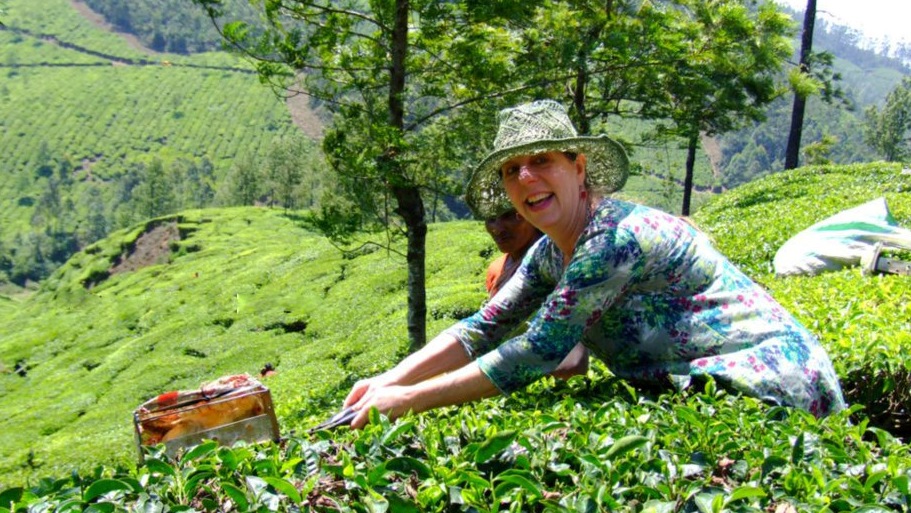
Munnar is famous for its tea plantations, rolling hills, sparkling waterfalls, and sprawling estates, a combination of features which makes it a popular tourist destination. Visitors to Munnar can not only enjoy Kerala’s natural beauty but also learn about and participate in the area’s culture and economy. As attested in these photographs, Munnar has been one of Kerala’s hotspots for tea production, with tea plantations scattered throughout the rolling mountain ranges. Continue reading

Farmageddon, Reviewed

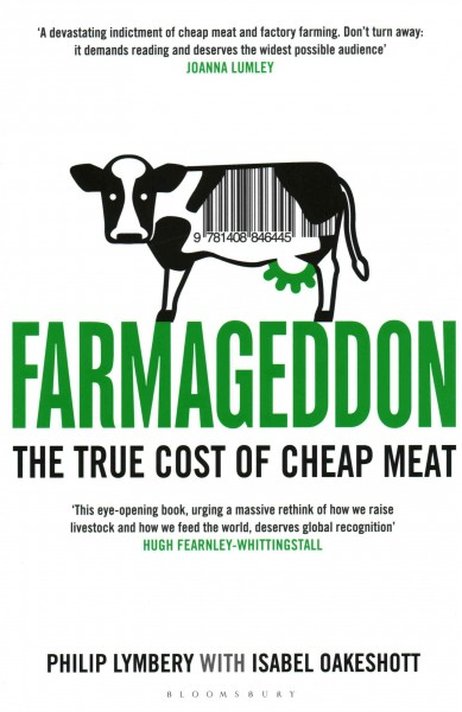
As Kayleigh continues work begun last month, bringing our attention to all the ways we can improve our food sourcing, this book review seems timely. Barbara King, the reviewer, is a noted anthropologist but even more noted author on the topic of animal emotions. We have not read the book yet, but as always with a good book review our attention is drawn to reasons why we might, or might not, make time for this one.

9781408846445_custom-edb29a20eb514ead6c26ac932f8f904d2cffa1a4-s3-c85

Thanks to National Public Radio (USA) for sharing the review:

For Philip Lymbery, head of the U.K.-based Compassion in World Farming and his co-author Isabel Oakeshott, a visit to California’s Central Valley amounted to an encounter with suffering.

In Farmageddon: The True Cost of Cheap Meat, Lymbery and Oakeshott write that the mega-dairies of the Central Valley are “milk factories where animals are just machines that rapidly break down and are replaced.” At one huge dairy they visited, cows stood idly outdoors, some in shade and some in the sun. No grass cushioned their feet and certainly none was available to eat since, like almost all factory-farm cows, the animals were maintained on an unnatural diet of crops such as corn. The stench in the air was “a nauseous reek.” Continue reading

Thank You, General Mills

cheerios

Photo Credit: Grist Article

I came across this article on Grist.com about General Mills’s new action plan to reduce their contribution to climate change. After being called out by Oxfam International,  Oxfam says that General Mills will be, “the first major food and beverage company to promise to implement long-term science-based targets to cut emissions.”

With both a mitigation and adaptation plan, I am pretty impressed by this corporations efforts to take responsibility of their role. On the official page of their website describing this policy, they cite the 2014 Intergovernmental Panel on Climate Change (IPCC) Working Group II Summary for Policy Makers, which suggests to me that they have people on their team helping them make really informed decisions grounded in scientific evidence. I appreciate in the report the full acknowledgement of the IPCC’s call to action:

“Science based evidence suggests we must limit the global mean temperature rise to less than 2 degrees Celsius above preindustrial levels in order to avoid permanently altering the atmosphere and negatively impacting the environmental, social and economic systems that sustain us – both today and in the future.”

I haven’t seen a big corporation like this that would normally be considered a “dirty business” so blatantly speak to the environmental reality we face. To see a corporation cite this gives me hope that mainstream conversations around climate change are moving towards what we can do and away from whether or not its real. I hope more corporations follow their lead just for the sake of drumming the beat of awareness.

The true colors of this policy will show in how effectively it is implemented, because that will determine whether it is a fluffy ‘greenwashing’ tactic with loopholes built in.

Here are a few of the main points of the policy:

  • Set global targets and track progress related to reductions in GHG emissions, energy, water, transportation, packaging and solid waste.
  • Support the Innovation Center for U.S. Dairy commitment to reduce fluid milk GHG emissions by 25 percent by 2020.  Work with smallholder and conventional farmers to strengthen globally sustainable farming practices.
  • Address GHG emissions due to land use change through sustainable sourcing efforts in key supply chains and growing regions.  Our aim is to achieve zero net deforestation in high-risk supply chains by 2020. We will regularly report progress towards the zero net deforestation goal.
  • Ensure responsible governance and oversight of all sustainability efforts, including climate mitigation and adaptation.  Convene the General Mills Sustainability Governance Committee 3 times per year to review and approve strategies, programs and key investments.
  • Report progress against goals – our own as well as those in our broader supply chain – on an annual basis via our Global Responsibility Report, available on the General Mills website

For a more extensive look at the report, click here.

While I raise my eyebrows at some of the vague wording in their initiatives, like “support”, “work with”, and “ensure” that are less concrete objectives, I also see timelines and checkpoints to keep themselves more accountable to this than they had to. I have learned to appreciate initiatives that move in the direction of the ideal, rather than criticizing anything that doesn’t model the most perfect action. While it is good to remain skeptical, I think it is important to acknowledge leadership in the right direction when we see it.

 

Notes from the Garden: Building a house or a vegetable cage?

photo 2

Measuring the length of our new monkey-protected area in the organic farm at Cardamom County

Building a 15 meter x 20 meter vegetable cage is no small feat. The last estimate we had was that it would cost about 4 lakhs, which is apparently the cost of a small house. A lakh is a unit in the South Asian numbering system equivalent to 100,000. So, is 400,000 rupees worth it for a vegetable cage? I think spending energy to get a smarter design would be more worth it.

With the help of Raxa Collective’s head engineer, it is very likely we will be able to lower that cost significantly. As I talked about in my post about quantifying farm-to-table, I think that with a combination of lowering the cost and then taking advantage of the monkey-protected area as vigorously as possible with efficient use of the space, it will be worth it. There are elements of farm-to-table that are not quantifiable but can be seen in the overall conservation story of supporting smart land-use practices.

At the end of the day, at least the food here is locally sourced mostly from the Cumbum vegetable market in Tamil Nadu. This market is only about 25 km away and the farmers in that market are relatively close. This is far better then the way most food is sourced in the United States.

In the United States, eating local is a challenge. Most agriculture in the states is for corn and soybeans, rather than vegetables. And “local” is difficult when the local environment has few green spaces left, let alone farmland. So even though we don’t have “monkey-challenges” to growing our food locally in the states, we have monocultures and rapid suburbanization keeping us farther and farther away from fresh food.  Continue reading

Notes from the Garden: Learning and Harvesting

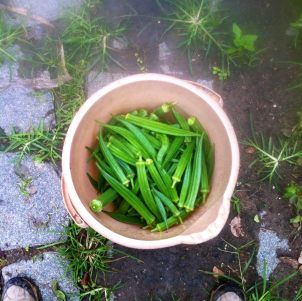
10559917_10201592002281680_8268726655977842745_nIn Cardamom County today, we harvested spinach, ladiesfinger (okra), mint, beans, and parsley. Our full wheelbarrow is heading straight to the kitchen. How many hotels have you heard of that grow a good portion of the food on site?

We have been hoping to get the monkey-proof vegetable cage approved so that we can grow the majority of our staple foods on site. Today, I will be meeting with one of the head engineers to see how we can make the design more smart: cut cost but still get the job done.

Continue reading

Add Agrivoltaics To Your Green Vocabulary

agrivoltaics

Farming food and fuel, side by side

Thanks to Conservation, and particularly Courtney White, for this synopsis:

What is the best way to utilize sunlight—to grow food or to produce fuel?

For millennia, the answer was easy: we used solar energy to grow plants that we could eat. Then, in the 1970s, the answer became more complex as fields of photovoltaic panels (PVPs) began popping up all over the planet, sometimes on former farmland. In the 1990s, farmers began growing food crops for fuels such as corn-based ethanol. The problem is that the food-fuel equation has become a zero-sum game. Continue reading

When Monkeys Lend a Hand

The monkey shepherds of Nelliampathy, photo credit: The Hindu

While we face the “monkey-challenges” at Cardamom County other forms of agriculture (or in this case, animal husbandry) have found forms of “primate collaboration”.

Thanks to The Hindu‘s K.A. Shaji for this timely story.

The term ‘monkey shepherd’ may not sound absurd here. A female monkey, aged about eight years, and her two children shepherd a flock of 150 goats on a farm at this picturesque hill station in Palakkad. Continue reading

Notes from the Garden: Monsoon Season

photo (8)

Burying the garden waste to prepare the land for planting

As it is monsoon season here in Kerala, we gardeners have to take into consideration the way it affects the soil. Today we did land preparation for the heavy rains. We dug holes in the new beds and took garden waste from old banana plants and buried it. The top of the soil had been mulched with manure and weeds were growing on them. We mixed the manure and weeds into the soil. I like the idea of just mixing the weeds in because then the nutrients that the weeds took from the soil can break down back into the soil again. When the heavy rains come, they would have washed the nutrients from the mulch away so this is to help with nutrient erosion. Continue reading

Notes from the Garden: The Gift of Cardamom

10304348_10201573979311117_9159413022094666722_n

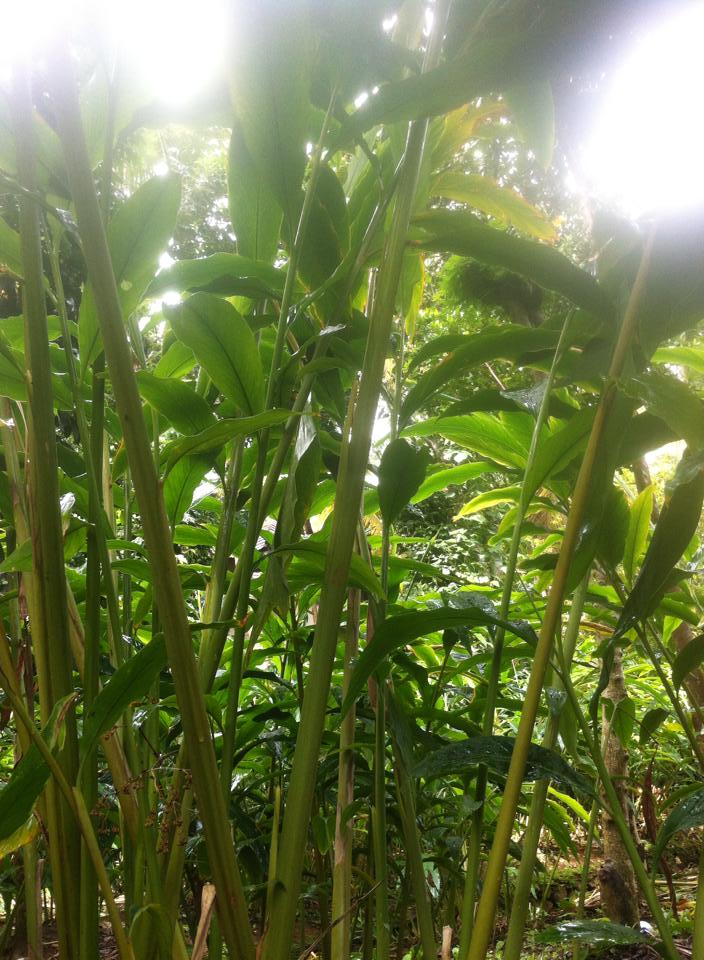
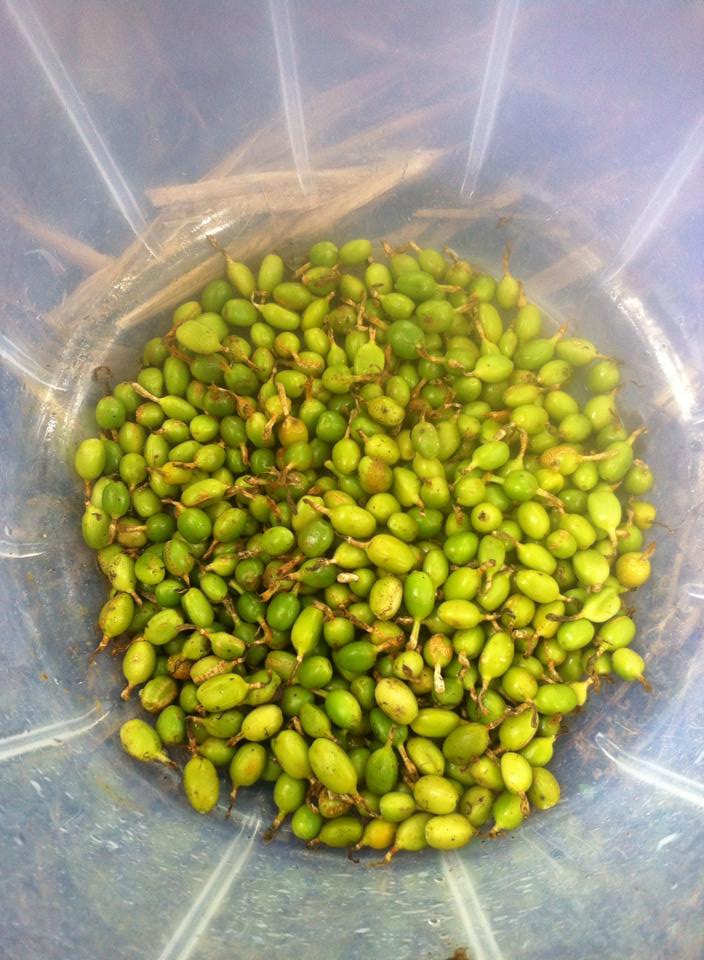
Today’s task in the garden was to harvest the ever-abundant cardamom in Cardamom County.

This is a task that cannot be completed by machines, so even in commercial fields, it must be handpicked. That is because figuring out which ones are ripe requires tuned fingers.

It was a bit of a learning curve for me at first because I thought I was supposed to be looking for which ones were the darkest, but then I learned otherwise.

I was looking for the ones that fell off easily into my hand from tugging slightly. When ripe, the small seed pods on the inside are dark colored.

10501720_10201573978111087_4542956712817123894_n

We may be most familiar with this sweet spice in masala chai tea, but it has many uses.

To do a little research, I asked the Ayurvedic doctor here if he could enlighten me on some of the traditional medicine uses of cardamom. He said that it is good for throat and lung troubles, skin problems such as acne, and digestive issues.

The type of cardamom we have here is the Malabar variety and it is native to Kerala. The green leaves are pretty tall- probably about 5 feet on average. The pods are on short vines that cluster at the bottom of the tall leaves.

When we were harvesting them, it started  Continue reading

Humanity’s Diet Makes A Difference, Historically As Well As Futuristically

On the timescale of evolutionary history, paleo enthusiasts note, agriculture is a fad. Credit Illustration by Mike Ellis.

On the timescale of evolutionary history, paleo enthusiasts note, agriculture is a fad. Credit Illustration by Mike Ellis.

Since the early days of this blog we have been hungry consumers of environmental long form journalism, of which Elizabeth Kolbert’s New Yorker chronicles are best-in-category. They are also, frankly, almost always depressing.

Nonetheless, they put humanity into its natural context. This not-at-all-depressing chronicle demonstrates the value of that contextualization well:

The first day I put my family on a Paleolithic diet, I made my kids fried eggs and sausage for breakfast. If they were still hungry, I told them, they could help themselves to more sausage, but they were not allowed to grab a slice of bread, or toast an English muffin, or pour themselves a bowl of cereal.

Continue reading

Notes from the Garden: A Harvest for Everyone

10491215_10201551076698566_8417073961388965292_n (1)

Green beans at Cardamom County

When we see an abundant harvest overflowing from a wheelbarrow, maybe it’s primal, but I think there is a sense of never going hungry. There is a sense of the aliveness of freshly picked food.

Remember how we used to share our food? Remember the connection to food we had before it came from chain grocery stores? I think something in us does. Or something in us wants to remember.

By simply putting out our hand, the food passes into our possession, but it’s a different kind of possession than picking up something in a supermarket and putting it in a cart. A possession isn’t really yours, which happened without the exchange of money. I think that the natural givingness of the land makes us feel like it is not really ours and that it is for everyone, meant to be shared. When I harvest, I remember this gift. I like sharing it with other people.


Since I have been here as an intern, I haven’t done all that much field work. This is probably the first day I’ve been able to help just by providing extra hands. I felt like it was a way to connect with the people I am working with as language barrier has stopped us. I appreciate the togetherness that can be felt by simply harvesting something together. They are teaching me Malayalam words and using the English words they know.

Continue reading

Notes from the Garden: Experimenting with Square Foot Gardening

10500557_10201531219202141_6893957344646617811_n

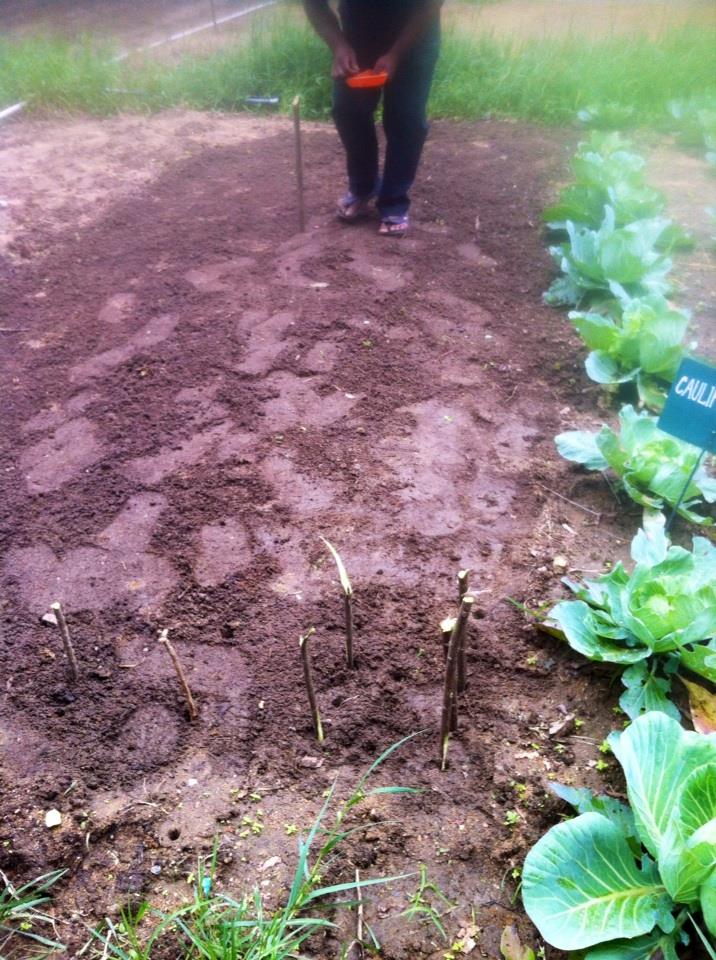
Sticks always help with communication across language barriers. Here we are marking the spacing of our radishes in Cardamom County.

Today, we tried a little experiment. I have mentioned my passion for efficient agriculture techniques and square foot gardening is one we are experimenting with in the garden here in Cardamom County. The vision is to grow as much food as we can to supplement the kitchen’s needs. Space is a luxury not to be wasted when it comes to growing food! Using elements of the square foot gardening method taught by Mel Bartholomew, it is amazing how much food you can fit on a 4 ft x 4 ft plot. Although he teaches that you should make raised beds, I think if you have good soil, as we do here, then there is no need. I think the audience his method appeals to is the urban and suburban dwellers, so making raised beds is usually the fastest way to good soil in their case. The part I take from his method is the dense plant spacing and not using single rows:

Continue reading

Xandari’s Mandala Herb Garden

If you’ve been following some of the recent posts about Xandari’s trails, flowers, and gardens in general, then you are probably aware that the resort’s property abounds with plant life that is beneficial to visitors — both human and otherwise — in some way. One element of the gardens that James and I have not emphasized as much, though James mentioned it in his post on Aloe vera and I did in an earlier post, is the mandala, a circular garden near the spa and the entrance to Xandari that holds dozens of herbs.

Continue reading

Notes from the Garden: Quantifying Farm-to-Table

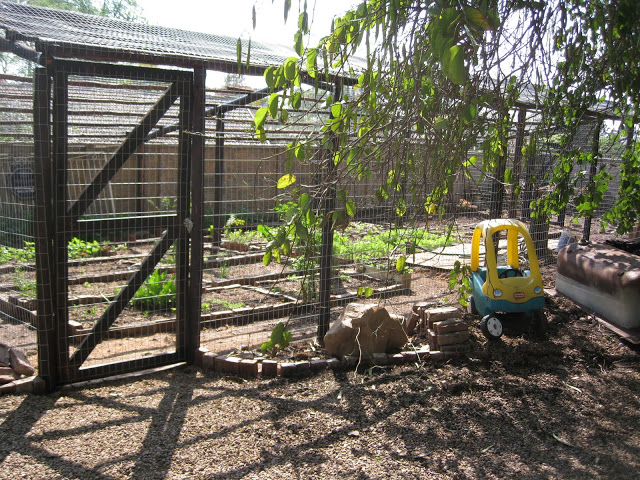
We are in process of building a monkey-proofed area of the garden. You can see my past post to get a feel for the evolution of this idea. The main issue with providing the Cardamom County restaurant with food from the on-site organic farm is monkeys. We were inspired by these subsistence farmers in Ixopo, South Africa, who blogged about building their monkey-proof vegetable cage. They, too, are neighbors with a nature reserve, so their situation is quite similar to Cardamom County! Now, we are on our way to having a truly farm-to-table menu!

Here is the cage we are modeling ours after. Check out their blog: http://foodieschannel.blogspot.com/2011/04/this-isnt-really-recipe-but-its-about.html

Here is the cage we are modeling ours after. Check out their blog: http://foodieschannel.blogspot.com/2011/04/this-isnt-really-recipe-but-its-about.html

You may be wondering, why is there all this buzz these days about farm-to-table? There is more to it than just fresh, delicious food.

Obviously, a lot of nature gets destroyed for agricultural purposes. In the United States, so much land gets wasted on sprawling, inefficient development. In the in-between spaces, you could feed a nation. But we eat up our open, natural spaces for agriculture. Our agriculture is rarely local so it leads to problems of unnecessary carbon emissions from transport and a lot of not-fresh food in grocery stores. When we can use the land we have already developed on to provide the people there with food, why spread ourselves out so thin into nature? Continue reading

Notes from the Garden: Mango Hunting

photo 4

The mango has its ancestral roots in India, so something felt really right about shaking mangoes out of the trees today in Cardamom County. Right now I’m reading this delicious book called The Fruit Hunters, written by Adam Leith Gollner. Since I have started it, I have had a whole new context to put my experience of fruit in! Turns out there are over 1,100 varieties of mangoes. The ones I know and love from supermarkets back in the United States are the Tommy Atkins mangoes, which are more common in international commerce.

photo 2Indian mangoes apparently weren’t allowed into the states for almost thirty years due to “pest concerns.” Actually, it was more like, nuclear trade concerns. India and Canada had a nuclear trade relationship in which Canadian nuclear reactors were being used to build a nuclear arsenal. In 2007 though, India signed a nuclear treaty with the United States, only under the condition that India’s mangoes be allowed back in the states. Later when President Bush flew to India to discuss the deal, he announced, “the U.S. is looking forward to eating Indian mangoes.” Continue reading