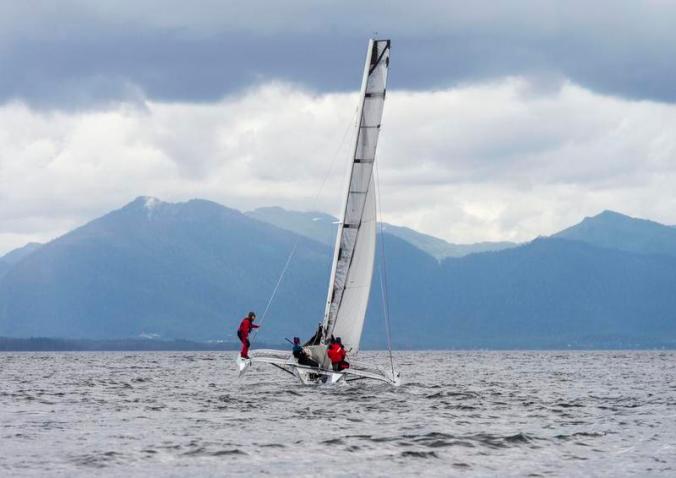
Team Elsie Piddock sails up Nichols Passage south of Ketchikan on the way to winning the Race to Alaska. TAYLOR BALKOM / KETCHIKAN DAILY NEWS
Fishermen gonna fish, sometimes pushed to do remarkable things under extreme challenge. Sailors gonna sail, sometimes pushed to do remarkable things under extreme challenge. We thank Seattle radio station KUOW for sharing the news of the conclusion of this race that has had our attention for the last week:
Ross Reynolds talks to Jake Beattie the director of the Northwest Maritime Center in Port Townsend and the organizer of the first ever Race to Alaska contest about how Team Elsie Piddock managed to defy expectations and win the race in one week and a day.
Tejas is a renovated Piaggio Ape with a 13-kilo-watt prototype engine, lithium-ion batteries and six solar panels. PHOTO: IBN
Our itinerary has been filled with travel all week. And we almost gave The New Indian Express article on the travel plans of Indian engineer Naveen Rabelli and Austrian filmmaker Raoul Kopacka a miss. That was only until we read the details: a 10,000 km journey from India to London on a self-built solar-powered tuk-tuk/autorickshaw to Britain to promote a sustainable low-cost alternative-transport solution and check air pollution in towns and cities across their journey. Talk about going the extra mile.
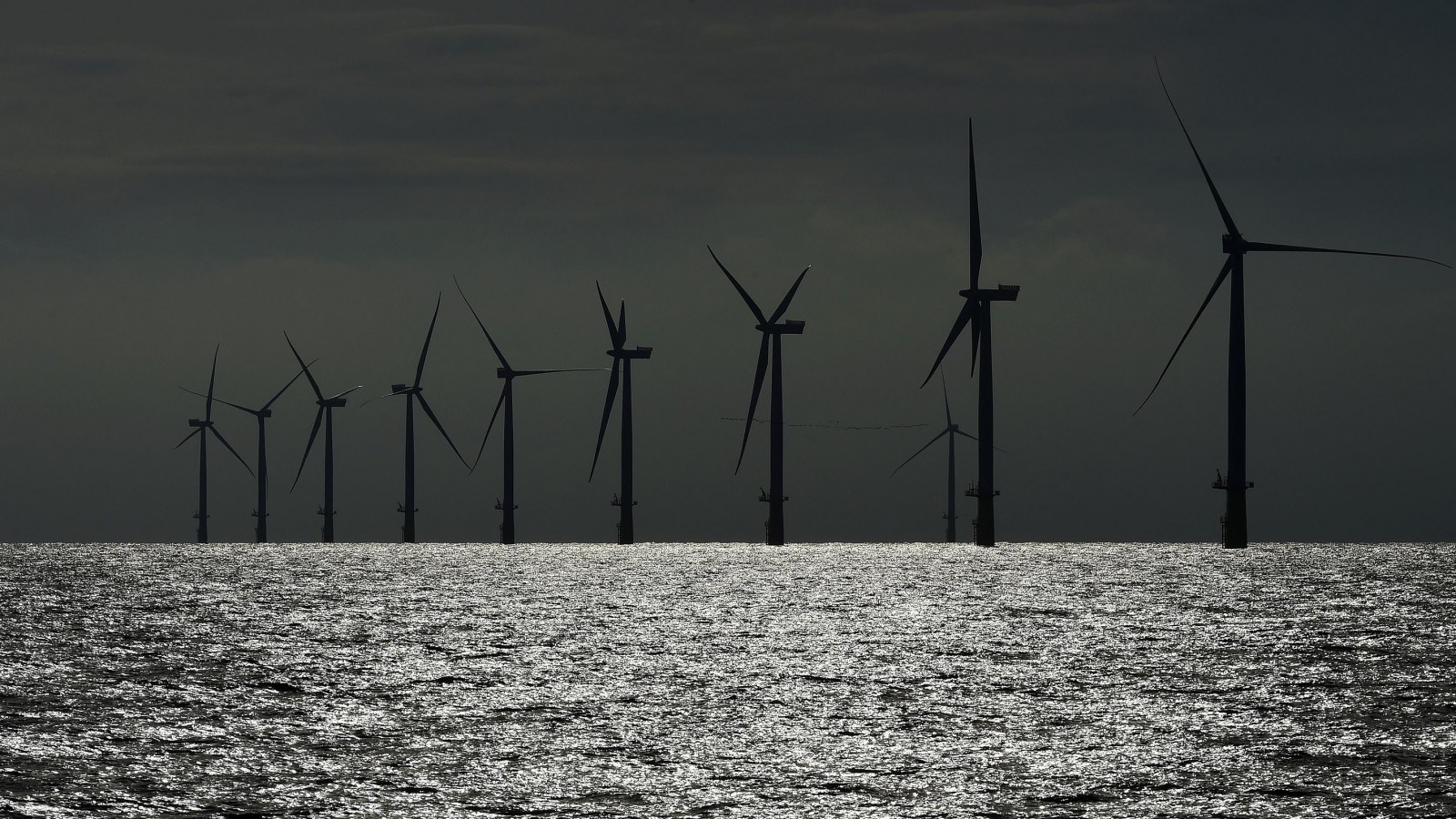
Germany is set to overtake the UK as the biggest installer of offshore wind globally. Denmark comes behind the UK by capacity, followed by Belgium and China. PHOTO: Reuters/Fabian Bimmer
We first discussed wind energy, as a viable resource to power the world’s needs, almost three years ago. Prior to that and in the time hence, Germany has done much about it. The country has chalked out a plan to replace nuclear power plants with offshore wind farms in a bid to use renewable energy round-the-clock. Importantly, the country is sticking to its plan. Above all, it is building on it.
Germany has hugely ambitious green goals. Five years ago it set a goal to produce 18% of its energy from renewables by 2020 (latest figures show it having reached 12.4%). The country also wants to reduce greenhouse gas emissions by 40% by 2020, compared with 1990 levels, and by 80% by 2050. The transformation is knows as the Energiewende—literally “energy turn.”
Ivanpah, the world’s largest concentrating solar power plant, located just southwest of Las Vegas, can produce a whopping 392 megawatts of solar energy to power 140,000 California homes with clean energy PHOTO: Inhabitat
So we’ve all learnt, at some time or the other, that black absorbs light the maximum. And that the sun is one of the best sources of clean and renewable energy. Now, put two and two together. Yes, we are definitely talking tapping the sun’s light and heat. And we need a black surface to do so. The catch: the color needs to be as black as black can get.
Team Blackfish set sail Thursday morning in what organizers called the first human-powered boat race to Alaska. Credit Evan McGlinn for The New York Times
Too much dullness and dimwittedness recently. We need a break from that. We like the optimism of Team Blackfish and their fellow sailors:
PORT TOWNSEND, Wash. — Scott Veirs and Thomas Nielsen have a little wooden plank mounted on their boat, just in front of the seat where they plan to take turns, for days on end, pedaling a bike-chain-driven propeller shaft all the way to Alaska.
“If in doubt,” the sign reads, “try some optimism.”
That could be the motto for the entire field of competitors in what is billed as the first race of its kind — human powered to Alaska — which set off Thursday morning from this city on the shores of Puget Sound, heading north across open water. The 54 entrants in the Race to Alaska— solo efforts and teams, novices and old-salt veterans — were fueled by a mix of determination, ingenuity and upward of 6,000 calories a day, but no motors. Continue reading →
We try to stay away from stereotypes, cliche, cute kitten videos and memes. But the editorial below will leave you with heightened awareness of just how low mining companies can go, literally, figuratively and spiritually to get what they want. Rio Tinto is a cliche, a nightmare about killing the earth and any cultural artifacts that get in the way of its profits. Let’s awake from this nightmare. Come on, Arizona, be better than this:
Selling Off Apache Holy Land
Lydia Millet
ABOUT an hour east of Phoenix, near a mining town called Superior, men, women and children of the San Carlos Apache tribe have been camped out at a place called Oak Flat for more than three months, protesting the latest assault on their culture. Continue reading →
With Swedes recycling almost half (47 percent) of their waste and using 52 percent to generate heat, less than 1 percent of garbage now ends up in the dump PHOTO: Shutterstock
Now, to ask someone to take your garbage will be met with censure in any part of the world, but not in Sweden. Since the country’s waste incineration program began in the 1940s, 950,000 homes are heated by trash; this lowly resource also provides electricity for 260,000 homes across the country, according to statistics. But there’s a problem: there is simply not enough trash.
Americans, in general, are bad at recycling. In 2010, U.S. residents recycled 34% of their waste—an embarrassing amount compared to European countries like the Netherlands, Germany, and Austria, where people recycle almost all of their waste. In Sweden, people are so diligent about recycling that just 4% of all trash ends up in landfills, It’s a heartening statistic, but it has led to a problem for the country—there’s not enough garbage to power the country’s large waste-to-energy program. Sweden’s solution: import trash. More.
A general view of the inside of M. Chinnaswamy Stadium. PHOTO: DIBYANGSHU SARKAR/AFP/Getty Images)
Well, nothing unites all of India like a good game of cricket. And when the legendary game takes a green turn for the better at one of the country’s premier cricketing grounds, it makes news. The heart of the matter: The M Chinnaswamy Stadium at Bengaluru is the only solar-powered cricketing ground in the entire world. Continue reading →
The egg-shaped Ecocapsule is designed by Bratislava-based Nice Architects
A wind turbine and solar cells power the Ecocapsule
Highly portable, the micro-shelter can supposedly fit two adults. PHOTOS: Ecocapsule.sk
Life off the grid? An actuality realized by just a few and romanticized by the rest. But if things go as per plan, Bratislava-based Nice Architects and their seven-year project Ecocapsule will make this possible by the end of 2015. Imagine having to pay no utility bills, being able to set up your own egg-shaped home in any corner of the planet, and being super sustainable through a life powered by the wind and the sun! Yes, let’s go get that dream!
Environmental Activism has never taken a back seat in Seattle and we continue to root for the individuals, organizations and public officials who are working to draw global attention to a possible environmental disaster. Certainly not the moment to “Keep Calm & Carry On”…
Hundreds of kayakers in Seattle were preparing to go and “shake their paddles” in protest at a newly arrived 400ft long, 355ft tall Royal Dutch Shell oil rig on Saturday, with hundreds – perhaps thousands – more scheduled to attend on dry land.
“We here in Seattle do not want Shell in our port. We want them to get out and change their business before they change our planet and destroy the life of future generations,” said Annette Klapstein, a 62-year-old retired attorney and member of activist group the Raging Grannies.
On Monday, the Obama administration effectively gave Shell the green light to restart its Arctic drilling and exploration operations with an approval issued by the Bureau of Ocean Energy Management, a governmental regulatory agency.
Shell was forced to halt its Arctic exploration in 2012 amid a series of severe security mishaps.
Environmental groups and scientists reacted to Monday’s news badly, warning that letting Shell back into the Arctic for exploration and drilling was very likely to cause an ecological disaster and contribute to climate change. Continue reading →
Thanks to EcoWatch for this article that, in a place like India where bicycles are a mode of common transport, and mobile phones are ubiquitous, is pointing us to a practical green innovation:
Who needs a power outlet when you have a bike? The Ride-A-Long charges your electronics as you pedal, providing a portable renewable energy source for bike-enthusiasts.
Biking is already pretty environmentally friendly, but this takes it to the next level.
Created by Siva Cycle, the product can juice up any USB-powered device such as smartphones and cameras whenever and wherever you’re biking. Simply mount the Ride-Along to any standard bicycle’s back wheel, and as you ride, the wheel delivers juice to the integrated generator and charges its 1650 mAh battery, kind of like a hand-cranked radio. Continue reading →
But UK’s second biggest university by endowment says it will not bow to campaigners’ demands for full divestment from fossil fuels
The University of Oxford has ruled out future investments in coal and tar sands from its multi-billion pound endowment, but said it would not divest from all fossil fuels as demanded by thousands of students, academics and alumni.
Campaigners welcomed the move as a victory for the fast-growing fossil fuel divestment campaign, as it was the first time the university had made clear its position on the issue.
“Many world leaders have studied under Oxford University’s spires,” said Andrew Taylor, at campaign group People & Planet. “They should be taking notes today. The lesson is: it’s time to phase out coal and axe tar sands.” Continue reading →
More than 150,000 bicyclists have used the road in the last six months in the Netherlands, where many people commute by bike. Photo credit: SolaRoad
When we first linked out to this story some months ago, it did not get the number of clicks and reads as we expected. So now that we read a bit more about the results since November, all we can do is recommend that you pay attention:
SolaRoad, the world’s first “solar road,” has only been in operation since November, but it’s already generating more power than expected. SolaRoad is a bike path in Krommenie, a village northwest of Amsterdam in the Netherlands, that also functions as a massive solar array. The project was developed by TNO, the Province of Noord-Holland, Ooms Civiel and Imtech. Continue reading →
Drought solution? A invention from MIT and Jain Irrigation Systems can turn salt water into clean drinking water using solar energy. Photo credit: Shutterstock
This solar-powered machine is able to pull salt out of water and further disinfect the water with ultraviolet rays, making it suitable for irrigation and drinking. As the MIT News Office explained, “Electrodialysis works by passing a stream of water between two electrodes with opposite charges. Because the salt dissolved in water consists of positive and negative ions, the electrodes pull the ions out of the water, leaving fresher water at the center of the flow. A series of membranes separate the freshwater stream from increasingly salty ones.”
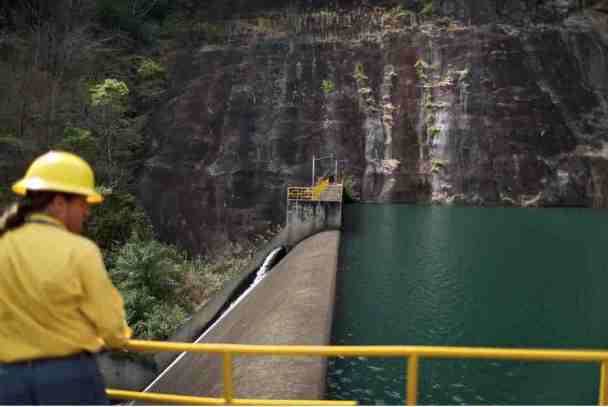
A dam in Guanacaste Province, Costa Rica, drives a hydroelectric plant. Developing nations will require large amounts of new energy to achieve American and European living standards. Credit Joe Raedle/Getty Images
We are in the sustainable development camp through and through, but Mr. Porter’s point is well taken:
Then there is the fridge in your kitchen. A typical 20-cubic-foot refrigerator — Energy Star-certified, to fit our environmentally conscious times — runs through 300 to 600 kilowatt-hours a year.
Kris Snibbe/Harvard Staff Photographer. With Charlie Rose as moderator, a panel of experts in science, politics, business, economics, and history shared their views during Monday’s Presidential Panel on Climate Change at Sanders Theatre. “The challenge of climate change is profound. The risks it poses are dire. Confronting those dangers is among the paramount tasks of our time,” said President Drew Faust in introducing the discussion.
Thanks to the Harvard Gazette, and the panelists who took the stage last week for another in ongoing series of assessments of the urgency of need for action on climate change:
There is hope in global action to fight climate change, in the slow adoption of wind and solar power, in moves by the U.S. government to cut emissions from vehicles and power plants, in the lead taken by some businesses to clean up operations and draw attention to the problem.
But it’s too late to avoid several more degrees of warming by the turn of the next century, too late to completely stave off dramatic melting, and too late to avoid the slow swamping of Pacific island nations, whose thousands of years of history and culture seem certain to be swallowed by rising seas. Continue reading →
Glenn Hurowitz sat down for his Thanksgiving meal discouraged. He’d spent 2013 flying halfway around the world to cultivate a fragile relationship with Kuok Khoon Hong, CEO of the world’s largest palm oil corporation, Wilmar. Kuok was the linchpin, Hurowitz believed — a single person who might turn the entire palm oil industry around. Wilmar buys palm oil from 80 percent of the world’s suppliers. If Kuok committed to buying only from farmers who promised not to cut down the rainforest, it would set off a chain reaction that might save hundreds of species from extinction and squelch one of the world’s biggest sources of carbon emissions. But after months of progress, the signals he’d been getting from Kuok were not encouraging. Continue reading →
It’s official, our blog-crush on this particular conservation-focused entrepreneur. We have not yet heard (click above for a podcast in which “Neil deGrasse Tyson explores the future of humanity with one of the men forging that future: billionaire entrepreneur Elon Musk, CEO of SpaceX and Tesla Motors. Co-hosted by Chuck Nice and guest starring Bill Nye.”) or yet read (continue below to Motherboard‘s interview) anything to make us question that he is the real deal; a living, breathing visionary achiever of heroic proportions:
Elon Musk, founder of Tesla and SpaceX, and chairman of SolarCity, and the guy who dreamt up the hyper loop, says we shouldn’t need an environmentally motivated reason to transition to clean energy. We’re probably going to run out of oil sometime; why find out if we can destroy the world while we do it, if an alternative exists?
“If we don’t find a solution to burning oil for transport, when we then run out of oil, the economy will collapse and society will come to an end,” Musk said this week during a conversation with astrophysicist and Cosmos host Neil deGrasse Tyson. Continue reading →
A Cargill-run palm plantation in Borneo in 2009. Image: David Gilbert/RAN
Every now and then we of non-technical education read an article written by and for a technical audience, and kind of get it, and feel the stretch is worth the effort. Raxa Collective works in locations where palm oil is grown, and recently has scouted locations in Borneo that make this article both eye-opening and eye-popping:
WRITTEN BY ALEX SCOTT FOR CHEMICAL & ENGINEERING NEWS
Palm oil is a wonderfully versatile and cheap raw material. On its own or via chemical derivatives, the oil makes its way into many packaged foods and into household products ranging from fine cosmetics to heavy-duty detergents.
Some 63 million metric tons of palm oil is harvested annually from tropical plantations, 87 percent of it coming from Malaysia and Indonesia. Palm oil is derived from the flesh and kernel of the fruit of oil palms. Demand for the oil is set to exceed 70 million metric tons by the middle of the next decade.
But palm oil’s large-scale use has environmental costs. In Southeast Asia, it is the leading driver of deforestation. Indonesia has the third-largest area of contiguous tropical forest in the world, but according to a 2007 United Nations Environment Programme report, 98 percent of the country’s natural rainforest will be destroyed by 2022 unless strict conservation measures are implemented. Continue reading →
Students have been rallying for change since the time of Plato with varying degrees of effectiveness. In fact, the act of questioning authority through dialogue is part and parcel to the educational process. It’s heartening when the voices of resistance from multiple communities join forces to activate change.
Congratulations to the students of Syracuse University for rallying SU to remove endowments to direct investments in coal, gas and oil companies.
Syracuse is the biggest university in the world to have committed to remove its endowment from direct investments in coal, oil and gas companies. It aims to make additional investments in clean energy technologies such as solar, biofuels and advanced recycling.
In a statement, the university said it will “not directly invest in publicly traded companies whose primary business is extraction of fossil fuels and will direct its external investment managers to take every step possible to prohibit investments in these public companies as well”. Continue reading →

















 Organikos