Turkeytails & Time

Trametes versicolor is a fascinating mushroom on many fronts – as a specialized organism within an ecosystem, as a beautifully variable natural art piece, and as  valuable medicine.  Fungi are an untapped resource in many scientific fields, and are vastly underappreciated as an entire natural kingdom. Food, medicine and art can all be created from but a single species alone, and the Kingdom of Fungi is one inhabited by thousands upon thousands of unique species, each of which has its own human uses and limitations.


_MG_7806

Human uses and limitations. Mushroom hunters (including myself) often inadvertently train themselves to ignore categories of fungi that don’t hold any immediate interest. Small, white polypores, for example, tend to be tough as bark, tasteless, or crumbly, so one simply doesn’t pick them. Little brown gilled mushrooms, on the other hand, are soggy and crumbly, and could be any of a million species. One usually does not pick these. However, human knowledge of fungi over the ages has waxed and waned – several ancient traditional medicines have made use of fungi with huge medicinal potential, but which modern scientists are unable to understand. That said, human industry has improved the lot of frustrated medical researchers by refining the process of mushroom cultivation to the point that almost any species is accessible for study.
 

Continue reading

Zombie Architecture & Rainforest Creatures

In the New York Times, the great science-explaining journalist Carl Zimmer writes about a mystery most of us would never otherwise encounter:

In the rain forests of Costa Rica lives Anelosimus octaviusa species of spider that sometimes displays a strange and ghoulish habit.

From time to time these spiders abandon their own web and build a radically different one, a home not for the spider but for a parasitic wasp that has been living inside it. Then the spider dies — a zombie architect, its brain hijacked by its parasitic invader — and out of its body crawls the wasp’s larva, which has been growing inside it all this time. Continue reading

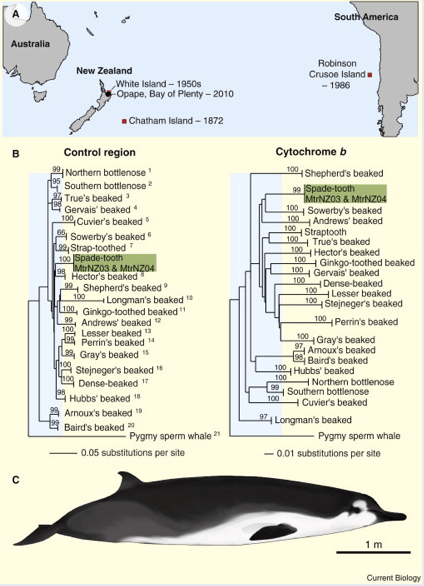
Rarest Whale, Never Seen Live, Leaves Clues Worthy Of Arthur Conan Doyle

Click the image to the left for a high resolution version of the same illustration from this month’s issue of Current Biology.  The full text version of the article (academic, but accessible for the motivated) can be found here, and its summary here:

The vast expanses of the South Pacific Ocean have, until recently, concealed the identity of the world’s rarest whale, the spade-toothed beaked whale (Mesoplodon traversii). Based on the scarcity of records and the total absence of previous sightings Continue reading

Here Comes A Great One

David Attenborough photographed at home in Richmond. Photograph: Suki Dhanda

We are reminded that David Attenborough will be sharing another round of greatness in the coming weeks (click the image to the left for the story):

Other stars to receive homage in 60 Years in the Wild include Jane Goodall and Dian Fossey for their ape-observation work, Francis Crick and Jim Watson Continue reading

Young Explorers

I recently discovered that National Geographic offers grants to researchers, conservationists, and explorers between 18 and 25 years old to pursue projects around the world in archaeology, filmmaking, biology, adventure, and exploration, to name a few fields. These Young Explorers Grants, which generally range between $2000 and $5000, can often be a perfect catalyst for more or future funding for people trying to fulfill a lifelong research dream or experiment with a concrete fieldwork idea — after all, having National Geographic’s name on your list of supporters is pretty impressive, and a sign of great potential!

This morning, I attended a workshop given by several members of the National Geographic team hosted by Cornell University and sponsored by the Lab of Ornithology, The North Face, and other groups, which gave an overview of NatGeo’s mission as well as quite specific examples of research possibilities from past and current Young Explorer Grantees. Continue reading

What Makes the Baya Weaver’s Nest a Baya Weaver’s Nest?

“Pick a nest.”

It was the first day of my architectural design studio class and we were told to pick a nest, any nest. I knew this was going to be a great semester: the first assignment was seemingly random, kooky, and just a little ‘out there.’ I was excited! As an architecture student, I love when things are approached in such a non-traditional way.

I know what you must be thinking: aren’t architects supposed to be designing buildings for people? Why are you looking at bird nests?!

I, too, was confused, but I didn’t question it because I had a really cool nest in mind. Because I spent the summer in India with bird-lover and birder extraordinaire, Ben Barkley, the Baya Weaver Bird, who builds its iconic hanging nests around the backwaters of Kerala, was an obvious choice.

Here are my “comprehensive drawings” of the Baya Weaver Bird that attempt to explain the complex relationships the bird maintains with its surroundings.

2nd Draft of Baya Weaver Nest Comprehensive Drawing (By Karen Chi-Chi Lin)

My 2nd draft of Baya Weaver nest comprehensive drawing (Photograph and drawing by Karen Chi-Chi Lin)

Continue reading

Animals We Know, Way Back When

Click the banner for the podcast:
Mammoths and saber-toothed cats may be the most famous beasts of the Ice Age. But they shared the prairie with horses and camels, too—both of which evolved in North America and crossed the ice bridge into Eurasia, before disappearing here. Matthew Kohn (Distinguished Professor, Department of Geosciences Boise State University Boise, Idaho) and Christopher Hill (Associate Dean, Graduate College Associate Professor, Anthropology Boise State University Boise, Idaho) talk about the lesser-known fauna of the Ice Age.

Evolutionary Biology Unhinged

From last week’s New Yorker, a book review about the challenge to the dominant strain of science related to how mental traits evolved, saying it makes no practical difference.  This is the stuff science is made of, starting with stories:

When Rudyard Kipling first published his fables about how the camel got his hump and the rhinoceros his wrinkly folds of skin, he explained that they would lull his daughter to sleep only if they were always told “just so,” with no new variations. The “Just So Stories” have become a byword for seductively simple myths, though one of Kipling’s turns out to be half true. Continue reading

Creating a Species List for CUBs-Galápagos

Screen Shot 2020-08-14 at 10.57.16 AMI think Puerto Ayora will be a perfect place to celebrate “(sub)urban” birds, as it is the largest urban center in an archipelago that boasts almost thirty endemic bird species—including two flightless ones (the Galápagos Penguin and the Flightless Cormorant, both seen mostly on the island of Isabella). Santa Cruz in particular hosts quite a few of the Galápagos’ fifty eight resident bird species.

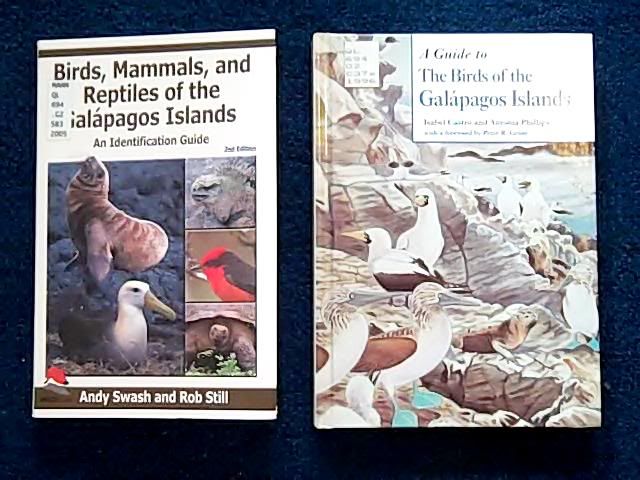
Looking through several bird guidebooks from Cornell University’s Mann Library, I have created my list of around twenty birds that should be seen on Santa Cruz and its shores. The list is biased towards land birds for now, because until I reach the island I won’t be able to determine what shorebirds are common enough migrants at this time of year.

Screen Shot 2020-08-14 at 10.58.43 AM

When creating a finalized list of birds to parallel the North American CUBs list, I’ll be trying to include species that will be frequently feasible for Santa Cruz’s youth to identify. Putting only the most common or most exciting birds in the list might lead to frustration or boredom, depending on how widely distributed certain species and the children that I have contact with are.

Once the list is finalized and I have spent more time in the Galápagos, I will also be able to write about each species in a focused, individual post, sharing where participants and I have seen the birds so far on Santa Cruz, and what unique behavior they may have exhibited around us. Continue reading

Celebrate Urban Birds

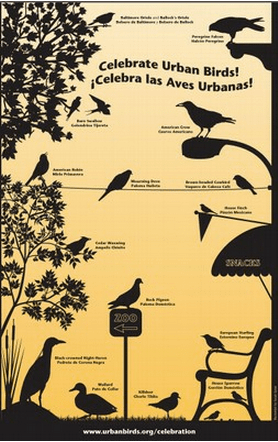
Screen Shot 2012-12-22 at 8.01.16 AMFor the past year, I have been working at the Cornell Lab of Ornithology for the project Celebrate Urban Birds. Distinct from other citizen science projects the Lab of O. is involved with, such as eBird or FeederWatch, Celebrate Urban Birds (CUBs) stays true to its name and hones in on the celebratory aspect of studying birds: artwork, festivals, education, and other activities promoting community. Of course, there is still data involved. Thousands of forms have been filed—both electronically and physically—containing information on sightings of the sixteen focal species within 10-minute observation periods. These observations, along with notes about sighting location, are the source of data for the project. Participants include the address from which they are looking for birds in the ten minutes, describe the general amount of greenery and pavement in the area (as well as the size of the area itself), and list whether they saw, did not see, or were not sure about each of the sixteen species. This information constitutes a checklist that can be compiled into a larger repository of sightings in various types of green spaces around the country; the CUBs website contains species maps according to the number of observations in the last 90 days, marking where, say, a Brown-headed Cowbird has and has not been seen.

Continue reading

Zimmer Jive

The ever clever science writer, Carl Zimmer, has an item in the new issue of National Geographic, accompanied by a lovely short video illustration, which you can see by clicking the image above (also see a sample of the opening below):

The Common Hand

Humans, of course, have them. So do bats, cats, dolphins, elephants, and frogs. Our artwork takes you inside these useful appendages.

By Carl Zimmer

Illustration by Bryan Christie Continue reading

Feelings on Ficus

Ficus. The word brings to mind many things – the juicy sweetness of a ripe, freshly picked fig; the summer heat of any tropical or Mediterranean setting; fertility. But recently, Ficus means one thing to me: strangler figs. This may sound morbid, and in a branchy way, it is. Many species of ficus begin their lives epiphytically –  generally after a seed is dropped by a bird or arboreal mammal onto the upper branches of what will become a host tree. Over time, the seeds will germinate and sprout aerial roots, which make their way to the ground by either hanging freely or by crawling down the host tree’s trunk. It is not at all uncommon in Indian forests to see roots hanging from the canopy.

Continue reading

Drifters

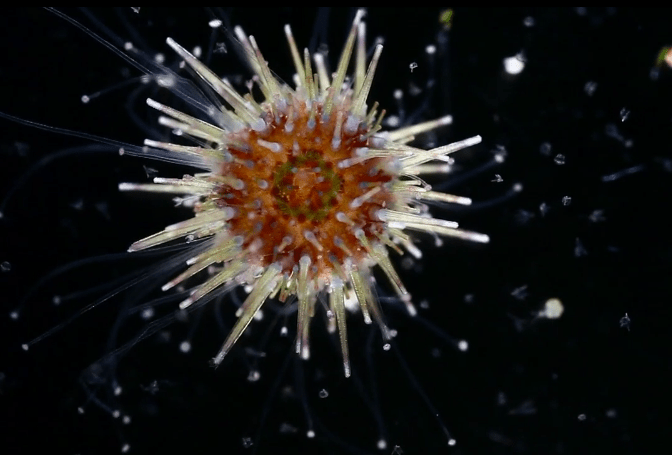
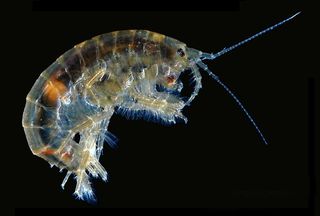
Despite its “Science Fiction Trilogy” sounding name, The Plankton Chronicles is a series of short, compelling educational videos made in conjunction with Tara Oceans Expeditions (a scientific expedition to “sail the seven seas” collecting plankton samples to understand and hopefully mitigate the effects of climate change) and the Observatoire Oceanologique de Villefranche-sur-Mer.

Viewed as a set, they invite the viewer into the kaleidoscopic world that exists in a teaspoon of seawater as well as the open oceans.  Click on the image for a macro lens glimpse. Continue reading

Why Is Mimicry Funny?

In Latin it’s called Thaumoctopus mimicus, but I’d call it The Master. It’s Meryl Streep in octopus form. There are ocean animals that can change shape, imitate plants, rocks, flora, and I’ve blogged about some of them. But this octopus is special. It seems to study other creatures and then imitate them, copying their moves and their bodies. It can do sea snakes, lion fish, flatfish, giant crabs, seashells, stingrays, jellyfish and weird beings that have no name, and maybe no earthly existence. Is it imagining? I don’t know, but no scientist has ever seen a shaggy sprinting bipedal crab — until our octopus decided to be one.

Click the banner above to go to the remainder of Robert Krulwich’s blog post on this wonder.  A bit more on the same after the jump (click the image to go to the original)… Continue reading

Hypothetical Biology: In Conclusion

This post concludes the hypothetical discussion of my previous three posts, the first of which you can find here.

By the end of this long thought-exercise it would seem that the most feasible explanation for the barring and display is that the male turacos developed the barring to signal their quality—both to females and other males—not because the barring is expensive to produce, but because the standardized bars allow for close comparison of individuals. By relating directly with growth, bars should allow females to assess the males’ age and relative fitness; they also probably accentuate indicators such as body symmetry, foraging ability, and health. If snake and raptor predators do in fact rely on the ultraviolet pigments to hunt the male turacos, then the barring is probably not only an indicator of (or proxy for) fitness but also an honest handicap that allows males to demonstrate their higher quality (e.g. their low feather wear despite increased need for predator avoidance).

Continue reading

If You Happen To Be In New York April 10

Seth’s third installment is well timed to coincide with an upcoming event covering similar issues (albeit one is an undergraduate’s ornithology student perspective and the other a Harvard superstar entomology professor’s perspective).  Click the image to the left to go to the New York Public Library’s invitation to visit with one of our favorite scientists.  Click here to read more about his upcoming book (and view the three short videos at the bottom of the front page when you click through).  The promo for the event at NYPL says: Continue reading

Hypothetical Biology: Part Three

This post continues the hypothetical situation described in my previous posts, the first of which you can find here.

What if the turaco barring and display were a different sort of quality indicator? They could be amplifiers that emphasize a trait perceived by other turacos as directly related to high fitness. For example, some birds’ feathers, such as those of the European jay, are colored in stripes that develop similarly to, or perhaps accentuate, growth bars. As the turaco’s barring correlates directly to its age, the bars must have typical widths at certain ages. These widths, along with the display, probably serve as a standard by which females can compare males, and males assess competitors. The bars are likely indicators similar to the stripes on jays and other birds—that is, they may portray the bird’s growth regularity, or accentuate flight behavior, body size, feather wear, symmetry, and other potential quality indicators. Should the turaco barring amplify any of these possible traits, then displaying the bars is not a deceptive signal, because it genuinely reflects quality. For instance, if a three-year-old male turaco has successfully avoided predators and found the best food throughout his life, his barring should reflect such facts, and portray his success through low feather wear, larger body size, or more regular bars; a one-year-old male with similar traits but different barring would presumably be less preferable to females. Continue reading

If You Happen To Be In New York City

In New York, of all places, you can see and learn about one of our favorite phenomena.  If we have not written about it yet, we will post on this topic from the perspective of some of our own contributors who have seen this in southern Chile, and as recently as last summer Seth took photos while at Morgan’s Rock in Nicaragua.  Here is what the New York Times has to say about the exhibition at the Museum of Natural History in New York:

A thoroughly engrossing exhibition at the American Museum of Natural History that opens on Saturday — “Creatures of Light: Nature’s Bioluminescence” — teaches us quite a bit about the phenomenon. Yet it still manages to preserve that otherworldly mystery, even cherishing it — treating it as if it were one of those ecologically vulnerable bioluminescent bays of glowing plankton in the Caribbean by whose shimmer visitors could once read in the middle of the night. Continue reading

Hypothetical Biology: Part Two

This post continues the hypothetical situation described in my previous post, which you can find here. I left off claiming that the most likely explanation for the barring and display of the male turacos was sexual selection; below I try to support this hypothesis in greater detail:

We know that the male turacos limit themselves to intraspecific displays, so the pigmentation and display must be signals for other turacos. It also seems likely that some element of the barring is, or is at least perceived as, evidence of quality. Depending on how elaborate and visible the display is, it may create a handicap for male turacos. The handicap theory posits that sexually attractive traits are frequently impediments to an organism’s ability to survive, and thus that an organism’s continued survival despite such a hindrance portrays its higher quality. For example, some male birds, peacocks being an immediate example, have displays of quality reflected by an honest handicap: their conspicuous and unwieldy tail feathers. Although the turaco’s ultraviolet pigment is inexpensive to produce and invisible to mammalian predators, it may be noticeable to some reptilian predators and is probably visible to avian predators, making it possible that the turaco barring display is an honest handicap signal.

Continue reading

Hypothetical Biology

Let’s say you’ve just found out something new about a species of bird, a certain turaco that is a very dark cryptic green, in the forests of the Congo. The species hasn’t been studied much, and you’ve discovered that the male birds have a special pigmentation only visible in the ultraviolet spectrum, and this pigment is found in a barred pattern across their undersides, which they display to females and other males in their dense colonies. Based on certain test results, you can positively claim that the pigment is easy and inexpensive to produce, and you’ve also ascertained that the bars of ultravioletly-pigmented feathers are closely correlated with the bird’s growth—that is, older birds have wider bars. But apart from these few facts, you know very little about the turaco species, and your job is to wonder how and why the ultraviolet barring and its display evolved.

Continue reading