One of the many reasons we highlight the Cornell Lab of Ornithology on the pages of this site is the vastness of their offerings to both students and the general community (actual and virtual) sharing current studies in the field of ornithology. Continue reading
Birds
UK Birders Unite
Voting for a National Bird seems like the perfect example of a ornithologically related Citizen Science activity.
Two amazing things happened in the mid 60′s. The Robin was voted Britain’s national bird and…
The surprising thing is neither has happened since.
Well, all that is about to change. David Lindo (AKA The Urban Birder) feels the Robin’s many decades in power needs to be challenged, so he is fronting a campaign to help find Britain’s new national bird. Running alongside this year’s General Election will be this alternative Election, which we’d love you to take part in. Continue reading
A Book Our For Our Collective Sympathies

Haunted by her father’s death, Helen Macdonald kept company with a bird of prey. CREDIT PHOTOGRAPH BY CHRISTINA MCLEISH / COURTESY GROVE ATLANTIC
Birds represent something important in our work, and it is not always clear exactly how and why, so every day we try to elaborate it for ourselves as much as for anyone.
If you did not take the moment to watch the video posted yesterday, or read the post from our boys in the Blue Mountains of Jamaica, no matter. Today those are complemented by a book review, of all things, that captures the essence of why we find birds so compelling, and helps us understand why their world has come to play such a vital role in this blog:
…Among those who know their birds of prey, the reputation of the goshawk is half Hamlet, half Lady Macbeth: mad, murderous, unpredictable, the kind of creature whose partners and intimates should brace themselves for trouble. “Spooky, pale-eyed psychopaths,”
Ornithology + Engineering = Bird Geek Bliss
There are natural wonders that help answer important questions, such as those about what climate change has wrought in the distant past; and there are wonders of man’s creation that raise important questions, such as whether man can do anything to reduce his impact on climate change if he, collectively, puts his mind and energy into it.
And then there are those who study natural wonders for reasons that appear more prosaic than climate change and yet punch above their weight class in terms of getting the rest of us motivated to participate in solutions; ornithology and its amateur cousin bird watching are two of Raxa Collective’s favorite choices of what to pay attention to, just because:
ScienceTake | Hawk Cam Captures the Hunt
BY Poh Si Teng and James Gorman
Thanks to a helmet camera, researchers discovered that a goshawk mixes its methods of chasing its prey.
Potoo Dreams

As the sun drifts below the horizon and the Jamaican bush is lit up with stars, the Northern Potoos begin to duet. QUAAAA-QUA-QUA-QUA-QUA QUA screams one into the night. Its neighbor responds in kind. As darkness settles over our tents, we fall asleep listening to their song.

Potoos are very odd birds. (This group of near passerine birds are related to frogmouths and nightjars.) During the day, they are practically impossible to spot, due to their legendary camouflage. They generally freeze at the end of a branch, and their streaky brownish and grayish plumage resembles an extension of their perch. Although we checked many snags while in Jamaica, we could never find a potoo in the daytime.
At night it was another story. Potoos are nocturnal, or active at night, and they like to hunt in open fields at the edge of the forest. They have huge eyes, which glow bright orange when light is shined in their direction. With headlamps, we were able to spot potoos perched on posts hundreds of feet away. Continue reading
If You Happen To Be Anywhere In the World…
Our interest in birds shouldn’t come as a surprise to readers of these pages. With contributors Seth and Justin on a Smithsonian Expedition in search of the Golden Swallow, over 3 years of our Bird of the Day feature from many talented photographers, and a plethora of posts about the subject, we assume it’s obvious.
Prior to 2013 the Great Backyard Bird Count focussed on North America, but that year it went global and the results were amazing! Continue reading
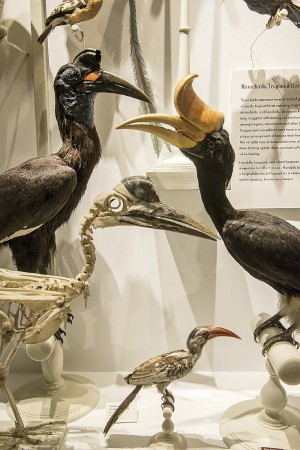
Museums, Birds, Natural History–A Few Of Our Favorite Things
If you happen to be in Boston, and are one of our many bird-motivated readers, you may want to visit a place where birds have helped a great institution become greater:
THE GREAT MAMMAL HALL has been emblematic of the Harvard Museum of Natural History for decades. Traditionalists will be glad to know that the gorilla tirelessly pounding on his chest, the placid okapi, and the room-long whale skeleton are still in place, and birds still fill cases on the balconies that run all around the hall. But the birds are no longer solely the “Birds of North America,” as has been the case for ages. Like the University that houses them, they have become more cosmopolitan and are now “Birds of the World.”
“I’m staggered by their diversity,” said Maude Baldwin, a doctoral student
Jamaican Columbids
In rural Jamaica there appears to be a traditional pastime of hunting pigeons and doves (scientifically known as the family Columbidae). There are a total of twelve species on the island, of which seven or eight can be expected in Cockpit Country.
So far we’ve seen six of those species, and although we’d like a closer look at some like the Crested Quail-dove, we’re pretty satisfied with our luck so far. Continue reading
Jamaican Hummingbirds

Red-billed Streamertail (male) by Seth
During the first week of our time in Jamaica, all of us were able to see the three species of Jamaican hummingbirds, although none of us had gotten a really good look at the prize: a male Red-billed Streamertail. Male Red-billed Streamertails are iridescent green with a black cap and two extremely long tail feathers that flutter behind the birds when they flit around. The birds move quite quickly and are often in and out of your field of view in a flash, but their call is relatively loud–as is the hum from their wings–so with practice you can locate them eventually.

Jamaican Mango by Seth
Jamaican Mangos are the largest hummingbird in the country and very recognizable given their flashy purple plumage and strongly decurved bills. From what I’ve noticed they perch for fairly long periods scanning their territory for intruders (most hummingbirds do something like this all the time), and this offers good photo opportunities. Continue reading
Northern Cockpit Country Complete

One of our camps
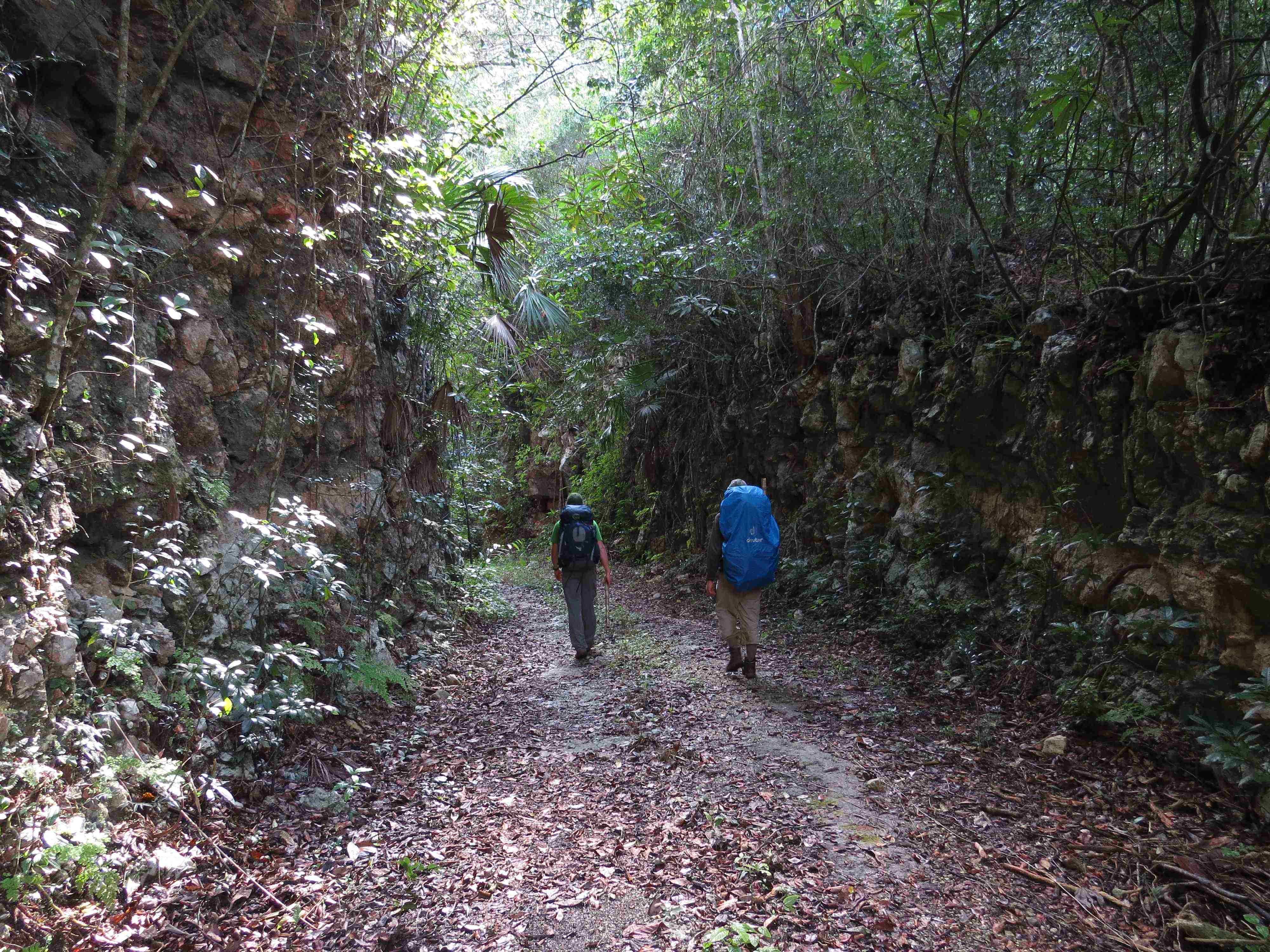
Justin, John and I have been in Jamaica almost two weeks, and the “Sharpied” names on our Rite in the Rain notebook covers have already faded off, our shirts smell soberingly of rotting onion, and our feet are eager to be released from their boots at any opportunity. At one point John had over a hundred tick nymphs on his body––the actual count was 163––but we won’t talk any more about that.
We’ve seen over sixty species of bird in our twelve days here, and only one of them has been a swallow: the Cave Swallow. In general, aerial insectivores like swifts and swallows have been quite scarce, which is really surprising since we’re going through huge swaths of great habitat.
Kuttanad – “the rice bowl of Kerala”
If you are like me, you enjoy the fresh air, green scenic views and appreciate a variety of cultures. Kuttanand, south of Cochin is a promising destination with its rich rice picking culture and its backwater systems. It also offers diverse species of animals, especially birds which can easily be spotted due to the open landscape.
Next on my Kerala bucket list!
(photo credits: Keralatourism.org)
Canopy Feeding
We were on our first Sunday outing of the new year at Hebbal Lake in Bangalore. Towards the end of the birding session, we stopped to click pictures of a little Egret and an Intermediate Egret.
The Intermediate Egret was busy preening for a very long time. As we enjoyed watching it, there was one another interesting behaviour that I got to record – “Canopy feeding”. Continue reading
First Days in Jamaica with Smithsonian Expedition
John, Justin and I have been at the Windsor Research Center for a day and getting ready for our first five or six day trip through Cockpit Country. Every single Jamaican we’ve met so far has been super friendly and helpful. We won’t be able to update as much as we’d like but hopefully every week we can send out one quick post. If you don’t hear from us though, it’s likely just because there’s some wind hitting the leaves that are reflecting the signal that the antenna here picks up and plugs into the desktop they use at Windsor. Continue reading
Avian Odyssey
As Seth and his team are in flight for their odyssey in search of the golden swallow, it seems fitting that we come across the stories of epic avian journeys. Just about a year ago we posted about the bar-tailed godwit, and it seems the species has some stiff competition in the semipalmated sandpiper.
Scientists from the Manomet Center for Conservation Sciences recovered data from a geolocator tagged sandpiper from sub-Arctic Coats Island revealing that the bird flew over 10,000 miles in the past year, including a remarkable six day, 3,300-mile nonstop flight across the Atlantic Ocean. Continue reading
A Trio of Jamaican Endemics
Jamaica has thirty endemic bird species, which is more than any other West Indies island. Justin, John and I have a good chance of seeing a good handful of those, especially since Cockpit Country and the Blue Mountains are such well-forested and protected areas. Although none of us are the type of birder that pursue “life lists” — a checklist of the thousands of bird species in the world that one has seen — we all use eBird and are definitely interested in seeing and identifying wildlife of any sort.
And if that type of animal happens to be found only in the area that we’re passing through, then that just makes us appreciate the relative rarity a little more. Endemism in a bird species does seem to assign that bird a bit of a higher status for life-listers, for the obvious reason that you have to be able to go to the certain region to find it — you can’t necessarily spot it merely by visiting a different continent, but rather you have to go to the country, or island, or mountain range.
The Golden Swallow Expedition
It’s now been several months since we last shared any news on the Smithsonian Institution’s expedition to search for the Golden Swallow (Tachycineta euchrysea) in Jamaica, where no sightings have been reported since 1989 — and even that report is a little questionable. While the Hispaniolan subspecies of the Golden Swallow is labeled as vulnerable, the Jamaican subspecies is labeled as critically endangered and possibly extinct, so this research trip is designed to lend some more finality to the issue. If our team of three positively identifies a Golden Swallow in Cockpit Country or the Blue Mountains between mid-January and late March, it will be the first confirmed sighting of the species in Jamaica in several decades, and new conservation efforts might be kick-started into action. If during our pair of one month trips to these two isolated areas of Jamaica we don’t see any signs of the Golden Swallow, the ornithological community can move a little closer to declaring the Jamaican subspecies of Tachycineta euchrysea extinct.
Pink Pigeons in Mauritius

Left, pink pigeon via Dick Daniels/CarolinaBirds.org/Wikimedia Commons; right Madagascan turtle dove via Roland zh/Wikimedia Commons.
We’ve featured pieces on another, less fortunate species of pigeon before, and it’s great to read news about a critically endangered species that has been making a comeback after conservation efforts. As the article by Jason Goldman for Conservation Magazine shows, however, there’s still a ways to go before the pink pigeon has fully recovered as a species:
The pink pigeon is the lone survivor of all the columbids – pigeons and doves – native to Mauritius. In 1990 the species was down to just nine individuals, but thanks to the work of the Mauritian Wildlife Foundation, there were some 400 individuals flying the skies of the island by 2013. In the year 2000, the IUCN downgraded the species from “critically endangered” to “endangered.” They’re not out of the woods yet, but their recovery remains an impressive and rare example of good news in conservation.
The Glossiness of Tinamou Eggs

Eggs from tinamous being used for research at Hunter College. Tinamou eggs are up to 14 times as glossy as the average chicken egg. Credit Fred R. Conrad/The New York Times
Readers of the blog who have visited in recent months will know that I do a lot of work with chicken eggs for artistic purposes, and readers from years ago might remember that I worked with Celebrate Urban Birds at the Cornell Lab of Ornithology, and I often wrote about bird-related topics (and still do!). During one of CUBs’ photo competitions called Funky Nests, I posted on egg coloration, and looking back on that post I am very surprised to see that I didn’t mention the eggs of a family of birds called tinamous. I’m puzzled as to why I wouldn’t have written about tinamou eggs because they are curiously glossy. In addition to having quite pretty colors, the eggs are extremely shiny to the point of looking fake, or varnished by wood elves after they’re laid.
Perhaps I didn’t include tinamou eggs in my post because very little is understood about why their glossiness exists, as Rachel Nuwer reports for the New York Times this week in an article with a title that obviously caught my eye:
Easter Eggs Without a Kit
The Shy, Drab Tinamou Has a Stunning Palette That Still Holds More Mysteries Than Answers.
When it comes to shell color, most birds’ eggs conform to one of four motifs: colored with spots, colored without spots, white with spots or pure white.
Humans Have DNA For Making Feathers
We’ve always found feathers fascinating, both from an aesthetic and a biological perspective. Recently, the Cornell Lab of Ornithology’s bird guide website AllAboutBirds uploaded an interactive page solely focused on feathers, which is quite a wonderful mine of interesting information, cool animation, and amazing videography. But now, about a month late, we’ve learned that DNA researchers working on the genetic recipe for feathers have found that the sequences responsible for most of the steps involved in creating feathers are actually much, much older than feathers themselves. This indicates that we humans should have a sizable chunk of the feather-making genetic recipe as well! Carl Zimmer reports for the Phenomena section at National Geographic’s website:
Feathers are like eyes or or hands. They’re so complex, so impressive in their adaptations, so good at getting a job done, that it can be hard at first to believe they evolved. Feathers today are only found on birds, which use them to do things like fly, control their body temperature, and show off for potential mates. The closest living relatives of birds–alligators and crocodiles–are not exactly known for their plumage. At least among living things, the glory of feathers is an all-or-nothing affair.
Cool Green Science Celebrates The Celebrate Urban Birds Initiative

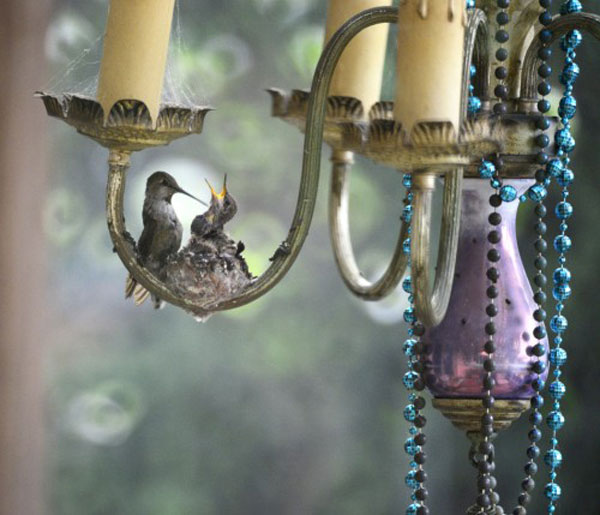
Hummingbirds nesting in a patio chandelier. Photo by Lydia D’moch for the CUBs Funky Nests in Funky Places 2014 competition.
The Nature Conservancy is currently promoting their blog called Cool Green Science, which we expect to be a new source for us to regularly share links to on topics we particularly care about. We like the blog’s stated purpose:
noun 1. Blog where Nature Conservancy scientists, science writers and external experts discuss and debate how conservation can meet the challenges of a 9 billion + planet.
2. Blog with astonishing photos, videos and dispatches of Nature Conservancy science in the field.
3. Home of Weird Nature, The Cooler, Quick Study, Traveling Naturalist and other amazing features.
Cool Green Science is managed by Matt Miller, the Conservancy’s deputy director for science communications, and edited by Bob Lalasz, its director of science communications.
Of course we would like you to consider visiting Xandari for this purpose, but we appreciate Lisa Feldkamp’s point. She is the senior coordinator for new science audiences at The Nature Conservancy and earlier this week she posted on a topic that is near and dear to us:
What is Celebrate Urban Birds?
You don’t need to book a trip to Costa Rica or the Amazon to enjoy great birding. Continue reading