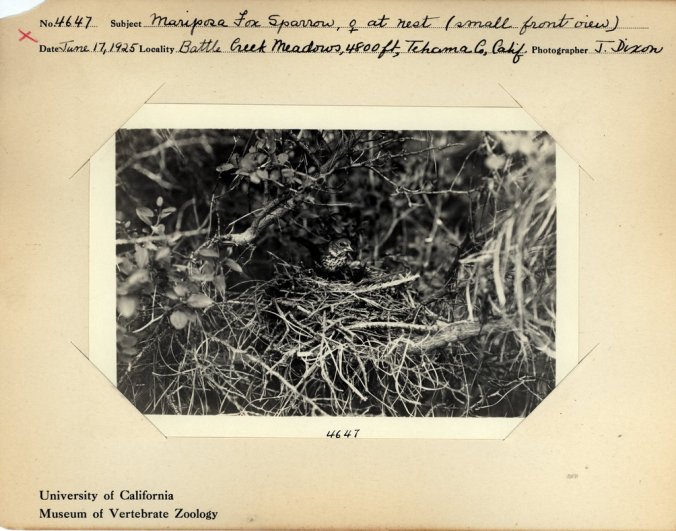
A Mariposa fox sparrow in its nest in 1925, observed during Dr. Joseph Grinnell’s surveys of California fauna. Credit Museum of Vertebrate Zoology, University of California, Berkeley
Retracing the steps of a century-old wildlife survey, ecologists find that birds are making remarkable adaptations to climate change.
More than a century ago, zoologist Joseph Grinnell launched a pioneering survey of animal life in California, a decades-long quest — at first by Model T or, failing that, mule — to all corners and habitats of the state, from Death Valley to the High Sierra.
Ultimately Grinnell, founding director of the Museum of Vertebrate Zoology at the University of California, Berkeley, and his colleagues produced one of the richest ecological records in the world: 74,000 pages of meticulously detailed field notes, recording the numbers, habits and habitats of all vertebrate species that the team encountered.
In 2003, museum scientists decided to retrace Grinnell’s steps throughout the state to learn what changes a century had wrought. And that’s why Morgan Tingley, then an ecology graduate student at the university, found himself trekking through the Sierra for four summers.
Dr. Tingley wanted to know how birds had fared since Grinnell last took a census. Years later, the answer turned out to be a bit of a shock. Continue reading →
NEW YORK — “Audubon is committed to protecting birds and the places they need — and the greatest threat to birds and people is climate change,” said David Yarnold (@david_yarnold), president and CEO of National Audubon Society.
“While some may be holding out for a perfect solution to climate change, we know that it will take an array of approaches to reduce planet-warming pollution.
“The Carbon Capture Coalition is pursuing many avenues—including a market-driven approach that has deep bipartisan support. Audubon is excited to be at the table with a range of voices exploring policy options that accelerate a reduction in carbon pollution,” Yarnold added.
The Carbon Capture Coalition is led by the Center for Climate and Energy Solutions and the Great Plains Institute. With over 50 members ranging from the energy industry, agriculture, labor unions and conservation leaders, the coalition is non-partisan and solutions-oriented. Recently, the coalition successfully advocated for improving and extending the carbon capture tax credit, known as the 45Q tax credit, led by Senators Heidi Heitkamp (D-ND), John Barrasso (R-WY), Sheldon Whitehouse (D-RI) and Shelley Moore Capito (R-WV). Continue reading →
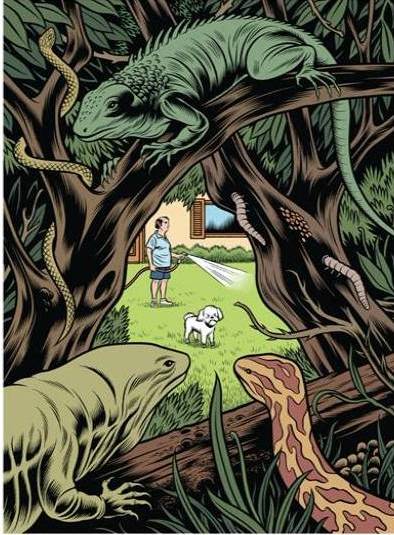
The state’s ecology is a kind of urban legend come true—the old alligator-flushed-down-the-toilet story, with a thousand species. Illustration by Charles Burns
It’s easy to spot a wild parrot in Miami, as in San Francisco, San Diego, and several other metropolitan areas in the U.S. But in Florida, “technically, it’s not illegal to take wild parrots, according to Florida Fish & Wildlife,” says Daria Feinstein, a parrot conservationist, in Neil Losin’s short documentary, Parrots in Peril. The film examines the threat that poaching poses to Miami’s wild macaws. Continue reading →
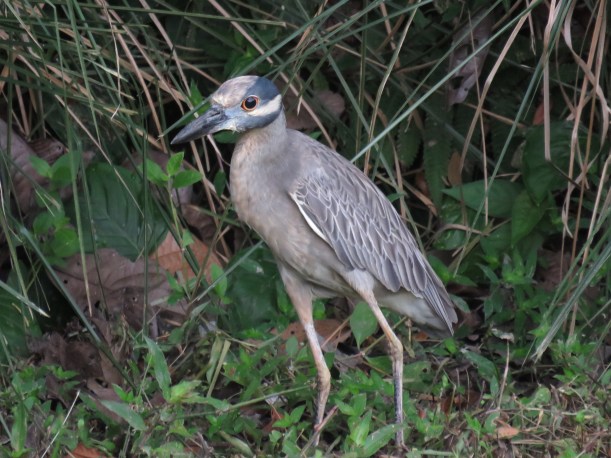
The first lucky bird of the day, a Yellow-crowned Night-Heron at Marriott, which I hadn’t seen yet on property
Almost four years ago, James and I took a day trip to Carara National Park, on the Pacific coast of Costa Rica where the tropical dry forest meets the moist rain forest in a transition zone that provides a great mix of habitats for all sorts of birds and other wildlife. On eBird, Carara’s Hotspot has over four hundred species, which made it a natural place for me to spend part of my Global Big Day this year, since I was already documenting the avian life on the property of the Marriott Los Sueños in Herradura, just half an hour south along the coast. These photos are from my May 5th efforts!
The Turquoise-browed Motmot is a regular at Marriott and one of my favorite “common” birds in the country
I started the morning at 5:30am, heading out onto the perimeters of the forests surrounding Marriott Los Sueños and its golf course. Continue reading →
Last year at this time, I was in Belize hosting a team from the Cornell Lab of Ornithology. I had known of the Lab starting 30 years ago when we moved to Ithaca for me to start graduate school at Cornell, and had known the Lab’s backyard, Sapsucker Woods, since Seth was born and we walked him through in a stroller from time to time. But I did not really know much about the Lab’s work until Seth started working there in 2011, during his sophomore year of college. And then in 2012 we had another young Lab worker join us in India.
We have been celebrating Global Big Day ever since, in India and Costa Rica, then last year in Belize. This year Seth is in Costa Rica, where he will be in a national park with a very high bird species counts. I hope we will hear from him about that experience. For now, may we recommend you click the button above to learn more?
Me (left, obviously) with my Costa Rican non-birder friends in Río Celeste, Costa Rica
We’ve discussed eBird countless times here in the past, but I don’t think I ever mentioned their monthly challenges, which are designed to encourage eBirders to contribute some extra element of data to their usual checklists in a given month, with the chance of being randomly selected from the pool of people who satisfy the challenge requirements. If you’re chosen, you’ll receive an excellent pair of binoculars from Zeiss Optics!
In the past there have been challenges related to adding breeding codes to checklists (for example, noting if a species was observed carrying nesting material, or displaying, or feeding a juvenile); noting flyover species; going out birding with someone else and sharing the checklist; using the eBird app; and more! I think I remember a challenge from 2015 that involved checklists including raptors and vultures, and I recall being frustrated because it came a month after I’d been in Jamaica reporting Turkey Vultures several times a day. Continue reading →
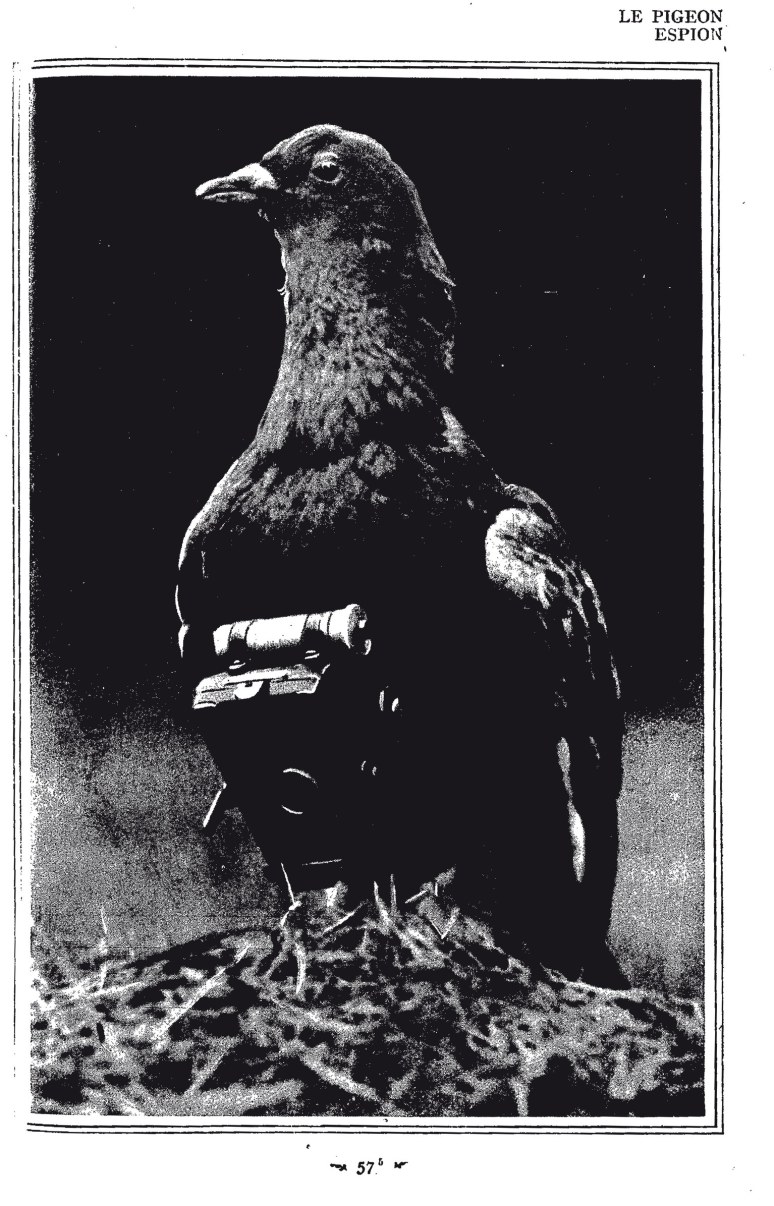
In 1907, just a few years after the Wright brothers lifted off in Kitty Hawk, and while human flight was still being measured in metres and minutes, Dr. Julius Neubronner, a German apothecary, submitted a patent application for a new invention: the pigeon camera. The device was precisely what it sounds like—a small camera fitted with straps and equipped with a timer so that pigeons could carry it and take photos in flight. Neubronner first used the device on his own flock of homing pigeons, which he sometimes employed to deliver prescriptions. In the following years, he showed his camera at international expositions, where he also sold postcards taken by the birds. Additionally, he developed a portable, horse-drawn dovecote, with a darkroom attached to it, which could be moved into proximity of whatever object or area the photographer hoped to capture from on high. Continue reading →
In 2016 I wrote a couple times about eBird’s data––the observations contributed by citizen scientists––being used for migration maps, among other things. Those posts included animated gif images that illustrated the flow of thousands of birds across the Western Hemisphere at different times of year, which could be used in a casual setting to predict when to go out looking for a target species one wants to see in the wild, or in a conservation setting to know what time of the year is best to enforce certain environmental regulations, like open hunting or hiking seasons in sensitive areas. The moving maps also served as a mesmerizing graphic to simply astound us with the magnitude of travel these birds are undertaking.
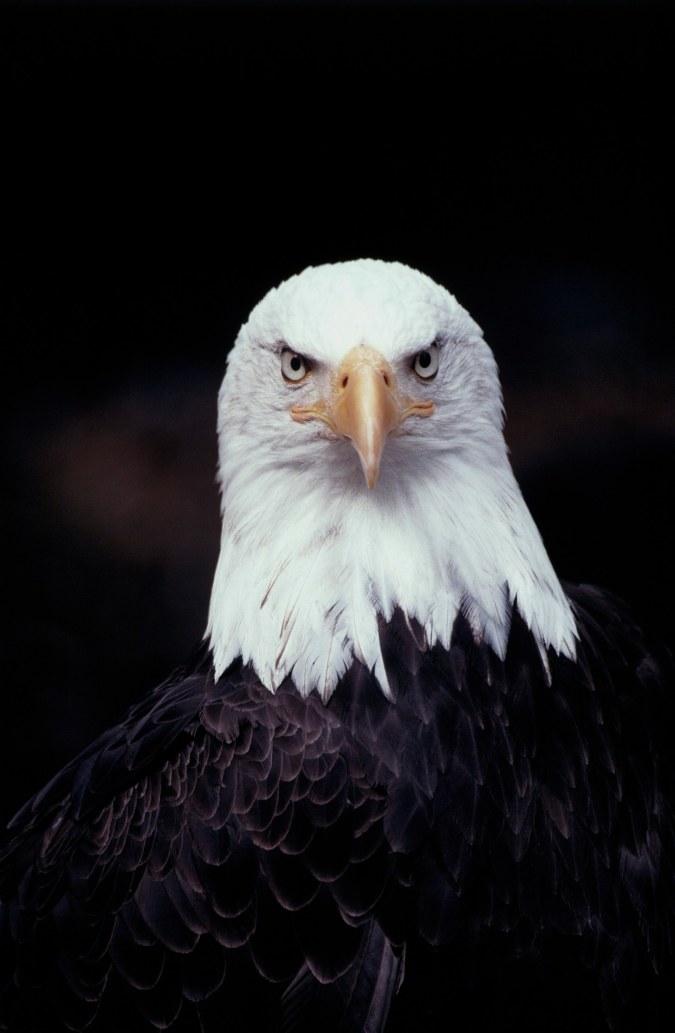
A proposed Republican amendment threatens to weaken the protections in the Migratory Bird Treaty Act of 1918. Photograph by Ernest Manewal / Camera Press / Redux
Thanks to writers who become birders, and this one in particular:
Catskill, New York—the small Hudson River town where the American painter Thomas Cole lived and worked, from 1825 to 1847—is also home to the RamsHorn-Livingston Sanctuary, which contains four hundred and thirty acres of tidal marsh, upland forest, and fallow farmland, and is presently occupied by common loons, great blue and green herons, wood ducks, mallards, a pair of bald eagles, northern harrier and red-tailed hawks, ruffled grouse, merlin falcons, eastern screech and great horned owls, belted kingfishers, pileated woodpeckers, warblers, scarlet tanagers, blue-gray gnatcatchers, a tiny and nervous-looking thrush known as a veery, and various other species of birds whose names, I will admit, are perilously delightful to type. There is also a beaver. Continue reading →
Ah, our favorite trifecta of the 2010-2017 era: coffee and birds and India! (Not to mention that the 2 species of birds featured in the article have graced this site in our Bird of the Day feature!) Just because we are back in Costa Rica does not mean the topics covered in this article are any less important to us. Thanks to Karen Weintraub for this:
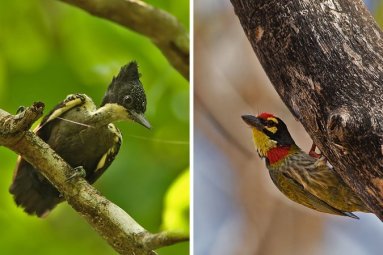
Left, a heart-spotted woodpecker. Right, a coppersmith barbet bangalore. Credit Left, Ramki S.; Right, Shashank Dalvi
Birds are not as picky about their coffee as people are.
Although coffee snobs prefer arabica beans to robusta, a new study in India found that growing coffee does not interfere with biodiversity — no matter which bean the farmer chooses.
In the Western Ghats region of India, a mountainous area parallel to the subcontinent’s western coast, both arabica and robusta beans are grown as bushes under larger trees — unlike in South America, where the coffee plants themselves grow as large as trees, said Krithi Karanth, who helped lead the study, published Friday in the journal Scientific Reports. Continue reading →
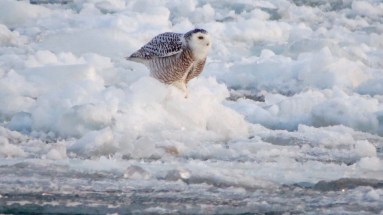
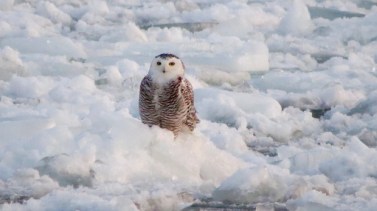
Every now and then, it is good to stop and smell the roses, which if you are a snowy owl looks like the scene above. Thanks to National Public Radio (USA) for bringing this to our attention:
Facebook | Gary Cranfield
Gary Cranfield recorded the video last weekend while he was out on a walk with his girlfriend, Betsy Waterman, along Lake Ontario near Oswego, N.Y.
“There are usually sightings this time of year and historically there have been snowy owls in this place for years and we decided to check it out,” Cranfield, 69, told Syracuse.com.
You can watch the results of that wintry expedition above. And for those of you out there worrying, Waterman assures us the bird was not stuck — they watched it chill for 30(!) minutes on the floe before it flew away to another one.
Cayuga County resident Gary Cranfield and his girlfriend, Betsy Waterman, enjoy the outdoors and love to go in search of wildlife to take pictures.
The two were out Saturday looking for snowy owls after hearing some might be out on the southeastern shore of Lake Ontario near Oswego. What they ended up getting was mesmerizing – a captivating video and photos of a snowy perched on some ice in a bay and bobbing with the waves.
We are constantly on the lookout for information useful to birders, for birding. Clara Chaisson made some choices for Wirecutter on which field guides to rate and which was best, and she had us at methodology:
Birding together is a bonding activity in my family in the same way that game night is in other households, so I’ve been casually birding for most of my life. Since studying ornithology in college, I’ve had opportunities to make my enthusiasm for bird observation more than just a hobby; I’ve done seasonal fieldwork that required me to know how to identify all Northeastern birds by sight and sound. Even now that I have a desk job and live in a city, I still get out as often as I can.
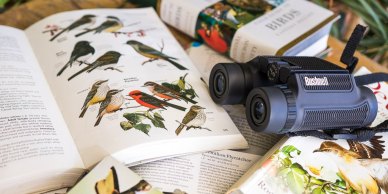
I spent a week testing nine of the most-recommended and best-selling bird guides at Mount Auburn Cemetery—the first garden cemetery in the US—and Fresh Pond in Cambridge, Massachusetts, both of which are hotspots, or popular public birding locations, on the online birding database eBird. Continue reading →
The birders among us say thank you, Noah Comet (and to the New York Times for providing the valuable real estate for this informative, charming essay):
ANNAPOLIS, Md. — Owls tend to be secretive. While there are a few American species that enjoy the daylight hours, most are nocturnal and spend their days behind thick greenery or uncannily blending into the bark of the trees they nestle against. Once they’ve found a secure place to snooze, they are likely to return to that spot daily, but even if you find evidence of their presence — scat and regurgitated pellets — good luck seeing the clandestine culprits.
Northern saw-whet owl, Ohio.Credit Noah Comet
I’m a seasoned birder with a particular interest in owls, and on my ventures to find them, even when I have specific information on where they’ve been seen just minutes before, I’ve failed to find them more often than not. Such elusiveness makes “owling” one of the great birding challenges. Being the first to find a particular owl is regarded by some as a badge of distinction, and those who find them regularly are viewed with awe-struck reverence. Continue reading →
Since 2014, Washington’s Elwha River has flowed freely through what once was Lake Mills and the Glines Canyon Dam. But the site still leaves a barren scar in Olympic National Park. Now, a human- and bird-led effort is turning it green again.Photo:Elaine Thompson/AP
Conservation is sometimes in the hands of animals, as this story in the current Audubon magazine illustrates:
After the largest dam removal in U.S. history, scientists, Native Americans, and wild animals are working together to restore the heart of the Elwha.
The Elwha Valley and Glines Canyon Dam prior to demolition.Photo:Elaine Thompson/AP
It’s a scorching August day in the Elwha Valley, and it only feels bleaker as we peer into the 200-foot void of Glines Canyon Dam. A sputtering trail of water marks the concrete lip where, for nearly a century, two hulking braces trapped logs, rocks, and sediments as they washed down from the mountains of northern Washington, forming a reservoir that was six times deeper than a competition-diving pool. At its height, the dam churned out 13.3 megawatts of hydroelectricity, enough to power 14,000 homes and a local paper mill. But it also seriously altered the Elwha River’s ecology, along with that of surrounding Olympic National Park. Endangered chinook salmon were cut off from their spawning sites; fish-eating birds and otters suffered; and estuaries became more brackish and shallow. Finally, in 1992, the U.S. government issued the order to destroy Glines Canyon Dam and the nearby Elwha Dam. Yet it wasn’t until two decades later when the water was completely freed. Continue reading →
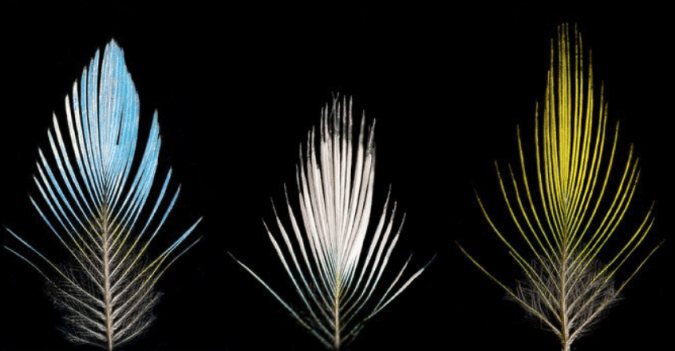
From left, the feathers of an opal-crowned manakin, a snow-capped manakin and the golden-crowned manakin. Credit University of Toronto Scarborough via NYTimes
Out of the roughly 250 bird families in the world, manakins (Pipridae family) are probably my favorite, because they’re like birds of paradise (Paradisaeidae family), except you don’t have to take a helicopter to remote areas of Papua New Guinea to see them. Almost all manakins are colorful––or at least the males are; females normally being a drab green––and they often have interesting behavior as well. I saw my first manakins in Ecuador, where two flashy species had some fun sounds to go along with their calls, but most of my exposure to the family has been in Costa Rica, where I did my best to record a Long-tailed Manakin lek.
I recently came across an Oxford professor’s blog that revolves mostly around conservation and birding, and one of his posts was particularly interesting to me. In it, Professor Paul Jepson discusses the increasing presence of photography in the British birding sphere, and what bird photography means for the hobby of birding/birdwatching. I encourage you to read his article (I’ll put a link below), but will first share one idea that Jepson brings up toward the end of the piece, and which was very thought-provoking:
Bird photography is part of the socio-technological assembly that is shaping futures. If birdwatching is to be a cultural force in the twenty-first century, our bird reserves will need to embrace developments and directions in digital technologies. … My thought experiment imagines a system of pay-for nature hides with an observation tower, like the one in Muritz National Park outside Berlin, as its centre piece. Birding has a strong ‘nature as a public good’ mentality. While many bird photographers agree with this principle, they are also willing to pay for entry to the facilities and special places that enable them to get the shot they desire. Nature hides are popping up across Britain and 2017 hide day rates are £75 for the opportunity to photograph Common Kestrels Falco tinnunculus, £99 for Kingfishers and £150 for Black Grouse.
Although I enjoy taking photos of birds and sharing them online, I do not consider myself a bird photographer, partly because I don’t have the specialized gear (my camera is a point-and-shoot model, though its exceptional 65x optical zoom is useful for bird photos). That being said, Continue reading →
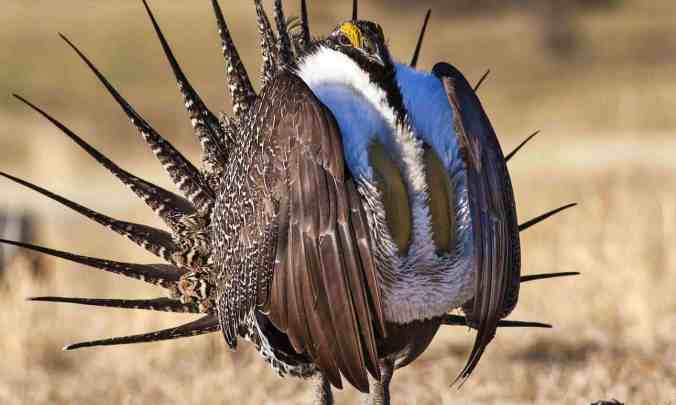
A plan to save the sage grouse was a rare instance where ranchers, the timber industry, scientists, landowners and environmentalists all agreed on something
At 5am, the day is black, and resounds with the steady drum of rain. My husband Rich is getting ready for work. He oils his leather gloves and fills a Thermos. He’ll spend a 10-hour day in the downpour: tramping through thorny salmonberry and wading through the roaring creeks. Continue reading →
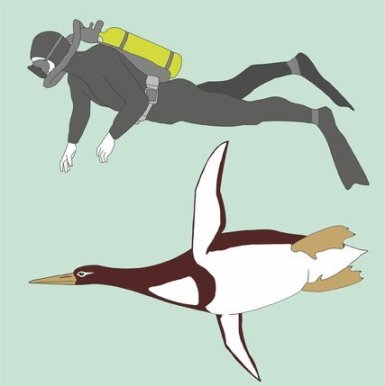
An artist’s rendering compares Kumimanu biceae, an extinct giant penguin, to a human diver. Kumimanu stood 5 feet 7 inches and weighed 220 pounds. It is among the earliest known penguin species. Credit G. Mayr/Senckenberg Research Institute
The 57 million-year-old fossil is both fearsome and comical: a long-beaked penguin that stood 5 feet 7 inches tall and weighed about 220 pounds.
“It was as tall as a medium-sized man,” said Gerald Mayr, a paleontologist at the Senckenberg Research Institute in Frankfurt, Germany, and lead author of a report in Nature Communications on Tuesday announcing the discovery.
By comparison, the tallest living species, the emperor penguin, reaches about four feet in height. Kumimanu biceae, as the fossil was named, would have towered above the emperor, and above just about all other known ancient penguins. Continue reading →
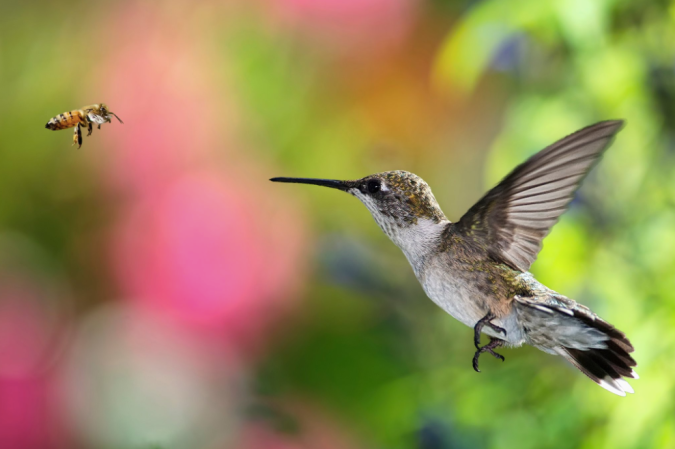
Scientists say that studying bee behavior could help them understand hummingbird behavior, too. Credit DansPhotoArt on flickr, via Getty Images
Members of our team have long been fans of bees and all bird species, with a particular soft spot for hummingbirds in particular. With their gemlike plumage and engaging personality, what’s not to love?
What’s small, buzzes here and there and visits flowers?
If you said bees or hummingbirds, you got it. And you wouldn’t be the first if you mixed the two up. In Medieval Europe, some called bees the smallest birds. In Chinese and Japanese, the words for hummingbird translate into “bee bird.” Today we call the smallest hummingbird — weighing less than a penny and only a bit larger than the biggest bee — the bee hummingbird.
And now a group of researchers say we should embrace our history of lumping the two together. The way scientists study bees could help them study hummingbird behavior, too, they argue in a review published Tuesday in Biology Letters. Continue reading →







 I spent a week testing nine of the most-recommended and best-selling bird guides at Mount Auburn Cemetery—the first garden cemetery in the US—and Fresh Pond in Cambridge, Massachusetts, both of which are hotspots, or popular public birding locations, on the online birding database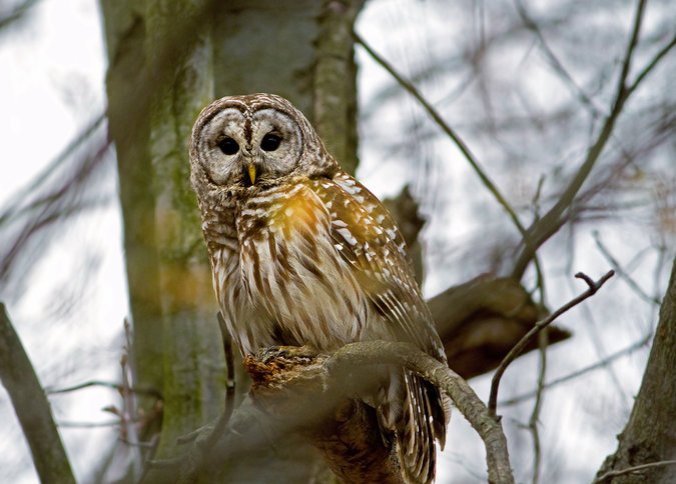


 Organikos