The Guardian Is A Public Service Newspaper

1157.jpg

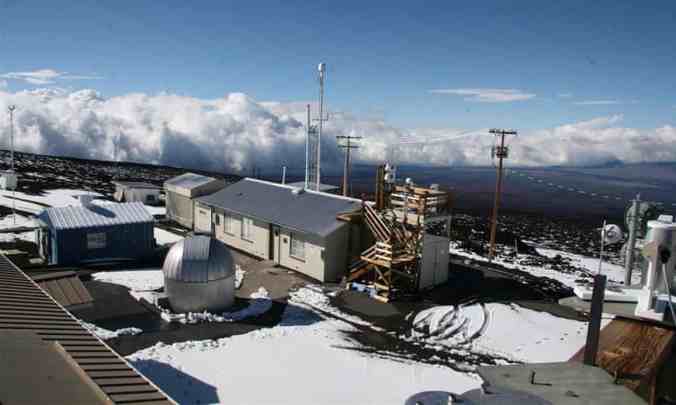
The Mauna Loa weather observatory in Hawaii. The Guardian will publish the Mauna Loa carbon count every day. Photograph: Courtesy of NOAA

Our thanks to the Guardian for this reminder of our shared responsibility:

Why the Guardian is putting global CO2 levels in the weather forecast

As CO2levels climb, the carbon count is a daily reminder we must tackle climate change now

The simplest measure of how the mass burning of fossil fuels is disrupting the stable climate in which human civilisation developed is the number of carbon dioxide molecules in the atmosphere.

Today, the CO2 level is the highest it has been for several million years. Back then, temperatures were 3-4C hotter, sea level was 15-20 metres higher and trees grew at the south pole. Worse, billions of tonnes of carbon pollution continues to pour into the air every year and at a rate 10 times faster than for 66m years.

At the dawn of the industrial revolution, CO2 was at 280 parts per million (ppm) in the atmosphere. By 1958, when the first measurements were made at Mauna Loa in Hawaii, it had reached 315ppm. It raced past 350ppm in 1986 and 400ppm in 2013.

The Guardian will now publish the Mauna Loa carbon count, the global benchmark, on the weather page of the paper every day.

“When I read the letter from Guardian reader Daniel Scharf encouraging us to include information on climate change in our weather forecasts, we thought it was a fantastic idea,” said the Guardian’s editor-in-chief, Katharine Viner. Continue reading

Renewables For Communities In Need

CEF_Shiloh-Temple_IMG_20180503_133709053_HDR_web.jpg

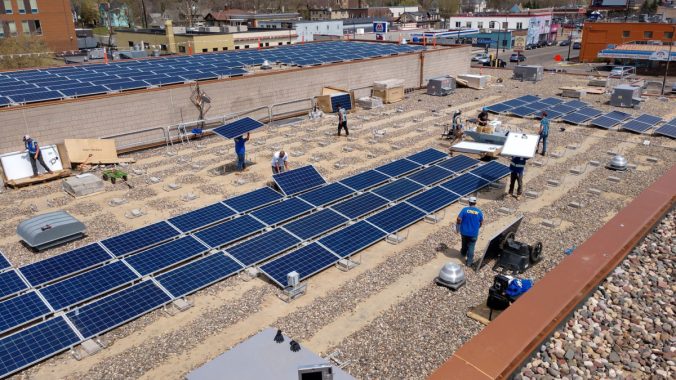
EnterA 204-kilowatt community solar array being installed on the roof of the Shiloh Temple International Ministries in Minneapolis. COURTESY OF COOPERATIVE ENERGY FUTURESa caption

Thanks to Maria Gallucci and Yale e360 for this:

Energy Equity: Bringing Solar Power to Low-Income Communities

Millions of Americans lack access to solar energy because they cannot afford the steep upfront costs. Now, more than a dozen states are adopting “community solar” programs that are bringing solar power and lower energy bills to low-income households from New York to California.

GRID-Alternatives_CO-Solar-Training-Academy-Platteville-0818-03_web.jpg

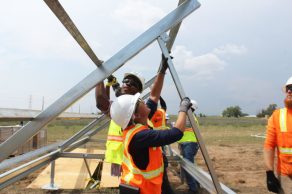
Workers receive job training while building a shared solar farm in Platteville, Colorado. COURTESY OF GRID ALTERNATIVES

Isbel “Izzy” Palans lives in a small cabin nestled among mountain peaks and towering trees in the Colorado Rockies. Her home is often shaded and, during the long winters, buried under heaps of snow. Her monthly utility bills show credits for solar electricity production, but no solar panels are affixed to her roof. Instead, the power comes from a solar array some 60 miles away in a nearby valley.

Last year, the panels nearly slashed her energy bill in half. “I’ve been thrilled,” said Palans, a 76-year-old retired waitress who relies partly on Social Security benefits to make ends meet.

Groundswell_DC_Dupont-Church_IMG_1237_web2.jpg

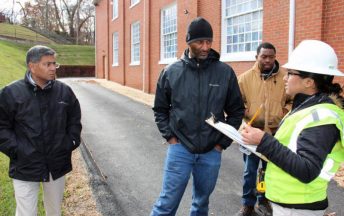
Solar contractor Brad Boston (center) and utility representatives meet with engineer Pranay Kohli to discuss a community solar project at DuPont Park Seventh Day Adventist Church in Washington, D.C. COURTESY OF GROUNDSWELL

Palans is a subscriber to a 145-kilowatt solar array project run by Holy Cross Energy, a rural utility cooperative. Built with state funding, the program provides solar credits to more than 40 low-income households in western Colorado that otherwise wouldn’t have the financial or technical means to access renewable energy. The venture is just one of a growing number of so-called “community solar” projects across the United States focused on delivering renewable energy — and the cost-savings it can provide — to low-income households, from California to Minnesota to Massachusetts. Continue reading

Authentica & Organikos

Organikos2019LogoAuthentica, mentioned a couple of times prior to the current series of posts, has the character of a startup but its goal is the opposite of disruption.

A major disruption already happened, and if one of the antonyms of disrupt is organize, then that is what we are doing. Authentica is part of a nascent movement in Costa Rica to provide market opportunities to artisans, farmers, food producers and others who design, craft, grow and cook things that are essentially Costa Rican. The disruption they faced is not the story we want to tell. The reversal of that disruption is the story.  One example is Organikos. Continue reading

Mass Transit Morphing

Weeks 297, 2008 - Photo by Stephen Mallon.jpg

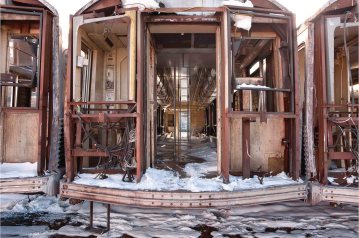
Subway cars set sail on a barge in “Weeks 297, 2008.” STEPHEN MALLON

Thanks to Winnie Lee and Atlas Obscura:

Photographing the New York City Subway Cars That Retired as Artificial Reefs

How Stephen Mallon captured this unusual voyage to the bottom of the ocean.

image.jpg

The rooftops of subway cars. “Abbey Road, 2008.” STEPHEN MALLON

The photographer Stephen Mallon specializes in documenting man’s industrial-scale creations. During his career, he’s focused his lens on the recycling industry, the largest floating structure ever built, and the transportation and installation of a new bridge in New York City. So it wasn’t surprising when, in 2008, he was drawn to an unusual program spearheaded by the MTA New York City Transit system: a multi-phased artificial reefing project that saw the shells of 2,580 decommissioned subway train cars repurposed and dropped into coastal waters off New Jersey, Delaware, Maryland, Virginia, South Carolina, and Georgia, between 2001 and 2010.

image (1).jpg

The abstract beauty of stripped-down vehicles in “Transfer, 2009.” STEPHEN MALLON

Mallon arranged to follow the outdated subway cars as they were prepared and cleaned, loaded onto barges, and finally plopped into the sea. As he traveled with a crew in a tugboat to get his shots, the photographer developed his sea legs.

image (2)

Subway cars hoisted in the air in “Mind The Gap, 2008.” STEPHEN MALLON

“I was never underwater, so just needed to keep myself steady on the back of the boat. It’s kind of like surfing or skiing—just keep your balance, keep the horizon line straight, bend your knees, and don’t fall overboard,” Mallon says. Continue reading

Green Building Techniques Inspired By Insects

The air conditioning system of the Eastgate Centre in Harare, Zimbabwe, was inspired by termites’ nests. Credit David Brazier, via Wikimedia Commons

It’s been quite some time since we posted about biomimicry. Thanks as always to JoAnna Klein for this illuminating story:

What Termites Can Teach Us About Cooling Our Buildings

“We think humans are the best designers, but this is not really true,” a researcher said.

In the capital of Zimbabwe, a building called Eastgate Centre holds nearly 350,000 square-feet of office space and shops. It uses 90 percent less energy than a similar sized building next door.

What’s Eastgate Centre’s secret? Termites.

merlin_152612904_38aa91c7-eec0-456c-ae7a-09920b6f5ed5-jumbo.jpg

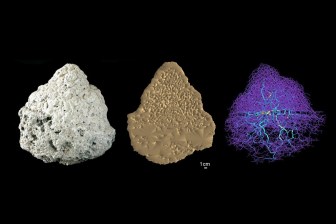
Three views of a termites’ nest, including from left, a photo of the nest, a tomography of the the nest’s interior and the networks of galleries and paths in it. Credit G. Theraulaz, CRCA, CBI, CNRS, Toulouse

In the 1990s, Mick Pearce, the building’s architect, took his inspiration from mounds built by fungus-farming termites he saw on a nature show. The insects created their own air conditioning systems that circulated hot and cool air between the mound and the outside.

As architects and builders seek new and improved ways to cool buildings without using more energy in a warming world, a study of another type of termite mound suggests that Mr. Pearce won’t be the last human to take design tips from these cockroach cousins. Continue reading

From South-South To North-North

merlin_150668253_8478433b-acb1-4e50-ad5c-07753a4a7545-jumbo.jpg

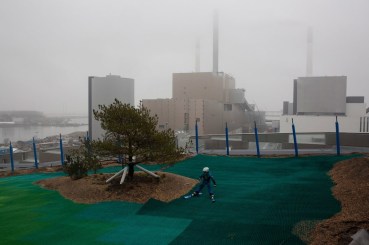
The beginning of a ski run on the roof of Copenhagen’s new trash incinerator, which will help heat buildings in the city. Photograph by Charlotte de la Fuente

South-south cooperation has been an important learning mechanism for some time and we have shared plenty of those stories in part because those places are where we work. According to Somini Sengupta Copenhagen Wants to Show How Cities Can Fight Climate Change,  so we now also should be paying attention to the northern counterpart of the cooperation that has been getting all our attention:

merlin_150668361_cc20049e-a87c-46f1-a7d1-8dcb474d3f5f-jumbo.jpg

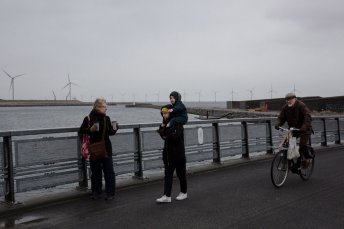
Wind turbines along the strait that separates Denmark from Sweden, seen from the Amager Strandpark in Copenhagen. Photograph by Charlotte de la Fuente

COPENHAGEN — Can a city cancel out its greenhouse gas emissions?

Copenhagen intends to, and fast. By 2025, this once-grimy industrial city aims to be net carbon neutral, meaning it plans to generate more renewable energy than the dirty energy it consumes.

merlin_150668178_4d6ca480-2e7d-41c4-b2ca-263eb31c8490-jumbo.jpg

The Copenhagen Metro. A new line, scheduled to open this year, will put most residents less than half a mile from a station. Photograph by Charlotte de la Fuente

Here’s why it matters to the rest of the world: Half of humanity now lives in cities, and the vast share of planet-warming gases come from cities. The big fixes for climate change need to come from cities too. They are both a problem and a potential source of solutions.

The experience of Copenhagen, home to 624,000 people, can show what’s possible, and what’s tough, for other urban governments on a warming planet.

merlin_150668325_10e1c59f-32f1-40bb-8099-87326409a305-jumbo.jpg

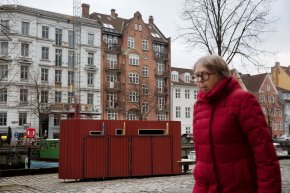
Recycling bins in the Christianshavn district of Copenhagen. The city requires residents to sort recycling into eight separate categories. Photograph by Charlotte de la Fuente

The mayor, Frank Jensen, said cities “can change the way we behave, the way we are living, and go more green.” His city has some advantages. It is small, it is rich and its people care a lot about climate change.

Mr. Jensen said mayors, more than national politicians, felt the pressure to take action. “We are directly responsible for our cities and our citizens, and they expect us to act,” he said. Continue reading

Regeneration & Food Futures

tnc_67697146_preview-1260x708.jpg

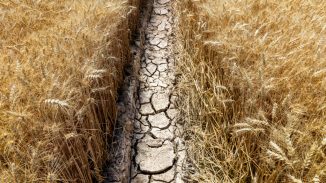
A view of wheat grown on Meaker Farm, Montrose, Colorado. Photo © Ken Geiger/TNC

While on the topic of food, thanks to Dustin Solberg and Cool Green Science for this:

Dirt to Soil: A Farmer’s Tell-all Puts Soil First

tnc_92212427_preview-1260x708.jpg

Circle irrigation tire tracks remain in the challenging soil conditions on a wheat farm in Colorado. Photo © Ken Geiger/TNC

Quite a few years back, while working the wheat harvest in the middle of Oklahoma, I met a leathery skinned farmer. He lived through the dusty, hardscrabble, droughty years of the Great Depression, and experience had taught him plenty. I still recall his silver belt buckle, his straw cowboy hat, and the funny joke he told me about the buffalo on a buffalo nickel, which I can’t repeat here. He wanted me to know, and so told me in no uncertain terms, that there’s one way, and one way only, to plow a field.

We were standing then in the fresh golden stubble of a wheat field. It was hot. We’d just finished combining and after a day of steady motion we were finally still, the diesel engines at rest. I can still recall the animated force in his muscly hands – he made his fingers into the tines of a chisel plow – to make his point as vividly as I recall what he said: “You’ve got to set the plow deep.”

The trouble was, he was wrong.

Continue reading

Getting The Food Puzzle Solved


http___com.ft.imagepublish.upp-prod-us.s3.amazonaws

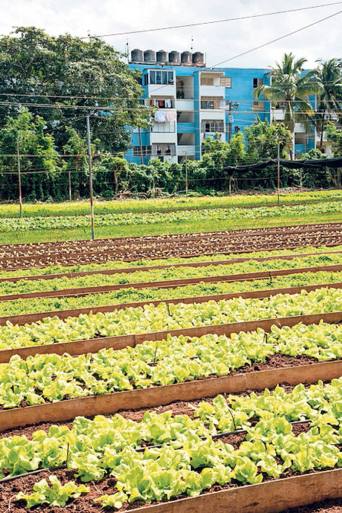
Green: an organic farm in Cuba © Getty

Thanks to FT’s Sarah Murray for this story–Organic farming’s growth only part of answer to food sustainability:

The approach has an impact far beyond its scale but questions remain over yields

While only a tiny proportion of the world’s agricultural land is devoted to organic farming, some argue that it punches above its weight in contributing to more sustainable farming practices. “Its influence goes far beyond the 1 per cent of land that is managed organically,” says Verena Seufert, assistant professor at the Institute for Environmental Studies at VU University Amsterdam. “It is influencing the debate by highlighting food sustainability and how big an impact the food we eat has on many of our environmental problems,” she says. Yet while some believe that organic agriculture could play a bigger role in helping feed the world, environmental advocates see it as one option in a number of more sustainable approaches to farming. Continue reading

Look Away, But At Least Listen

9780525576709.jpegWe have already linked to stories about life after warming enough that it borders on repetitive. No choice, as the book to the right makes very clear. This recent short video by the author will make you wince. There is something about visual cues on this topic that make it tougher to listen without being distracted. One of the better conversations with him is this one hour+, so if you only have that much time for him, make the best of it:

After years of hovering on the periphery of American politics, never quite the star of the show, it seems that climate change is having a moment. Continue reading

Stories Without End – The Grandmother Project

The Ogelthorpe University Museum of Art is one of the gems of the Atlanta area, for good reason. Not only does the museum have its own well curated collections, it receives visiting collections that are timely and powerful.

Tara Rice‘s Grandmother Project photographic series highlights the historically matriarchal influence within African cultures, coinciding with the project based in Senegal “promoting health, well-being and rights of women and children in developing countries through grandmother-inclusive and intergenerational programs that build on communities’ cultural values and resources.”

The photo series dovetails perfectly with the female centric collection of sculptures and masks in the sister exhibit, Stories Without an End.

Stories Without an End: Power, Beauty and Wisdom of Women in African Art of the Mehta Collection

January 18 – April 21, 2018

The exhibition Stories Without an End: Power, Beauty and Wisdom of Women in African Art of the Mehta Collection includes a selection of 50 classically carved wooden sculptures and masks drawn from the collection of Dileep and Martha Mehta.

The exhibition represents art from more than 25 ethnic groups spanning 12 countries. These objects are gathered into thematic groups including women in governance, maternity, idealized beauty, and female ancestors.

OUMA members Dileep and Martha Mehta are collectors of African and Asian arts. Their African art collection, including objects in this exhibit, has greatly benefited from diligent sourcing by and wise counsel of African Art dealers Tamba Kaba and Sanoussi Kalle.

This exhibition was developed by Elizabeth H. Peterson, OUMA director, and organized by Amanda Hellman, PhD, curator of African art, Michael C. Carlos Museum, Emory University.

Stories Without an End was inspired in part by the work of the Grandmother Project (GMP) an American 501(c)(3) nonprofit organization and a Senegalese NGO with representatives throughout the USA and abroad. GMP, with headquarters in Senegal, works with elders in West African villages to fight the maltreatment of young girls. This includes bettering maternal and child nutrition, reproductive health, and marriage standards. The exhibition title is inspired by the GMP initiative “stories without an ending,” which is a tool used to facilitate communication via the elders. For more about the Grandmother Project please visit www.grandmotherproject.org.

The Grandmother Project: Photographs by Tara Rice

January 18 – April 21, 2019

The Grandmother Project (GMP) develops community approaches that promote positive and sustained improvements in the lives of girls, children, women, and families by building on existing cultural and community values, roles and assets in southern Senegal. Continue reading

Citizen Science Goes Far Afield

lr-yalee360-print_websized.jpg

LUISA RIVERA / YALE E360

We have been on watch for citizen science stories since the early days of this platform. Seth had just accepted an offer to work at the Cornell Lab of Ornithology, and typical of him, did his homework on what he had committed to. Since then, dozens of first person and linked-to citizen science stories from other members of our community have appeared in these pages. Thanks to Yale e360 and Jessica Leber for this story about how far and wide the practice has spread, and a few of its more amazing discoveries:

Species Sleuths: Amateur Naturalists Spark a New Wave of Discovery

Scientists have not kept pace with the work of discovering new species. Now, a growing number of committed hobbyists – ranging from a Belgian bus driver to a California cybersecurity expert – are out in the field, igniting a boom in documenting the world’s biodiversity.

Clements_7400192_web.jpg

COURTESY OF TERRI CLEMENTS

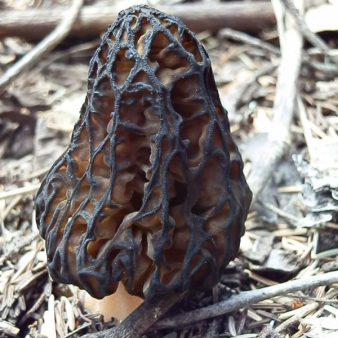
When mushroom hunter Terri Clements found a unique specimen near her home in Arizona, she couldn’t be certain by its appearance that she’d stumbled across a new species. She tracked down a commercial lab that would process DNA from samples she collected and studied the resulting sequences. Only later did she cold email a mycological scientist, who confirmed her work. As a result, this December, she became part of a team publishing a scientific paper describing her new mushroom species, Morchella kaibabensis, along with three others.

Clements_IMG_1300-2_web.jpg

Mushroom hunter Terri Clements used DNA sequencing to confirm a new species of black morel, Morchella kaibabensis, she found near her home in Arizona.

A former restauranteur and real estate executive who retired in 2012, Clements has no formal scientific training beyond her college microbiology minor. But using a combination of traditional taxonomy — the science of describing, naming, and classifying life on earth — and increasingly accessible DNA classification tools, she’s now hooked on documenting fungi either previously unknown in her region, or, just as often, new to science. “I spend hours and hours on it,” she says. “It’s like a full-time job for which I don’t get paid.”

Her work puts her in the ranks of an increasingly vibrant group of hobbyists busy documenting unexplored species on the planet, ranging from a chemical engineer in France, to a cybersecurity specialist in California, to retirees like Clements. Many study organisms from specific groups of fungi, insects, and other invertebrates that are less charismatic and surveyed than the orchids, birds, and butterflies that have long attracted the public’s interest. Continue reading

Green Is The New Black & Costa Rica Is Evergreen

merlin_151348896_9c4c515c-54c6-4612-a114-deaec4c35159-jumbo

Costa Rican wildlife was the theme of reception in February to formally introduce the government’s decarbonization strategy.

Somini Sengupta and her colleague Alexander Villegas published a story yesterday that resonates with the explanations Amie and I gave friends and family about our original decision to live in Costa Rica. It also resonates with the decision we made recently to return. In 2010 when we moved to Kerala it was not clear when, or even if, we would be back here. But our work in India was intertwined with Costa Rica’s evergreen pioneering role in the global conversation about conservation. So we are back. And the evergreen is appreciated, especially in the way Costa Rica’s president and his wife tell the story within a story.

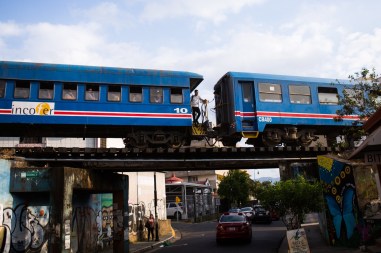
A diesel commuter train in San José. The government plans to replace older trains with electric models.

Despite it’s diminutive size, Costa Rica been at the forefront of the climate change conversation. While the country has only about 0.25% of the world’s landmass, it contains almost 5% of the world’s biodiversity. These statistics give both an added incentive to focus energies on shifting the juggernaut of climate change and the ecological soapbox from which to be heard.

Costa Rica has an infrastructural uphill climb, most specifically with transportation as is illustrated below, but the country has stood its ground successfully in the past. When we think of the country’s road network in the mid-1990s relative to the roads today, it gives one of many reasons to be optimistic:

Tiny Costa Rica Has a Green New Deal, Too. It Matters for the Whole Planet.

SAN JOSÉ, Costa Rica — It’s a green big deal for a tiny sliver of a country. Costa Rica, population 5 million, wants to wean itself from fossil fuels by 2050, and the chief evangelist of the idea is a 38-year-old urban planner named Claudia Dobles who also happens to be the first lady. Continue reading

The Mouth of the Well

The archaeologist Guillermo de Anda next to pre-Columbian artifacts in a cave at the Maya ruins of Chichén Itzá. Credit Karla Ortega/Mexico’s National Institute of Anthropology, via Associated Press

This new discovery in Mexico’s Yucatán Peninsula came to our attention just when we’re on an archaeological roll. It definitely gives us pause that there are still such important finds in the world.

In a cave under the ancient city of Chichén Itzá, Mexican archaeologists discovered a trove of ceramic artifacts that appear to be over 1,000 years old.

Archaeologists announced this week that they had discovered an extraordinary trove of well-preserved Maya artifacts under the ancient city of Chichén Itzá in Mexico’s Yucatán Peninsula.

The artifacts were found in a cave called Balamkú, less than two miles from the famed pyramid known as the Temple of Kukulcan, or The Castle, which sits in the center of the site.

Guillermo de Anda, an investigator with the National Institute of Anthropology and History, said in a statement on Monday that the remarkable discovery could help researchers rewrite the history of Chichén Itzá, which flourished from roughly A.D. 750 to 1200.

The city was built on top of a network of waterways, including sinkholes called cenotes, which the ancient Maya believed were sacred places that provided a portal to the underworld. Its name is sometimes translated as “the mouth of the well of the Itza,” the name of the main ethnic group in the area at the time.

Continue reading

Urban Archaeology


We’ve had friends and family members living in Atlanta for close to 30 years, and although I knew it was the hub of important aspects of American history, it never occurred to me to think of it in archaeological terms. At first consideration, I think about archaeology as the study of ancient cultures in far away places. Yet, with family in countries like Greece, I acknowledge that awesome layers of history can be just under the surface, or deeply buried and unearthed as cities grow with constructions of buildings and transit infrastructure.

This piece in the Georgia State University Magazine made that quite clear.

Treasures of Terminus

From its days as a railroad boomtown to Sherman’s tinderbox to one of America’s great cities, Atlanta’s history runs deep. The Phoenix Project, more than 100,000 artifacts collected by a team of Georgia State archaeologist in the 1970s, tells the city’s story through unearthed historical objects.

There is buried treasure at Georgia State University. Stacked high and deep in more than 500 boxes stashed throughout the labyrinths of Kell Hall, more than 100,000 artifacts tell the story of Atlanta’s history.

These boxes contain the lost pieces of a tumultuous past that dates to the city’s earliest days — bullet casings from the Civil War, mystery tonics in antique glass bottles, creepy toys, fashion accessories, ancient grooming tools and much more. Many of them still await examination and haven’t been opened since archaeologists first packed them four decades ago.

This massive array of objects is called the Phoenix Project, and Georgia State professors and students have been methodically studying, cataloging and mapping each item since 2011.

Collected all over the city between 1976 and 1980, the objects belong to the largest archeological collection ever associated with Atlanta. They are the fruit of one of America’s earliest urban archaeological projects — the roving excavation that followed construction crews as the Metropolitan Atlanta Rapid Transit Authority (MARTA) cleared land, leveled blocks and tunneled underground to build the first iteration of its rail system.

Jeffrey Glover, associate professor of anthropology, has curated the Phoenix Project for years in hopes of providing the public with a different kind of city history, a slice of Atlanta’s past through the lens of historical objects.

Catalog No.: P1848/170 Swamp Root Kidney, Liver and Bladder Cure, c. 1890, manufactured by Dr. Kilmer & Co., Binghamton, NY.

Choosing one box among hundreds, Glover removes a small amber bottle that once held Valentine’s Meat Juice, a concentrated beef tonic from the 1870s. Advertisements said it could help with gastroenteritis, dysentery and even cholera.

“It was supposed to bring vitality,” Glover says, “like an early energy drink.”

From another box, he takes out the misshapen head of a porcelain doll. Featuring dark, empty eye sockets and covered in burn marks, the scary toy looks hungry for souls. While Glover affectionately calls it the “creepy doll head,” its official artifact ID is “a3161,” written in impeccable script with archival ink across its neck.

That’s because the archaeologists who bagged all this stuff in the 1970s methodically described and organized each item using a numbering system adapted from the Georgia Department of Transportation. For example, the “a” in “a3161” stands for “general artifact” while the number indicates the item was the 3,161st general artifact to be cataloged from that accession. (And there are about 100 accessions.) Containers, such as glass and pottery, begin with “p,” and building materials with “m.” Plant remains use “eb” for “ethnobotanical” while animal bones start with “ez” for “ethnozoological.”

Just one of the standard cardboard bankers boxes can contain dozens, if not hundreds, of artifacts, each wrapped in brown paper and labeled with a unique artifact ID. Though they’ve all been recorded in a logbook alongside a one-line description, unwrapping each one is like opening a birthday present because you don’t know exactly what you’ll get.

“It’s an excavation of boxes,” says Lori Thompson (M.A. ’16), assistant laboratory director at New South Associates.
Continue reading

Fighting Climate Change With Ecosystem Restoration

Photo by Pexels

Throughout the history of this site we’ve focussed on accentuating positive steps in conservation, while also pointing out the negative forces with the intention that knowledge is power that leads to action.

We applaud the UN Environment Assembly for pressing further into the remaining window of opportunity to restore ecosystem health.

New UN Decade on Ecosystem Restoration to inspire bold UN Environment Assembly decisions

The UN Environment Assembly in Nairobi, Kenya, is the world’s leading decision-making forum. From 11 to 15 March 2019, it will be considering how best to improve outcomes for people and planet. Ecosystems will be high up on the agenda.

The timing looks good. The UN Decade on Ecosystem Restoration 2021-2030, declared on 1 March 2019 by the UN General Assembly, aims to massively scale up the restoration of degraded and destroyed ecosystems as a proven measure to fight climate change, and enhance food security, water supply and biodiversity.

The degradation of land and marine ecosystems undermines the well-being of 3.2 billion people and costs about 10 per cent of the annual global gross domestic product in loss of species and ecosystems services. Key ecosystems that deliver numerous services essential to food and agriculture, including supply of freshwater, protection against hazards and provision of habitat for species such as fish and pollinators, are declining rapidly.
Restoration of 350 million hectares of degraded land between now and 2030 could generate US$9 trillion in ecosystem services and take an additional 13 to 26 gigatons of greenhouse gases out of the atmosphere.

UN Environment and the Food and Agriculture Organization of the United Nations will lead implementation of the UN Decade on Ecosystem Restoration. Continue reading

From Panama, Of Bushwick, Reducing The Impact Of Food Waste

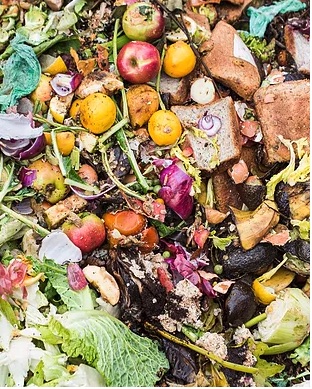
Food waste, a problem whose partial solutions are myriad, has been on my radar since Milo posted about it. Its root seems obviously related to not properly pricing the input resources, like land, water, etc., which paradoxically makes it possible to produce an abundance sufficient to waste. But dealing with the problem at the tail end of the value chain is another partial solution so the video above is worth a few minutes of your time.

BKRotIf, when you finish that, you want to learn more, click the logo to the left. And if you live in Brooklyn you might want to participate in some manner.

BKRot2.jpg

Home Composting.  Rabbit Roots is a home food scraps pick up service. For a monthly rate our bikers will collect straight from your door to our compost site.

If you live nearby, get more information about how to subscribe to their home composting program by clicking here. Sandy and her operation tell me that waiting for someone else to solve the collective action problem is wasted time. David Owen brought her and it to my attention in this short profile:

…BK ROT was founded, in 2013, by Sandy Nurse. She was born in Panama, in 1984—both her parents were in the U.S. Navy—and grew up mainly there and in South Korea and Japan. She studied international affairs at the New School and assumed that she was headed for a diplomatic career. But she changed her mind after working on food assistance in Haiti after the big earthquake there in 2010.

190311_r33860web.jpg

This article appears in the print edition of the March 11, 2019, issue, with the headline “Sacred Rot.”

“I came back to New York and got really excited about urban resiliency and food sovereignty and disaster recovery,” she said recently. BK ROT was one of the results. “We have a very specific mission of environmental and social-justice values, and grassroots accountability to the neighborhood, and transparency, and giving our output, the compost, back into food-growing and soil-building operations.” BK ROT is partly a grant-supported jobs program for young people. (Ibarra and his co-workers, most of whom live in the neighborhood, earn fifteen dollars an hour.) Nurse also teaches community activism and basic construction skills, which she studied as a trainee of the New York City District Council of Carpenters.

BKRot1.jpgAt BK ROT, food waste is mixed with wood chips and sawdust, then moved, over a period of weeks, through a succession of wooden bins the size of washing machines. By the time it reaches the final bin, it’s black and bug-covered and unrecognizable as former food. Then it’s heaped into sloping, loaflike piles, called windrows. “Convection sucks in air from the bottom and pulls it to the top,” Nurse said. “That keeps the microorganisms inside the windrows healthy.” The resulting mass is eventually shovelled into a rotating cylindrical sifter that looks like something you might pull bingo numbers out of; the original version was built by a friend of Nurse’s, who found instructions on YouTube. The compost is sold in local stores and directly to individuals—“Somebody came from Staten Island yesterday and took a bunch,” Nurse said—but most of it goes to nearby urban farms and community gardens, a few of which Nurse herself helped to start.

Adaptation & South-South Cooperation

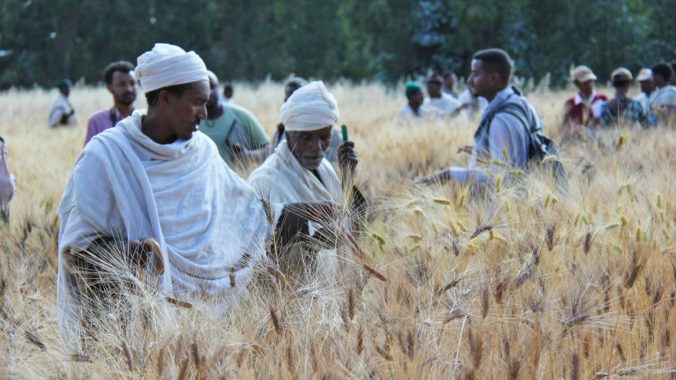
Ethiopia_Wheat_23496722552_5868e72816_k_web

Ethiopian farmers examine the results of a trial of wheat varieties. BIOVERSITY INTERNATIONAL

The bread we eat in the not so distant future may depend on the type of cooperation described below. Thanks to Yale e360 and Virginia Gewin for this story:

How Crowdsourcing Seeds Can Help Farmers Adapt to Climate Change

In Ethiopia and other developing nations, scientists are working with small-scale farmers on trials to see which seed varieties perform best in changing conditions. These initiatives are enabling farmers to make smarter crop choices in the face of rising temperatures, drought, and more extreme weather.

Ethiopia_Wheat_23605266175_c076fa1be7_k_web.jpg

Durum wheat varieties grow in trial plots in Ethiopia’s Amhara region. Thousands of farmers participated in the project, testing how various wheat strands performed under changing climatic conditions. BIOVERSITY INTERNATIONAL

In Ethiopia’s undulating, high-elevation grasslands, farmers — most of them working parcels of only two to three acres — produce more wheat than anywhere else in sub-Saharan Africa. They accomplish this feat in the face of chronically short supplies of high-quality seed. Still, Ethiopia’s record harvest of 4.6 million metric tons in 2017 didn’t satisfy the country’s needs, forcing it to import an additional 1.5 million tons of wheat. Continue reading

Elephants By The Sea

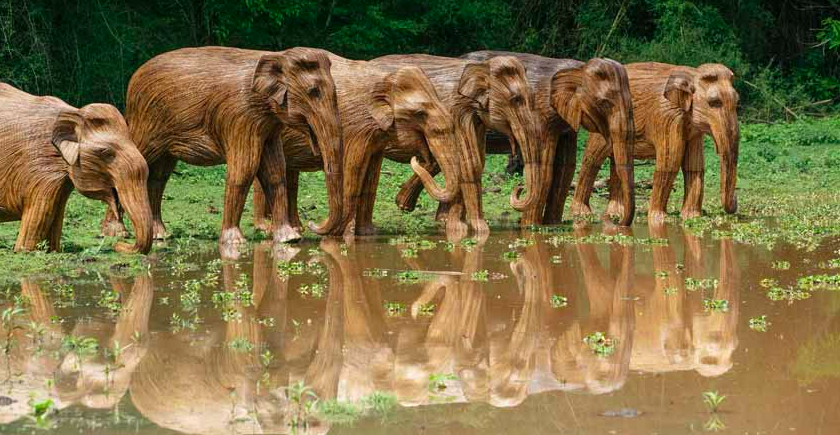
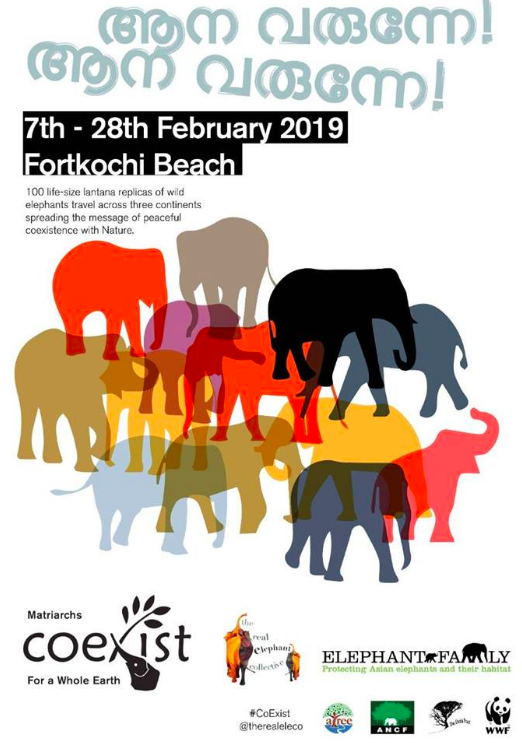
100 life-size lantana replicas of wild elephants will travel across three continents spreading the message of peaceful coexistence with nature.

The beautiful herd of Asian Elephants calmly drinking from this watering hole poses no threat to any onlooker. They’re actually sculptures made from the invasive lantana, introduced to the Indian subcontinent as an ornamental shrub by the British. The harmless looking plant is a scourge to native flora, animals and people of the regions where it’s taken over, as it literally poisons its surroundings so nothing else can survive there, destroying the natural biodiversity of the area.

30 of these extraordinary, life-sized works of art have been on display in Kerala, at Kochi’s South Beach, coinciding with the Kochi-Muziris Biennale. The outdoor exhibit, entitled Co-Exist: Matriarchs for a Whole Earth, is on display for only until the end of February, after which it will travel to Bangalore and New Delhi. In 2020, the elephant models will be taken to England where they will be displayed at the Victoria and Albert Museum and the Royal Parks, both in London. In 2021, they will travel by truck across the USA, where they will finally be auctioned, the proceeds of which will go to preservation of wild animals.

The project is a collaboration between multiple organizations, designers and indigenous community artisans. Members of the Ashoka Trust Trust for Research in Ecology & the Environment (ATREE) devised a way to safely craft with lantana as a raw material and support for the making and display of lantana elephants is through the NGOs Elephant Family, The Real Elephant Collective (TREC), and The Shola Trust.

Fort Kochi To Have 100 ‘Lantana’ Elephants. And Here’s Why You Need To See Them

Highlighting the cause of nature and wildlife conservation at a global scale, the Lantana elephants are part of a greater initiative to raise funds for conservation and help people and elephants live together more harmoniously.

On February 7, if you are wandering around the popular South Beach in Fort Kochi, you are sure to come across a magnificent herd of 100 Asian elephants.

If you are wondering about the possibility of such a huge congregation of these beings at one place, let us break the news.

These are beautifully sculpted life-size elephants that have been made by tribal artisans from Thorapalli in Gudalur using Lantana camara or Lantana, a toxic invasive weed.

Lantana elephants are part of a greater initiative to raise funds for conservation and help people and elephants live together more harmoniously.

“Our vision is to bring Asia’s elephants and the issues they face out of India and the shadow cast by the African ivory crisis. With Asian elephants numbering only a tenth of their African counterparts, the importance of this unique migration cannot be underplayed. The survival of a species is at stake,” says Ruth Ganesh, principal trustee and the creative force of Elephant Family.

She had conceptualised the Lantana herd along with Shubhra Nayar of TREC. Modelled on real elephants from the Gudalur-Pandalur region, in its bid to raise awareness and funds for the conservation of Asian elephants, this unique project is also clearing the harmful Lantana from the Nilgiri forests while providing livelihoods to about 70 artisans from the Paniya, Bettakurumba and Soliga communities.

With their inherent knowledge of wild elephants and their exceptional crafting skills with Lantana, these artisans are bringing life to the elephant forms, while earning a dignified income. The elephants are designed by Shubhra Nayar and Tariq T of TREC, with Subhash Gautam overseeing the process. Continue reading

15 Minutes Of Fame For A Good Cause

It takes the full 15 minutes of video above to fully appreciate what happened a few days ago. The soundbite 57 second version had me convinced that the senator was haughty and deserved to be schooled by these kids. But the full picture above, as often happens, provides better perspective, an attribute of little l liberalism. She was not quite the jerk I first thought.

McKibben-Dianne-Feinstein.jpg

In an exchange that went viral, the senator from California demonstrated why climate change exemplifies an issue on which older people should listen to the young. Photograph by Mark Peterson / Redux

There was a moment in time when a political slogan about something very important became a movement with potential; and then it seemed to disappear as quickly as it had appeared. That was my first exposure to political activism, and certainly not my last. But it provided an important lesson. Use the time you have on the stage wisely. I get reminded of this constantly in the last few years. This dispatch by Bill McKibben is what I take away from the moment these kids had in the spotlight:

Preparing For Global Big Day 2019

GBD-world-map_2-1024x624.jpg

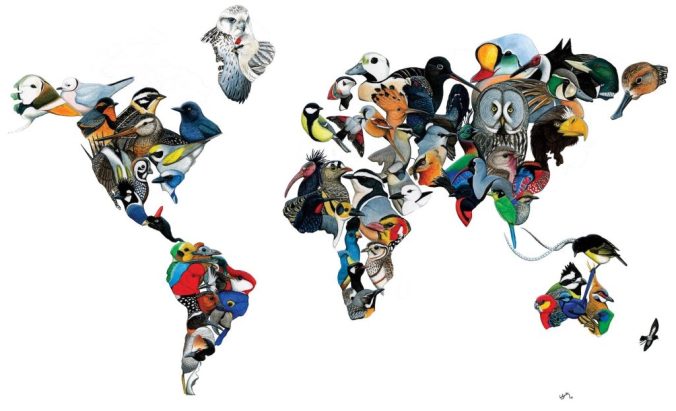
Global Big Day artwork by Luke Seitz

The first time we took part in this annual event, we had already had several years of advance prepping. For example, we had this young man as an intern who was something of a birding wunderkind. Ben helped us determine whether our region of the Western Ghats was likely to appeal to birdwatchers. Short answer, yes. That same summer, 2012, Seth was in his second year working for the Lab of Ornithology and we could see that not only our company’s work but our own family was becoming more birdy, if not yet bird-nerdy.

This year will be the best year yet for birding, and to prove it I am starting today to get ready for the next Global Big Day. I do not know where we will be that day, yet, but I am working on plan. May I suggest you do the same?

Global Big Day—4 May 2019

By Team eBird 

Last May, more than 30,000 people took to fields and forests around the world, noting more than 7,000 species in a single day—Global Big Day. In less than 3 months, birding’s biggest day is coming back. Wherever you are in the world, you can be a part of birding’s next world record!

On 4 May, will you join more than 20,000 others and become a part of Global Big Day? You don’t have to commit to birding for 24 hours—an hour or even 10 minutes of watching birds makes you part of the team. Visit your favorite spot or search out someplace new; enjoy a solo walk or get some friends to join in the Global Big Day fun.

How to participate

  • Get an eBird account: eBird is a worldwide bird checklist program used by millions of birders. It’s what allows us to compile everyone’s sightings into a single massive Global Big Day list—while at the same time collecting the data for scientists to use to better understand birds. Sign up here. It’s 100% free. Continue reading