Library Futures

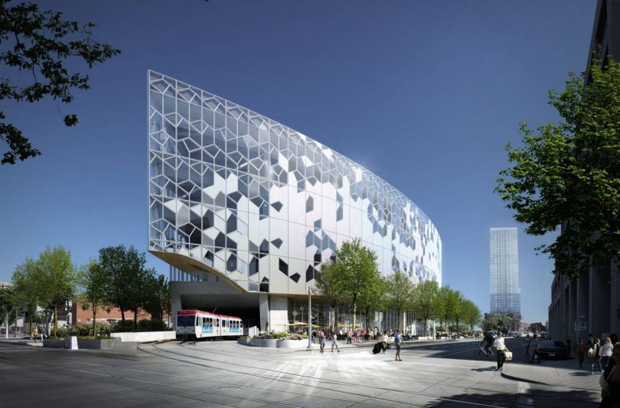
The New Central Library, Calgary, Canada - Snøhetta

The New Central Library, Calgary, Canada – Snøhetta

Thanks to Phaidon for these images and accompanying story that leads us to believe that libraries are less endangered than we might otherwise have thought, a story about a beautiful new library:

Snøhetta unveils ‘floating’ library design in Canada

Calgary design will feature arches inspired by cloud formations and will house over half-a-million books

As the Frankfurt Book Fair opens this week work has already begun in Calgary, Alberta, to construct a home for 600,000 books directly above a transport hub. The New Central Library by Norwegian starchitects Snøhetta will sit at the intersection of Downtown Calgary and the cultural hotspot that is East Village.

Trains on the light rail track will chug along tracks that appear out of the base of the slim, curved structure, with the library ‘lifted’ above the public transport below. A covered plaza has been created by cutting away the ground levels of the building, as if slicing through the corner of a pat of butter. Continue reading

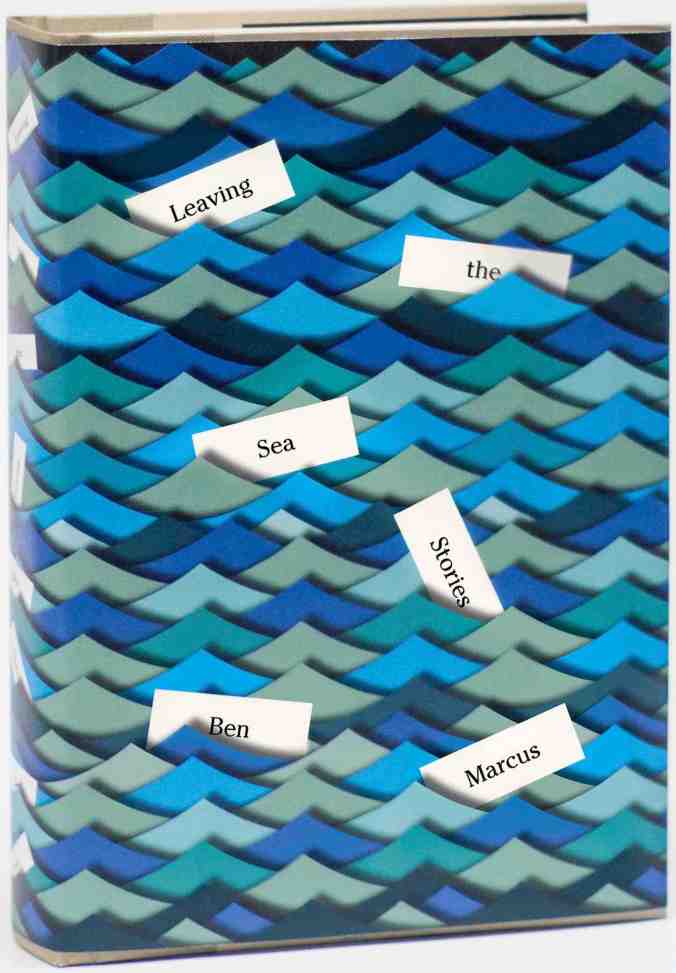
Book Covers, Storytelling, And The Mind’s Eye

Author Ben Marcus described Peter Mendelsund's cover for his story collection Leaving the Sea as "sumptuous, playful and gorgeous to look at."

Author Ben Marcus described Peter Mendelsund’s cover for his story collection Leaving the Sea as “sumptuous, playful and gorgeous to look at.”

We are most of the time sharing stories, told by our own contributors or chosen by them from other sources, that say something relevant about community, about collaboration, and/or about conservation.  And many of us are involved day to day in hospitality that offers authentic experiences of immersion in “faraway places” relative to where the traveler comes from. We frequently share stories about books and libraries because they are the building blocks of preparation for appreciating what one finds on a long journey away from the familiar. So, this story about a book cover designer was destined to capture our attention:

Peter Mendelsund estimates he’s designed “somewhere between 600 and 1,000 book covers,” ranging from Crime and Punishment to Girl with the Dragon Tattoo. But the self-taught, sought-after designer says he spends a lot of time reading, too. Continue reading

A Norwegian Sense Of Obligation

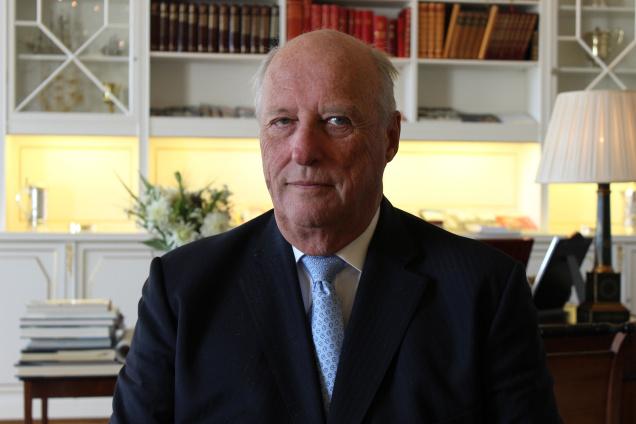
Norwegian King Harald V.  Photo: P. J. George

Norwegian King Harald V. Photo: P. J. George

From today’s Hindu, an interview with the King of Norway. It may be an example of noblesse oblige, but it is an interesting story at a time when some other developed economies have determinedly charged hard right, away from state-sponsored welfare:

‘We had a problem — too much money’

Interview with Norwegian King, Harald V, on the country’s successful welfare model, its oil and gas reserves and the threat of climate change

The Norwegian society is at present debating several issues, including its economy, climate change, immigration and the changing cultural milieu. In all these, the country often looks to its King, Harald V, for a decisive voice… A renowned sailor, he carries out royal duties with aplomb even at the age of 77. He spoke to The Hindu recently in Oslo on the triumphs and concerns of his country. Excerpts: Continue reading

If You Happen To Be In Big Sur (But You Don’t Have to Be…)

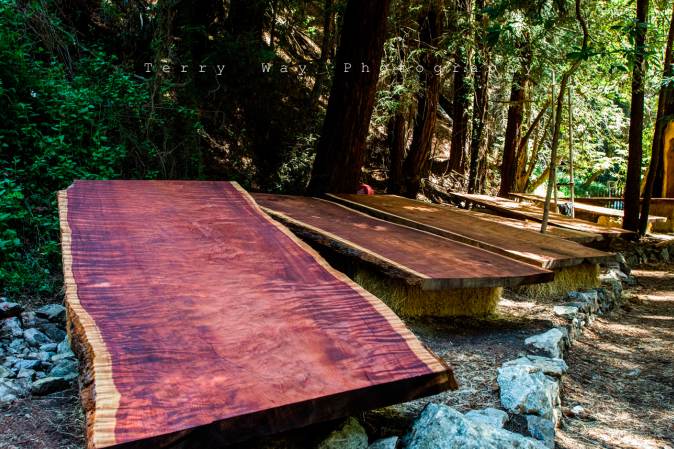
Big Sur fallen redwood auction: Proceeds benefit the Henry Miller Memorial Libarary

Big Sur fallen redwood auction: Proceeds benefit the Henry Miller Memorial Libarary

Although we’d never wish damage to a tree of this age and history we’re happy to hear that the rare and beautiful wood will help a cause near and dear to our hearts.

Profits generated from the redwood auction will be used for the following purposes:

Upgrading the Library to meet State and Federal regulatory requirements. This includes a water-treatment system, ADA compliant bathrooms, upgraded septic system, and more. Bringing the Library into compliance will ensure the Library can remain operational while also providing exceptional programming, including our acclaimed short film screening series,workshops, audio series, etc. This will require paying for building and maintaining a water system as well as paying related legal and administrative fees. Continue reading

World Tourism Day

September 27th is World Tourism Day! As the UNWTO Secretary-General Taleb Rifai said in his address this year,

Tourism is a people-based economic activity built on social interaction, and as such can only prosper if it engages the local population by contributing to social values such as participation, education and enhanced local governance. At the same time, there can be no real tourism development if such development damages in any way the values and the culture of host communities or if the socio-economic benefits generated by the tourism sector do not trickle down to the community level.

Continue reading

Throwback Thursday: Community, Collaboration & Conservation Exemplified

When Horace Greely (well, actually John B. L. Soule) said “Go West, young man, and grow up with the country!” he was speaking from the perspective of limitless possibilities. The Lewis and Clark Expedition had helped map out the west and many young men, and later women, answered the call.

With wilderness in peril, that same entrepreneurial spirit has opened up a new world of empowerment and possibilities for later generations.  The California Conservation Corps and Southwest Conservation Corps have teamed with the non-profit Veterans Green Jobs in a win-win program to support both the country’s military veterans and the country’s national parks. Continue reading

Conservation, Passenger Pigeons, History Of Extinction

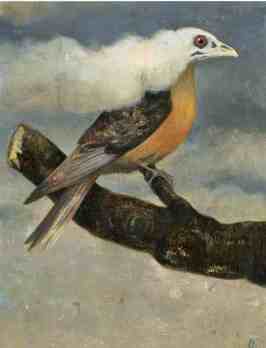
Gérard DuBois

Gérard DuBois

My favorite doomsday journalist (and I mean that as the highest compliment) posted over the weekend an unamusing memo to remind us that this is an important centenary anniversary. It ups the ante on our commitment to the community of birdwatchers, casual and serious alike, who support important conservation of wildlife habitat all over the world.

It is not amusing to be reminded about various tragic commons, especially ones for which collective action would seem to have been achievable. We link to these stories in the hope that doomsday outcomes will become less likely if we remind ourselves often enough.

Yesterday the ever-better New York Times, newspaper of record that pays more and better attention to environmental issues than most other publications, saw fit to print this piece by the Executive Director of the Cornell Lab of Ornithology, for which we give our thanks and share with you in whole due to its value as a public service:

ITHACA, N.Y. — THE passenger pigeon is among the most famous of American birds, but not because of its beauty, or its 60-mile-an-hour flight speed. Nor is it a cherished symbol of our great country. No, we remember the passenger pigeon because of the largest-scale human-caused extinction in history.

Continue reading

Why We Walk

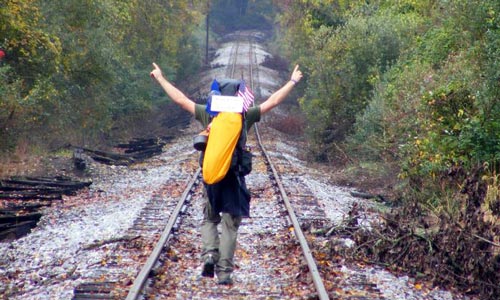
Photo Courtesy of digitaldeconstruction.com

Photo Courtesy of digitaldeconstruction.com

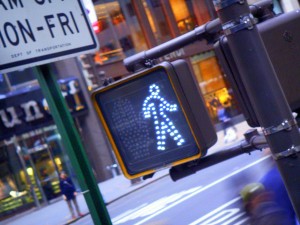
I have been endlessly fascinated by walking. I asked myself Why We Walk while I walked 400 km on the Camino de Santiago. A recent article by Adam Gopnik in the New Yorker has brought me to this question again in a new context. The article talks about what it means to be a pedestrian in the modern world and how the role of walking has changed as it’s become less necessary. The sad thing about walking for pleasure instead of necessity means that it occurs less. Many of us spend our lives in the sitting position: sitting in cars to then go sit at work and then sitting at home after a long day of sitting. I’m generalizing here as I call myself out on my sedentary life. Our bodies are made to walk, so I must ask myself, Why Don’t We Walk?

Roads are not enjoyable to walk in an increasingly auto dependent world. When living in a residential area there isn’t much activity to make walking around something that invites ‘randomness’. Adam Gopnik writes in the New Yorker about Why We Walk. He says,”We start walking outdoors to randomize our experience of the city, and then life comes in to randomize us.” The sidewalks are public space. In the suburbs we have a lot of private space and little public space. I have to wonder how it could affect our psyche to not brush up against the world. I wonder what we take away when we lose the opportunity to have chance interactions in indeterminate public spaces.  I wonder how creative we could be as a culture if the majority of our interactions with strangers didn’t occur over money exchanges. Adam Gopnik talks about the vague excitement and pure chance of walking in New York City.

You could walk anywhere. Saturday all day, Sunday all day, I’d tramp through the lower-Manhattan neighborhoods. The differences, architectural and social, among Tribeca and SoHo and the East Village, to name only contiguous areas, were distinct and vivid and nameable then: cast-iron buildings shading off into old egg- and paper-carton factories sweetly interrupted by small triangular parks, and edging over, as you walked east, into poor-law tenements that were just being reclaimed by painters. I would set off on a Saturday morning and walk all day, and achieve Kazin’s feeling of vague excitement, of unearned release, in a way that I have never felt before or since.

I like this description because it shows the way he was able to interact with the environment around him as a walker. Suburbs that are designed for cars make walking an outdated form of transportation. It’s inefficient and time consuming if you live in a city that’s designed for cars rather than pedestrians. In the suburbs, there aren’t many people dancing in the ‘sidewalk ballet’ as Jane Jacobs puts it. So, I just wonder what a healthier culture there would be if there were more public space for people to live outward facing lives that brushed up against each other.

The article brings up a quote from Frédéric Gros’s book A Philosophy of Walking, “The purpose of walking, is not to find friends but to share solitude, for solitude too can be shared, like bread and daylight.” This quote to me highlights the sort of communion we can have with each other while walking. While I was walking the Camino, I felt that communion with fellow walkers as well as with the landscape. I was sharing solitude with the landscape. I think taking away that walking aspect of communion in our lives further isolates us from nature. Continue reading

Andrew Forsthoefel, Come To Kerala!

AndrewSlider

Andrew Forsthoefel. Photo by Therese Jornlin, Andrew’s mom. Chadds Ford, PA.

The interns we have had the honor of hosting since setting up shop in Kerala a few years ago have all shared in the responsibility to communicate their experiences in writing on this blog. We are committed to the written word, but not Ludditically opposed to other forms of communication. We have barely put a toe in the water with video, and not even thought about radio as an option, even though we consider Jay Allison an epic hero of good, important communication.

Because of him, we know alot of worthy things that otherwise would have escaped our attention; most recently we learned of and from Andrew Forsthoefel, whose radio story is worth an hour of your time. After which, if you are like us, you will want to know where he is now, and what he is doing. We hope Andrew will see our shout out here and consider our welcome mat in Kerala. Here is his introduction to the podcast when it originally aired nearly 17 months ago: Continue reading

Humans of New York: The power of documentation

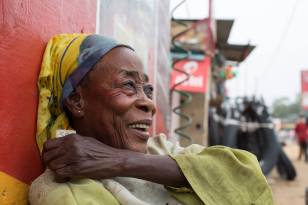
10575445_746153385458764_7383111873998406356_o

She said she’d let me take her photo if I bought some peanuts from her. Afterward, I asked if she could remember the saddest moment of her life. She laughed, and said: “You’re going to need to buy some more peanuts.” (Kasangulu, Democratic Republic of Congo) Photo Credit: Brandon Stanton

This article from the New York Times describes the recent social media phenomenon- Brandon Stanton’s Humans of New York site and facebook page. At first he was just making portraits of strangers in New York City after losing his job as a bond trader. Then it evolved into interviewing the people about their lives and using them as captions to the photos. Now, he has been commissioned by the United Nations to do a 50-day world tour doing the same thing, but in some of the areas of the world with “the most extreme headlines coming out” to document life on the streets there.  The purpose of the tour is to raise awareness for the UN Millenium Development Goals and to inspire a more global perspective.

I have been a part of the 9.2 million people following him on facebook and just watching the exponential rise in followers since this UN tour has been quite incredible. There has been overwhelming support for his work. Thousands of people writing extensive comments reflecting on how the portraits capture what’s happening in the world. I’ve noticed a lot of heartfelt dialogue inspired by his work in the comments. Continue reading

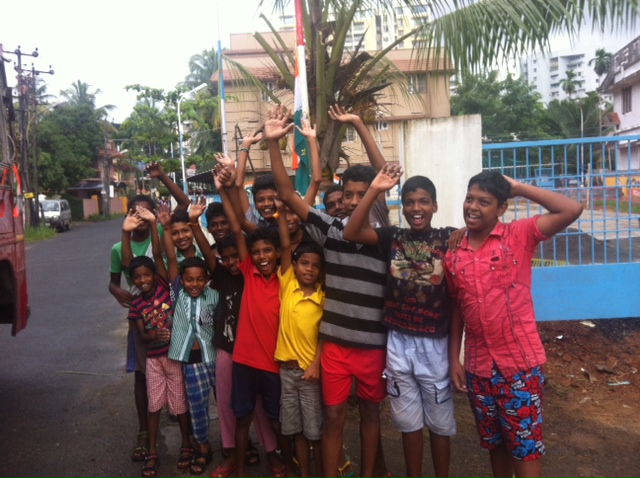
Our Gang, Thevara, On Independence Day

It has been a while since so much of the gang was gathered in one place at one moment. If you look back through the Our Gang, Thevara series over the life of this blog, you will find these, our usual suspects, all represented one time or another. Today, Independence Day 2014, they wanted their voices heard and faces seen again!

Hambledooners, Conservation Entrepreneurs

Hambledon Hill, Dorset, UK, in late afternoon sunlight. Photograph: Mark Bauer/Alamy

Hambledon Hill, Dorset, UK, in late afternoon sunlight. Photograph: Mark Bauer/Alamy

National Trust is a private UK-based conservation organization whose nearly 4,000,000 members and more than 60,000 volunteers make great things happen. That leads to about 50,000,000 visitors to sites like this recently created protected area:

National Trust buys Hambledon Hill in Dorset

Pristine chalky outcrop is a treasure trove of plant species and a butterfly haven untouched by modern farming since Iron age

Continue reading

Newspaper Bag Station at Cardamom County

???????????????????????????????

New member of PaperTrails stationed at Cardamom County

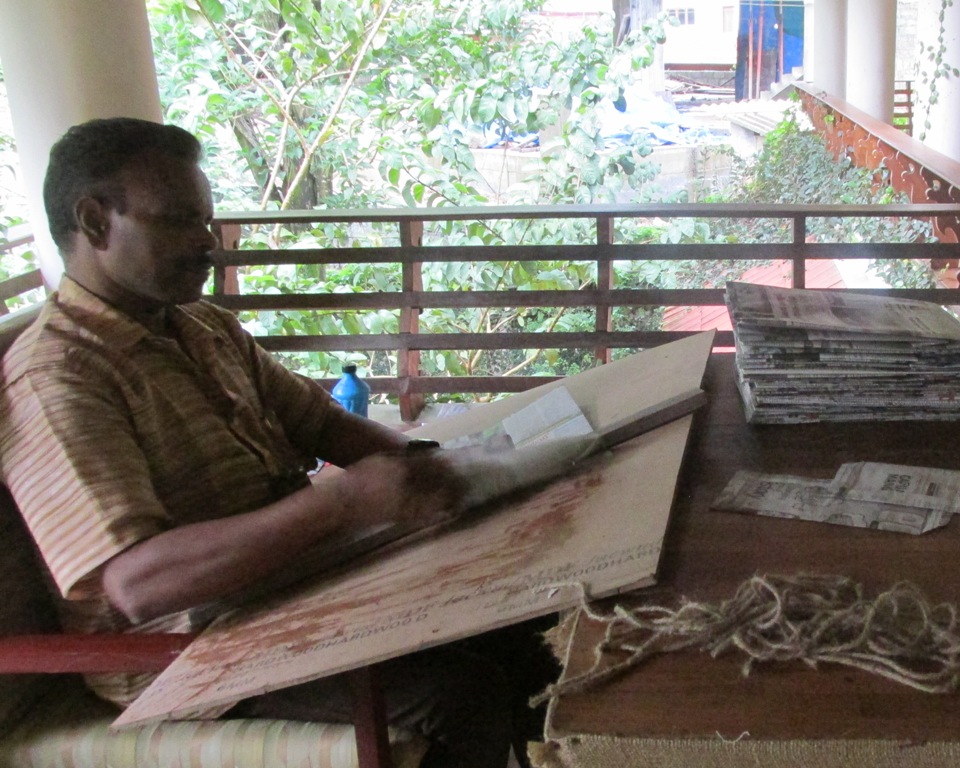
At Cardamom County, we have been working to get the local community involved through the group PaperTrails. PaperTrails helps provide jobs for people who could otherwise not get them. La Paz Group has appreciated the way it involves the locals by providing work and  re-purposing old newspaper. For La Paz Group they make gift bags out of recycled newspaper and sanitary bags from recycled paper. Now, we have a new member of the PaperTrails team stationed at Cardamom County. He is stationed on the second level of the Ayurvedic Center and makes bags for all the La Paz Group properties.. We like this because now guests can engage with the paper bag initiative in a new way. They can see how they are made and learn to make them as well.  Continue reading

Festival Of The Gods – Theyyam

Photo credits : Shymon G

Photo credits: Shymon G

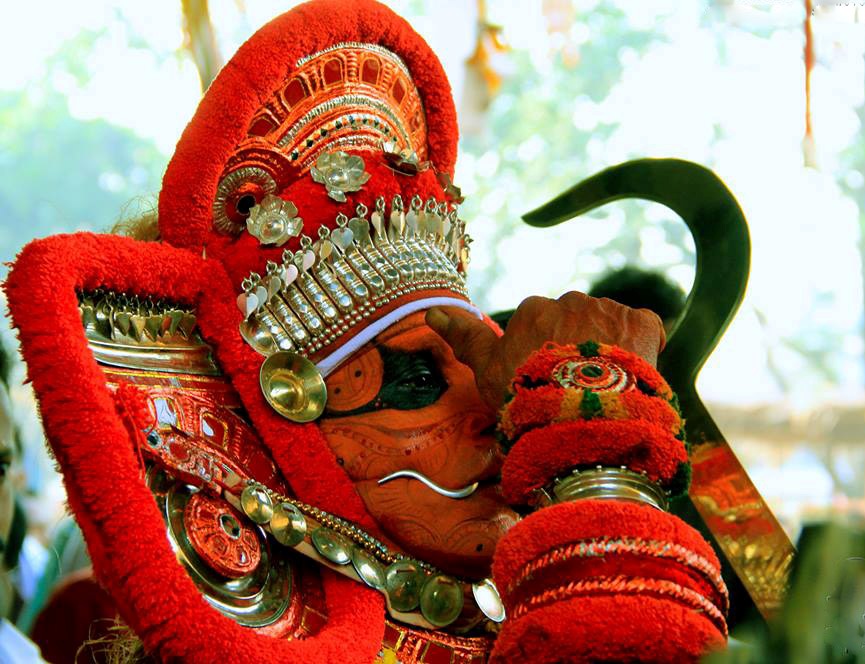
Theyyam is one of the most popular ritualistic dances of Kerala. It is a devotional performance with a surrealistic representation of the divine. Almost every village in Kerala has its own temple with an annual festival. So there’s always a local festival happening somewhere or the other, each with its own special flavour. Continue reading

Al Fresco Meals Across Time and Space

This slideshow requires JavaScript.

Long after humans made living indoors commonplace we still carry the strong desire to commune with nature in one way or another. Whether through gardening or exploration, we crave being outdoors, and that often has meant bringing our meals with us.

The origin of the word “picnic” is unclear. It first appeared in an English dictionary in 1748, and it probably derived from the French pique-nique.

A 17th-century French pique-nique may have been what we now think of as a potluck. In the 18th century, its American counterpart may have been more like a salon gathering. By the 19th century, though, it had become common for Americans to hold these events outside. Continue reading

Temple Festival – Ezhara Ponnana

Photo credits : Ramesh Kidangoor

Photo credits: Ramesh Kidangoor

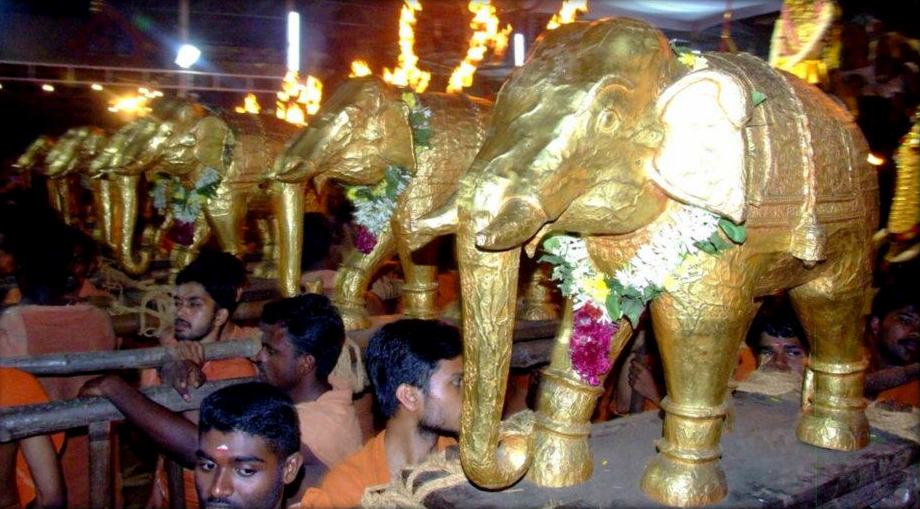
Ezhara Ponnana is a unique temple festival at Ettumanoor, a temple to Lord Shiva near Kottayam. “Ezhara” means seven-and-a-half and “Ponnana” means golden elephant. Statues of these elephants are made of nearly 13 kg of gold each. Seven of the elephants are two feet high, but the eighth one is only one foot tall, which gives the procession and festival of Ezhara Ponnana its name. Continue reading

Temple Dance – Kerala

Photo Credits : Ramesh Kidangoor

Photo Credits: Ramesh Kidangoor

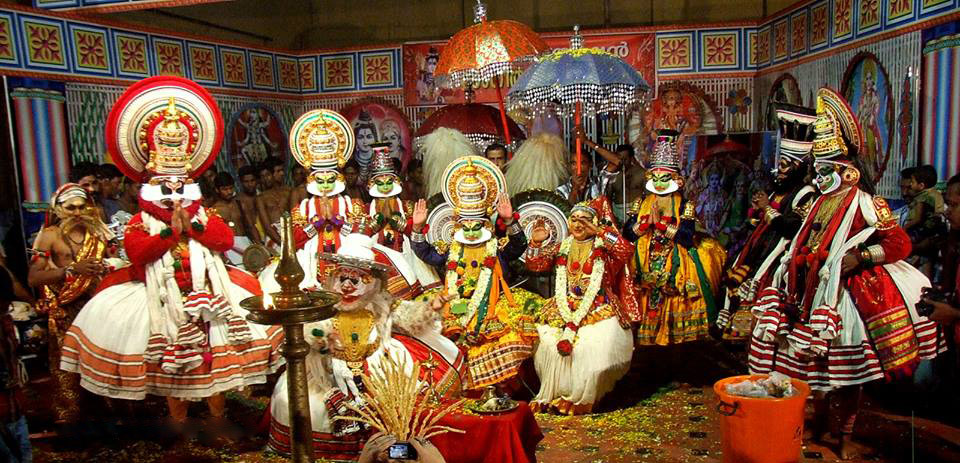
Kerala temples offer a veritable array of performing arts, often related to religious rituals and and mythological stories. The rhythm and elegance of the temple dances of Kerala are a result of  the various cultural influences that took place in the state. The dramatic costumes, vibrant colors, and throbbing music all make watching temple dances an unforgettable experience. Continue reading

The Ritual of Karkidakam Vavu bali


Photo credits : Remash Kidangoor

Photo credit: Remash Kidangoor

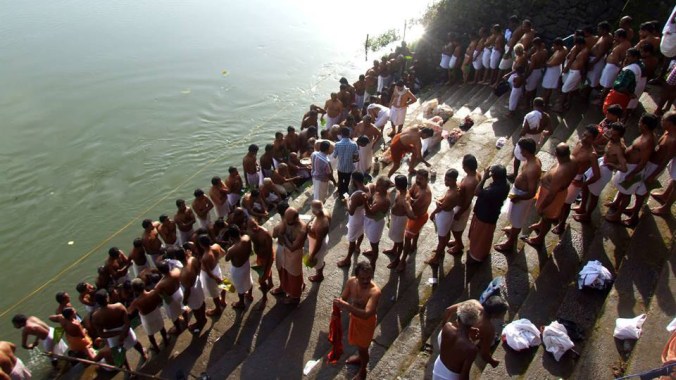
Karkidakam is the last month of Malayalam calendar, a calendar of significance for Hindus living in Kerala. On the eve of the new moon in Karkidakam–two days ago, July 26th–Keralite Hindus gather on the beaches and river banks to pay obeisance to their ancestors by performing the bali tharpanam ritual. This day is known as Karkidakam Vavu. Keralite Hindus believe that the souls of their ancestors attain liberation by the ritual pujas (prayers) and bathing on this day. Continue reading

Community, Control, Conservation

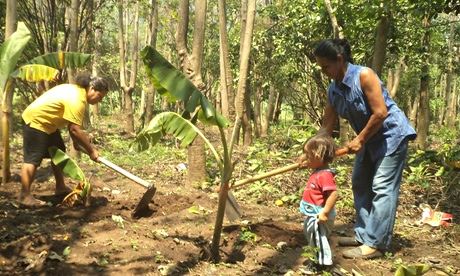
Salvadorans Elsy Álvarez and Maria Menjivar, with her young daughter, plant plantain seedlings in a clearing in the forest. Photograph: Claudia Ávalos/IPS

Salvadorans Elsy Álvarez and Maria Menjivar, with her young daughter, plant plantain seedlings in a clearing in the forest. Photograph: Claudia Ávalos/IPS

We have normally emphasized the word collaboration in conjunction with the conservation initiatives carried out by communities. This article in the Guardian points to research findings that indicates that another c-word, control, is sometimes key to understanding how communities reduce deforestation:

…Analysis suggests that in areas formally overseen by local communities, deforestation rates are dozens to hundreds of times lower than in areas overseen by governments or private entities. About 10-20% of global greenhouse gas emissions are attributed to deforestation each year.

The findings were released by the World Resources Institute (WRI), a thinktank, and the Rights and Resources Initiative (RRI), a global network that focuses on forest tenure. Continue reading

Gianluca, Come To Kerala!

sada-bike

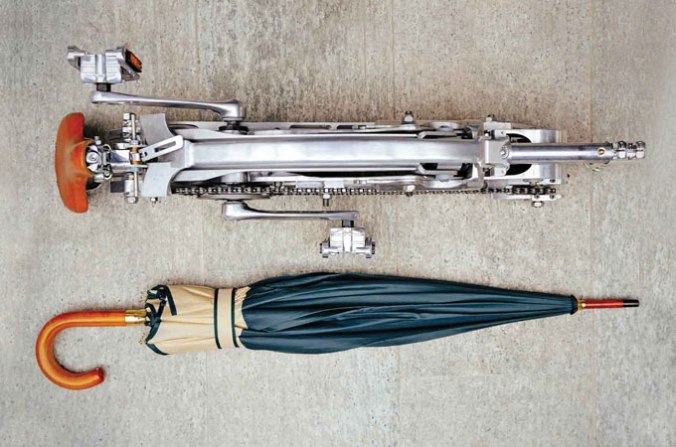
As the metropolitan area of Ernakulum, where Raxa Collective has many contributors who commute to work, completes its futuristic mass transit scheme, our thoughts reach out to a time when the collapsible bike is a necessity here. For now, we can appreciate the design for its own sake of this model that has just come to our attention.

We like everything we read about it, as much as the visual aesthetics. We even hope we might be of some service to its creator, given our history with entrepreneurial conservation. We are on the lookout, constantly, for opportunities to collaborate with creative craftsmen and to welcome them into Raxa Collective’s growing community across the globe. Conservation magazine brought Gianluca Sada onto our radar. We extend to him our usual invitation for a visit thanks to that:

COLLAPSIBLE COMMUTE

Carrying a bicycle onto a bus or subway for unrideable sections of your carless commute is less than convenient. This is where the Sada Bike fits in. Whereas other foldable bikes have shrunken frames and wheels, the Sada Bike’s full-sized frame folds down to the size of an umbrella; its spokeless, hubless, 26-inch wheels double as a backpack frame.

Continue reading