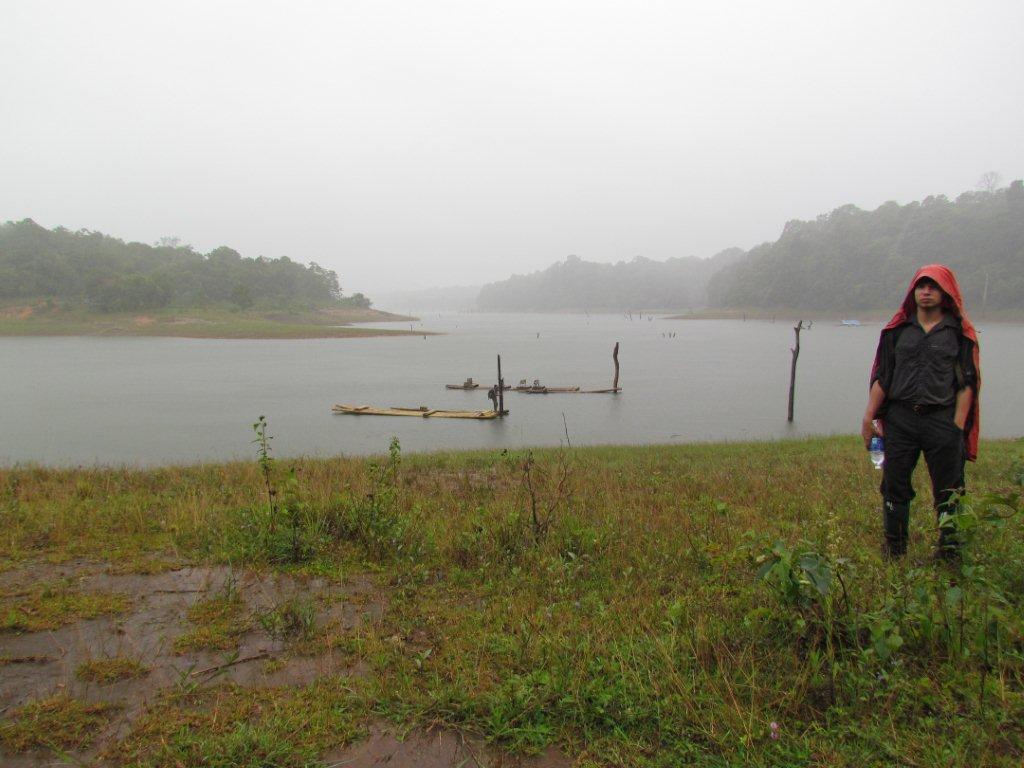
It was an experience worth revisiting. Here’s one more the photo that Tal shared, Michael on that misty morning.
It was an experience worth revisiting. Here’s one more the photo that Tal shared, Michael on that misty morning.

My last post introduced the problem of hypoxia in the Gulf of Mexico, and I promised to start trying to answer that question. Today I’ll shed some light on some subsidies and federal policies that could be altered and bolstered in the right ways to stop nutrient-rich runoff from reaching the Mississippi River. I’m going to point out right away that although the most obvious way of preventing hypoxia is by reducing fertilizer use, this is also the most difficult and expensive tactic to implement. My goal is to start laying out elements of a more cost effective, pragmatic plan for ameliorating hypoxia in the Gulf of Mexico.
The agricultural subsidies that I discuss here are measures that can be implemented through various policy tools (e.g. direct payments, technical assistance, tax incentives) to reduce costs for producers and attempt to benefit the economy in doing so. One positive form of subsidy, known as a cross-compliance program, discourages creation of farmland from current wetlands or land that is highly erodible. Continue reading
We have been using this word for years as a shorthand for one of the core objectives of our entrepreneurial conservation work: collaborating with communities to assist in the retention of heritage that has meaning, and that those communities feel should remain essentially as it was. It is therefore interesting to consult OED (finally) on exactly what this means.
Top of the list of entries:
a. Of authority, authoritative (properly as possessing original or inherent authority, but also as duly authorized); entitled to obedience or respect.
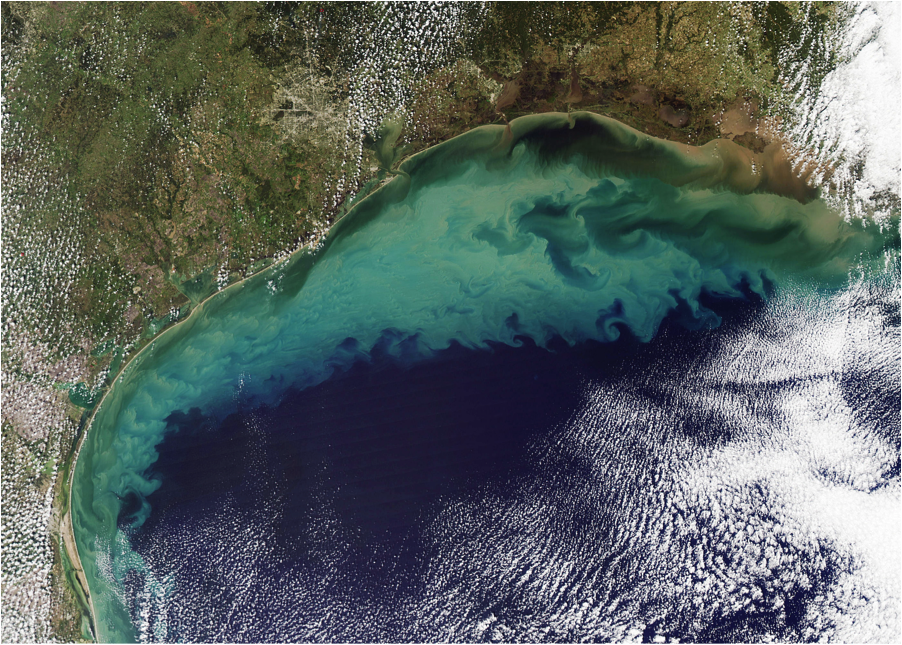
This picture is of the hypoxic area in the Gulf of Mexico, the largest “dead zone” in the western Atlantic. Since the beginning of this site we have tried to accentuate the wonders of nature, creative and collaborative approaches to conservation, and other fun stuff. Every now and then a dose of scientific explanation helps put this in perspective, even if it is a downer like hypoxia.
Hypoxia occurs when oxygen concentrations in the water are too low to sustain most life, and is created by a process known as eutrophication. This is the over-enrichment of water by nutrients, which cause dense growth of algae that consumes oxygen as it multiplies and decomposes. The resulting lack of oxygen can cause large die-offs of marine life, seriously threatening ecosystems in the Gulf.
Although the Kenyan destination tourism market has commercialized the Masai name, I was pleasantly surprised to find the traditions and heritage of the Masai people thriving and vibrant in the Masai Mara. In Nairobi, you will find merchants and craft markets collectively selling Masai blankets, beaded jewelry, artwork and more. I would contend the Masai name is an over-utilized marketing tool, a clear indication it’s moving dangerously close to holding a “tourist trap” reputation. Although my position on the matter remains unchanged, the innate beauty of the Masai culture should not be dismissed. The Masai Mara may be best recognized as Kenya’s wildlife mecca, but the region is also home to over fifty authentic Masai villages of tremendous character and unique local charms.
After our concluding full day safari game drive, our guide gave us the option of visiting a Masai Village near our camp. Indicating that the venture would cost us an additional 15USD, I immediately believed yet another “tourist trap” pitstop was in store. Nevertheless, faced with the alternative option of sitting in my non-electrified tent, I succumbed to the sales proposal and scrambled together 1500 Kenyan Shillings to visit this so called “authentic village”. The entrance fee granted us a traditional Masai welcome dance, entry into the villagers’ homes, a guided tour of the community, and complimentary photo opportunities. With my skepticism still intact upon entering, I anticipated some sort of lazily executed, artificial village re-creation of primitive Masai Mara life, à la Plymoth Plantation or some cheesy Renaissance Fair. While the community has certainly optimized their culture’s tourism appeal, I was happily surprised to find that what we witnessed wasn’t just for show or to indulge us “muzungus” (foreigners); conversely, it demonstrated how the native Masai currently lived day-to-day.
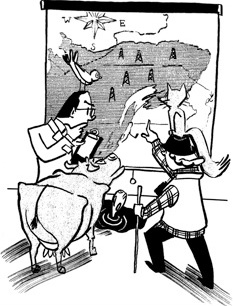 Click the image to the left for context. As we learn more on this complex issue, the enlightened position must be literally that–enlightened by fact. Sometimes sarcasm is an easier position, especially when the facts seem outrageous. But thankfully there are more and more facts to tone down sarcasm to a chiseled tool. Our ever-appreciated investigator shares some this week in her usual venue and as always her balanced-yet-urgent perspective probably is appreciated:
Every kind of energy extraction, of course, poses risks. Mountaintop-removal mining, as the name suggests, involves “removing” entire mountaintops, usually with explosives, to get at a layer of coal. Coal plants, meanwhile, produce almost twice the volume of greenhouse gases as natural-gas plants per unit of energy generated. In the end, the best case to be made for fracking is that much of what is already being done is probably even worse. Continue reading
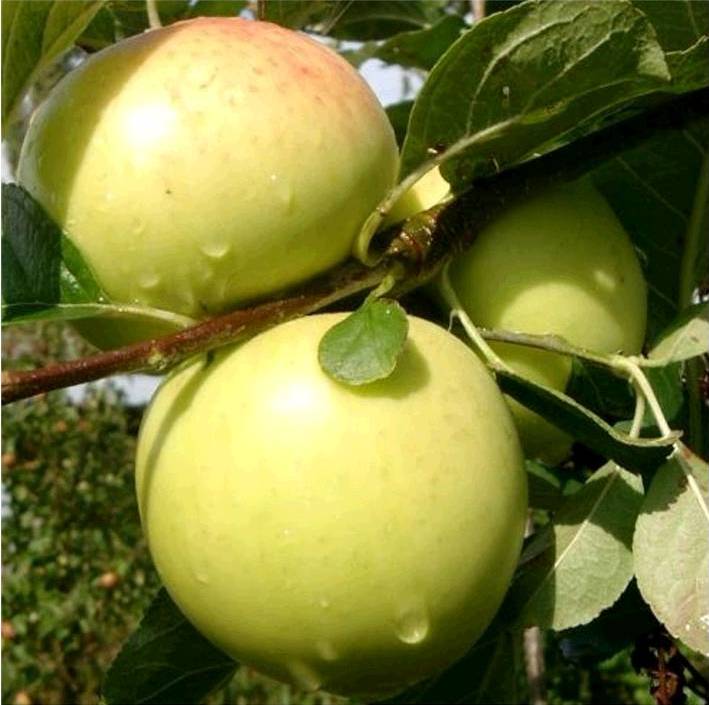
Second only to bananas, apples are one of the most popular fruits in many parts of the world. Yet when domesticated and planted in monoculture production, they run the risk of falling into the same trap as their “homecoming king” cousins, i.e. susceptibility to pests that requires a great deal of chemical hand holding.
A member of the rose family, there are believed to be 7,500 cultivars of Malus domestica, stemming from their original Western Asian ancestors. In fact, the apple is believed to be the earliest tree to be cultivated, beginning in what is now southern Kazakhstan and eastern Turkey. The fruit has played a staring role in mythology and folk tales, from the Greeks to the Germanic and northern European cultures, and finally taking center stage in Renaissance depictions of Biblical lore in the 15th Century CE. Continue reading
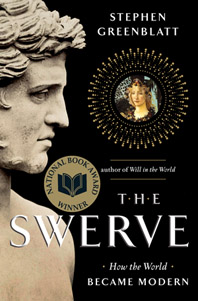 It is just the way things are. My reading list/pile is always longer/taller than I have time for. And living between the rice fields and spice-laden Western Ghats I do not have access to the kind of bookstores we took for granted while living elsewhere. Amazon does not deliver in India, nor would I put a penny in their coffers until I have the sense that they are not trying to monopolize the book trade, not to mention everything else.
Even if I had access to a great book store I might not have picked this one up off the shelf, though I admire the author’s writing. I have not been in the mood for anything too canonical or Great lately; rather merely useful, interesting, lesser reading. Short- and long-form journalism tend to be my standard fare. There was something in the pile with Greenblatt’s name on it, a magazine article, that I kept burying for months and which persistently kept resurfacing. Continue reading

If you cannot read the article (it is behind the pay wall) about this new breed of apple, then spend a few minutes watching this video that the author made about it.

Travancore Coins from Beena Sarasan’s Collection. Photo: Special Arrangment
A couple of my recent posts appreciating the perspective of a capable Western observer on the topic of India, combined with my family’s pending celebration of Thanksgiving in a foreign land (as per our tradition), got me thinking: what news item in India since living here am I most grateful for.

No hesitation. It has to do with the aftermath of a discovery in July. The discovery happened not too far from where we live, in the foundations of a Hindu temple. The descriptions were remarkable on their own, in part just because of the difference between journalistic style in the culture where I grew up (fourth estate and all) versus India’s journalistic flourish:
…gold, jewels, and other treasures were unearthed in the vaults of the temple. Several 18th century Napoleonic era coins were found, as well as a three-and-a-half feet tall gold idol of Mahavishnu studded with rubies and emeralds, and ceremonial attire for adorning the deity in the form of 16-part gold anki weighing almost 30 kilograms (66 lb) together with gold coconut shells, one studded with rubies and emeralds… Continue reading
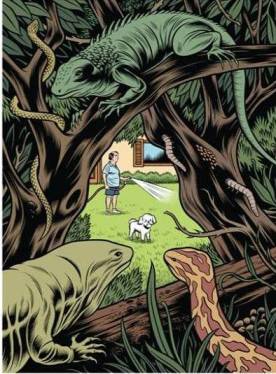 Click the image to go to the article, which examines what happens when exotic animals are bought as pets, then released into ecosystems where they have no predators or other population-regulating mechanisms. Yikes:
…As Magill was driving to the Miami Metrozoo, where he is the communications director, he passed a troop of rhesus macaques scampering up the road, as if on the plains of Kashmir. Later, the monkeys were spotted wandering through nearby farm fields, gorging themselves on tomatoes. Elsewhere, a small antelope was found wandering the halls of an administration building, a group of juvenile baboons broke into the weight room of a private home, and a python was found dead on the beach in Miami, with two full-grown raccoons in its belly. It was as if all Florida had turned, for a moment, into Disney’s Animal Kingdom. Continue reading
Reading this post from Elizabeth Kolbert, a familiar cloud of doom came over me. Read almost anything she writes, and you will know what I mean. She writes most frequently about seemingly intractable environmental problems, and those about climate change have the most intense effect on me. But ignorance is not an option, so I read. The cloud lasted about seven hours, and parted just now in a most interesting manner. As if my head were just lifted out of the sand. First, the portion that stuck with me:
Since we can’t know the future, it is possible to imagine that, either through better technology or more creativity or sheer necessity, our children will be able to find a solution that currently eludes us. Somehow or other, they will figure out a way to avoid “a 4°C world.” But to suppose that an answer to global warming can be found by waiting is to misunderstand the nature of the problem.
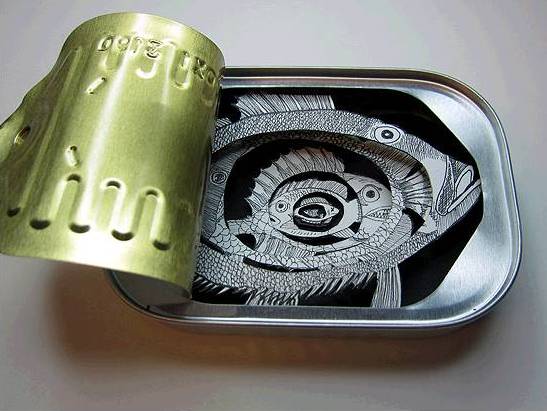 Like a Fish Needs a Bicycle, Jim Doran
When I recently came across the artist/web designer Jim Doran’s work my mind began to swim with connections. In a world where resources, whether our land or our seas, are becoming more and more precious, the more we need to give free rein to our imaginations. In other words, rarely are solutions found within the status quo. Continue reading
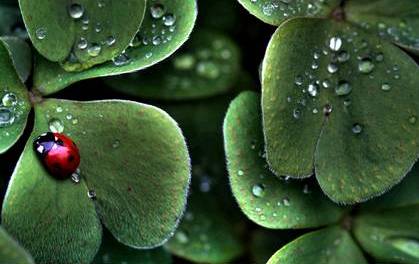
Earlier this week, James posted about a crowd of ladybugs he spotted on a recycling bin at Emory. His account reminded me of a guest lecture in my entomology class earlier this year, when John Losey came to talk to us, in part, about the Lost Ladybug Project.
The Lost Ladybug Project, which is a citizen science similar to the ornithological projects I’ve written about previously, aims to educate participants on the values of biodiversity conservation and the importance of ladybugs as predators in ecosystems. Continue reading
Today I saw something very odd: dozens of ladybugs crawling along the top of a recycling bin. Some were the dark red that we normally associate with ladybugs, while others were a pale orange verging on yellow. Strange looking half-formed ladybugs, seemingly crouched in tight balls, adhered themselves along the surface as well. In the midst of it all swarmed long, fat black bugs with orange spotting along their backs. What was going on here? And what was this panoply of ladybug life occurring on a recycling bin in the middle of a college campus?
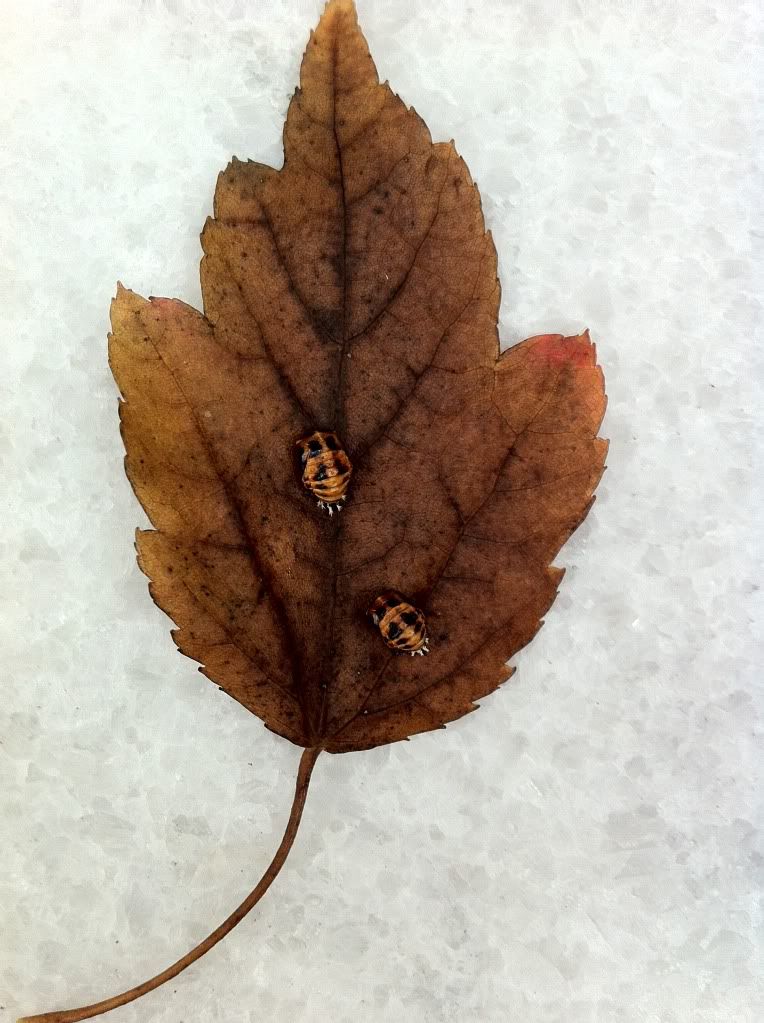
Two ladybug pupae
When I afterwards looked up ladybugs, I found that I had actually witnessed something pretty cool: the full life cycle of Coccinellidae, known as the ‘ladybug’ in America but the ‘ladybird’ elsewhere in the world. It’s also known as ‘God’s cow,’ the ‘ladyclock,’ or the ‘lady fly.’ There are over five thousand species worldwide, but the name ‘ladybug’ is perhaps most readily synonymous with the image of a small, round red bug with black spots.
The ladybug, as I had seen, has four distinct phases in its life cycle. The life of the ladybug begins in an egg; small clutches hatch after three or four days at which point the larval form of the bug emerges. It may molt three to four times over a period of about twelve days before pupation (i.e., the beetle creates a pupa). Continue reading
Did you read this? If so, how many times did you say out loud, as I did no less than 14 times: really, Coca Cola? Here is one example, among many, of a disturbing perspective:
A spokeswoman for Coca-Cola Refreshments USA, Susan Stribling, said … “Banning anything is never the right answer,” she said. “If you do that, you don’t necessarily address the problem.” She also characterized the bottle ban as limiting personal choice. “You’re not allowing people to decide what they want to eat and drink and consume,” she said.
Is this really about something as sacred as liberty? No. One of the greatest ideas of all time (the one about certain unalienable rights) is being invoked for purely commercial interests, and that is disturbing enough. Continue reading
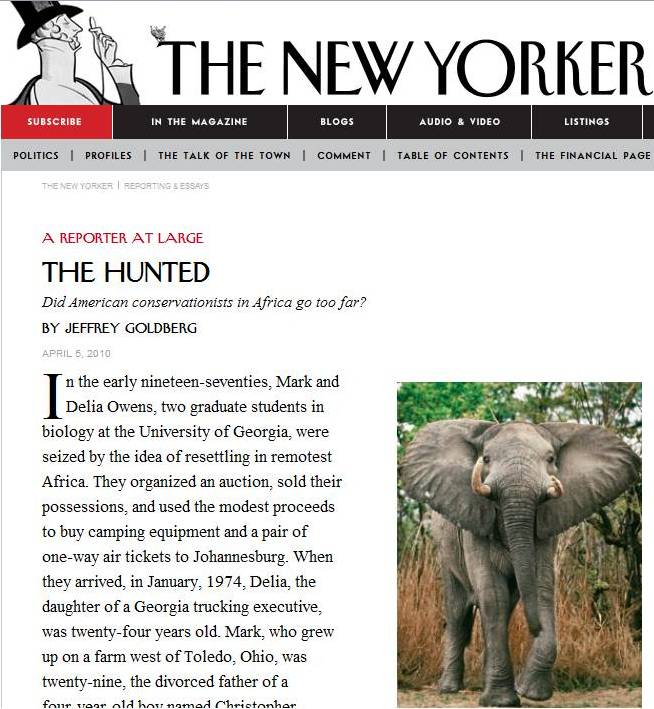
Click on the image to the right to get the full story of a conservation whodunnit. After linking to Felicity Barringer’s investigative story on the scuttling of a trash reduction plan for one of the world’s most iconic national parks (really, Coca Cola?), some other conservation-focused articles seem worthy of attention.
The New Yorker has a deliciously quirky approach to covering environmental issues, and this one is representative. It delivers on multiple fronts, reading like a detective story while also informing about one of those before it’s too late topics.
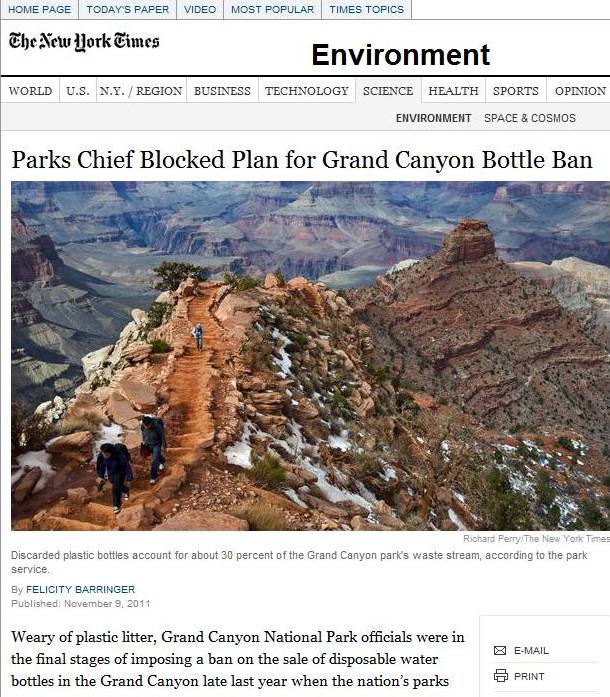
Click on the image above to be taken to the story, which describes a great trash reduction plan in the Grand Canyon National Park that suddenly got scrapped under mysterious circumstances. The circumstantial evidence suggests that Coca Cola was influential, if not responsible, for that canceled plan. Every day this newspaper seems more worth the subscription price. Continue reading
From the New York Times, a statistical reminder of progress to date and how far yet to go:
Over the past 25 years, the number of conservation areas set aside for the nonhuman species has grown considerably. Globally, there are now more than 100,000 protected areas, including national parks, biological reserves and marine sanctuaries. All told, they protect slightly less than 13 percent of the land on earth and slightly more than a half-percent of the oceans, though only a minute fraction are “no-take” zones that bar fishing. But can these protected areas do enough to protect biological diversity?

