Elephant Diet

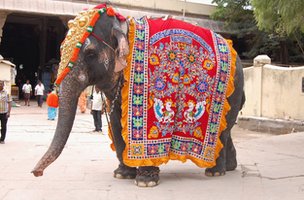
Cuisine and wellness, topics we think about mainly in the context of resort operations in India, also have a role to play in the life of a particular group of elephants, as this BBC story (click the image to go to the source) illustrates:

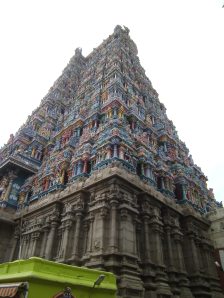
In parts of India, elephants are kept in temples for religious reasons – taking part in ceremonies and festivals.

Efforts are on in the South Indian state of Tamil Nadu to get these over-pampered tusked animals to slim down, officials have told the BBC. Continue reading

Finding History in High Tech

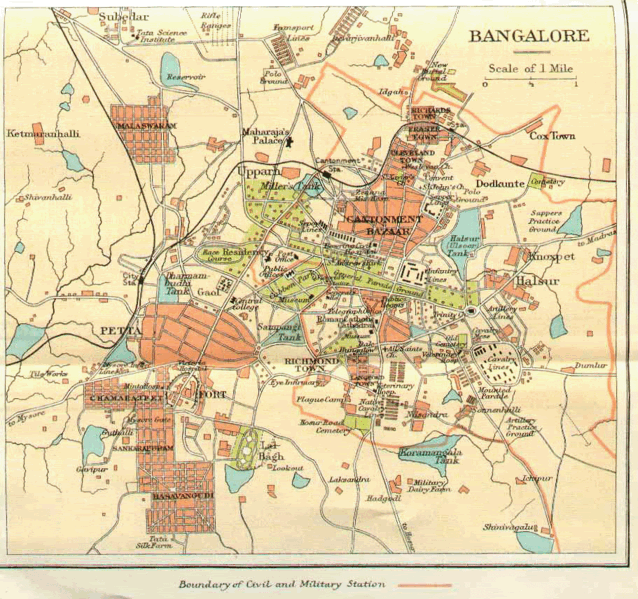
Bangalore city map, circa 1924 from “Murray’s 1924 Handbook”

Before a recent trip to Karnataka I’d asked my Indian friends for advice prior to any urban travels, getting their opinions on the iconic activities in each of the cities on my itinerary.  There were pearls and biryani in Hyderabad, palaces and markets in Mysore…but for Bangalore, most friends said things such as, “Oh Bangalore. That’s where people from Cochin go to get their shopping done.”

Well, okay.  Considering I actually did need to get some shopping done, I wasn’t terribly distressed about this advice. However, the fact remains that I am not a particularly good shopper, so I’d hoped that there was more to the city than just consumer attraction. Continue reading

Onam Celebrations At Thekkady

This slideshow requires JavaScript.

Celebrations in Kerala are never focussed on the individual; they are about the land, the people and the society. The state’s most famous festival, the Harvest Festival of Onam takes place during the time when granaries overflow. In contemporary Kerala in addition to traditional customs there are exhibitions and sales across the state with music and dance events, flower shows and food festivals. These are some of the Onam festival pictures from Thekkady, which are organized by the Tourism department and Grama Panchayat (the local municipality).

Onam The Festival Of Kerala

This slideshow requires JavaScript.

The most spectacular event of all Kerala festivals, Onam epitomises a new found vigour and enthusiasm about everything. The festival celebrates the return of King Mahabali, who is said to visit his subjects each year. To convince their beloved King that Kerala continues to be prosperous land of milk and honey people decorate their homes and celebrate to the fullest sometimes even faking prosperity to present a happy and flourishing facade to their King. Continue reading

A Great Finale To Our Kerala Experience

Photo credit: Milo Inman

Our time at Cardamom County in Thekaddy, Kerala was way too short.  After returning from a wonderful trip with River Escapes in the backwaters of Kerala we headed for the state’s iconic hill stations in the Western Ghats.  I suggested to my husband Dave that we take a taxi, but being a former backpacker, he urged me to give the bus a chance.  I stood my ground, insisting the trip would take several hours and I could bet the buses wouldn’t pass an inspection. But Dave was persistent and persuasive – I acquiesced and don’t regret that decision for one moment.  It was a wild ride.

Continue reading

Go, Marcus!

In case you missed my earlier post on the topic, you may want to listen to that podcast before reading this more straightforward “business wunderkind” story in today’s Sunday New York Times.  Still, the closing paragraphs of the story circle around to why this fellow has our attention.  Great food interests us, yes; entrepreneurship, yes; but even more so this sense of community:

He often seeks interaction with the broader community, whether at his restaurants, through the Internet, or on his daily subway ride. In Harlem, he has held free cooking classes for children and has helped expand the farmer’s market in the area. More than 70 percent of Red Rooster employees are local residents, many of whom had little experience with fine dining. The restaurant hired additional managers to get the employees up to speed.
“When you look at strategy, it’s not set up to be a pure moneymaking machine,” says Derek Evans, the media adviser for the Marcus Samuelsson Group. “It’s a passion machine.”

Connecting Over Competition

Guest Author: Siobhan Powers

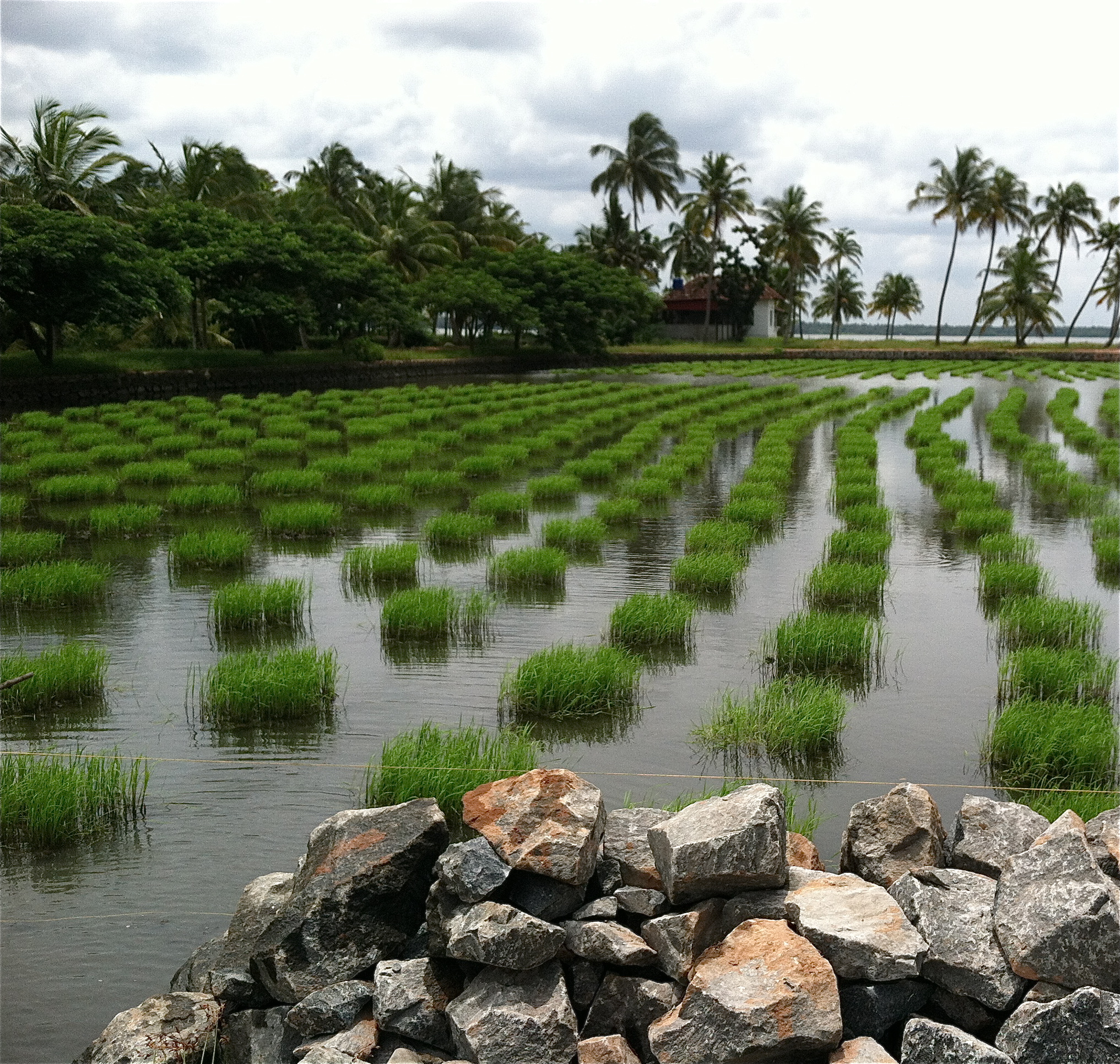
I’ve been staying in the beautiful backwaters of Kerala for the past few days, which has put me at ease as I always feel more comfortable by the water.  Jonathon and I took some time out of our workday to take a walk and get a feel of the area, including all it has to offer, both culturally and agriculturally. We interrupted the construction of a stone wall surrounding a rice paddy field and watched a young boy catch fish in a stream at the side of the narrow road. In the heat of the Indian sun’s rays, we contemplated buying ice cream, but, on our return, settled on the universal refreshing thirst-quencher that is an ice-cold cola.

Rice paddy in Panangad

Continue reading

How Big Is A Billion?

Community, collaboration and conservation are the categorical things–ideas, actions, examples–that we most like to talk about on this site and point to with links elsewhere.  Still, perhaps half of the posts here would be hard pressed to fit into those categories in any literal sense.  This little item below, for example.  Two guys talking about cultural differences in mathematical expression.  Go figure.

Marigold (Calendula)

Marigold is a tropical plant found widely throughout south India. The beautiful flowers are mainly cultivated for commercial purpose as temples offerings. It comes in different colors, yellow and orange being the most common. This flowers has a strong pungent odor that is not only used in cosmetics and herbal medicines but in gardening as a natural pest deterrent.

Continue reading

Earliest Inhabitants

Tribals have been an integral part of the Wayanad district for thousands of years. Its earliest settlers were the tribes of Adivasis, which are divided into various sects such as Paniyas, Kurumbas, Adiyas and Kurichyars. It is currently estimated that nearly 400,000 tribal people live Wayanad.  The sects are physically distinguisable with their dark skin and stout builds. Tribal dwellings recreated on the adjoing grounds of the wildlife sanctuary offer a glimpse into their traditional life.

Continue reading

“There is no better designer than nature.”

Color is quite possibly the most strategic tool a designer can use to breathe life into a concept.

And it comes as no surprise to the RCDT that used effectively and responsibly, color can transform an existing space more powerfully than any other single alteration. But it is important to realize that color does not exist as an object in itself; rather color is the relationship between light and an object, producing a condition that is unique and inherent to a specific material. As pure white light from the sun reaches a material’s surface, various light frequencies are either absorbed or reflected causing our visual perception to interpret the surface as a certain color. Thus color is actually a very scientific narrative between light, a surface, and our eyes.

This post could delve very deeply into the science of color and those factors that cause us to perceive what we do, but the scenery of India is far too inspiring to diminish it to wavelengths. Instead I dedicate this post to the basic and simple application of color, what it is, and why it is one of the things that makes India one of the most beautiful places on our earth. Continue reading

Poothan-Thira Kali

Kerala offers a veritable array of the performing arts, most of them springing from folk tradition. Though often related to religious rituals and mythological stories, they are also very much the language of the  people. Dramatic costumes, vibrant colours, throbbing music; watching a folk dance is an unforgettable experience. Poothan-Thira Kali is one of the popular ritualistic dances of North Kerala. Continue reading

Tea Factory Tour

If you spend time in India, you are sure to have four or maybe five cups of tea a day.  A former British colony, India has absorbed many British customs, and tea drinking is certainly one of them.  As you drive throughout Kerala, you are bound to see numerous tea plantations on the beautiful hillsides, and Cardamom County offers you the opportunity to tour one of these plantations as well as its factory.  Take the tour and learn how the cup of tea you just enjoyed at All Spice Restaurant ended up in front of you.

Continue reading

113 Hemingway

Screen shot from my subscriber’s access to old New Yorker articles–the text is cut off at the bottom of the image but you can still savor the journalistic description in the sampling.

Lillian Ross, today among the last living chroniclers, along with A. E. Hotchner, of Hemingway in living technicolor, wrote this profile of him when he was a 50-year old superstar and she was a 24-year old who had been a New Yorker staff writer since she was 19.  How’s that?

Who cares how?  I care that.  And thank her for it on this, his 113th birthday.  She has always had a distinctively invisible presence in her writing, which makes Hemingway pop on her page.  Of course he never popped. He banged. Exploded.  Her profile makes a trip to your local public library worthwhile to find a 62-year old hard copy of the magazine.

Or, if the library near you is no longer, subscribe to the magazine and gain access to all content in past issues.  I care that she, and Hotchner, and others, have shared small sketches not designed to titillate as gossip, but yes to amuse.  As in amuse-bouche.  Small tastes for those who aspire to greatness and are not embarrassed from time to time to wonder how the great think, how they feel, what they do:

Consequential Incidents

We have all had defining moments.  An event–small, medium or large–that seems to change the course of everything.  For me, it was the rather random choice of topic (more on which after the jump) for a research project with a friend in graduate school, leading to my doctoral dissertation and then onward to nearly two decades in entrepreneurial conservation.  Not my expected career path in my teens, my twenties or even my early thirties. When I saw this opening line in a “culture” piece on The New Yorker‘s website, I was hooked:

In 1833, Ralph Waldo Emerson, a New England pastor who’d recently given up the ministry, delivered his first public lecture in America. The talk was held in Boston, and its nebulous-sounding subject (“The Uses of Natural History,” a title that conceals its greatness well) helped lay the groundwork for the nineteenth-century philosophy of transcendentalism. It also changed Emerson’s life.

With no illusions or delusions about the significance of Emerson’s random epiphany, versus my own, I can still relate. Emerson’s ideas and their impact had consequence during his lifetime for the place that became my research focus a century later.  As it happens, Emerson visited that place just before his 60th birthday, and was deeply amused (it inspired his writing for another two decades) and amazed.  That place, which I was interested in for historical reasons related to collective action (thus the occasional posts on this site with that topic as centerpiece), had consequence for late twentieth-century notions of how to develop tourism under a new model.

Continue reading

Nadaswaram – Indian Musical Instrument

The Nadaswaram is a unique instrument in many traditional South Indian and Hindi ceremonies.  Today, it is constructed primarily from bamboo, but materials such as sandalwood, copper, brass and ivory are historically included.  This instrument is made of three parts: kuzhal, thimiru and anasu.  All of these parts combine to make to the double-reed, bell shaped instrument that creates music with a range up to two and a half octaves.  Because of its intense volume and strength, the Nadaswaram is most often enjoyed outdoors, but one thing is certain: the sound it produces is sure to be music to many ears.

Bullock Cart – A Traditional Transportation

The whole world is moving towards new technologies and scientific inventions, but still one can find the oldest and traditional mode of transportation in Kerala across some villages: the Bullock cart. Some merchants and travelers prefer the bullock cart over other transportation vehicles. Continue reading

Colorful Wonderland: Fort Cochin, Kerala

Five hours away from Thekkady is a colorful land of ornate architectures and a hometown of many fishermen that represent the historical harbor city, Fort Cochin, Kerala. The narrow and winding streets are filled with houses and churches that clearly showe their Dutch, Portuguese, or British influence from the colonial time. As I carelessly stroll down the streets only with my camera and some rupees (Indian currency) in my purse, I didn’t mind the stares from the local village people, nor the heat and humidity that made me drench in my own sweat; but, my mind got carried away seeking the remains of what time had left us.

Blue door and window with a wagon

Continue reading

A Day Without Shoes

Over dinner one night, I revealed to a few of my fellow interns my fear of feet, specifically adult feet.  We established that I may have podophobia: an irrational fear of feet.  You may think that I should consider taking a quick course in dinner convo dos and don’ts, or consider seeking psychiatric help; however, I guess I feel I have bigger fish to fry than to try to acquit myself of this fear.  We discussed other phobias and how many people overcome theirs by simply “facing” them.  I certainly am not at a place in my life to face my peculiar fear, but I am happy to say that a trip the following day to Meenashki Amman Temple helped me take one step (well, many steps really) towards defeating podophobia.

This beautiful Hindu temple is located in Madurai, Tamil Nadu, India, and devoted to Meenashki, an avatar of Parvati, one of the few female Hindu deities to have a major temple named for her.  Before entering the temple, visitors must remove both socks and shoes to be held outside.  Thousands of devotees and tourists visit this temple daily, and from the lines of barefoot men, women, and children, I and my fellow interns seemed to be visiting on a busy day.  I must admit: at first, I was not keen on sauntering around where so many people have trod, and for some time I tip-toed around to minimize my foot-to-ground contact.  Though, with each step against the granite flooring, my focus shifted to the detailed sculptures and the passionate faces of those around me. Continue reading

Post-Poned

Funny: I was just about to follow up on yesterday’s news about UNESCO’s declaration, with some further explanation for those less familiar with the various definitions/forms of patrimony and heritage considered worthy of protecting.  Then Tim’s post popped up when I refreshed this page.  Then my other tab opened, eerily on its own, to The New Yorker‘s website.  Although it is a site of frequent visitation for my browser, the eery thing was that it chose to open on its own, at that particular moment, and in the most visible spot on the page was this particular blog post:

Rounding out the weekend reading was a piece in Le Monde about the California ban on foie gras—another death notice of sorts. As Dana Goodyear has written, the Californians see the ban as a life-extending measure for ducks and, potentially, for humans who relish their fatty livers, whereas the French fear the demise of their patrimony before its time. “The French producers are furious,” Le Monde wrote, quoting a diplomatic source who reasoned, somewhat shakily, “It’s a subject that can seem anecdotal, but it’s necessary to take it seriously … Foie gras is an important part of our gastronomic heritage, recognized by Unesco.”

I no longer need to write the post I had intended, so I will just link to a post that partially explains my love of heritage, culinary patrimony in particular.  Truth be told, Tim’s compelling post notwithstanding, the above in extra-particular is among my culinary favorites.