 The book mentioned in this previous post is proving difficult to stop thinking about. The historical clarifications are part of it in a purely fascinating way (no domesticated animals in the pre-Columbian New World, really?); better understanding of phenomenal events such as the potato blight of 150+ years ago, and kudzu in the present day southeastern USA, are equally illuminating, if more alarming. For anyone who has lived in the old or new tropics, this naturally leads to thinking about bananas, and then the clicking starts. And if you are lucky you end up somewhere like this (click on the image above): Continue reading
Ecosystems
Footprints
 As of this writing, the biographical section of this author’s personal website begins with an inaccuracy that can be easily forgiven. He just hasn’t updated it yet. That’s okay, glass houses and all. But what about all the students interested in topics like this, at places like Brown and Cornell, who want to figure out how one becomes Charles C. Mann? We learn a bit about the initial C in his name, but not about how he got interested in this topic, he prepared to research it, write it, etc. That’s okay too.
He brings light to so many topics that we take for granted, even those of us studying some of these topics–do you picture the local population of what is now North America, pre-Columbus, riding horses?–that we can be thankful that he has been busy at researching and writing this book, and less busy explaining to us how he learned to do such work. Just this passage should get you thinking:
Newspapers usually describe globalization in purely economic terms, but it is also a biological phenomenon; indeed, from a long-term perspective it may be primarily a biological phenomenon. Two hundred and fifty million years ago the world contained a single landmass known to scientists as Pangaea. Geological forces broke up this vast expanse, splitting Eurasia and the Americas. Over time the two divided halves of Pangaea developed wildly different suites of plants and animals. Before Colón a few venturesome land creatures had crossed the oceans and established themselves on the other side. Most were insects and birds, as one would expect, but the list also includes, surprisingly, a few farm species—bottle gourds, coconuts, sweet potatoes—the subject today of scholarly head-scratching. Continue reading
Borneo On Our Mind
If you enjoyed Nicole’s post, you will definitely want to watch this. We had the opportunity to exchange emails with Willie and can affirm what you will see at 1:11 (one minute and eleven seconds) into this TED talk: being an activist for a cause you care about can be frustrating and challenging enough that applause is not a motivator. He is already recognized by enough famous organizations that our two cents will seem a pittance, but we consider him a hero of entrepreneurial conservation, so must say: thank you Willie!
If you feel the same way after watching this video, say so by visiting this website and then this one. Especially this latter link should give you some ideas about how to get involved and make a difference.
Borneoculars: Observations from a Scientific Expedition in Borneo
Guest Author: Nicole Kravec
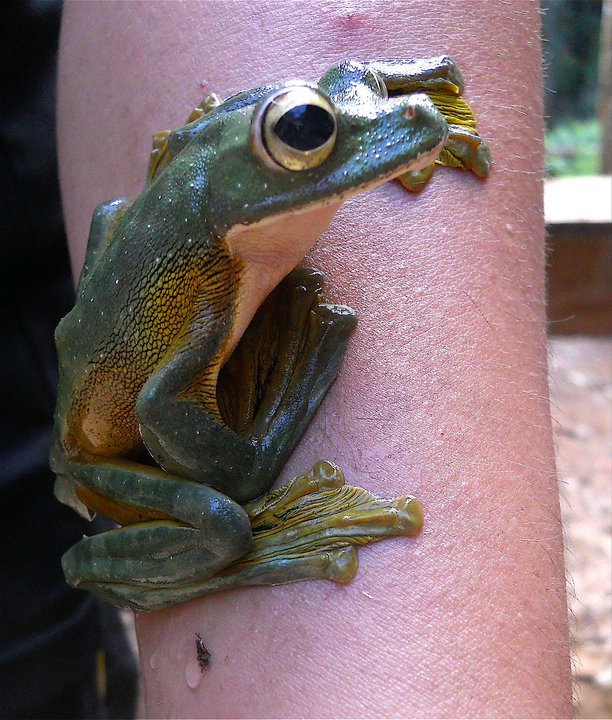
Indiana Jones would be proud of the entire scientific expedition team. For two weeks we trekked through the jungles of Malaysia’s Imbak Canyon, the “biological gene bank” in the heart of the Malaysian state of Sabah in northern Borneo. It was one of the best – and most adventurous – trips of my life.
Jellyfish Preserves
Ever heard of Jellyfish Lake? Located on the Eil Malik island of Palau, Ongeim’l Tketau (as the natives call it) is a lake which was formed about 12,000 years ago by the Pacific Ocean. Along with the clean blue waters of the Pacific, the tides brought in immigrants – jellyfish of the genus Mastigias . Today, after 12,000 years of isolation and removal from the predator-rich environment of the Pacific Ocean from which they originated, the jellyfish have evolved into a significantly different organism. Due to the fact that the only predators the scyphozoans have is a species of anemone which is significantly removed from their swimming depth, they reduced their defensive mechanisms to virtual non-existence, meaning that unlike most beach-faring jellyfish, they don’t sting.
Due to this remarkably friendly gesture, Jellyfish Lake has become a popular snorkelling destination, and those fortunate enough to swim those waters are graced with an ethereal sensation of a world different and far removed from our own.
[vimeo 23079092]
Changing the Land
A previous post described the beliefs about land usage that settlers brought to New England, and the resulting impact on the environment. The same source material (Cronon’s “Changes in the Land”) provides a fascinating description of what Native Americans had been doing to “improve the land” since pre-Columbian times.

In southern New England they would burn large areas of the surrounding forest once or twice a year, creating forests that Europeans saw as “open and parklike.” The fires would consume all the undergrowth so that the result was “a forest of large, widely spaced trees, few shrubs, and much grass and herbage.” Wherever Native Americans in southern New England lived, the English traveler (1633) William Wood noted, “there is scarce a bush or bramble or any cumbersome underwood to be seen in the more champion ground.”
Improving the Land
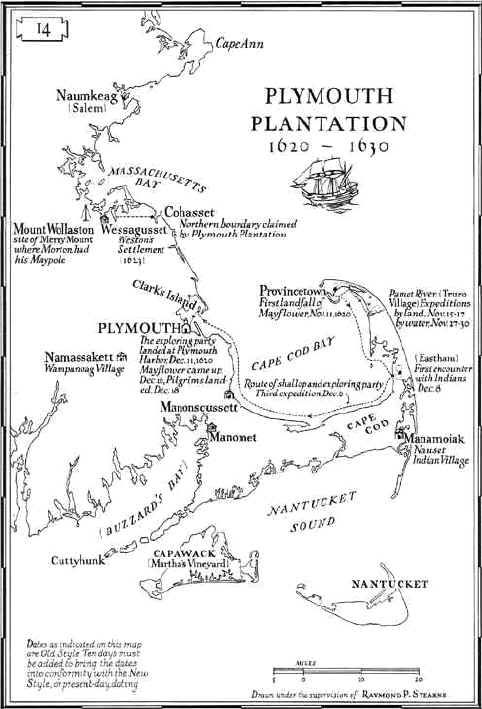 When the English arrived on the coasts of New England to form colonies in the 17th Century, they generally viewed Native Americans as savages who, despite their skills at hunting and farming, didn’t rightfully own the land they occupied.
The northern tribes didn’t practice agriculture at all, and the southern tribes were partially agricultural: during temperate months they would harvest corn, beans, and squash, and when winter came they moved north because it was easier to track and hunt animals in the snow. All tribes were fairly nomadic; every year they picked up their few possessions and traveled wherever seasonal sustenance was to be had.
In the King James edition of the Bible, which Pilgrims carried across the ocean, Genesis 1:28 has God commanding man to “fill the earth and subdue it.” To say the least, Puritan colonists took these words very seriously. When they saw that Native Americans weren’t taming the land as the norms in Europe dictated, it was clear evidence that they did not have the right to own it.
Sculpteur Par Excellence
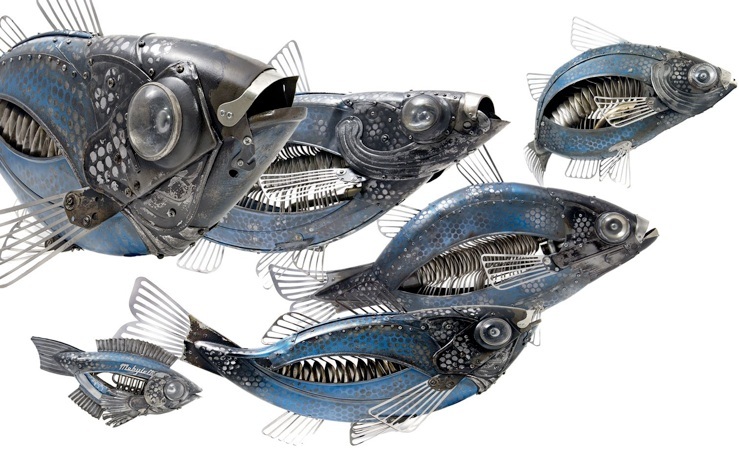
If you were as amused as we were by this animation, and especially if it gave you hope related to beautiful, if not organic, marine ecosystems of the future, then this display of sculpture is probably for you. Edouard Martinet’s lovely and lovable marine life is rivaled by his entomological wonders, which you will see at his entry page but be sure to dig deeper to find the other lovelies.
“Go Green, Young Man (or Woman)…!”

When Horace Greely (well, actually John B. L. Soule) said “Go West, young man, and grow up with the country!” he was speaking from the perspective of limitless possibilities. The Lewis and Clark Expedition had helped map out the west and many young men, and later women, answered the call.
With wilderness in peril, that same entrepreneurial spirit has opened up a new world of empowerment and possibilities for later generations. The California Conservation Corps and Southwest Conservation Corps have teamed with the non-profit Veterans Green Jobs in a win-win program to support both the country’s military veterans and the country’s national parks. Continue reading
An Abundant Life
 I recently read an essay in the Wall Street Journal titled, “Living to 100 and Beyond.” As I read about the technology that is rapidly increasing human longevity, the movie Death Becomes Her began replaying in my mind. I imagined myself following in Meryl Streep’s and Goldie Hawn’s footsteps and taking some magic potion that makes me immortal. However, instead of the body deteriorating with age like the Streep and Hawn rivalry, advances in modern technology will likely not only increase life span but also health spans. Living for centuries may seem appealing on the surface, but we should consider the overall effects of a longer life.
From Sea to Sand
There seems to be no limit to the spirit of creativity! Art often represents a “call and response” relationship to the natural world.
Water is elemental. Earth and wind follow. Are these the mechanics of life?
The Anthropocene
I wrote yesterday about the North American cod stocks that have practically disappeared during the last century as a result of overfishing. Needless to say, this is just one of many species that humans have had a seriously detrimental effect upon in their shaping of the Earth. An article from The Economist this May discusses the geological forces that humans have had on the Earth, focusing on topics like the carbon cycle or nitrogen fixation rather than species extinction.
Paul Crutzen and Eugene Stoermer coined the term “Anthropocene” in 2000 to classify what they see as a new age on the geological time scale, and the fairly abrupt and sharp decline of cod may be one of the many changes visible in the fossil record thousands or millions of years from now. As you can see in the image below, we are currently in the Holocene, but Crutzen and Stoermer, along with many other scientists, including several of those in the International Commission on Stratigraphy (which arbitrates the geological time scale), believe that we have entered an age primarily shaped by Homo sapiens.

Image from The Economist
The Buzz Is Worthy
The New York Times is on a roll with excellent coverage of topics we care about.
Baby Elephant Rescue in Kenya
Guest Author: Nicole Kravec
 In the morning I was at my computer, preparing for a visit from Muriel, a woman from London who is a director of a top-notch research firm. She’s doing pro-bono work for the Maasai Wilderness Conservation Trust and Campi ya Kanzi Community Ecolodge (www.maasai.com) where I am, and I am preparing for her 3 day visit that starts tomorrow. After a few hours of mind-numbing regression analysis I heard some commotion outside. Continue reading
Colombia & Kerala, South-South Cousins
In another superb field note, Paula Pedraza echoes sentiments seen in several posts by our own Contributors:
Everyday life for these people is like a lifetime of adventures for us. Working here really has been an illuminating, inspiring and humbling experience.
Michael’s reflections on the Tiger Trail comes to mind. So does the follow up to that. Speaking of Michael, we are certain that when he is back in the swing of things at Amherst College, and with a bit of encouragement from his fan base, he will be gracing these pages again soon.
Snowy Charisma
There just seems to be something about Owls. Wisdom personified. Avatar of the Greek Goddess Athena and also of the Hindu Goddess Lakshmi. Which came first? To complicate matters, in other ancient traditions they represent less desirable qualities (bad omens in Arabian mythology, and death in some African and Mesoamerican cultures).
I can almost picture a Zack Snyder battle on the big screen covering all this territory.
Meanwhile they remain charismatic members of the ornithological world.
According to veteran Owl researcher Denver Holt:
“People pay attention to owls more than other birds because they look like us,” he said. “They have a symmetrical face, eyes facing forward, a round, flat face and a round head with feathers that look like hair.”
In his New York Times article Jim Robbins writes that owls are not only harbingers but barometers, helping us understand the status of fragile ecosystems. Daniel J. Cox’s photographs give readers a stunning view of both the owl’s majesty and scientific importance in these studies.
Bird of the Day? Let’s call these Strigiforme ambassadors the Bird of the Hour!
When Good, He’s Very Good
Mark Bittman took it down quite a notch when he started up-slumming with celebrities. Nothing against Gwyneth, nor Mario. Just that this fellow is better at what he does than they are at what they do. Case in point today: he is on game.
An Expedition Worth Tracking
Take a look at Paola Pedraza’s post today titled Discovery and Conservation of Plants. The photos are beautiful but the concept is even better. It makes the New York Times worth subscribing to. Thank you Bill Keller!
It Takes a Thief. And 50 Million Years of Practice
Roughly 50 million years before the first Neolithic human grain in the ground on purpose, three insect groups—ants, beetles, and termites—evolved the ability to practice agriculture with fungi. When humans started planting nearly 12,000 years ago, it changed the trajectory of life on earth, and today our species dominates its environment with a visible sense of superiority. Insects have been at agriculture for tens of millions of years longer than we have, and we are just beginning to understand their tools and traditions. We don’t know have a sense of their own purpose or not, but we do know that their collective act has had consequences that are still playing out today. Humans may seem to rule the planet, but hidden from their eye most of the time there are insects that dominate the undergrowth.

Fungiculture originated in the beetle family tree at least seven independent times (by comparison, it only originated once each in ant and termite lineages), which Dr. Ulrich Mueller of the University of Texas at Austin says is “perhaps not surprising, given the sheer diversity of beetle species and given the importance of feeding specializations in beetle diversification.” [1]
About 40% of all insect species are in the family Coleoptera, more commonly known to us as beetles. Fungiculture is carried out by the 3,400 species of beetles known as ambrosia beetles, which line the wooden walls of their burrows, or galleries, with fungi that absorb nutrients from the wood. The various fungi strains have been called ambrosia since the late 19th Century.
The black stains that the fungal growths leave on wood are Continue reading
Trope Talk
In another short burst of wisdom, Mr. Egan brings attention to the remarkable risks that accompany forays into wilderness, quoting one of the elders of the field:
Yosemite’s most lyrical advocate, the naturalist John Muir, anticipated the urban hordes as the population moved away from field and farm. At the dawn of the 20th century, he saw the parks as places to escape “the stupefying effects of the vice of over-industry and the deadly apathy of luxury.” But Muir also expected people to have some basic understanding of the outdoors.
This paragraph is bounded by vignettes of sublime and ridiculous examples of nature providing refuge as well as danger. It is not clear why he validates a trope of ideologues–his point would have been made without the nanny state reference. Or would it?
 Organikos