Danish Can-Do Greenery

Screen Shot 2015-04-10 at 5.53.12 AM

Read a bit about their work, mission and invitation, and contagion takes on a new meaning:

Sustainia is a think tank and consultancy headquartered in Copenhagen, Denmark. We identify readily available sustainability solutions across the world and demonstrate their potential impacts and benefits in our work with cities, companies, and communities.

By focusing on innovative breakthroughs, inspiring alternatives and new opportunities, Sustainia is shaping a new narrative of optimism and hope for a sustainable future that seeks to motivate instead of scaring people with gloom and doomsday scenarios. Continue reading

Disrupting The Odds

An entrepreneur uses his laptop near graffiti-decorated walls at Hubspace in the Khayelitsha township. Emily Jan/NPR

An entrepreneur uses his laptop near graffiti-decorated walls at Hubspace in the Khayelitsha township. Emily Jan/NPR

Entrepreneurship always catches our attention, especially when the odds appear long from the standard perspective:

Far From Silicon Valley, A Disruptive Startup Hub

EMILY JAN & ADAM SEGE

Starting a business is tough anywhere.

But when you live in a place where many people lack basic services, such as electricity and toilets, it’s even harder.

These are the obstacles facing new business owners in South Africa’s townships — sprawling communities designated for nonwhites during apartheid. Apartheid may be history, but two decades into democracy, townships remain overwhelmingly disadvantaged.

Internet service and office space are difficult to come by. There are few sources of investment from within the community, and if you manage to interest a potential funder who is an outsider, you have to hope you can manage to travel to a meeting.

Continue reading

Be Wary, Is The Point

Crouch-Amazon-dash-button-690

What would the opposite of a blog-crush be called? Whatever that is, we may have it for Amazon, not least because of their various commercial practices we cannot admire–though we admit to finding Jeff Bezos one of the most fascinating individuals alive today. But also because of our resistance of the standard rush to advance consumerism, and our wariness of innovations that make consumerism more difficult to resist, which this blog post explores in punchy terms:

The Horror of Amazon’s New Dash Button

BY IAN CROUCH

Amazon’s new Dash Button, which will allow shoppers to reorder frequently used domestic products like laundry detergent or paper towels with the click of a real-life button, is not a joke. Many people assumed it was, mostly because the announcement came the day before April Fool’s, but also because the idea seemed to poke fun at Amazon’s omnipresence, making it visibly manifest with little plastic one-click shopping buttons adhered to surfaces all over your home.

There was also something slightly off about the promotional video. Continue reading

Big Goals About Basic Things

In response to this successful project, the Gates Foundation recently approved a two-year grant to Kohler to design and fabricate five closed-loop flush toilet systems for field testing in developing world locations that do not have adequate sanitation. Kohler

Some of the things many of us take for granted in the “developed” world – access to toilets and clean drinking water among them, are daily challenges for many living in the “developing” world. India’s new prime minister set a challenge for a Clean India by 2019, which will include 100 million toilets across the country. The goals coincide well with the Bill and Melinda Gates Foundation’s Reinvent the Toilet Challenge, and Kohler’s production of a closed loop toilet system design created by Caltech University that is already coming on line in test areas in India. Continue reading

Menacing Weed or Wonder Plant?

©Peter Chadwick/DK Images

©Peter Chadwick/DK Images

We’ve written about the invasive species water hyacinth on these pages before, discussing its environmental impact as well as its material value for eco-development projects. But we haven’t seen stories such as this one from Conservation Magazine where there’s a positive side to what many people call the “weed from hell.”

The scene at Florida’s Crystal River National Wildlife Refuge in Kings Bay last October would have been familiar to anyone who has ever engaged in the battle to control the spread of invasive plants. Eager volunteers scurried about the shoreline of this manatee wintering ground, carting large plastic bins stuffed with water hyacinth, a notorious aquatic weed that’s caused headaches on five continents. Closer inspection, however, would have revealed the activity to be anything but business as usual: instead of hauling water hyacinth out of the bay, the conservationists were putting it back in—almost 4,300 gallons’ worth by day’s end.

Those volunteers were taking part in a bold pilot project that is the latest chapter in a half-century-long ecological story that reads like a fable. It starts with a well-intentioned campaign to rid Kings Bay of the water hyacinth, an aggressive nonnative species. Next come decades of additional control measures and a tragic downward spiral that transformed these crystal-clear waters into an unpleasant soup of slimy green algae. Then the story takes an unexpected turn, back to its original antagonist. Only this time, Bob Knight, the wetlands restoration ecologist leading this pioneering project, has recast water hyacinth as the unlikely hero. He believes this South American native, if controlled, could help solve the algae problem and return the bay’s ecosystem to a more desirable state. The irony in this approach is not lost on anyone involved. Continue reading

The Beauty of Life With X-Ray Vision

Python and protea flower. The snake’s trachea is visible (credit: Arie van ’t Riet / SPL)

Thank you to the BBC’s Earth section for sharing Dutch medical physicist and artist Arie van ’t Riet’s work, which he accomplishes with his home x-ray machine and dead flora and fauna.

Arie van ’t Riet has a unique view of life on earth.

As a medical physicist based in the Netherlands, van ’t Riet teaches radiographers about radiation physics and safety. As part of his teaching program, van ’t Riet searched for an example to demonstrate and visualise the influence of x-ray energy on the contrast of an x-ray image. The higher the x-ray energy, the lower the contrast.

“I arrived at flowers. After some years I started to edit and partly colour these x-ray images. And I added animals,” he says.

Continue reading

Aquatic Ecstasy, Safely

Greg Long at the the 2004-2005 Mavericks Big Wave Surf Contest; Half Moon Bay, March 2, 2005. CREDIT PHOTOGRAPH BY BY ROBERT B. STANTON/WIREIMAGE VIA GETTY

Greg Long at the the 2004-2005 Mavericks Big Wave Surf Contest; Half Moon Bay, March 2, 2005.
CREDIT PHOTOGRAPH BY BY ROBERT B. STANTON/WIREIMAGE VIA GETTY

We are looking forward to the arrival in a few weeks of our colleague Derek, coming to us from Costa Rica, where he grew up at Bosque del Cabo. Which means that, among other things, he is a surfer dude like his dad. Which means, while he knows the thrill of a wave he also knows that safety is essential.

Derek will be leading the Aquatic Ecstasy initiatives at our newly opened Marari Pearl and this blog post below reminds us of one of his key imperatives if there is to be any lasting effect of aquatic ecstasy. Safety. We excerpt the blog post below beginning the quotation after some gruesome description of what waves can do, and some language (the type of salty language that surfer dudes use in the most harrowing situations) that our younger readers do not need to see, but you can read the whole post here):

…With more influential surfers wearing the vests, inflatable technology caught on quickly. Dorian’s Billabong wetsuit, too, found a market among professionals. (Neither the V1 suit nor Patagonia’s vest are available commercially yet.)

“No one’s doing anything in giant surf without flotation devices unless they’re trying to act macho or something,” Hamilton said. Continue reading

Starry Night Bike Path

Artist Dan Roosegaarde pays tribute to Vincent Van Gogh's painting Starry Night by creating this bike path in Van Gogh's hometown of Eindhoven. Courtesy of Studio Roosegaarde

Artist Dan Roosegaarde pays tribute to Vincent Van Gogh’s painting Starry Night by creating this bike path in Van Gogh’s hometown of Eindhoven. Courtesy of Studio Roosegaarde

Thanks to National Public Radio (USA) for this follow up to another recent story from Holland about bike path innovations:

In the Dutch town of Eindhoven, artist Daan Roosegaarde has paid homage to its most famous resident, Vincent Van Gogh, by creating a glowing bike path that relies on solar-powered LED lights and interprets his classic painting Starry Night.

Roosegaarde says he wants his work, illuminated by thousands of twinkling blue and green lights, to speak to everyone. Continue reading

Sidestepping To Success

16innovations_ss-slide-GB8J-sfSpan

The Estate of André Steiner via Archive of Modern Conflict

This week’s Sunday Magazine in the New York Times has a focus on the role of failure on the path to successful innovation. It is not lost on us, having recently designed, built and opened two properties– one at the beach and the other in a historic cultural urban zone–in the state of Kerala, India that sometimes it seems you take two steps sideways Continue reading

Preparing For Citizen Science

shutterstock_200307821-copy

© kim7 | Shutterstock

Thanks to Roberta Kwok for her ever-clear and concise reviews of important scientific findings in Conservation, this one of particular interest to Raxa Collective contributors Seth Inman for the last few years, and Phil Karp since he started contributing to our blog in 2013:

HOW SHOULD CITIZEN SCIENTISTS BE TRAINED?

The potential power of citizen science is huge: Scientists can enlist smartphone-equipped nature enthusiasts to identify species, monitor ecological trends, and submit photos and other observations on a shoestring budget. But researchers who want to conduct studies over large or remote areas face a problem. If they need to train volunteers in person, their cheap citizen science project suddenly isn’t so cheap anymore.

Now cash-strapped researchers can take heart from a new study in PLOS ONE. Continue reading

Going Crazy The Best Way We Know

9781591846642M

Myths about entrepreneurship are dragons we need to slay every day, just about, and this book is a support.

Listen to the podcast conversation with its author here, and take a look at what the publisher has to say here:

OVERVIEW

“If people aren’t calling you crazy, you aren’t thinking big enough.”

These days taking chances isn’t just for college dropouts in hoodies. Whether you work at a Fortune 500 company, a nonprofit, or a mom-and-pop, everybody needs to think and act like an entrepreneur. We all need to be nimble, adaptive, daring—and maybe even a little crazy—or risk being left behind.But how do you take smart risks without risking it all? That’s Linda Rottenberg’s expertise. As the cofounder and CEO of Endeavor, the world’s leading organization dedicated to supporting fast-growing entrepreneurs, she’s spent the last two decades helping innovators think bold and execute smart.

Continue reading

Chocolate, New Sense

Le Laboratoire Cambridge features a restaurant, the Cafe ArtScience. The restaurant's bar features a glass-globed drink vaporizer called Le Whaf. Andrea Shea/WBUR

Le Laboratoire Cambridge features a restaurant, the Cafe ArtScience. The restaurant’s bar features a glass-globed drink vaporizer called Le Whaf. Andrea Shea/WBUR

Thanks to National Public Radio’s program, the salt, for this idea on how we can expect to enjoy chocolate in new ways in the future:

David Edwards has been called a real-life Willy Wonka. The biomedical engineer has developed, among other things, inhalable chocolate, ice cream spheres in edible wrappers, and a device called the “oPhone,” which can transmit and receive odors.

Edwards is based at Harvard, but much of his work has been done in Paris, at a facility he calls Le Laboratoire. Now he’s opened a similar “culture lab” closer to home: Le Laboratoire Cambridge in Cambridge, Mass. Continue reading

Aerial Photography, Old School Edition

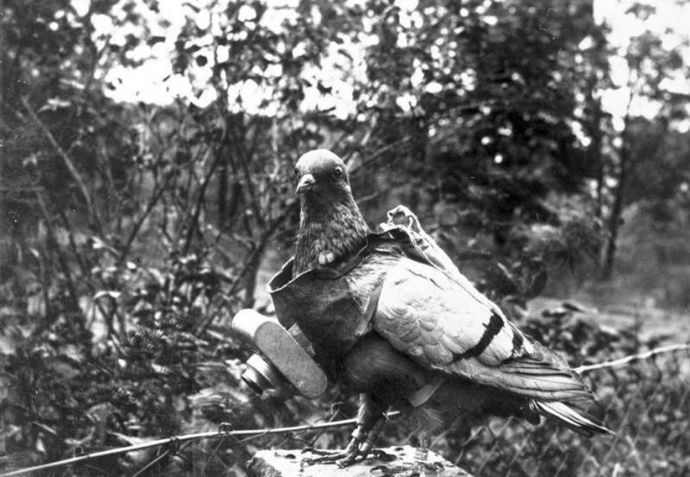
A pigeon with a small camera attached. Neubronner used the trained birds to capture aerial images before and during the war. PHOTOGRAPH COURTESY DEUTSCHES BUNDESARCHIV

A pigeon with a small camera attached. Neubronner used the trained birds to capture aerial images before and during the war. PHOTOGRAPH COURTESY DEUTSCHES BUNDESARCHIV

A post on the New Yorker‘s website adds one more drop in the ocean of appreciation we have for birds:

The Origins of Aerial Photography

BY

…In 1908, Julius Neubronner, who had used carrier pigeons in his work as an apothecary, filed a patent for a miniature camera that could be worn by a pigeon and would be activated by a timing mechanism. Continue reading

Walter Isaacson On Geniuses Of The Digital Revolution

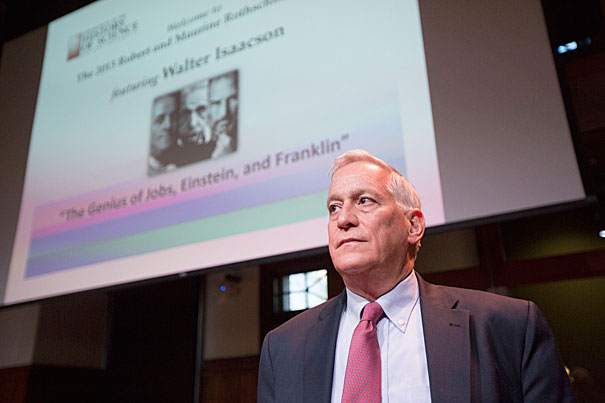
File photo by Kris Snibbe/Harvard Staff Photographer.  "We’re now in a phase in which the connection of creativity to technology is going to drive innovation," said Walter Isaacson ’74, a Harvard Overseer, biographer, and CEO of the Aspen Institute. "I do believe that it’s important for people to have an appreciation for the arts and humanities."

File photo by Kris Snibbe/Harvard Staff Photographer. “We’re now in a phase in which the connection of creativity to technology is going to drive innovation,” said Walter Isaacson ’74, a Harvard Overseer, biographer, and CEO of the Aspen Institute. “I do believe that it’s important for people to have an appreciation for the arts and humanities.”

Thanks to Christina Pazzanese and Harvard Gazette for this conversation with one of the more interesting biographers writing today:

Ghosts in the machines

The history of the Digital Revolution touches our hearts and heads, Isaacson says

In many ways, the entire Digital Era can rightly be laid at the courtly foot of Lord Byron’s rebellious daughter, Ada. Lady Lovelace was the poet’s only child born in wedlock, inheriting both her father’s headstrong, Romantic spirit and her mother’s practical respect for mathematics.

As the Industrial Revolution bloomed, her appreciation for the beauty of numbers and invention, an analytical approach she called “poetical science,” led her to write what is now regarded as the first algorithm and to help refine a machine that could be programmed to perform many different tasks, an idea that anticipated the modern computer by a century.

That’s where Walter Isaacson’s latest book, “The Innovators: How a Group of Hackers, Geniuses, and Geeks Created the Digital Revolution,” steps off.

Continue reading

Lionfish, Prized Case Study In Innovative Environmentalism

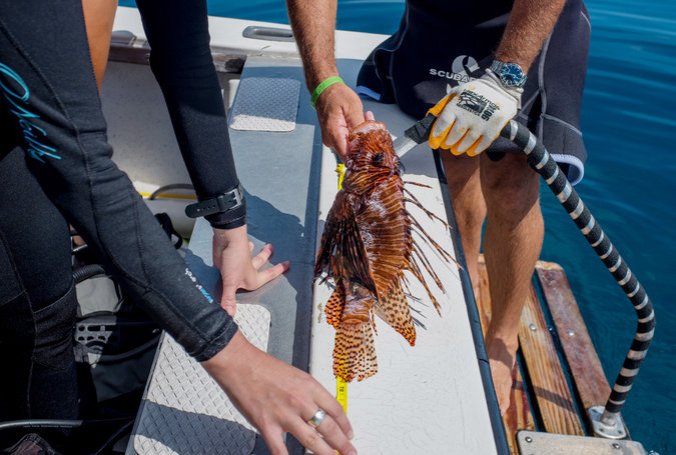
A lionfish caught near Homestead, Fla., by researchers for the Reef Environmental Education Foundation, which is trying to curb the species’ proliferation. Credit Angel Valentin for The New York Times

A lionfish caught near Homestead, Fla., by researchers for the Reef Environmental Education Foundation, which is trying to curb the species’ proliferation. Credit Angel Valentin for The New York Times

We have hosted a series of posts from Raxa contributor Phil Karp, with citizen science and entrepreneurial conservation angles to the story; and now the New York Times considers the story fit to print in a well-detailed reportage:

A Call to Action Against a Predator Fish With an Import Ban, an App and Even Rodeos

Continue reading

Radio Simplified

public-radio-w-typewriter-small_slide-96cb44cba3000a97d7787e78953e7f58e9060639-s4-c85

The Public Radio can be programmed to one station and one station only. Courtesy of Zach Dunham


National Public Radio (USA) can be forgiven what seems like a potential conflict of interest, giving media attention to a product that shares key brand attributes. There are enough distractions in the world that we can but pick and choose those to pass on here, and this one passes the test due to its innovative simplicity relative to its capacity to induce a smile:

Mason jars have been riding a huge wave of popularity thanks to hipsters who embrace them for pickling projects, cake containers and all sorts of craft creations. Now, two engineers from Brooklyn are turning Mason jars into simple sound machines, to play your favorite FM radio station. Continue reading

Advances In Solar-Based Flight

We do not expect this to mean we will board such a plane anytime soon, but anyway thanks to the New York Times for this news about advances in in our ability to harness the sun in ever-better ways:

SOLAR-01-thumbStandardSwiss Pilots to Fly Solar Plane Around World

The trip, which will begin and end in Abu Dhabi, will involve about 25 days of flying over four to five months, with stops in Asia, the United States and Southern Europe or North Africa.

Breakthroughs In Nutrition Via Entrepreneurial Conservation

Exo's peanut butter-and-jelly bar contains about 40 ground-up crickets and has a familiar nutty, sweet flavor. Meredith Rizzo/NPR

Exo’s peanut butter-and-jelly bar contains about 40 ground-up crickets and has a familiar nutty, sweet flavor. Meredith Rizzo/NPR

Thanks to National Public Radio (USA)’s food-focused program, The Salt, for another story on unexpected breakthroughs in nutrition:

…”Insects are probably the most sustainable form of protein we have on Earth,” Bitty Foods founder Megan Miller, who spoke passionately about eating bugs at a TEDx Manhattan event earlier this year, tells The Salt. “The only real barrier to Americans eating insects is a cultural taboo.” Continue reading

Bicycle Zeitgeist

We love design and we love bicycles, and we’ve been writing about their innovation-intersection long before Gianluca’s collapsable model came to our attention.

But we’re grateful for the reminders of the creativity that urges us to upcycle, recycle and craft our “ride”.

If You Happen To Be In London

bell03_3613_04

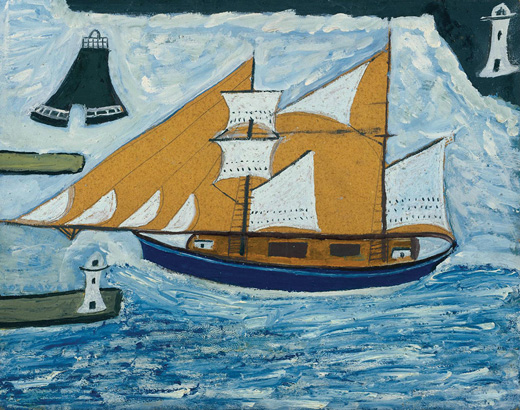
We have been meaning for nearly a year to recommend this article on the relationship between one man and several artists who were otherwise completely unrecognized by the art establishment over many decades. With this man as a champion, after a long effort the artists have finally come into the recognition previously denied to them.

This new show in London reminds us not only to share that article, but to share this review. What explains our interest in this sort of exhibit is the outsider status of the artists. Not “bad boy” outsiders clamoring for attention, but innovators. Thanks to London Review of Books for this review of a current show at the Tate:

‘Proud’ is an epithet that extends from the parade to the workbench. The swagger of troops marching down the street is transferred by the carpenter to the nail that juts out, no less cocky, no less full of itself. There’s much in Tate Britain’s new exhibition, British Folk Art (until 31 August), that straddles both forms of pride. It opens with a fanfare of stout, galumphing tradesmen’s signs: the outsize models of boots, keys, teapots, top hats and so on that dangled over high streets two centuries ago. Continue reading