Plastics Conservation Science

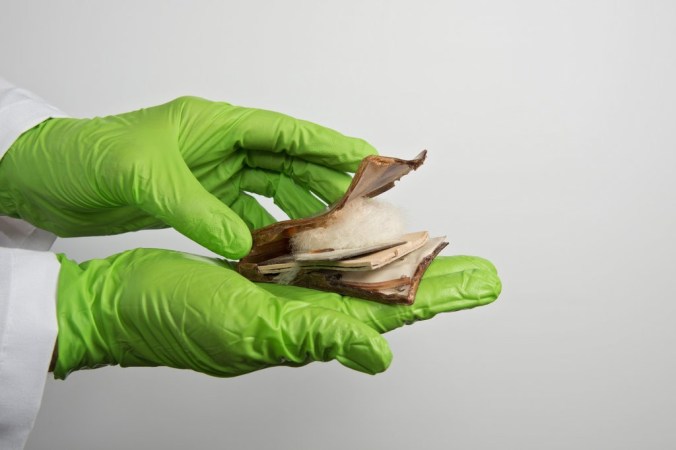
Dr. Odile Madden, of the Getty Conservation Institute in Los Angeles, holding a piece of degrading plastic for use in trying out new methods of preservation. Credit Melissa Lyttle for The New York Times

The irony of the need to conserve aging national treasures or works of art configured from plastics and other petroleum-based materials in the time of the “Pacific Vortex” and other plastic-created environmental disasters is difficult to miss. It never would have occurred to any of us that a field called “Plastics Conservation Science” has any need to exist.

And yet, it does…

These Cultural Treasures Are Made of Plastic. Now They’re Falling Apart.

Museum conservators are racing to figure out how to preserve modern artworks and historical objects that are disintegrating.

The custodians of Neil Armstrong’s spacesuit at the National Air and Space Museum saw it coming. A marvel of human engineering, the suit is made of 21 layers of various plastics: nylon, neoprene, Mylar, Dacron, Kapton and Teflon.

The rubbery neoprene layer would pose the biggest problem. Although invisible, buried deep between the other layers, the suit’s caretakers knew the neoprene would harden and become brittle with age, eventually making the suit stiff as a board. In January 2006, the Armstrong suit, a national treasure, was taken off display and stored to slow the degradation.

Of an estimated 8,300 million metric tons of plastic produced to date, roughly 60 percent is floating in the oceans or stuffed in landfills. Most of us want that plastic to disappear. But in museums, where objects are meant to last forever, plastics are failing the test of time.

“It breaks your heart,” said Malcolm Collum, chief conservator at the museum. The Armstrong suit’s deterioration was arrested in time. But in other spacesuits that are pieces of astronautical history, the neoprene became so brittle that it shattered into little pieces inside the layers, their rattling a brutal reminder of material failure.

Art is not spared either, as Georgina Rayner, a conservation scientist at Harvard Art Museums, showed at the American Chemical Society’s national meeting in Boston this month.

Claes Oldenburg’s “False Food Selection,” a wooden box containing plastic models of foods like eggs and bacon, a banana and an oatmeal cookie, now appears to be rotting. The egg whites are yellowing, while the banana has completely deflated.

In museums, the problem is becoming more apparent, Dr. Rayner said in an interview: “Plastics are reaching the end of their lifetimes kind of now.”

Of all materials, plastics are proving to be one of the most challenging for conservators. “I find plastics very frustrating,” said Mr. Collum. Because of the material’s unpredictability and the huge variation in forms of deterioration, he said, “it’s just a completely different world.”

Continue reading

Roots Of Biodiversity

052918_antonelli_0090.jpg

Alexandre Antonelli references the International Plant Names Index to identify specimens.
Rose Lincoln/Harvard Staff Photographer

Our practice was born in Costa Rica, so we sometimes may appear partisan when it comes to celebrating the sciences related to biodiversity. Costa Rica has impressive credentials in that realm, especially relative to its size as a country. But we are very clear on the fact that it would take dozens of Costa Rica-sized biodiversity hotspots to match the scale of the Amazon region, and it is no surprise that studies like those of these scholars are carried out with Amazonian data:

The Amazon as engine of diverse life

052918_antonelli_0233.jpg

“Most evolutionary research focuses on how new species form. But we want to understand how whole ecosystems evolve,” said Alexandre Antonelli.
 Rose Lincoln/Harvard Staff Photographer

A recent study says that many of the plants and animals that call Latin America home may have had their roots in the Amazon region.

The study, co-authored by Harvard Visiting Scholar Alexandre Antonelli and an international team of researchers, says that a dynamic process of colonization and speciation led to the formation of the American tropics, which is the most species-rich region on the planet. The study is described in a paper published in the Proceedings of the National Academy of Sciences.

“We were astonished to detect so much movement across such different environments and over such large distances,” said Antonelli, the study’s lead author. “Up until now, these natural dispersal events were assumed to be quite rare. Our results show how crucial these events have been in the formation of tropical America’s unique and outstandingly rich biodiversity.” Continue reading

The Science Of Nature, Exhibited

27folkart2-jumbo.jpg

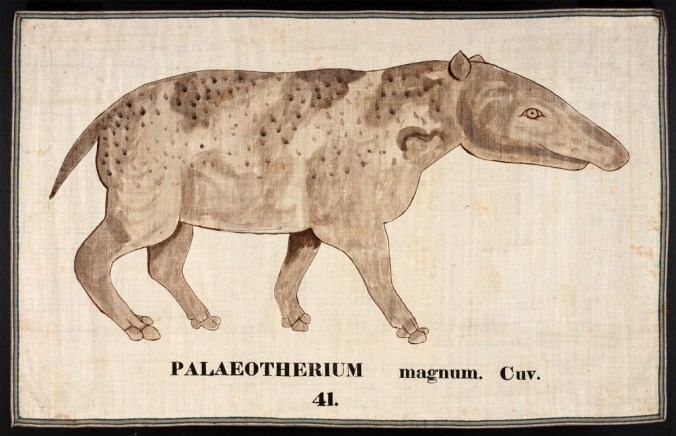
Classroom chart on linen drawn by Orra White Hitchcock, 1828–1840. Credit Amherst College Archives & Special Collections

Thanks to Jason Farago for this review of  Charting the Divine Plan: The Art of Orra White Hitchcock at the American Folk Art Museum:

Mushrooms, Magma and Love in a Time of Science

27folkart1-superJumbo.jpg

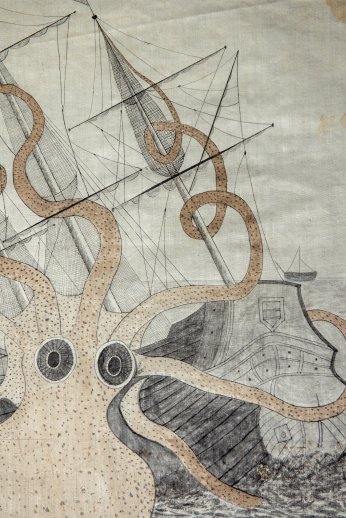
“Colossal Octopus,” 1828–1840, by Orra White Hitchcock, one of America’s first female scientific illustrators, on view at the American Folk Art Museum. Credit George Etheredge for The New York Times

Women remain grossly underrepresented at the highest echelons of American science, and continue to face absurd claims of “innate” inferiority, whether from former Harvard presidents or senior engineers at Google. But until the mid-19th century — when the sciences became professionalized, and when Charles Darwin and others put Christian doctrine under pressure — a woman’s place was in the laboratory, or among the geology and zoology specimens.

Back then the humanities (classics and philosophy, especially) were understood as masculine academic pursuits. It was the more genteel disciplines of natural science, astronomy, chemistry, botany and anatomy, to which women of a certain class gravitated.

merlin_141627540_d42f254c-e955-4d3d-9751-733e1d3723eb-superJumbo.jpg

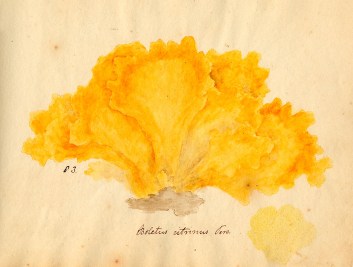
Orra White Hitchcock’s “Fungi Selecti Picti, Vicinity of Conway, Massachusetts” (1821), watercolor, pencil, pen and ink, and ink wash on paper in sewn album. Credit Smith College Special Collections

Orra White Hitchcock (1796-1863) was one of the most remarkable women from this more egalitarian age of scientific study. She had a deep knowledge of botany, zoology and paleontology, and she was also an artist — though that “also” would have seemed unnecessary to her. She produced two albums of botanical illustrations, and later, as introductory materials for her husband’s classes, she diagramed volcanoes, sketched the skeletons of extinct fish and mammals, and drew undulant squids and octopuses on large cotton sheets.

They’re all united at the American Folk Art Museum in “Charting the Divine Plan: The Art of Orra White Hitchcock,” a handsome and unexpectedly passionate exhibition on art, science and education in the early American republic. More than 100 watercolors and classroom charts are here, from painstakingly accurate paintings of reeds and mushrooms to boldly colored abstractions of the earth’s crust and core, and they share space with a splendid array of diaries and correspondence, redolent with the Hitchcocks’ intertwined loves for science, God and each other. Continue reading

If You Happen To Be In Mexico City

28redpaint4-master675

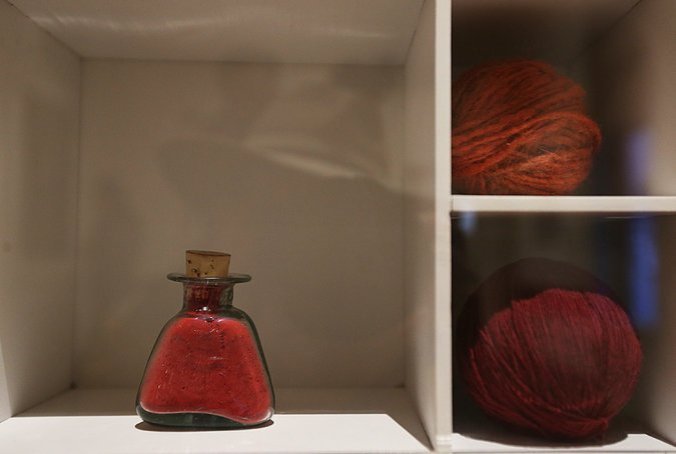
A jar of dye and some red yarn colored by cochineal, part of the Mexico City show. Credit Marco Ugarte/Associated Press

Colors used in dyes and paints in earlier centuries came from various organic and inorganic sources, and this particular red comes from an insect. An exhibit with this “Mexican red,” highlighting the relationship between nature’s sources, artists and their patrons, strikes us as as good a reason as any to curate a show:

28redpaint3-master675

Van Gogh’s “Bedroom in Arles, Third Version” (end of September 1889), which uses cochineal. The artist likened the color to the “red of wine.” Credit Musée d’Orsay, Paris

MEXICO CITY — Along with silver and gold, the first ships that sailed from the New World after the Spanish Conquest carried another treasure: a natural dye that produced a red so intense that European artists quickly embraced it as their own.

28redpaint5-blog427

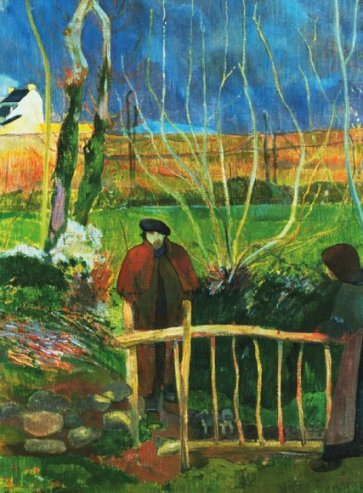
“Bonjour, Monsieur Gauguin” (1889), by Gauguin, is on display in “Mexican Red,” though its use of cochineal has not been confirmed. Credit Hammer Museum, Los Angeles

The trade in this dye reaped vast riches for the Spanish crown and supplied the crimson palette that would color the sacred and secular art of Europe for more than three centuries.

An exhibition that runs through Feb. 4 at this city’s Palace of Fine Arts, “Mexican Red, the Cochineal in Art,” traces the journey of the color from the highlands of pre-Hispanic Mesoamerica to Europe. There, it became increasingly associated with the projection of power in the 17th and 18th centuries. Cochineal fell into decline in the 19th century, as synthetic dyes were introduced, but was sought out later by the Impressionists. Continue reading

If You Happen To Be In New York City

171106_r30835

The British visionary Samuel Palmer drew “Oak Tree and Beech, Lullingstone Park,” ca. 1828, using pen and ink, graphite, and watercolor. Thaw Collection; The Morgan Library & Museum

We try not to judge a book by its cover, but if the sample above is any indication this looks like a show worth visiting:

Five Centuries of Drawings at the Morgan

From a study of drapery by a German artist circa 1480 to an Ellsworth Kelly collage from 1976, the collection is almost unbearably excellent.

The almost unbearably excellent show “Drawn to Greatness: Master Drawings from the Thaw Collection” begins with a love story. In 1954, the dealer Eugene Thaw—the son of a heating contractor and a high-school teacher, from Washington Heights—had a prescient assistant who suggested that he start buying art for himself. Continue reading

If You Happen To Be In Cambridge

9780674975910-lg

Thanks to Jonathon Shaw and Harvard Magazine for bringing our attention to this book:

Life Beyond Sight

The microbial earth, brought into view

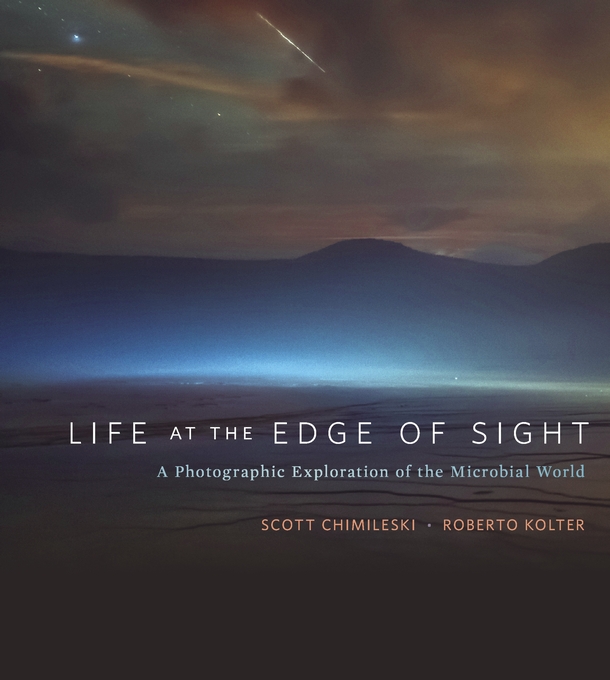
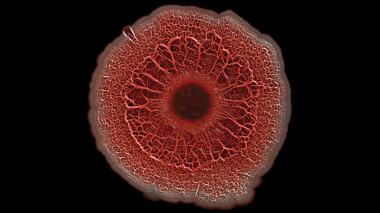
world.drop_.sig_IN ROCKS AND SOIL, air, ponds and oceans, life is dominated by creatures that humans cannot see. Microbes thrive everywhere, from gardens and kitchens to the harshest environments on the planet: under polar ice, in hydrothermal vents at the bottom of the sea, in hot springs that spew acid. A single gram of soil teems with billions of them, and their genetic diversity is equally impressive, dwarfing that of all the plants and animals round.microbe.2 (1)on Earth. Life at the Edge of Sight: A Photographic Exploration of the Microbial World (forthcoming from The Belknap Press of Harvard University Press), brings the planet-shaping diversity of these single-celled, microscopic organisms into view through stunning images. Co-authors Roberto Kolter, professor of microbiology and immunology, and Scott Chimileski, a research fellow in microbiology and immunology at Harvard Medical School, share their passion for the subject in part by magnifying what cannot be seen unaided, in part by revealing large-scale microbial impacts on the landscape. Kolter has long been a leader in microbial science at Harvard, while Chimileski brings to his scholarship a talent for landscape, macro, and technical photography…

Read the whole article here, and if you happen to be in Cambridge (MA, USA) this exhibition might be of interest:

World in a Drop: Photographic Explorations of Microbial Life

logofinalThe minuscule ecosystem within a single drop of water is home to an astonishing diversity of organisms busily living out their lives and interconnected by myriad complex relationships. The photographic exhibit World in a Drop is an aesthetic journey into this microbial world, as revealed through cutting-edge imaging microbe.gallery.1technologies. With expertly executed photography, videography, and poetic narration, Scott Chimileski and Roberto Kolter capture the intrinsic beauty of a mysterious world that is seldom recognized.
Patagotitan, Farm To Museum

028596730

Patagotitan cast, in a hangar. D. Pol.

Thanks to Ed Yong, at the Atlantic, for expanding our horizons beyond the farm to table movement and reminding us that discoveries are still bringing new/old wonders of the planet Earth to the attention of scientists, and then to the rest of us via museums:

…Patagotitan lived during the Cretaceous period around 101 million years ago. And for some reason, it frequented the area that eventually became the Mayo family’s farm. Carballido and Pol’s team returned to the site more than a dozen times, disinterring every fossil they could find. In the process, they built a road and partially removed a hill. Eventually, they recovered bones from at least six Patagotitan individuals. And their bones reveal that they were in their prime—young, still growing, and not yet at their full adult size. Continue reading

Tradition and Memory, Handed Down Stitch by Stitch

If you happen to be anywhere near the Philadelphia Museum of Art, you have a few more days to visit this extraordinary exhibit of Phulkari: The Embroidered Textiles of Punjab.

Thanks to Architectural Digest contributor Medhavi Gandhi for this informative and culturally sensitive article.

Philadelphia Museum of Art showcases the history of Punjab’s rich embroidery craft through ‘Phulkari’

Phulkaris, which literally translates into ‘flower work’, is a unique style or technique of embroidery peculiar to Punjab, and today constitute the lavishly embroidered head scarves and shawls crafted in the region. ‘Phulkari: The Embroidered Textiles of Punjab’ presents phulkaris from the collection of Jill and Sheldon Bonovitz alongside the Philadelphia Museum of Art’s permanent collection, focusing mostly on embroideries from a pre-partitioned Punjab.

The threads of phulkari have since endured much: partition, industrial reforms, changing economic and fashion trends, and the exhibition aptly helps you develop a perspective around all these.

GEOGRAPHICAL INDEXING
Curators Dr. Cristin McKnight Sethi and Dr. Darielle Mason position the craft as art, presenting phulkaris through the historical and cultural lens, thus offering a renewed contact with the old way of life; ceasing to be a commodity of high commercial value but more as a window into the lives of people.

In a brief issued by the Museum, Timothy Rub, The George D. Widener Director and CEO of the Philadelphia Museum of Art, said: “This exhibition, which examines the artistic, cultural, and political significance of phulkari, is long overdue and will certainly delight visitors who may be unfamiliar with this remarkable art form”. I couldn’t agree more, and here’s why: Continue reading

Italian Curiosities In Lovely Cabinets

18LIBRARIESA-jumbo-v2.jpg

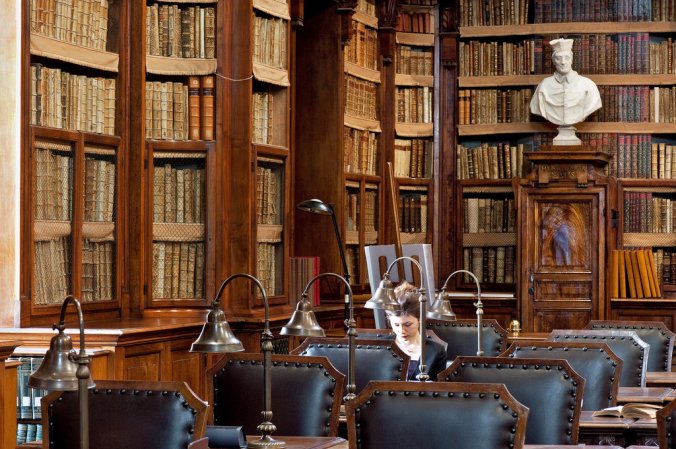
The Biblioteca Angelica in Rome holds the first volume of Cicero’s “De Oratore” that was printed in Italy, in 1465, and a precious early edition of Dante’s “Divine Comedy.” Credit Susan Wright for The New York Times

If You Happen to Be in Washington DC…

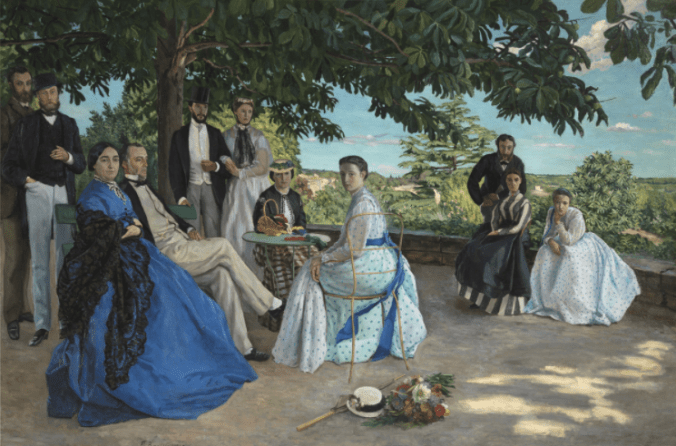
Frédéric Bazille’s The Family Gathering has none of the quick, airy brush strokes his future impressionist peers would discover; but the sunshine is there, as are the bright colors. Musée d’Orsay, Paris/Courtesy of the National Gallery of Art

Considering the changes in the air of the 1860’s Paris art scene, the “might have been” aspect of this story about a lesser known 19th century French painter is poignant, to say the least. Thanks, once again, to NPR for sharing this story about what could have been.

France’s ambassador to the United States, Gérard Araud, is a fan of 19th-century French painter Frédéric Bazille. But I had a confession to make when I spoke with him about the National Gallery’s “Frédéric Bazille and the Birth of Impressionism” exhibition. I said that I usually walk right past Bazille’s paintings and go straight to the impressionists — and I assume I’m not the only one who does that.

Araud understands, but says he likes Bazille for the opposite reason: The impressionists are so well-known, he says, “I’ve reached a point where I don’t look at them anymore.”

Those impressionists were also Bazille’s pals. Continue reading

Art as Public Domain

Young Woman with a Water Pitcher by Johannes Vermeer (Dutch, Delft 1632–1675 Delft)

Young Woman with a Water Pitcher
by Johannes Vermeer (Dutch, Delft 1632–1675 Delft)

In these current times when Art, Culture and Civility appear to be under constant attack, news that museums and galleries – both private and public – are opening their virtual archives of Public Domain artworks to be just that, public, is newsworthy.

For example, a click on the image to the left takes viewers to the Metropolitan Museum’s website that includes not only the full details of the painting (description, catalogue entry, provenance and exhibition history, etc.), but also a hyperlink to a map of the gallery where viewers can find the actual painting, and related objects within the museum’s vast collection.

We’re happy to know that museums, whether virtual or physical, still provide inclusive space to breathe deep.

Met Museum Makes 375,000 Images Free

Continue reading

Model Mad, Museum

04MOMATRAVEL3-master768.jpg

“K+L+32+H+4. Mon père et moi (My Father and I)” right, by Charles Hossein Zenderoudi, on display at the Museum of Modern Art in New York. Credit Sam Hodgson for The New York Times

When the two words model mad first occurred to us, it was simply to thank one of our favorite people for continuing to resist wrongness in new, clever manner, without losing his cool and thereby keeping it effective. Since then we have found a story almost every day that illustrates the fertile ground of protest created in recent times. And today, thanks to the New York Times, we see another one:

MoMA Takes a Stand: Art From Banned Countries Comes Center Stage

By

President Trump’s executive order banning travel and rescinding visas for citizens of seven majority-Muslim nations does not lack for opponents in New York — from Kennedy Airport, where striking taxi drivers joined thousands of demonstrators, to the United Nations, whose new secretary general, António Guterres, said the measures “violate our basic principles.

Now the Museum of Modern Art — which in past decades has cultivated a templelike detachment — is making its voice heard as well. In one of the strongest protests yet by a major cultural institution, the museum has reconfigured its fifth-floor permanent-collection galleries — interrupting its narrative of Western Modernism, from Cézanne through World War II — to showcase contemporary art from Iran, Iraq and Sudan, whose citizens are subject to the ban. A Picasso came down. Matisse, down. Ensor, Boccioni, Picabia, Burri: They made way for artists who, if they are alive and abroad, cannot see their work in the museum’s most august galleries. (A work from a Syrian artist has been added to the film program. The other affected countries are Somalia, Yemen and Libya.) Continue reading

If You Happen To Be In Williamstown

photogclark

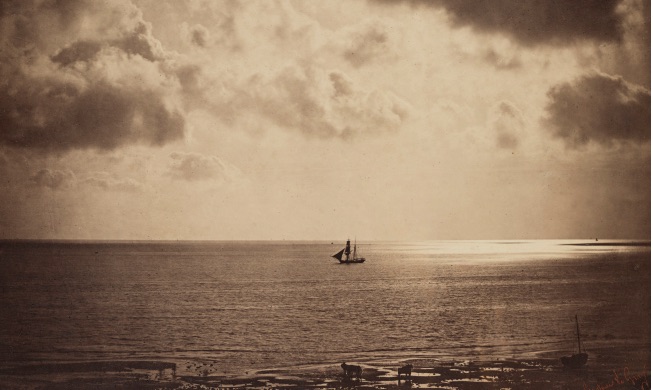
Thanks to Louis Menand, whose post THE MAJESTY OF EARLY PHOTOGRAPHY brought to our attention this exhibit (his comment on the museum itself, shared at the end of this post, is worthy of a read to the end):

…Right next to “Photography and Discovery” is another small exhibit, also of works the Clark owns, of early-nineteenth-century British paintings, many by Turner and Constable. I looked in to try out Galassi’s thesis, and you really can see the continuity between what those painters were doing, exploring the effects of sunlight on everyday subjects, and what the photographers would start doing a few years later…

The museum’s description makes us think of the parallels between photography and travel in terms of opening up horizons to an ever-widening audience:

When photographs were first widely produced and distributed during the second half of the nineteenth century, they offered viewers new ways to discover unknown people, places, and things. This exhibition explores how photographers considered these subjects during the medium’s first seventy-five years. During this exciting period, images were captured for many different reasons—from documentation to curiosity—and they came in many forms, including deluxe book illustrations, portable portrait cards, and frame-worthy landscapes. Continue reading

If You Happen To Be In London

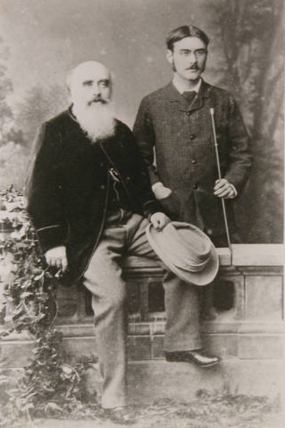
John Lockwood Kipling with his son Rudyard Kipling, 1882. © National Trust/Charles Thomas

John Lockwood Kipling with his son Rudyard Kipling, 1882. © National Trust/Charles Thomas

Kipling is almost a household name for many in our group, but primarily in the context of Rudyard Kipling, the writer of the well-known stories and fables about India. When researching the author a few years back I was surprised to learn about his talented father, whose beautiful illustrations graced the early editions of several of his son’s books.

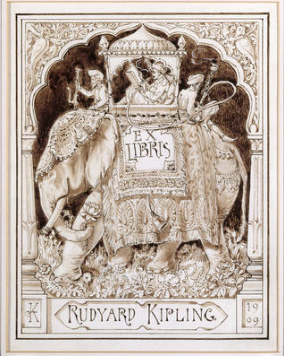
Rudyard Kipling’s bookplate ‘Ex Libris', Lockwood Kipling, 1909. © National Trust Images/John Hammond

Rudyard Kipling’s bookplate ‘Ex Libris’, Lockwood Kipling, 1909. © National Trust Images/John Hammond

Those lucky enough to be in London this month can visit the Victoria & Albert Museum for the exhibition Lockwood Kipling: Arts and Crafts in the Punjab and London.

More of note, not only was the senior Kipling an artist, writer, museum director, teacher, and influential figure in the Arts and Crafts movement – he was also a conservationist, distinguished for promoting the traditional textile crafts of India and what is now Pakistan.

The exhibit coincides with Conferences and Symposia related to the 3-year international research project on Kipling’s legacy.

The 19th century Arts and Crafts revival in British India is a fascinating chapter in the international history of art and design. However, John Lockwood Kipling’s career as designer and architectural sculptor, curator and educator, illustrator and journalist, has received little attention. Continue reading

Greening Museums

garden_drawing

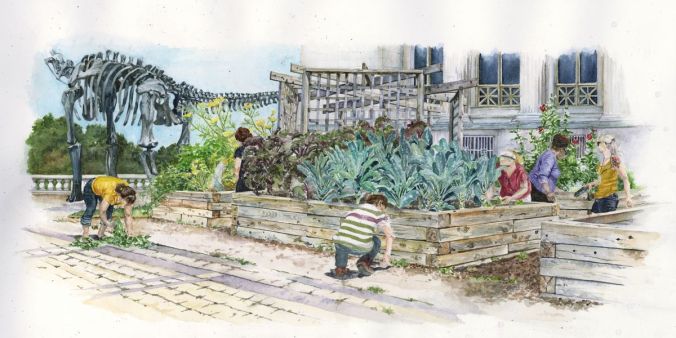
Illustration by Emily Woodworth

There have been moments in recent months when continued attention to the little details we see, and link to concerning incremental improvements in environmental sensitivity, social responsibility, or any other sustainability metric seems akin to “rearranging the deck chairs on the Titanic.” Political turmoil, and specifically political commitment to dismantle environmental protection in various influential countries, might make incremental change seem even less significant to some. These deck chairs are different. Every instance of care and action is a data point worthy of attention, and we will continue to connect the dots. Today, from the Field Museum of Chicago and their awesome Green Team:

THE FIELD MUSEUM’S GREEN TEAM

A Greener Field (the Museum’s “green team”) began as a grassroots recycling effort in 1989, and now has over 40 members representing every area of the Museum.  Staff members who share the Museum’s commitment to improving sustainability attend monthly meetings which provide an outlet for them to share successes and challenges in terms of greening their departments, as well as a vehicle to initiate and help implement institution-wide programs.  From bike sharing programs to recycling and composting Continue reading

Vatican’s Small Steps Toward Gender Equality

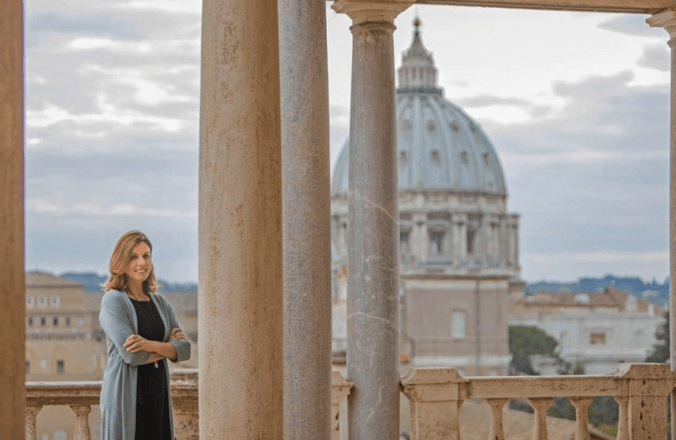
Barbara Jatta will oversee an institution that is one of the Holy See’s major sources of funds with about $311 million in gross revenues a year. PHOTO: VATICAN MUSEUMS

Barbara Jatta will oversee an institution that is one of the Holy See’s major sources of funds with about $311 million in gross revenues a year. PHOTO: VATICAN MUSEUMS

Without religious affiliation, we’ve applauded the current pope’s embrace of environmental protection and other progressive leaning policies. In a current political atmosphere where gender often overrides qualification, we appreciate this appointment all the more.

Pope Francis Names New Female Director of Vatican Museums

ROME—The Vatican Museums, one of the world’s pre-eminent art collections, announced Tuesday that Barbara Jatta, an Italian art historian and longtime Vatican official, will become its new director, making her the first woman to hold one of the most prestigious jobs in the art world.

The appointment by Pope Francis, which is effective Jan. 1, will also make Ms. Jatta the most prominent female administrator at the Vatican. The pope has spoken about expanding the roles of women in the Catholic Church, but most high Vatican offices are reserved for cardinals and bishops, who must be men. (Margaret Archer, a British sociologist, was named president of the Pontifical Academy of Social Sciences, an advisory body to the pope, in 2014.)

The Museums, which include priceless masterpieces including the Sistine Chapel frescoes by Michelangelo, regularly appear among the world’s top 10 museum complexes by attendance, with over six million visitors in 2015. The collections include 70,000 objects, dating back from antiquity through the 20th century. Continue reading

If You Happen To Be In Tokyo


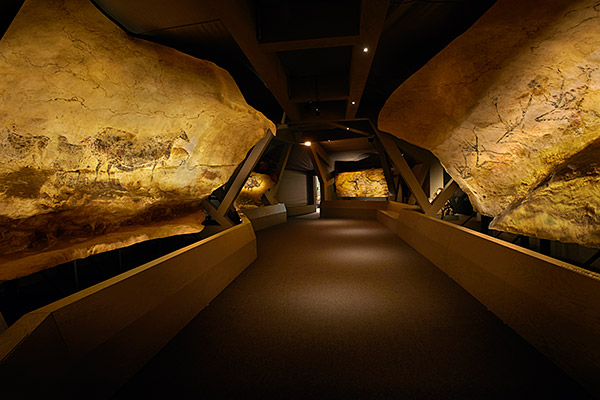
© SPL Lascaux international exhibition

© SPL Lascaux international exhibition

It’s the rare few who will have the opportunity to enter the original Lascaux Cave, but thanks to the foresight of the French government and the hard work of dedicated scientists and artists, an exact replica was opened in 1983 that gave visitors a chance to experience the amazing archaeological site. Nearly 20 years later additional replicas have begun to tour the world.

A few days ago we posted about Judith Thurman’s receiving a Medal of Chevalier in part for her inspiring writings about the Chauvet cave. It was a happy coincidence that the traveling exhibit had just opened in Toyko’s National Museum of Nature and Science.

The National Museum of Nature and Science, the Mainichi Newspapers, and Tokyo Broadcasting System Television, Inc. will hold a special exhibition, “Lascaux: The Cave Paintings of the Ice Age”, from Tuesday, Nov. 1, 2016 to Friday, Feb. 19, 2017. About 20,000 years ago, dynamic pictures of animals were painted on the walls of caves found in southwestern France, the Lascaux Caves. Continue reading

Merdacotta from Castelbosco

Merdacotta (baked processed cow dung mixed with clay and hay) products. Credit Alex Majoli

I’ve shared some thoughts on dung in the past, and also experienced first-hand the use of methane collected as an alternative energy source at a coffee farm in Nicaragua. There, the gas was used for cooking fuel, but in the case of Castelbosco farm in Piacenza, Italy, dairy farmers who make Grana Padano cheese also generate electricity from their dung’s methane, and run a museum that showcases poop in part of a medieval castle. They also make the beautiful pots, tableware, and tiles shown in the photo above. Christine Smallwood writes for the New York Times Style Magazine:

THE DAIRY FARMER Gianantonio Locatelli climbed up the steel ladder and peered over the brim of a large corrugated vat, about the size of a very deep above-ground swimming pool. “It’s full!” he exclaimed, with warbling joy. “It’s beautiful!”

The vat was full of liquid cow dung. I handed my phone to Locatelli’s friend, the architect Luca Cipelletti, and climbed the ladder to the top, disembarking on a viewing dock. Beneath my feet the manure bubbled and gurgled, forming foamy peaks and crests. It was a topographical map, a primordial stew. A rich and beautiful shade of brown.

Continue reading

Museums, Things, Epiphanies

Reading the review, and the museum’s description of this show, I immediately thought of a museum that Amie and I had the chance to visit in Istanbul, which had been on our to-do list for some time; and the next click through the museum’s website led me to this:

THURSDAY 09/29 /16 7PM 

Orhan Pamuk in Conversation with Massimiliano Gioni

Which just seemed right because the museum in Istanbul was create by Orhan Pamuk. I will do my best to find a recording of this conversation, if they make a recording or transcript available and but for now the best I can do is direct you to the website of the museum in Istanbul which, hopefully, will lead you to the actual museum, easily the most moving museum experience of my life:

slider-1

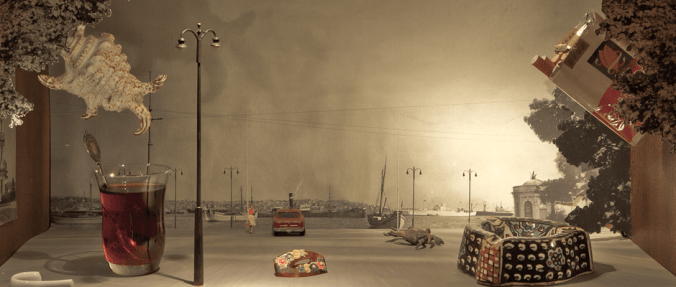
The Museum of Innocence is both a novel by Orhan Pamuk and a museum he has set up. From the very beginnings of the project, since the 1990s, Pamuk has conceived of novel and museum together. The novel, which is about love, is set between 1974 and the early ’00s, and describes life in Istanbul between 1950 and 2000 through memories and flashbacks centred around two families – one wealthy, the other lower middle class. The museum presents what the novel’s characters used, wore, heard, saw, collected and dreamed of, all meticulously arranged in boxes and display cabinets. It is not essential to have read the book in order to enjoy the museum, just as it is not necessary to have visited the museum in order to fully enjoy the book. But those who have read the novel will better grasp the many connotations of the museum, and those who have visited the museum will discover many nuances they had missed when reading the book. The novel was published in 2008, the museum opened in Spring 2012.

Be sure that you read the explanation for this floor motif.

Reflections On Collecting Things

Museum.jpg

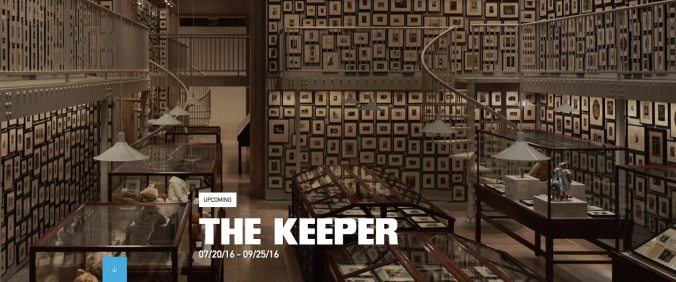
This exhibition, brought to our attention by a lengthy respectful review here, is the first time we have heard of this museum, but now that it is on our radar we stay tuned. This looks like our kind of show:

Object Lessons: The New Museum
Explores Why We Keep Things

Curators at the New Museum have created an exhibit with over 4,000 objects that examines the various ways we collect and own items.

By

We live in a sharing economy of collaborative consumption — services, not stuff. Crowdsourcing, peer-to-peer rentals like Airbnb: An interest, exemplified by millennials, in a temporary ownership of goods.

Apps, not objects. Continue reading