The Truth About Komodo Dragons

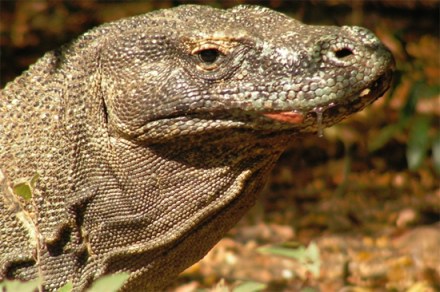
The Komodo dragon: surprisingly clean.

The Komodo dragon: surprisingly clean.

Myth-busting science writers, especially when they free a phenomenal animal from the clutch of wrongly bad reputation, are heroic folk to us:

In 1969, an American biologist named Walter Auffenberg moved to the Indonesia island of Komodo to study its most famous resident—the Komodo dragon. This huge lizard—the largest in the world—grows to lengths of 3 metres, and can take down large prey like deer and water buffalo. Auffenberg watched the dragons for a year and eventually published a book on their behaviour in 1981. It won him an award. It also enshrined a myth that took almost three decades to refute, and is still prevalent today. Continue reading

Pampanar – Thekkady, Kerala

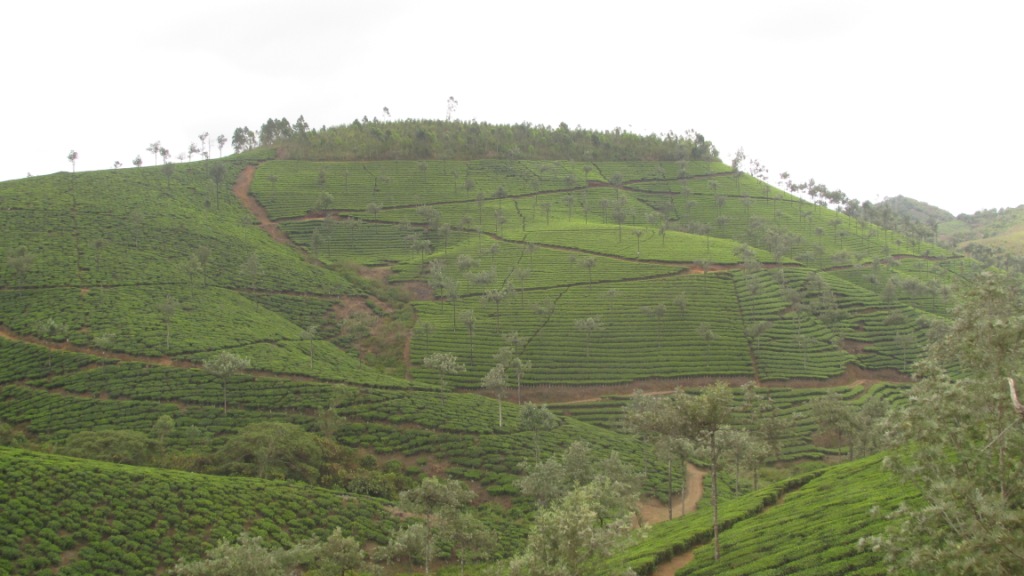
Tea Estates

Pampanar is located near Thekkady en route to Kottayam. It is a picturesque place with an unending expanse of lush green tea plantations. Tea estates, lush hillsides, forests and coffee estates views lend charm to this hill station. Continue reading

Celebrating Conservation’s Important Moments In History

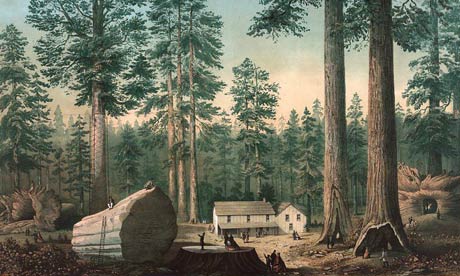
Tourists inspecting the stump of the 'Mammoth Tree' in Calaveras County, California, c1860. The 'Mother of the Forest', without its bark, can be seen in the background. Image: LoC

Tourists inspecting the stump of the ‘Mammoth Tree’ in Calaveras County, California, c1860. The ‘Mother of the Forest’, without its bark, can be seen in the background. Image: LoC

We have written about and sometimes celebrated important moments in conservation history in the past, and these celebrations are among those most responded to by readers of this blog.  A few days ago, a landmark anniversary was observed in an editorial at the newspaper that most consistently keeps us in perspective:

Today marks the 160th anniversary of a seminal, but largely forgotten moment in the history of the conservation movement.

On Monday, 27 June, 1853, a giant sequoia – one of the natural world’s most awe-inspiring sights – was brought to the ground by a band of gold-rush speculators in Calaveras county, California. It had taken the men three weeks to cut through the base of the 300ft-tall, 1,244-year-old tree, but finally it fell to the forest floor. Continue reading

Plants & Math

NIGEL CATTLIN/GETTY

NIGEL CATTLIN/GETTY

Heidi Ledford introduces the following scientific finding on Nature‘s website:

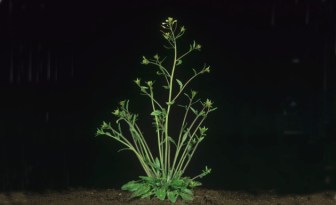
As if making food from light were not impressive enough, it may be time to add another advanced skill to the botanical repertoire: the ability to perform — at least at the molecular level — arithmetic division. Continue reading

Veg Beat

New research shows that cabbage, carrots and blueberries are metabolically active and depend on circadian rhythms even after they’re picked, with potential consequences for nutrition. Photo by Flickr user clayirving

New research shows that cabbage, carrots and blueberries are metabolically active and depend on circadian rhythms even after they’re picked, with potential consequences for nutrition. Photo by Flickr user clayirving

Smithsonian has an article about a surprising natural phenomenon, which may not impact your feelings but should get your thoughts stirred up a bit:

You probably don’t feel much remorse when you bite into a raw carrot.

You might feel differently if you considered the fact that it’s still living the moment you put it into your mouth.

Of course, carrots—like all fruits and vegetables—don’t have consciousness or a central nervous system, so they can’t feel pain when we harvest, cook or eat them. But many species survive and continue metabolic activity even after they’re picked, and contrary to what you may believe, they’re often still alive when you take them home from the grocery store and stick them in the fridge. Continue reading

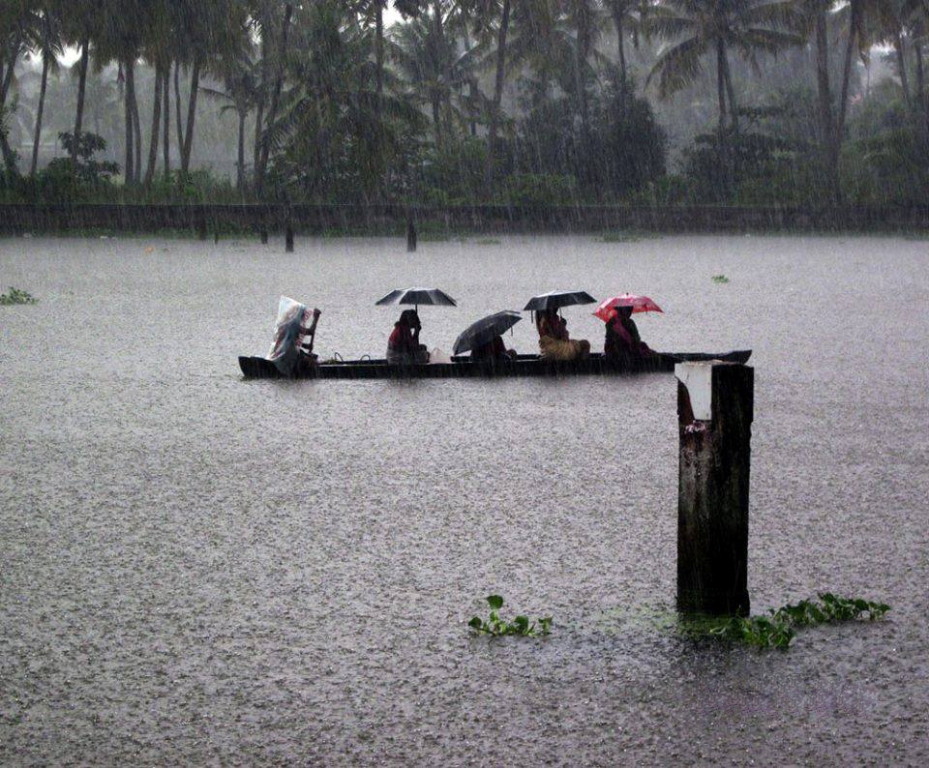
Monsoon – Kerala

Photo credits :Sreekuttan

Photo credits: Sreekuttan

Monsoon rains are very much linked to the economy and ecology of Kerala; almost 85 percent of the state’s annual rainfall is received during that period. The slopes of the Western Ghats are among the places in India that receives the highest amount of rain. According to Ayurvedic theory, monsoon is the best season for rejuvenation therapies. It is the period when the atmosphere remains dust-free and cool. The Monsoon also plays an important role in the healthy growth of spices and crops like Cardamom, Pepper and Coffee. Continue reading

Cactus plant

Cactus plant

Cactus plant

Cactus are unique plants found naturally growing in tropical regions, dry areas and deserts. Belonging to the family of cactaceac, instead of leaves from which water can easily evaporate, members of this family have spiney succulent body parts that help to control the water levels. Continue reading

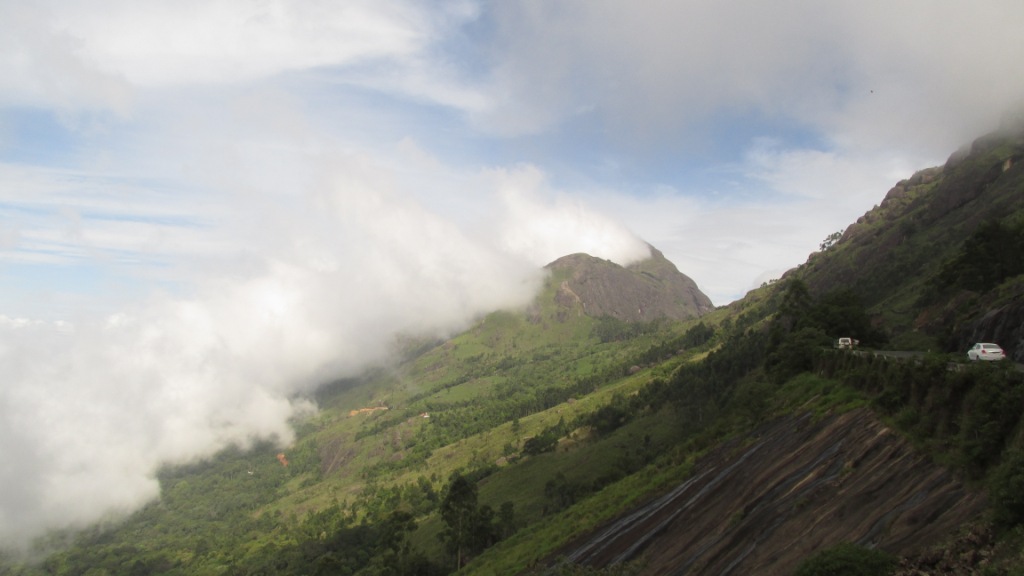
Beauty Of Munnar – Lockhart Gap

Lockhart Gap

Lockhart Gap

Munnar abounds in amazing views. The Lockhart Gap is located near Munnar on the Thekkady road, offering a bird’s-eye view of Bison Valley and the surrounding  hills and tea plantations. It is also an ideal place for rock climbing. Continue reading

Exploring Iceland

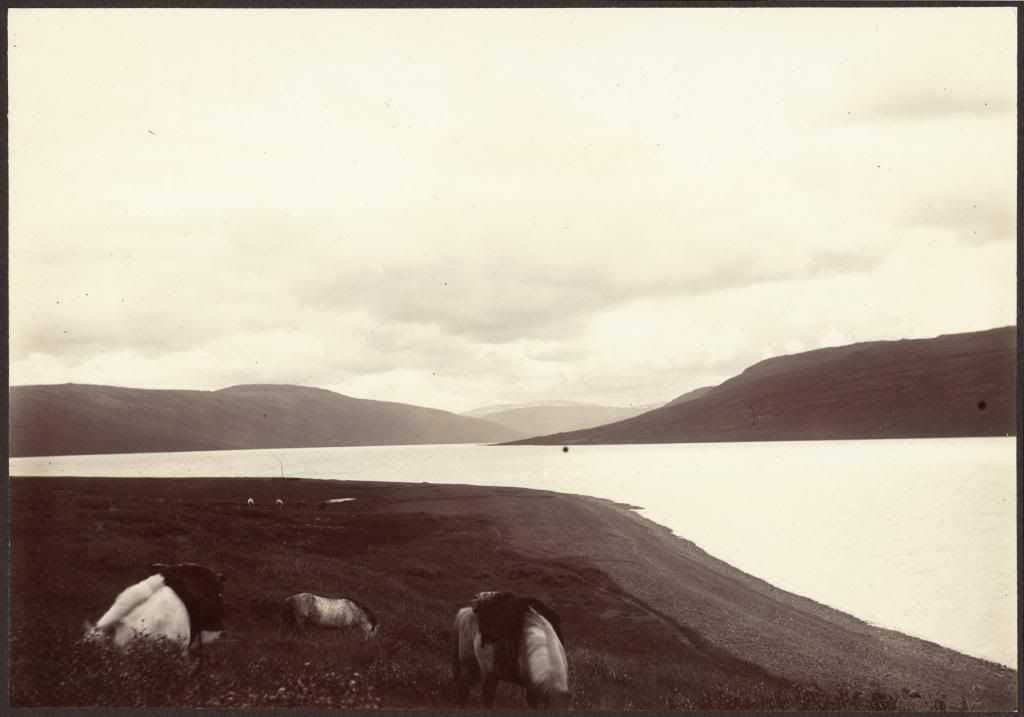
The head of Skorradalsvatn. Collodion print ca. 1900 by Frederick W. Howell. Bequest of Daniel Willard Fiske; compilation by Halldór Hermannsson at the Fiske Icelandic Collection of Cornell University.

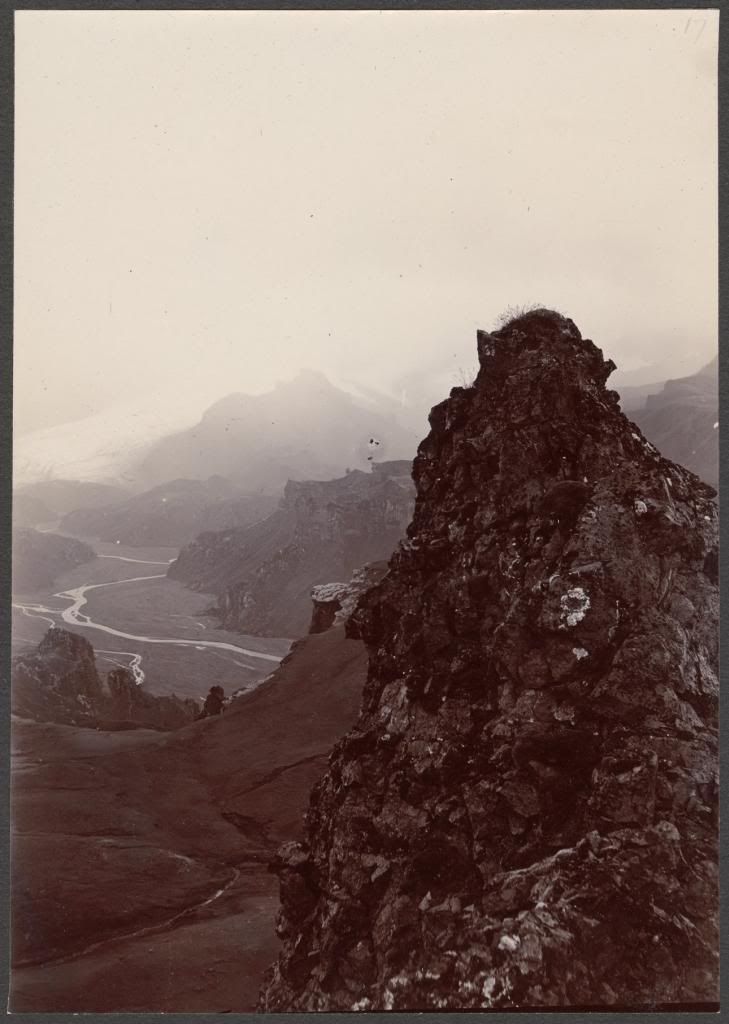
Þórsmörk. Head of Krossárdalur. Collodion print ca. 1900 by Frederick W. Howell. Bequest of Daniel Willard Fiske; compilation by Halldór Hermannsson at the Fiske Icelandic Collection of Cornell University.

It was mentioned a week or two ago that Iceland is in the air. For me, Iceland is on my mind, in my laptop, hidden throughout the Cornell libraries, and scattered about my room. After a couple essays for an environmental history course last year and some preliminary research for finding an honors thesis topic in the history major, I discovered that, thanks primarily to Cornell University’s first librarian, we have one of the largest collections of Icelandic material in the world. Since one of my projects for the environmental history class had shown me that Iceland was an interesting place to examine more closely, I did some more research and found the topic of European travel there during the eighteenth and nineteenth centuries engaging enough to choose as an honors thesis subject.

One of the places in Europe with the most spaces left blank by cartographers through the eighteenth and nineteenth centuries, Iceland’s inner regions were not fully mapped until 1901. Continue reading

WED 2013 : Taste the waste… of water

WED 2013 - Raxa Collective

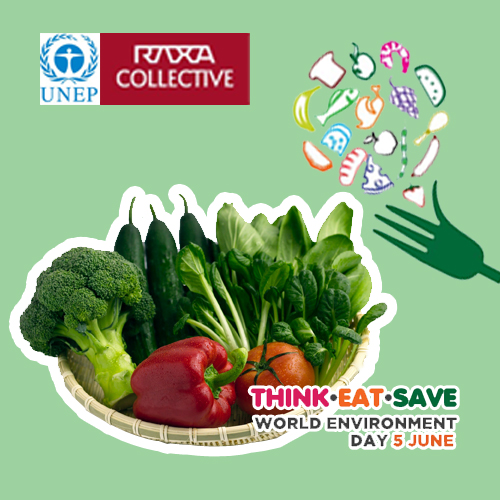
On June 5, we’ll celebrate World Environment Day. This year UNEP focuses on the theme Food waste/Food Loss. At Raxa Collective we’ll be carrying out actions and sharing experience and ideas. Come and join us with your ideas and tips to preserve foods, preserve resources and preserve our planet.

image_gallery_close_up

 Most part of the world water consumption depends on food production. Every year 30% of it is wasted. We can reduce the wastage of water reducing the food waste. The Stockholm International Water Institute (SIWI) has released a short documentary titled ‘Taste the Waste of Water’ Continue reading

Krulwich On Insect Communities Understood Through Mathematics

Another of those wonders, this time about bees, brought to you by the godfather of fun science reporters:

Solved! A bee-buzzing, honey-licking 2,000-year-old mystery that begins here, with this beehive. Look at the honeycomb in the photo and ask yourself: (I know you’ve been wondering this all your life, but have been too shy to ask out loud … ) Why is every cell in this honeycomb a hexagon? Continue reading

Siberian Tigers Return, Humans Shrug In Ambivalence

Decades of poaching and logging in China and elsewhere have ravaged the Siberian tiger population, with only about 500 left in the wild worldwide. Photograph: Tim Davis/Corbis

Decades of poaching and logging in China and elsewhere have ravaged the Siberian tiger population, with only about 500 left in the wild worldwide. Photograph: Tim Davis/Corbis

In our day to day work, how humans and wild animals interact is often a matter of personal fulfillment, though at times we tend to the challenging aspects as well.  The Guardian‘s coverage of the fate of charismatic mega-felines falls into this latter category with a mixed message of one wild animal’s population rebound and what can only be described as practical human reaction:

…Decades of poaching and logging have ravaged the population of the big cat, also known as Amur tigers– only about 500 still live in the wild worldwide. In 2010, Chinese authorities launched an initiative to boost numbers in the Hunchun National Siberian Tiger Nature Reserve near the country’s border with Russia and North Korea. Continue reading

Solitary togetherness : a walk into Periyar Tiger Reserve

Traveling in a pack, or you might say a group, is not something I do on holidays. I’m a lone wolf kind of traveler. See what I mean? Then I took the opportunity to escort a group coming to Cardamom County for a bird photography workshop into Periyar Tiger Reserve, and all my preconceptions disappeared. Although my companions came from all parts of India to take wildlife pictures and I arrived on day 1 with just an iphone, I quickly felt like I belonged. Continue reading

The Darien Gap, Panama

Darien


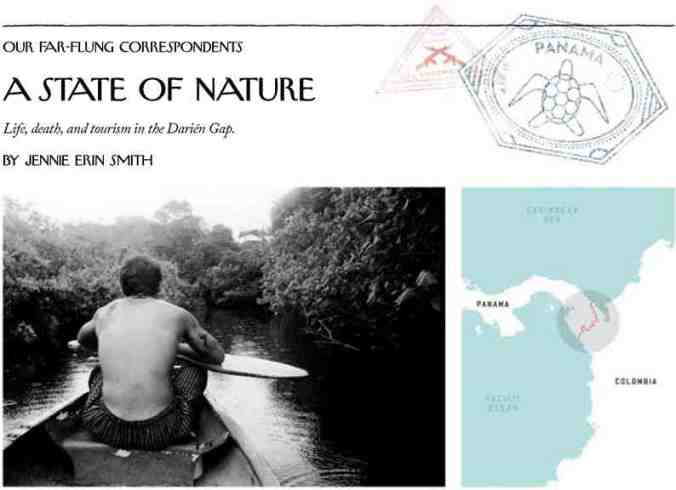
Remarkably, a second article in the same issue of the New Yorker devoted to one of our favorite topics–the wonders of nature. Click the image above to go to the source. The first one we linked to is by one of the magazine’s most distinguished writers, and we are pleased to encounter the author of the following for the first time:

The Pan-American Highway runs sixteen thousand miles, from Anchorage to Tierra del Fuego, with one significant interruption: an expanse of rain forest along the border of Colombia and Panama. The road ends abruptly on the Panama side, just north of a national park, and picks up again as a dirt path, sixty miles southeast, in Colombia, in the floodplain of the enormous Atrato River. The region in between, which spans two coasts with jungles and mountains and a confounding web of rivers, is known locally as the Tapón del Darién—the Darién Plug—for its seeming impassability. Continue reading

A Great Magazine Becomes A Great Insititution

The consistently superb essayist Adam Gopnik, who often writes about topics unrelated to the themes of our blog, in this week’s New Yorker writes on a topic close to our heart (click the image above to go to the article, subscription required):

Magazines in their great age, before they were unmoored from their spines and digitally picked apart, before perpetual blogging made them permeable packages, changing mood at every hour and up all night like colicky infants—magazines were expected to be magisterial registers of the passing scene. Yet, though they were in principle temporal, a few became dateless, timeless. The proof of this condition was that they piled up, remorselessly, in garages and basements, to be read . . . later. Continue reading

Nature Books: Birds

9780810996137

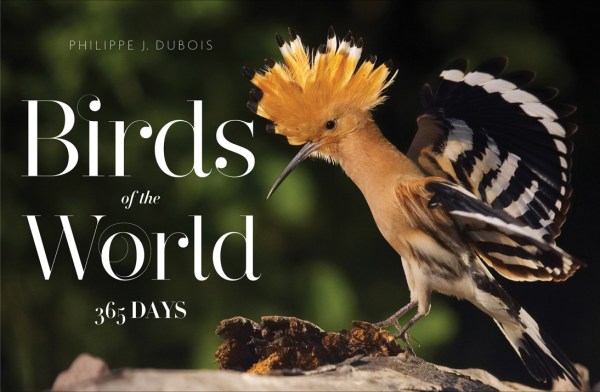
Looking through this publisher‘s catalogue, we see they give attention to a wide variety of charismatic flora and fauna.  For example, this book (click the image above to go to the source):

Birds of the World: 365 Days gives this perennially popular subject the 365 treatment: ornithologist and conservationist Philippe J. Dubois presents a “day in the life” of a year’s worth of species from five continents. The stunning images of birds in action, taken by some of the best avian photographers in the world, illustrate the text beautifully. Continue reading

Yosemite’s Finest

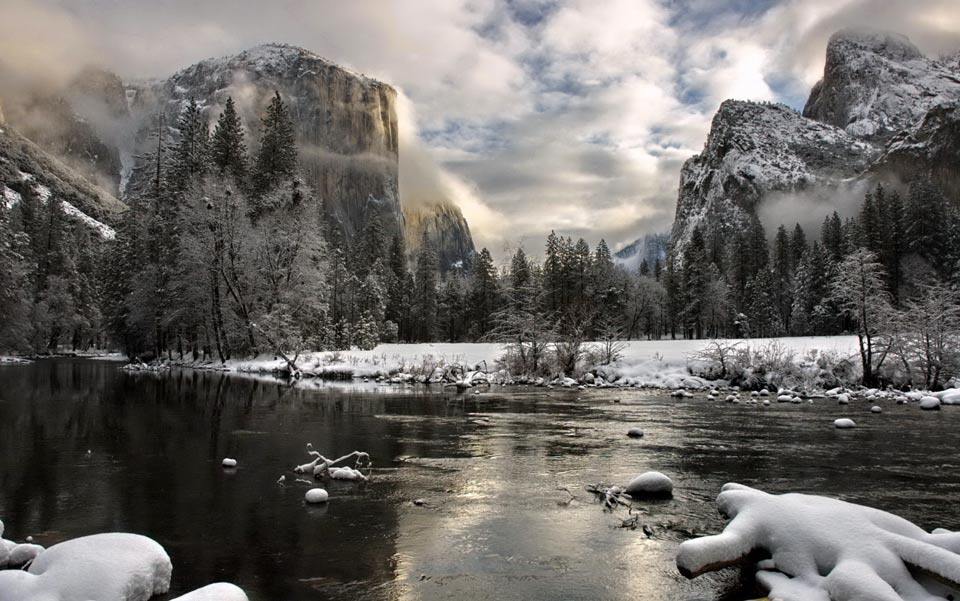
Sunrise over the Merced River after a winter snowstorm, Yosemite National Park, California. Photo by Flickr/Getty Images

Sunrise over the Merced River after a winter snowstorm, Yosemite National Park, California. Photo by Flickr/Getty Images

Listen to the description of Yosemite in the words of someone who knows:

I sit in an alpine lake basin and eat my lunch: cheese and crackers, lemonade, and an apple. I lay my head on my knapsack, which is almost an extension of myself. I have had it for a long time, and thanks to all of the food I have carried in it, it is an odoriferous repository of memory of peaks climbed and meadows traversed, of the sounds of meadow thrush in canyons, of canyons idled in to feel sunlight and wind on skin, to see the waning light of day and the starry light of night, and be bathed in the ambience of alpenglow. The sounds of gurgling streams — like Beethoven’s Ninth Symphony — banish all worry from the human soul. Continue reading

Nature’s Value

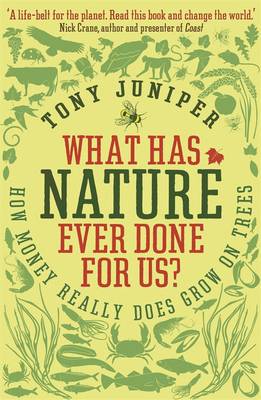
5606A review of this provocative book appears in the Guardian (click the image of the book to the right to go to the review) and an interview with its author is here, via mp3 download or as an iTunes podcast.  The book’s blurb supports the reviewer’s conclusion that it is worth the read:

Money doesn’t grow on trees. Or does it? From Indian vultures to Chinese bees, nature provides ‘natural services’, 24/7. Recycling miracles in the soil; an army of predators ridding us of unwanted pests; an abundance of life creating a genetic codebook that underpins our food, pharmaceutical industries and much more. It’s been estimated that these are worth an annual $50 trillion Continue reading

Beauty of Jordan: Spotted Fan-Footed Gecko

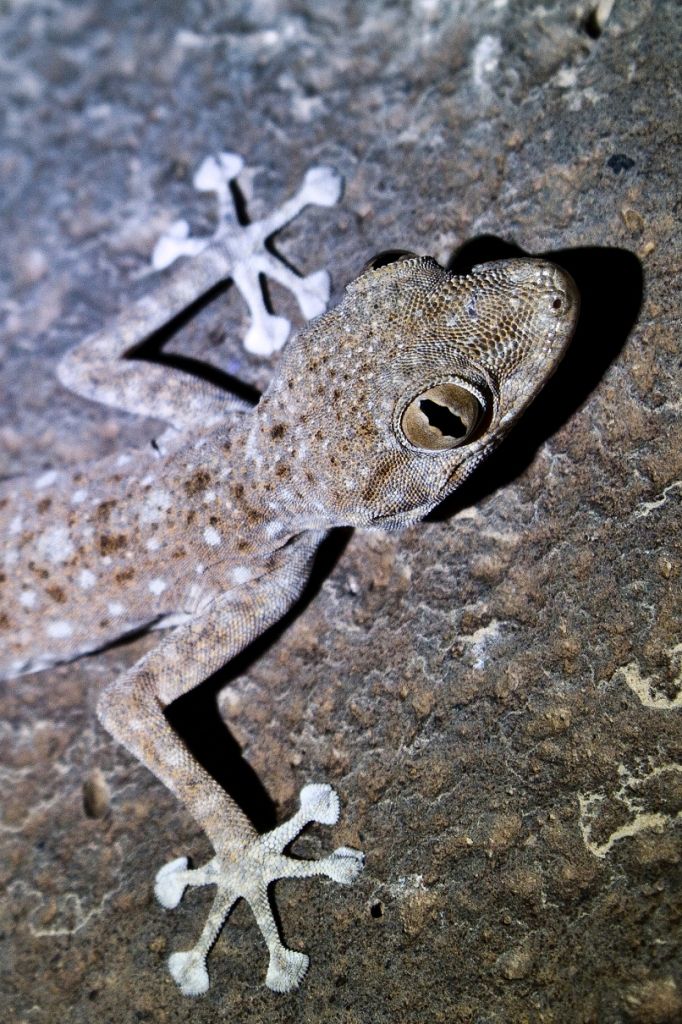
Geckos are more or less ubiquitous throughout the tropics, but visualizing them outside of such environments poses a challenge. Ptyodactylus guttatus, however, is a desert-dwelling species I found and photographed extensively in Jordan. Not only was this species my first subject to attempt capturing nocturnal macro photographs of, its residence within my own probably saved me quite a few mosquito bites over the weeks we shared it.  Continue reading