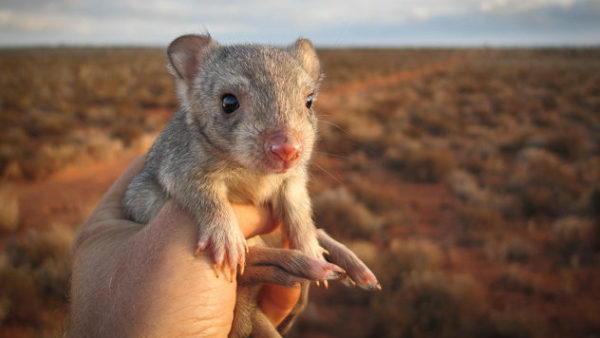
A burrowing bettong, also known as the boodie, in the Australian Outback. COURTESY OF AWC
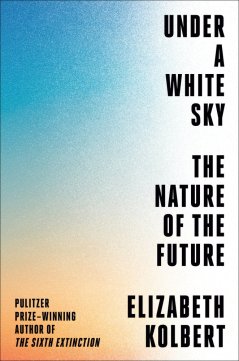
I have not acquired the book yet, but I have heard her discuss it and read an interview with her about it; the author has moved from reporting on extinction and climate phenomena to reporting on human intervention schemes that respond to those phenomena. The stories as told in the article below adhere to a claim Kolbert makes in her discussion with Ezra Klein, that as a journalist she is not in the judgement business:
An Australian project to help threatened marsupial species adapt to avoid predatory cats is among a host of ‘assisted evolution’ efforts based on the premise that it is no longer enough to protect species from change: Humans are going to have intervene to help them change.
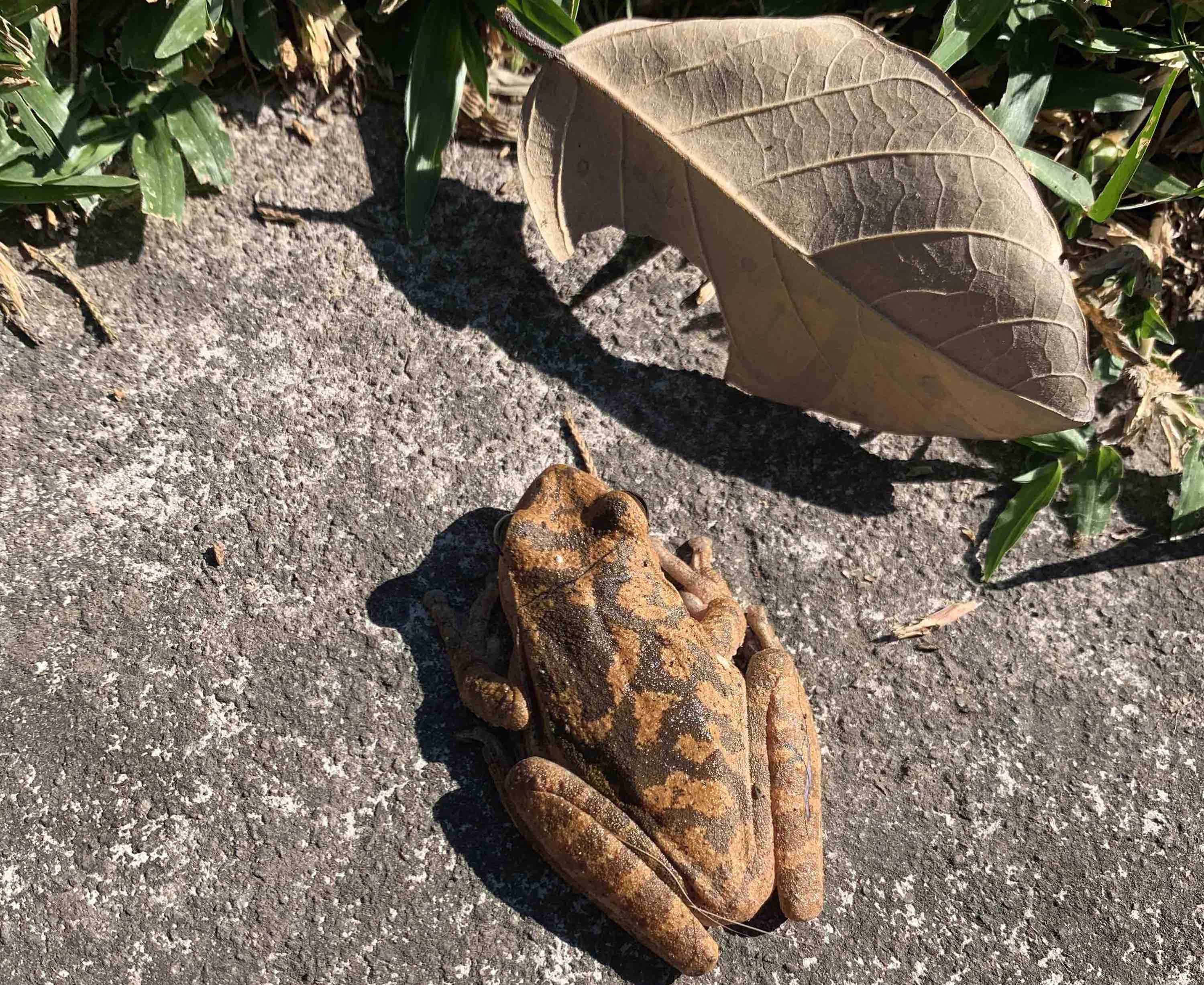
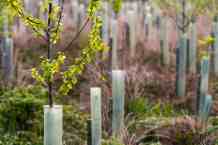
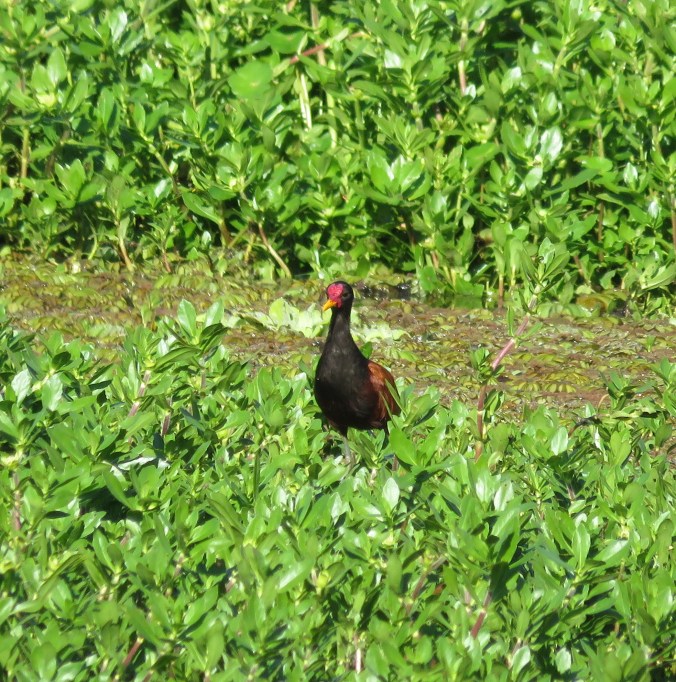
We got as many trees in the ground as we could during 2020, and since it has been dry season for a couple months now we are mostly in maintenance mode. The most pleasure to be had during these months is seeing how the wildlife on our small plot of land changes. For example, the creature above, which I saw yesterday. I believe it is a Drab Tree Frog, but if you have a different opinion please let me know. Tomorrow we begin coffee germination, take two–and I will post on that. Meanwhile, thanks to the Guardian’s coverage of the environment, we have this news:
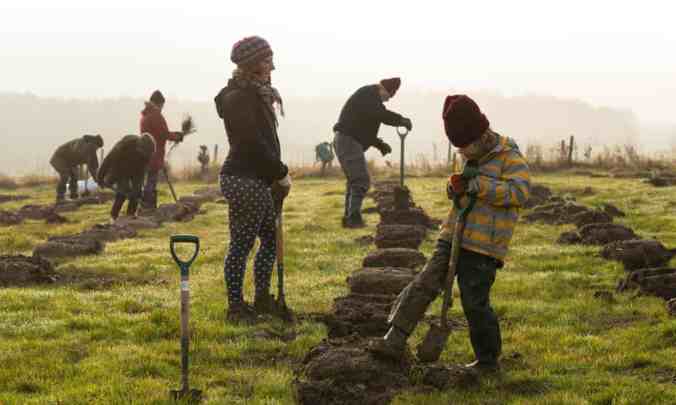
Volunteers helping on project for Woodland Trust, which sent out a million trees last year. Photograph: Philip Formby/PA
Community forest projects have seen a surge in volunteers keen to reduce CO2 emissions by creating new woodlands
According to the Horticultural Trades Association, garden centre sales of hardy plants, shrubs and trees have soared. Photograph: Alamy
The UK may be in the grip of a winter lockdown but in one village on the edge of the Yorkshire Dales the local climate-change group has been busy.
Plans are afoot to plant hundreds of trees on land surrounding Newton-le-Willows, in lower Wensleydale, in an effort to tackle the climate crisis. According to scientists, planting billions of trees across the world is one of the biggest and cheapest ways of taking CO2 out of the atmosphere. Continue reading →
Every time I listen to or read an interview with an author who has recently published a book, and want to get a closer look at the book itself, I click the link provided. Nearly 100% of the time the link goes to Amazon. Not good. When I listened to an interview with Elizabeth Kolbert on a podcast I respect, that is what happened. Frustrated by that link, I looked for alternatives to Amazon for buying this book, and found plenty. For example, thanks to Powell’s Books for making the discussion about this book available in the online event above.
One option is Bookshop.org, which came to my attention while trying to find an interview with Kolbert about her new book that did not link to Amazon. It took some effort, after finding the Powell’s links, but thankfully I found an interview given a couple days ago to Audubon for their review of Kolbert’s book. None of our many earlier links to Kolbert stories have featured an image of the author, so I will share here the one that accompanies the Audubon piece. In the middle of the interview there is this exchange:
Elizabeth Kolbert at the American Museum of Natural History in New York. Photo: Suzanne DeChillo/The New York Times/ReduxI have seen plenty of images of her, but this may be the only one in which she is smiling.
A: We’re, of course, doing this interview for Audubon, which focuses a lot on species conservation. Much of the work that people do to save various species—and there are so many examples of this in your book—involves altering previous ways that we’ve altered the natural world. How do you suggest that people who care about species protection think about efforts like these?
K: Well, that’s a really profound question, and to be honest that is the question at the center of the book. One of the points is, what do we think of as conservation, right? Continue reading →
The study also found that bells on collars made no difference to the number of animals killed by a cat. Photograph: GluePromsiri/Getty/iStockphoto
I am a cat person by nature. I have lost count of how many cats I had as pets since early childhood and well into adulthood, but I do remember our last two cats from three decades ago. Boris, a black cat with a tip of white on his tail, learned to jump up into my cradled arms if I stood in front of him and made a certain noise. His sister Mimi was named for the plaintive mi-mi cry she made when she climbed up onto the bathroom sink and rubbed her mouth against the faucet head, wanting us to turn the water on to drip out so she could drink. They lived long lives as indoor cats who did no harm to anyone or anything (that we knew of). But when we learned how many birds, among other wildlife, that cats kill per year we decided not to adopt any more cats; we switched to dogs. Now, all these years later, I am happy to see there is hope for reformed cat behavior:
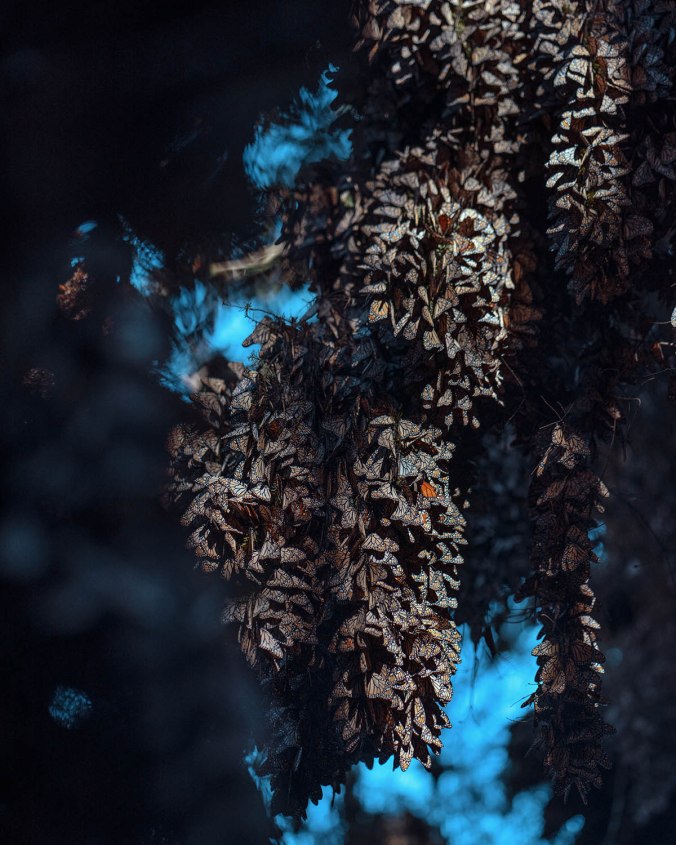
Monarchs in the early morning. They hibernate from November until the beginning of March. With warmer temperatures, they become sexually mature, mate, and begin their northerly migration.
Just for the beauty of the photographs, this is worth a visit. But there is also an audio accompaniment, allowing you to hear the butterflies. The story of the challenge their habitat faces is, like so many other stories we encounter, painful to read. But there is hope as well:
Marciano Solis Sacarias, a landowner, working at Las Novias del Sol, a tree-nursery coöperative.
Every November, around the Day of the Dead, millions of monarch butterflies descend on a forest of oyamel firs in the mountains of central Mexico. The butterflies have never seen the forest before, but they know—perhaps through an inner compass—that this is where they belong. They leave Canada and the northeastern United States in late summer and fly for two months, as far as three thousand miles south and west across the continent. The journey is the most evolutionarily advanced migration of any known butterfly, perhaps of any known insect. Continue reading →
I am responsible for managing a small enterprise. As we expanded into ecommerce some months ago, I looked into the advantages offered by Amazon’s fulfillment services. But the disadvantages, which I have been reading about and posting about here for some years outweighed the advantages.
Andy Jassy. David Paul Morris/Bloomberg
Having just read this op-ed on the same topic, I am more convinced than ever of the dangers Amazon poses to companies like ours. Maureen Tkacik, a senior fellow at the American Economic Liberties Project, does an an additional service by highlighting the efforts of Congresswoman Lucy McBath (who Amie had the good fortune to be able to campaign for and who our family voted for when we resided in her district during her first campaign) to hold the company accountable:
The Amazon founder prepares to step back just as Washington turns up the heat on the mega-retailer and cloud company.
If I had to guess who inspired Amazon’s founder, Jeff Bezos, to kick himself upstairs and appoint Andy Jassy, a deputy, as his successor as chief executive, I might wager that at least part of the blame can be laid on Lucy McBath, the freshman Georgia congresswoman, and her understatedgrilling of one of the world’s richest men at a July hearing held by the House antitrust subcommittee. Continue reading →
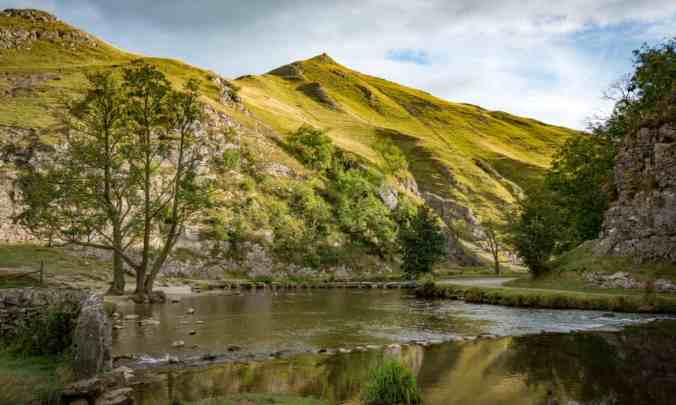
Scenic beauty spot or potential hydropower storage facility? The Dovedale national nature reserve in the Peak District. Photograph: dianajarvisphotography.co.uk/Alamy
Thanks to the Guardian for giving us a different view on one possible part of a solution to the problem posed in yesterday’s post:
Engineers explore using gentle slopes rather than steep dams or mountains to store electricity
Hundreds of hills across the UK could be transformed into renewable energy “batteries” through a pioneering hydropower system embedded underground.
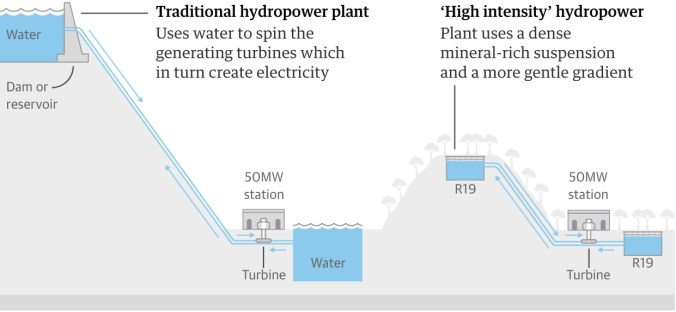
Guardian graphic. Source: RheEnergise
A team of engineers have developed a system that adapts one of the oldest forms of energy storage, hydropower, to store and release electricity from gentle slopes rather than requiring steep dam walls and mountains. Continue reading →
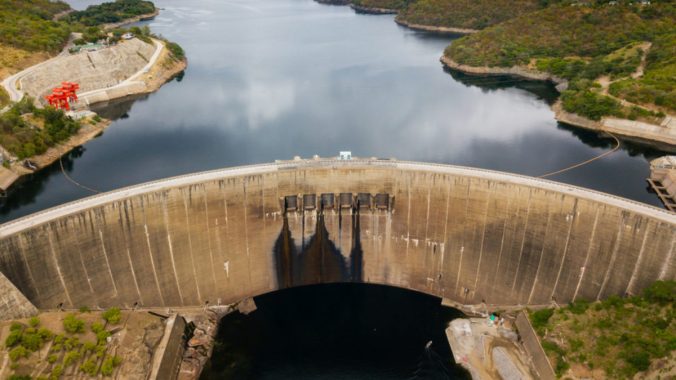
Engineers have found cracks in the 420-foot-high Kariba Dam on the Zambezi River in Southern Africa. DMITRIY KANDINSKIY/SHUTTERSTOCK
When we lived through the cross-border tensions that were dam-driven we thought cooler heads would eventually prevail. But, it has proven not so easy. And who knew there were 10,000 such puzzles out there? Thanks to Fred Pearce, as always for raising our awareness:
Tens of thousands of large dams across the globe are reaching the end of their expected lifespans, leading to a dramatic rise in failures and collapses, a new UN study finds. These deteriorating structures pose a serious threat to hundreds of millions of people living downstream.
Who would want to live downstream of the 125-year-old Mullaperiyar Dam, nestled in a seismic zone of the Western Ghats mountains in India? Continue reading →
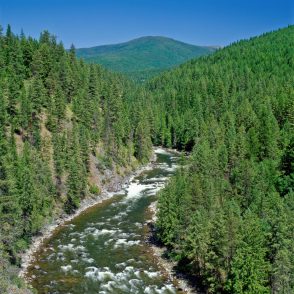
The Biden Administration’s next few weeks may decide the fate of the remote Yaak Valley, on Montana’s Canadian border. Photograph by John Lambing / Alamy
The blizzard of federal climate initiatives last week (a blizzard that might help allow actual blizzards to persist into the future) is without precedent. For the first time in the thirty-plus years of our awareness of the climate crisis, Washington roused itself to urgent action; veterans of the cautious Obama Administration—the domestic climate adviser Gina McCarthy and the global climate czar John Kerry chief among them—were suddenly going for broke. In fact, only one branch of the Cabinet seemed conspicuous by its muted presence: the Department of Agriculture, which has responsibility for the nation’s farms and for many of its forests—that is, for the natural features that will either speed or slow the flow of carbon into the atmosphere. Continue reading →
Thanks to an inter-party agreement, the clean energy hub in the North Sea is set to be the largest construction project in Danish history
Denmark’s government has agreed to take a majority stake in a £25bn artificial “energy island”, which is to be built 50 miles (80km) offshore, in the middle of the North Sea.
The island to the west of the Jutland peninsula will initially have an area of 120,000 sq metres – the size of 18 football pitches – and in its first phase will be able to provide 3m households with green energy. Continue reading →







 Organikos