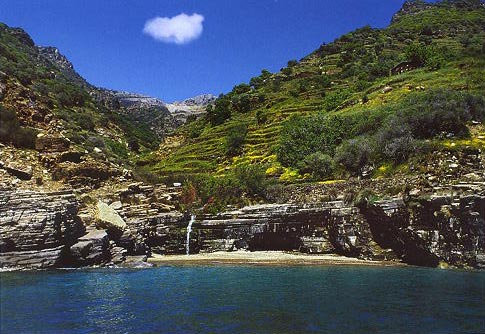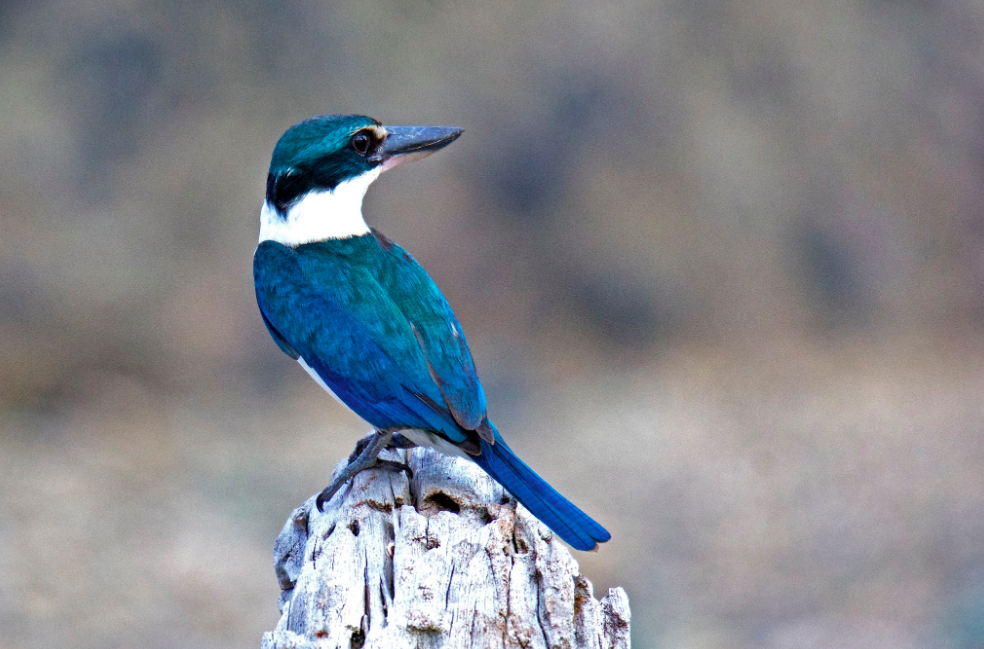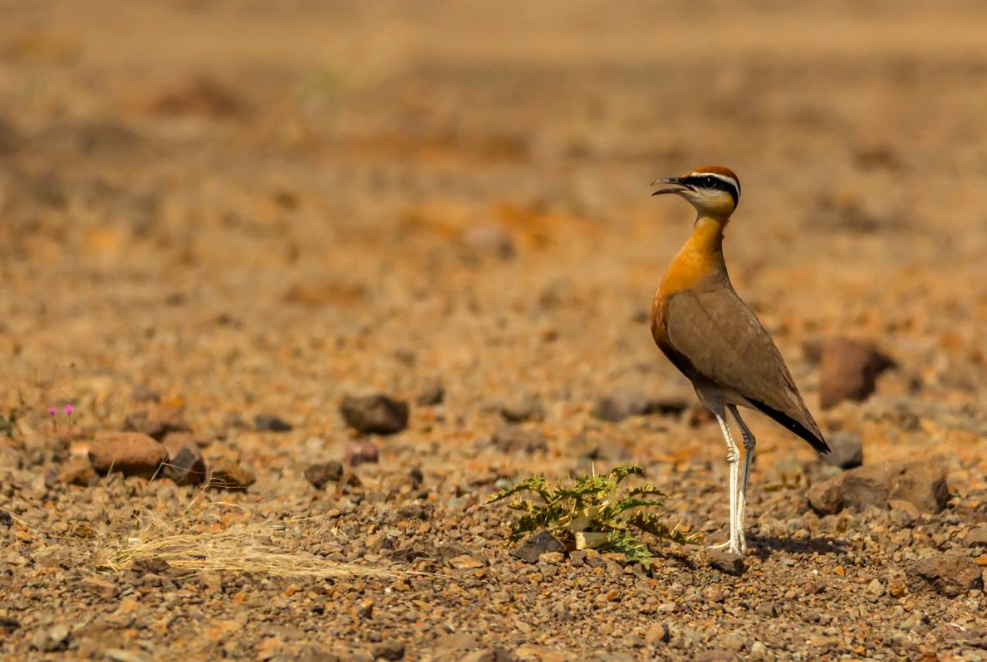
Andaman Islands
Biophilia By Any Other Name
It is surprising that neither E.O. Wilson nor his biophilia concept is mentioned here, but still it is an interesting finding. Our thanks to Jim Robbins for sharing:
Ecopsychology: How Immersion in Nature Benefits Your Health
A growing body of research points to the beneficial effects that exposure to the natural world has on health, reducing stress and promoting healing. Now, policymakers, employers, and healthcare providers are increasingly considering the human need for nature in how they plan and operate.
A park ranger leads a hike through the Kahuku unit of Hawaiʻi Volcanoes National Park. NPS PHOTO/JANICE WEI
How long does it take to get a dose of nature high enough to make people say they feel healthy and have a strong sense of well-being?
Precisely 120 minutes. Continue reading
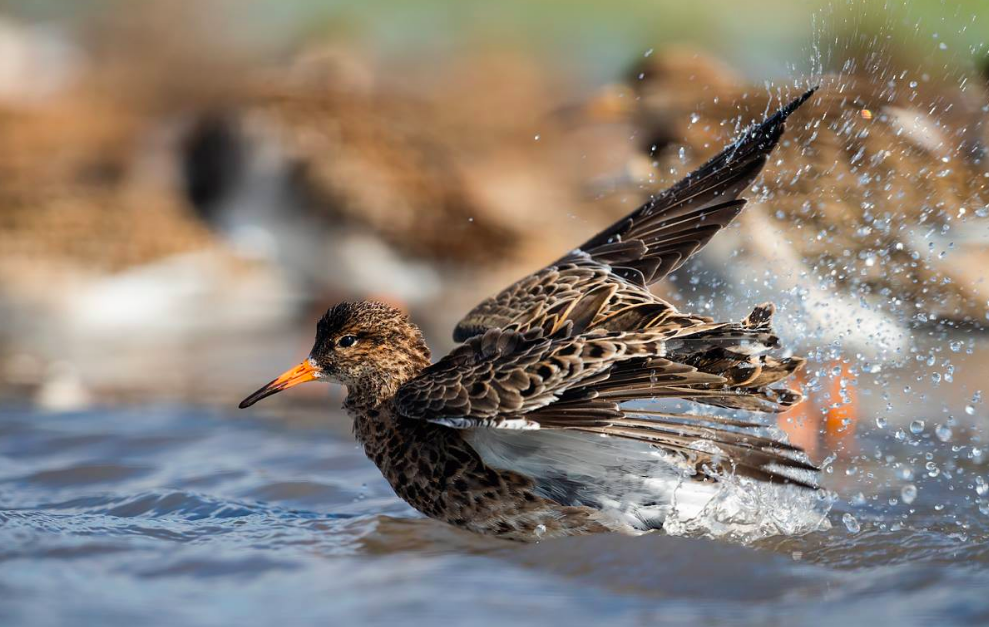
Bird of the Day: Spotted Sandpiper
Estero San José, Baja California Sur, Mexico
Bees, Almonds & Futures

Dennis Arp stands for a portrait near a colony of honeybees outside Rye, Arizona. Photograph: Caitlin O’Hara/The Guardian
Bees are not finding the near future any brighter than the recent past. Thanks, as always, to the Guardian for keeping us apprised on this topic:
‘Like sending bees to war’: the deadly truth behind your almond-milk obsession
Bees are essential to the functioning of America’s titanic almond industry – and billions are dying in the process
Dennis Arp was feeling optimistic last summer, which is unusual for a beekeeper these days.
Thanks to a record wet spring, his hundreds of hives, scattered across the central Arizona desert, produced a bounty of honey. Arp would have plenty to sell in stores, but more importantly, the bumper harvest would strengthen his bees for their biggest task of the coming year.
Beehives stand stacked along a blooming almond orchard near Shafter, California. The bees pollinate many crops, including almond trees in February, and are essential to the food chain. Photograph: Ann Johansson/Corbis via Getty Images
Like most commercial beekeepers in the US, at least half of Arp’s revenue now comes from pollinating almonds. Selling honey is far less lucrative then renting out his colonies to mega-farms in California’s fertile Central Valley, home to 80% of the world’s almond supply. Continue reading
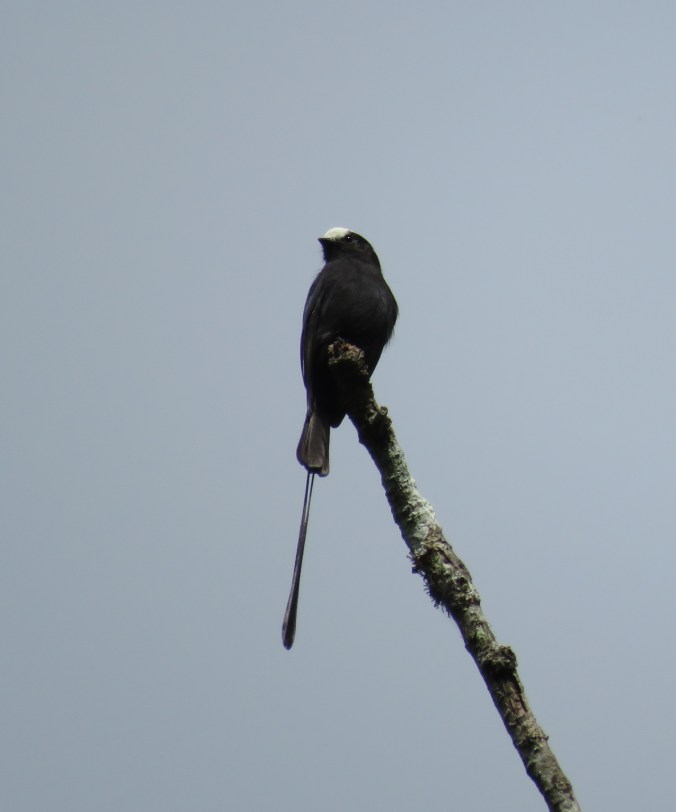
Bird of the Day: Long-billed Wren Babbler
Life In Southwest India

An elephant eats jackfruits in the backyard of a house in Valparai, Tamil Nadu. COURTESY OF SREEDHAR VIJAYAKRISHNAN
Thanks to Yale e360 for this reminder of the amazing nature we witnessed from 2010-2017 while living in the Western Ghats.

The Anamalai Hills in India’s Western Ghats region, shrouded in mist. COURTESY OF GANESH RAGHUNATHAN
The Young Writers Awards, presented by Yale Environment 360 and the Oak Spring Garden Foundation, honor the best nonfiction environmental writing by authors under the age of 35. Entries for 2020 were received from six continents, with a prize of $2,000 going to the first-place winner. Read all the winners here.
Song of the Western Ghats: A Green Island in a Crowded Land
For a young ecologist, the mountains of the Western Ghats are a respite from India’s intense urban life — a lush land of monsoon rains, elephants, king cobras, leopards, and a spectacular assortment of birds — and a place where wildlife and villagers still largely manage to coexist.
What is it that draws us to the quiet, to the green? To the mist-curtained mountains, where everything is crystal clear – leaves in high definition even against an overcast sky. Where leopards leave their mark in soft mud, and you smell where an otter has walked. Continue reading
Bird of the Day: Oriental White-eye
Do Not Wait
Citizens of the USA have not much right to tell Australians what or how to think about climate change, and certainly not at this precise moment. On the contrary, scenes coming from Australia might well get Americans immediately wondering:
What Will Another Decade of Climate Crisis Bring?
2019 has been called the year we woke up to climate change. Australia’s wildfires are yet more evidence that it’s time we started acting like it.
Last week, thousands of people in the Australian state of Victoria were urged to evacuate their homes. “Don’t wait,” the alert warned. Bushfires were burning across the state; so large were some of the blazes that, according to Victoria’s commissioner of emergency management, they were “punching into the atmosphere” with columns of smoke nine miles high. The smoke columns were producing their own weather, generating lightning that, in turn, was setting more fires. Some time after residents received the evacuation warning, many of those in the most seriously affected region, East Gippsland, which is a popular tourist destination, received another alert. It was now too late to leave: “You are in danger and need to act immediately to survive.” Continue reading
Bird of the Day: West Peruvian Dove
Chorrillos, Peru
Field of Greens

Assembly required: Sweetgreen’s hexagonal, compostable bowls have become status markers. Rozette Rago for The New York Times
It is not the first time we are linking out to a story on this company, but thanks to the New York Times for In a Burger World, Can Sweetgreen Scale Up?—for a more in depth look at them.
And for that matter, for a theme we care deeply about, which is that we should all be putting more thought into the food we eat, and how it is packaged.
The market is rewarding those companies paying attention to these themes:
Squashing the competition: A worker preparing zucchini. Rozette Rago for The New York Times
The chain that made salads chic, modular and ecologically conscious now wants to sell you a lot of other stuff.
On a Wednesday morning last fall, several executives at Sweetgreen, the fast-casual salad chain, gathered around a conference table at their headquarters here. They were discussing a new store format, called Sweetgreen 3.0, that had recently been introduced in New York City after two years of planning. At Sweetgreen’s other 102 locations, customers brave queues that, at peak lunch, can make T.S.A. lines look tame. Up front, employees assemble Harvest Bowls, Kale Caesars and infinite customized variants from a spread of freshly prepared ingredients, in a ritual that has become a hallmark of the modern midday meal.
At 3.0, to increase efficiency, the action had been moved offstage, to a kitchen in the rear. Customers give orders to a tablet-wielding “ambassador,” if they haven’t done so ahead of time with their smartphones, retrieving their salads from alphabetized shelves. While they wait they can mull adding one of the Sweetgreen baseball caps or $37 bottles of olive oil on display to the tab.
Many of the changes being tested at 3.0 seem crucial to realizing the ambitious plans of Sweetgreen’s co-founder and chief executive, Jonathan Neman. With its prescient mobile technology strategy, the company hopes to become something bigger — much, much bigger — than a boutique urban chain serving arugula to health nuts and yoga moms. Continue reading
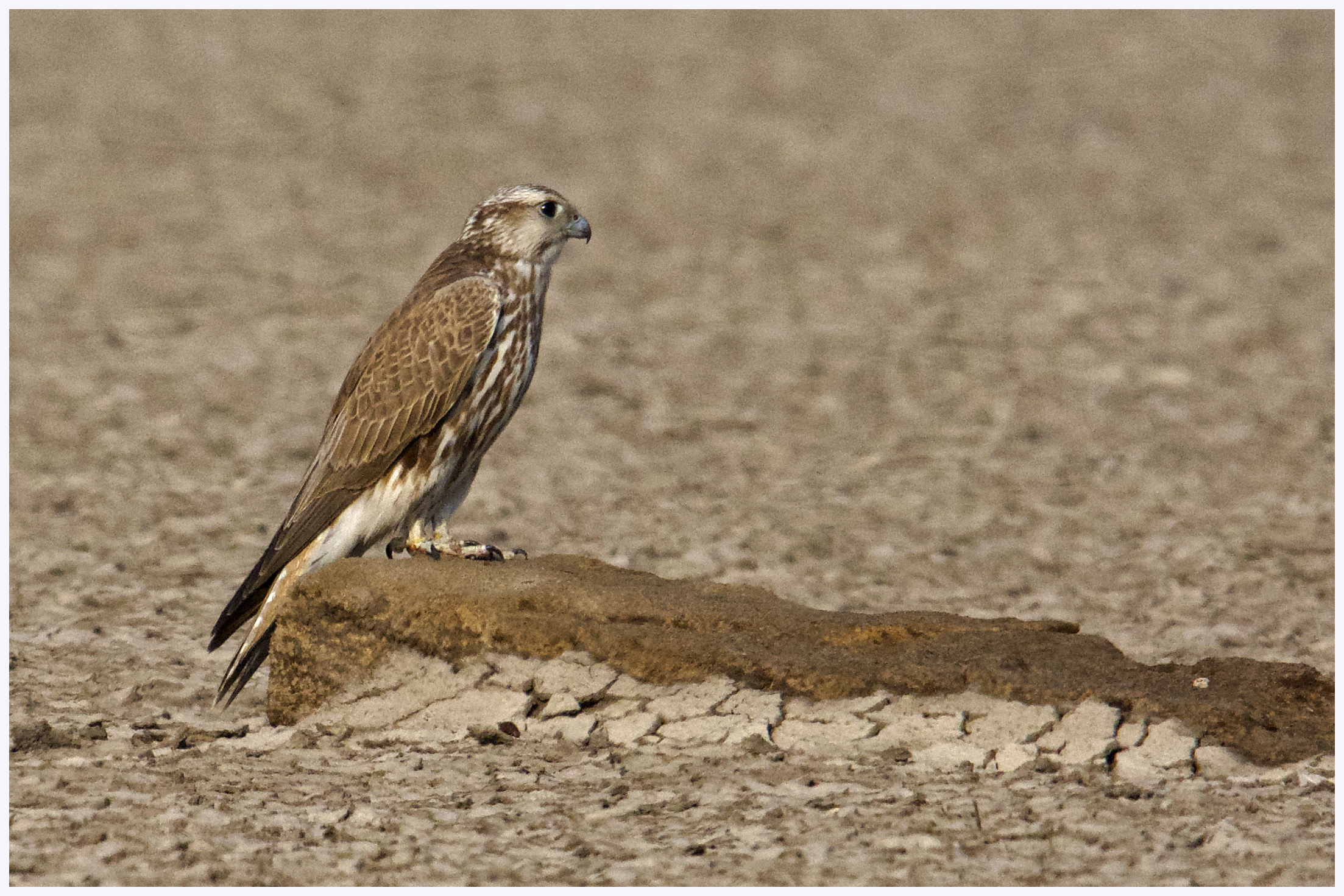
Bird of the Day: Bay-backed Shrike
Concise Primer On Carbon Sequestration’s Latest, Greatest Options
We always look for the latest on how to fight climate change and in this podcast episode there is a concise and clear explanation:
It is increasingly clear that putting less carbon dioxide in the atmosphere will not be enough to combat climate change; we take a look at the effort to actively remove the stuff from the air. Our correspondent takes a ride on Chicago’s Red Line, whose length represents a shocking level of inequality. And why a push to go organic in Turkey isn’t everyone’s cup of tea.
Bird of the Day: Grey-headed Fish-Eagle
Stop Funding Arctic Drilling

‘The Arctic refuge is not just a piece of land with oil underneath. It’s the heart of our people; our food security, way of life and very survival depends on its protection.’ Photograph: Saul Loeb/AFP/Getty Images
Thanks to the Guardian for this op-ed by Bernadette Demientieff:
Goldman Sachs agreed to stop funding Arctic drilling. Will other banks join them?
If banks destroy our homeland, they’ll have the Gwich’in Nation, and the millions of Americans who stand with us, to answer to
Last fall, I traveled more than 4,000 miles from my home in Alaska to meet with major banks and urge them to help protect the Arctic national wildlife refuge from destructive oil drilling and exploration. In all the years I’ve worked to defend this place, we’ve been focused on trying to make our voices heard by leaders in the White House or in Congress, and I never thought I’d be sitting in a conference room on the 43rd floor of Goldman Sachs’ global headquarters in downtown New York, talking about the Arctic refuge. Continue reading
Bird of the Day: Common Hill Myna
It’s Not Easy Being Green In 2020
Thanks to
Building climate-saving tech digs up new problems
Solving the climate crisis is going to take a lot of mining
The solar power and electric vehicles we need to stop the climate crisis pose a different threat to people and the environment: a boom in mining. Moving away from fossil fuels depends on tech like batteries and solar panels that can provide alternative forms of energy. But digging up the raw materials can undermine human rights and destroy fragile ecosystems. As governments and industries try to tackle climate change by building up renewable energy, they’ll need to consider other problems unearthed in the process. Continue reading
Bird of the Day: Yellow-throated Warbler
Crooked Tree,Belize
Adaptive Re-Use, Puffin Style
Thanks to Audubon Magazine we start 2020 with a short story about an adaptation that is not just pretty, but practical in more than one way:
Those Big Orange Bills Also Help Puffins Stay Cool After a Workout
Good for more than just attracting a mate, the clownish feature appears to keep the subpar fliers from overheating.
The puffin’s iconic orange bill might be its most recognizable feature, but it’s also quite functional, serving the charismatic seabird in all avenues of life. The bill’s large volume makes it a hefty food carrier, and its ultraviolet glow amps up puffins’ sex appeal. Now, scientists have identified yet another use of this dramatically curved bill: staying cool. Continue reading
Coffee & Redemption
Thanks to Amy Chozick for a great story about coffee, redemption and creative solutions to close out 2019:
The Rikers Coffee Academy
Can teaching prison inmates to make lattes give them a chance at a better future?

Omar Jhury and Joshua Molina, right, at Rikers Island manning the espresso machine. Todd Heisler/The New York Times
Officer Green wanted her vanilla latte piping hot. “With vanilla on top, not a lot, just a drizzle, and very hot, don’t make it warm,” she shouted to Eddie Rodriguez, who was taking orders. He nodded and wrote Green on the side of a cup. “Don’t worry, I got ya. Extra hot for Officer Green.” Then he slid the cup down the bar where Mr. Rodriguez and the other inmates in the barista training program at the Rikers Island prison complex were adding ice, steaming milk and grinding beans to load into a $3,000 Nuova Simonelli espresso machine. Continue reading