Northern Karnataka
Northern Karnataka
 Thanks to Sierra for publishing In Pursuit of an Ecological Resilience in the Anthropocene, an excerpt from Alejandro Frid’s “Changing Tides”:
The birth of my daughter, in 2004, thrust upon me a dual task: to be scientifically realistic about all the difficult changes that are here to stay, while staying humanly optimistic about the better things that we still have.
By the time my daughter turned eleven, I had jettisoned my nostalgia for the Earth I was born into in the mid-196os—a planet that, of course, was an ecological shadow of Earth 100 years before, which in turn was an ecological shadow of an earlier Earth. Continue reading
Parque Nacional Valle Nuevo, Dominican Republic
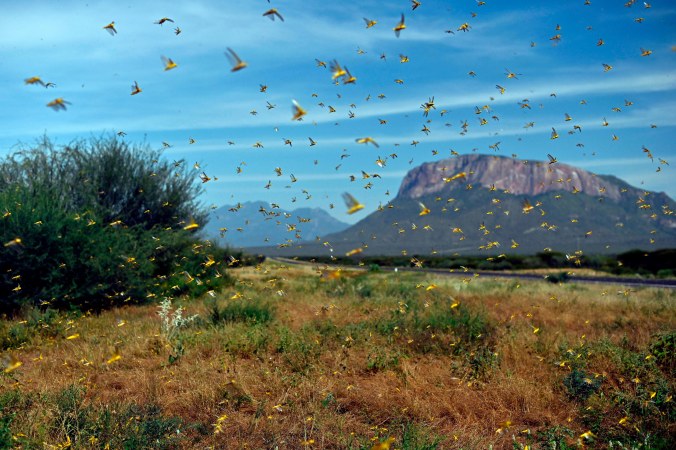
A swarm of locusts north of Nairobi, Kenya, in January. The U.N. described an outbreak of desert locusts as a threat to food security. Photograph by Tony Karumba / AFP / Getty
We need more information, better quality information, and the most relevant information on climate issues. A newsletter, maybe? Bill McKibben is on it:
WELCOME TO THE CLIMATE CRISIS NEWSLETTER
We’re eight weeks into the new decade, and, so far, we’ve had the warmest January ever recorded. (Indeed, researchers at the National Oceanic and Atmospheric Administration said that 2020 is more than ninety-eight per cent likely to be one of the five warmest years ever measured, with a nearly forty-nine-per-cent chance to set a new annual record.) We’ve seen the highest temperature ever measured on the Antarctic continent, and also record swarms of locusts descending on the Horn of Africa, a plague which scientists assure us will “become more frequent and severe under climate change.”
I’m calling this new newsletter—and welcome aboard—The Climate Crisis because this is what a crisis looks like. Continue reading
Kalamassery, Kerala
Costa Rica
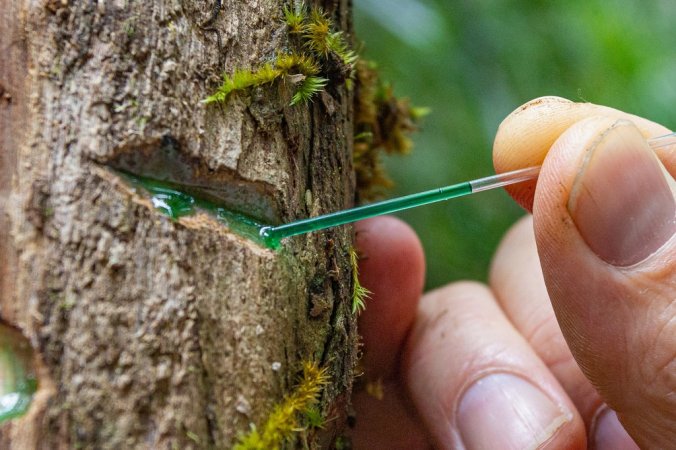
Antony van der Ent
Thanks to Ian Morse for the most surprising twist on the mythological possibilities of the philosopher’s stone:
Down on the Farm That Harvests Metal From Plants
Hyper-accumulating plants thrive in metallic soil that kills other vegetation, and botanists are testing the potential of phytomining.
Some of Earth’s plants have fallen in love with metal. With roots that act practically like magnets, these organisms — about 700 are known — flourish in metal-rich soils that make hundreds of thousands of other plant species flee or die.
Slicing open one of these trees or running the leaves of its bush cousin through a peanut press produces a sap that oozes a neon blue-green. This “juice” is actually one-quarter nickel, far more concentrated than the ore feeding the world’s nickel smelters. Continue reading
Canary Islands, Spain

The Scots pines near Glenfeshie. Photograph: Murdo MacLeod/The Guardian
Rewilding continues to intrigue me, as it has since my first introduction to the concept and the practice. Thanks to Christopher de Bellaigue for this long-read addition to the intrigue:
The end of farming?
For decades, the way we farm has been degrading land and destroying wildlife. Now there’s a revolution coming – but is it going to create more problems than it solves?
John Cherry of Weston Park Farms inspects and smells the soil in one of his fields. Photograph: David Levene/The Guardian
In the last years of the 20th century, Glenfeshie, a 17,000-hectare estate in the Scottish Highlands, was in steep decline. Decades of overgrazing by deer had reduced its hillsides to clipped lifelessness. Denied the protection afforded by tree roots, the banks of the River Feshie were losing soil each time it flooded, the water depositing silt downstream. Those few Scots pines that had survived the browsing of the deer were nearing the end of their lives; soon there would be no seed source for the next generation. Continue reading

Mishmi Hills, Arunachal Pradesh
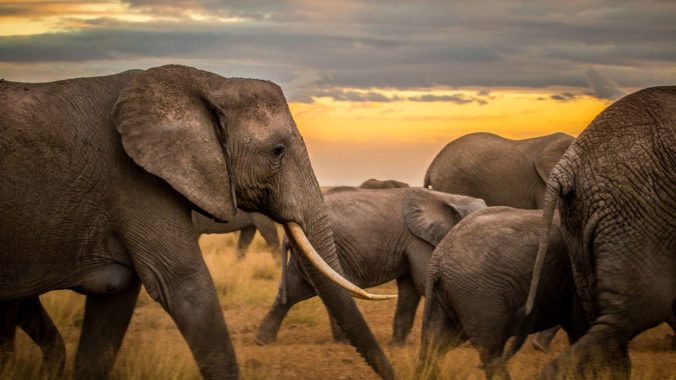
An elephant herd in Kenya. PIETER RAS / 500PX / GETTY IMAGES
Thanks to Yale e360 for the reminder that, as trouble rumbles, there is more need than ever for keeping our eyes on the prize:
Psychic Numbing: Keeping Hope Alive in a World of Extinctions
The litany of lost species can be overwhelming, leading to what has been called “psychic numbing.” But as the recovery of species from bald eagles to humpback whales shows, our actions do matter in saving species and the aliveness and beauty they bring to the world. Continue reading

Little Rann of Kutch, Gujurat

1. Collected heat can also be transferred into gas and shot down ducts into manufacturing plants. 2. The 3.5-square-foot receiver takes in 400 kW of light, 1,200 times denser than direct sunlight. 3. Each heliostat gets realigned every few seconds so maximum light hits the receiver all day. PHOTOGRAPH: CINEATRA MEDIA
After nearly nine years of monitoring the mainstream and more scientific news for evidence that harnessing the sun is one of our highest potential solutions to climate change, and considering all the noise that comes from climate change skeptics and deniers, it is easy to lose track of whether solar has what it takes. Laura Mallonee shares this brief in Wired:
Automated Solar Arrays Could Help Incinerate Global Warming
Software-driven systems can produce enough searing heat to power manufacturing processes that now gorge on fossil fuels.
Plenty of days, temperatures in California’s Mojave Desert climb above 120 degrees Fahrenheit. A measly figure. These 400 silvered glass panels, tucked into the western edge of that hot, hot desert, are there to generate heat 15 times that amount. And, ideally, to help cool the planet too. Continue reading
Chopta Tungnath, Uttarakhand

Rhododendron petals line the Appalachian Trail at Roan Mountain State Park in Tennessee. Aheflin/iStock, via Getty Images Plus
Thanks to Will Harlan, a journalist, for this opinion:
Will the Appalachian Trail Stop an $8 Billion Pipeline?
It’s up to the U.S. Supreme Court.
BIG IVY, N.C. — I live in Appalachia, and on Sunday mornings I hike the Appalachian Trail across the mountains I call home. It is my church. I drink from its springs and rest in the shade of its ancient forests.
For decades, the trail has been my refuge. I have run for miles through tunnels of rhododendron, crossed paths with bears and camped with my children beneath starry skies.
A few years ago, however, the 600-mile Atlantic Coast Pipeline broke ground, and crews began clear-cutting a scar across the mountains to move fracked natural gas from West Virginia to customers in Virginia and North Carolina. On my trail treks in Virginia, I watched the bulldozers creep closer.
Then suddenly, on a crisp fall morning in 2018, the bulldozers stopped. The U.S. Court of Appeals for the Fourth Circuit vacated a permit allowing the pipeline to cross the trail deep beneath the ground. Continue reading
 Todos Santos Cuchumatan National Park, Guatemala
 The title of today’s post comes from a book review that serves me well after reading yesterday, then re-reading just now, about the conversation between a journalist I respect and a conservationist I admire. Since I am stuck in this myopic debate, a bookend to that conversation is the best I can hope for today. I do not yet have a copy of this book, but I hope to review it in these pages soon. For now, thanks to Hua Hsu for bringing it to my attention in THE SEARCH FOR NEW WORDS TO MAKE US CARE ABOUT THE CLIMATE CRISIS:
The reason we find ourselves verging toward planetary extinction is fairly simple: for quite some time, it’s been profitable for humans to behave this way. For business and government, it’s always been easier to toggle between plunder and neglect than to mind long-term, civilizational time lines. The actual conspiracy is that we are made to feel as though humanity’s fate were purely a matter of personal choice—our desire to buy this, that, or nothing at all, our collective willingness to recycle or compost. This isn’t to say that we possess no power at all. But the scale of the problem is difficult to comprehend, and discussions leave many of us feeling overwhelmed and paralyzed, reduced to myopic debates about whether we are too scared or not scared enough. Continue reading

Udupi, Karnataka
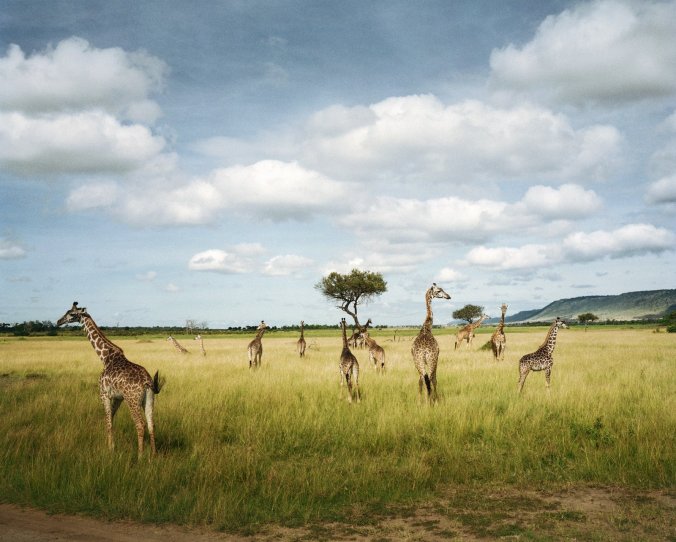
Giraffes in the Maasai Mara game reserve. Shrinking habitats and industrial pesticides have caused populations to plummet in recent years. Photograph by Guillaume Bonn
Jon Lee Anderson, who I am sourcing here for the third time, gives us perspective on Richard Leakey, who surprisingly was only mentioned once previously in nine years on this platform. Both men know their respective worlds. There is plenty of perspective among both, not much optimism, but a determined look forward:
CAN THE WILDLIFE OF EAST AFRICA BE SAVED? A VISIT WITH RICHARD LEAKEY
The paleoanthropologist Richard Leakey is pessimistic about the future of Kenya’s wildlife. Photograph by Mickey Adair / Getty
The week before Christmas, Richard Leakey, the Kenyan paleoanthropologist and conservationist, celebrated his seventy-fifth birthday. He is lucky to have reached the milestone. A tall man with the burned and scarred skin that results from a life lived outdoors, Leakey has survived two kidney transplants, one liver transplant, and a devastating airplane crash that cost him both of his legs below the knee. For the past quarter century, he has moved around on prosthetic limbs concealed beneath his trousers. In his home town of Nairobi, Leakey keeps an office in an unlikely sort of place—the annex building of a suburban shopping mall. His desk and chair fill most of his cubicle, which has a window that looks onto a parking lot. The space has no adornments other than two framed photographs, each sharply symbolic of the parallel interests that have absorbed most of his adult life: the world of extinct prehistoric hominids and the contemporary natural environment that is being pushed toward extinction by humankind.
In one of the photographs, Leakey is three decades younger, a trim man wearing a dark suit and standing amid a group of senior Kenyan officials, including then President Daniel arap Moi, who are gathered next to a pile of elephant tusks. It is a snapshot from 1989, when, as the head of the Kenya Wildlife Service, Leakey oversaw the public burning of several tons of poached elephant ivory. At the end of the nineteen-seventies, there were an estimated quarter of a million elephants in Kenya, but, when the photograph was taken, only sixteen thousand were left. Leakey wanted to stigmatize the ivory trade by treating poached tusks in the same way that police treated cocaine seized from drug traffickers. His publicity-seeking gambit worked, making global headlines and leading the way for an international ivory ban that went into effect that same year. The killing of elephants went down for a while as well, allowing Kenya’s herds to recover. Today, Kenya has a relatively stable population of about thirty-five thousand elephants.
Parque Nacional Valle Nuevo, Dominican Republic