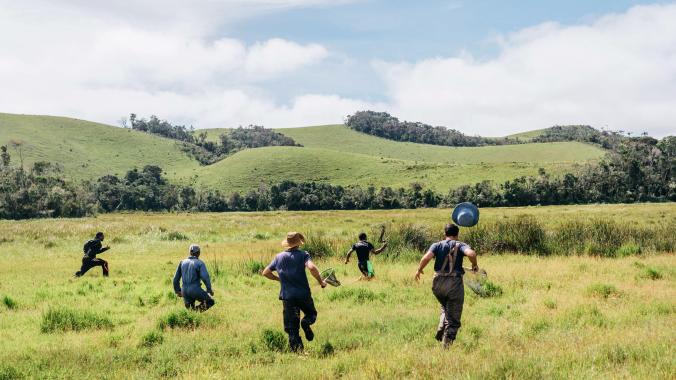
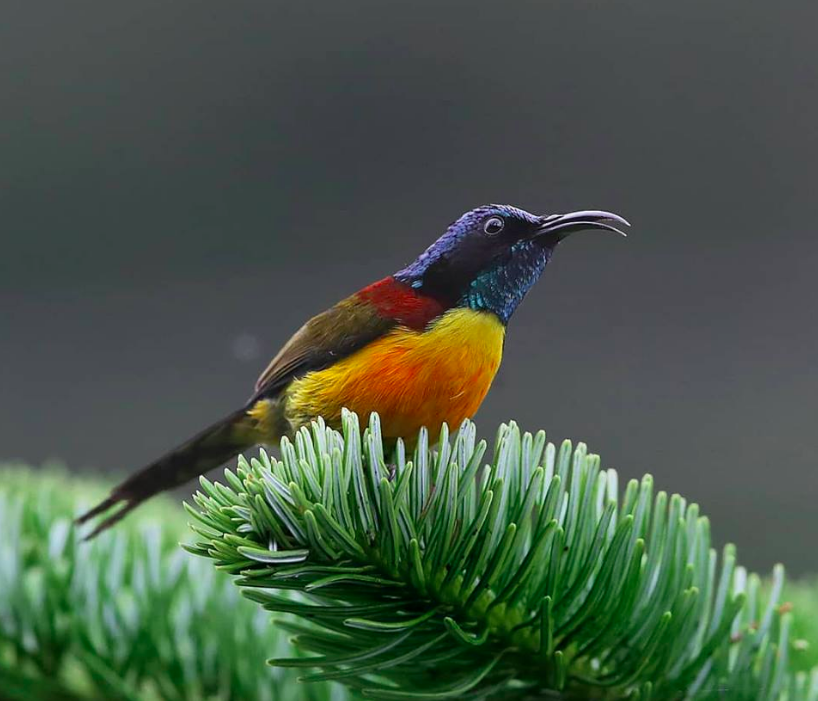
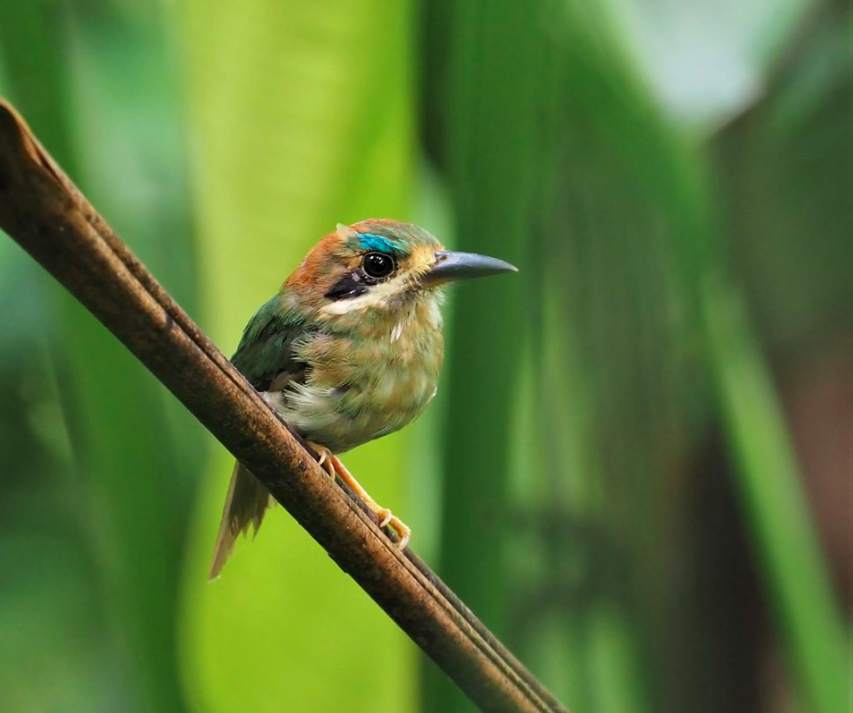
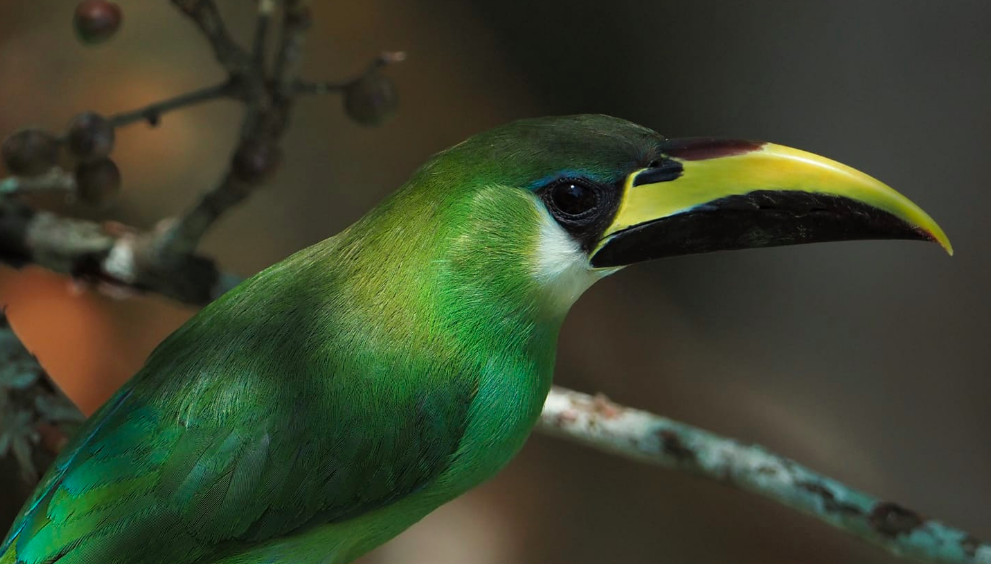
Expedition members sprint to flush Slender-billed Flufftails, among the world’s most elusive birds, in a marsh in Bemanevika reserve.Photo:Tristan Spinski
Bioprospecting, a topic we have not posted enough about, came to our attention in the mid-1990s through Costa Rica’s National Institute of Biodiversity. Kimon de Greef, writing for Audubon Magazine, offers an inside view of a prospecting expedition in one of the most wondrous, and at-risk natural habitats on the planet:
The rediscovery of a long-lost duck spurred the creation of two protected areas in the country. Now researchers are scouring these spots for other endemic species before it’s too late.
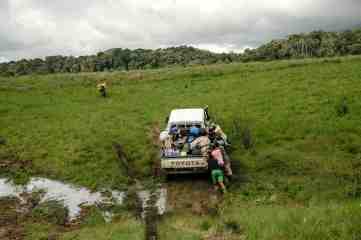
With only a few kilometers to go during day-long to Bemanevika, challenging road conditions forced the group to disembark from the two Toyota Land Cruisers and push them through the deep mud. Much of the terrain required the forest technicians to utilize the wench, which they fastened to tree stumps to wind the vehicles up the muddy mountain roads. Photo: Tristan Spinski
We had come this far and now we were stuck, dug in on a dirt track high above the plains. It was monsoon season in Madagascar, and thunderstorms had laid waste to the deeply rutted road. Already we had traversed seemingly unnavigable passes on our way to the remote northern mountains, mud churned to slurry by each passing set of wheels. Almost 24 hours later, this slope flanked by agave plants had defeated us. Our drivers took up shovels: There were ruts to flatten, boulders to excavate and heave into the bushes. As the workers toiled, cicadas hissed from the treetops.
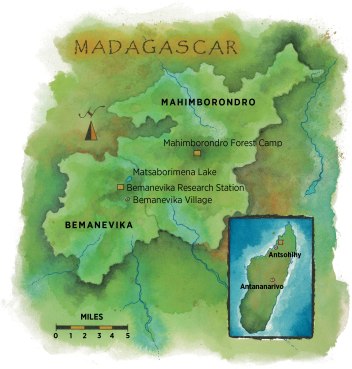
Map: Mike Reagan
For the field biologists I was accompanying, this breakdown of rural infrastructure held great promise. They were on their way to survey some of the island’s last remaining virgin rainforests—shrinking havens of exceptional biodiversity, including some of Earth’s rarest birdlife. “There’s definitely a correlation with how hard it is to get in,” said John Mittermeier, an expedition leader, ornithologist, and geography Ph.D. student at Oxford University, “and how likely you are to find new stuff.”
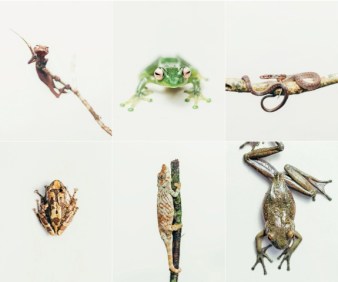
Clockwise from top left: Spearpoint leaf-tail gecko; Andreone’s tree frog; Compsophis fatsibe snake; Boophis goudot frog; Calumma nasutum chameleon; Spinomantis nussbaumi frog. Photos: Tristan Spinski
Now a cry went up among the team. A snake was moving its way through the undergrowth, and with abandon they leapt after it. Luke Kemp, the herpetologist on the expedition, crouched beside the bushes, poking around but coming up empty. “It’s like an addiction,” he told me. “I can’t stop.”
The biologists had congregated from four countries, united by a relentless, even maniacal fascination with wildlife. They wore faded shirts from scientific conferences and were never without their binoculars. Instead of making small talk, they discussed bird calls and sampling methods, animated by purpose and shared expertise. In unison, like meerkats, Mittermeier and the other two birders swung their binoculars from side to side, trying to glimpse what sounded to them like an endemic robin. The two entomologists swept the air with butterfly nets; they would not hesitate, when their hands were full, to pop wriggling insect specimens between their lips.Continue reading →
A rendition of the new main branch of Deichman, Oslo’s public library. This library is designed to see and be seen. Atelier Oslo and Lund/Hagem architects
Libraries are having a moment. In the past few years dozens have opened across the world, resembling nothing like the book-depot versions from the past.
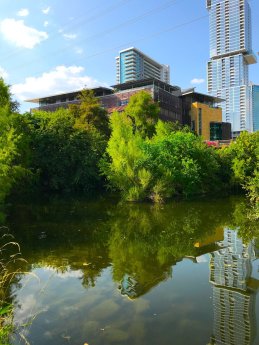
Austin Public Library
About a decade ago libraries across the world faced a dilemma. Their vital functions — to supply books and access to information for the public — were being replaced by Amazon, e-books and public Wi-Fi.
To fight for their survival, said Loida Garcia-Febo, president of the American Library Association, libraries tried to determine what other role they could play. “They invented these amazing new initiatives that are finally launching now,” she said. It took them this long to raise money and build them.
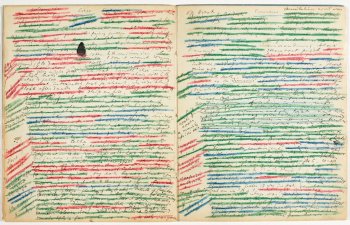
A page from the “Ulysses” notebooks of James Joyce. Museum of Literature Ireland
Libraries are certainly having a moment. In the past few years dozens of new high-profile libraries have opened close to home and across the world. And they certainly don’t resemble the book-depot vision of libraries from the past.
To attract visitors from home and abroad, many libraries have advanced, even quirky amenities. They have rooftop gardens, public parks, verandas, play spaces, teen centers, movie theaters, gaming rooms, art galleries, restaurants and more. The new library in Aarhus, Denmark, has a massive gong that rings whenever a mother in a nearby hospital gives birth.
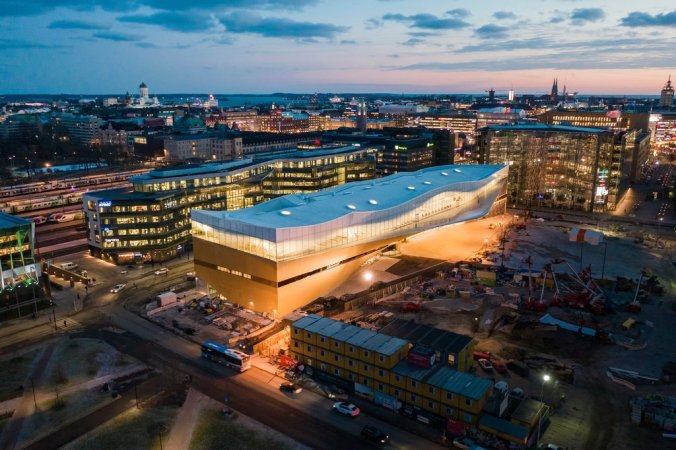
Only one-third of the 185,000-square-foot Helsinki Central Library Oodi is allocated to books. Tuomas Uusheimo
In March, Oodi welcomed its one millionth visitor. “We have tourists from all over the world visiting, but mainly from Europe mostly, China, Japan and America,” said Anna-Maria Soininvaara, the library’s director. “Usually they want to experience the Maker Space and ask where all the books are because the shelves are always half empty because they’re all on loan.”…
According to a new report from the Intergovernmental Panel on Climate Change, deforestation, along with unsustainable agriculture and food systems, is contributing to greenhouse emissions. Photograph by Lalo de Almeida / NYT / Redux
Thanks to Carolyn Kormann for this reminder of the impact our diet has on the future of the planet:
In the Amazon, or in the parts of the Amazon that people have mowed down and converted into grazing pasture, the average abattoir-bound cow has nearly three acres to himself. Nice for the cow, perhaps, but senseless and dangerous in every other way. Every year, on average, tropical deforestation adds ten to fifteen per cent of global greenhouse emissions. Of this amount, around half happens in South America; deforestation in the Amazon recently increased. If the rate continues, scientists have found, it could lengthen the forest’s dry season, triggering even greater warming and drying, killing trees in the nearby (still intact) forest, and eventually causing mass tree mortality and an entire ecosystem shift—from rainforest to savannah. The tipping point in the Amazon would be a rate of twenty-twenty-five per cent deforestation—fifteen to seventeen per cent is already gone. “If you exceed the threshold,” Carlos Nobre, a Brazilian climate and tropical-forest expert, told me, “fifty to sixty per cent of the forest could be gone over three to five decades.” Continue reading →
A set of pink seesaws allowed people to share some fun along the U.S.-Mexico border wall this week. Here, a woman helps her little girls ride the seesaw that was installed near Ciudad de Juarez, Mexico. Christian Chavez/AP
Despite being a few days late within the news cycle, this story deserves to be highlighted. In fact, in face of the bombardment of negatives along the border, we’d say it’s imperative to keep the power of joy as a constant point of reference.
A stretch of the border wall between the U.S. and Mexico was adorned with a set of pink see-saws this week — allowing children (and grownups) to play together across the barrier. The event was “filled with joy, excitement, and togetherness,” says architect Ronald Rael, a leader of the project.
The seesaws were installed on Sunday, when their steel beams were eased through the slats of the tall fence that divides Sunland Park, N.M., from Colonia Anapra — a community on the western side of Ciudad Juárez in Mexico.
“Everyone was very happy and excited to engage the seesaws,” Rael says via email, describing the mood at Sunday’s event. And while he admits to being a little nervous about the completion of a project that had been brewing for 10 years, he says it went off without a hitch.
“It was peaceful and fun — a day at a park for the children and mothers of Anapra,” Rael says.
The seesaws were created by Rael and fellow architect Virginia San Fratello; the two are partners in a design firm. By installing playground toys, they sought to tweak the meaning of a border fence. Continue reading →
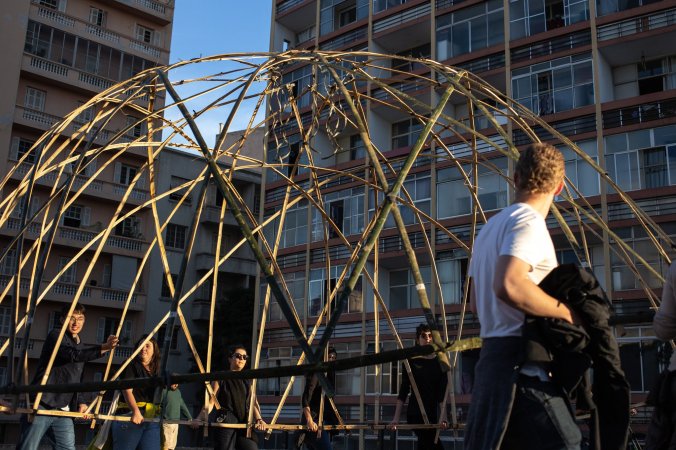
The bamboo dome “had even more useful structural properties than I had envisaged,” Ms. Martin said. “Deployability, nice structural stability and highly portable.”Credit Gabriela Portilho for The New York Times
Limits often lead to creative solutions. That’s exactly what is happening in Brazil. Alison Martin is pushing the limits of what can be built from weaving bamboo and is helping to create more natural cityscapes. She is surprising even the computer engineers with the strength and shapes of her material, all without the use of nuts and bolts. This is a new way of combining nature and architecture. Her work is also helping to solve some of the problems created by elevated highways. These highways block out the sun and create “a fracture in the urban environment”.
With designer and artist Alison Grace Martin, architects and engineers are embracing “the logic of the weave.”
SÃO PAULO, Brazil — On a Tuesday afternoon in early July, Alison Grace Martin, the British artist and weaver, joined a steady stream of Paulistanos along the elevated freeway that curves through downtown São Paulo. The two-mile “Minhocão” (named after a mythic “gigantic earthworm”) was closed to cars that day. The only traffic was on foot and bikes, skateboards and scooters. Picnickers lounged on the median sipping wine. Children ran after soccer balls. A retriever chased a coconut; a pit bull peed on a pile of bamboo.
The bamboo — freshly cut and split into strips about 20 feet long — had arrived with Ms. Martin and engineer James Solly, who were leading an urban design workshop, “High Line Paulista,” inspired loosely by Manhattan’s elevated greenway. Their students for the week had carried the strips, which would be put to use in an experimental dome construction, like a barn-raising, but with bamboo.
Plans have long been in the works to turn the Minhocão into a park. Since its opening in 1971, the freeway has been the subject of controversy: a concrete scar that bifurcated neighborhoods, smothering residents with noise and pollution.
“It ripped apart the urban fabric,” said Franklin Lee, from São Paulo, and director of the workshop with his partner Anne Save de Beaurecueil. (The workshop is part of the Architectural Association international visiting school program.) In January, after years of discourse and debate, the mayor, Bruno Covas, announced that the freeway would eventually be deactivated, finally making way for “Parque Minhocão.”
The impact of changing weather patterns becomes particularly evident when looking at the interrelationships of animal life cycles based on season. When it comes to habitat, conservationists are winning some battles, but climate change will require longer range goals.
The migration patterns of the Bracken Cave bats are changing, adapting to the rapid rate of warming, but experts say these adaptations won’t be enough to counter the effects of climate change.
Bracken Cave, a collapsed sinkhole on the side of a lush limestone hill in southern Texas, is home not only to the world’s largest known bat colony but also to one of the largest concentrations of any mammal. More than fifteen million Mexican free-tailed bats live, for part of the year, deep in its recesses. One evening in late July, I visited the cave, situated just outside San Antonio, with a group of bat-curious tourists. As the sun went down, we watched hundreds of bats emerge every second, fifty yards from where we sat, swirling up in what our guide, Niki Lake, a volunteer from Bat Conservation International, called “a batnado.” They created their own breeze, with its own murmur—an ASMR-inducing summer buzz, insectivorous and thrumming, the sound of thousands of beating wings coming in waves. (Lake called the sound a “bat ocean.”) The show would go on for about four and a half hours, until every last bat that could fly had exited the cave. One member of our party said that, if he had discovered this place in prehistoric times, he would have thought it was a portal to another world. As he spoke, I felt a wet spot on my hand. A bat had peed on me.
The bats are so numerous that they appear on radar systems—great blobs popping up and hovering above Bracken Cave every night. (Traffic controllers at San Antonio International Airport have to direct planes to avoid them.) A study published last year used weather-radar records from south-central Texas to analyze the bats’ migration patterns in the course of more than two decades. “Using radar, we were able to see the bats emerging from Bracken Cave every single night for the past twenty-three years,” Charlotte Wainwright, an atmospheric scientist at Notre Dame, told me. Wainwright and Phil Stepanian, the study’s lead author, found that the bats’ spring migration to Texas—they spend their winters scattered across Mexico—had advanced by two weeks. A small percentage of the bats were not leaving Bracken Cave at all. When researchers first visited, in the late nineteen-fifties, there were no bats present in December and January, and yet, according to the data, there are now fifty thousand or more bats emerging during the winter. In the most extreme cases in recent years, more than a quarter of a million bats are spending at least part of the winter at the cave, Stepanian said. “That’s a very sudden change—to have no animals there, to having some, to having so many.”
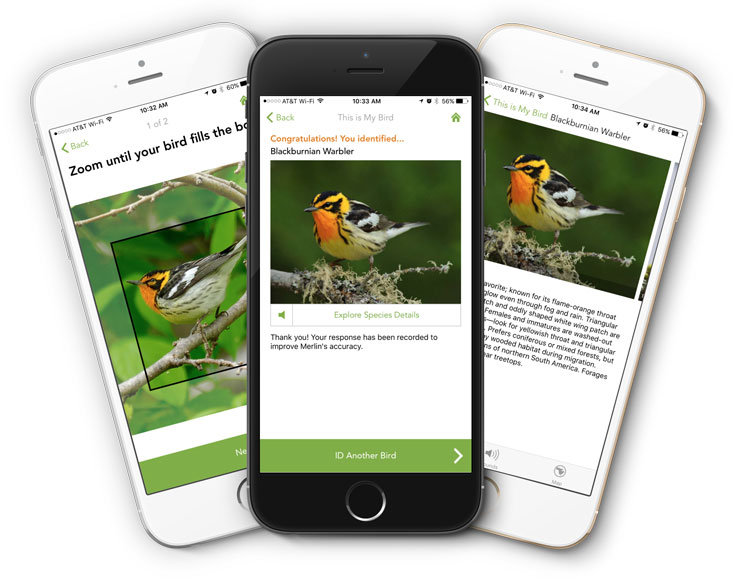
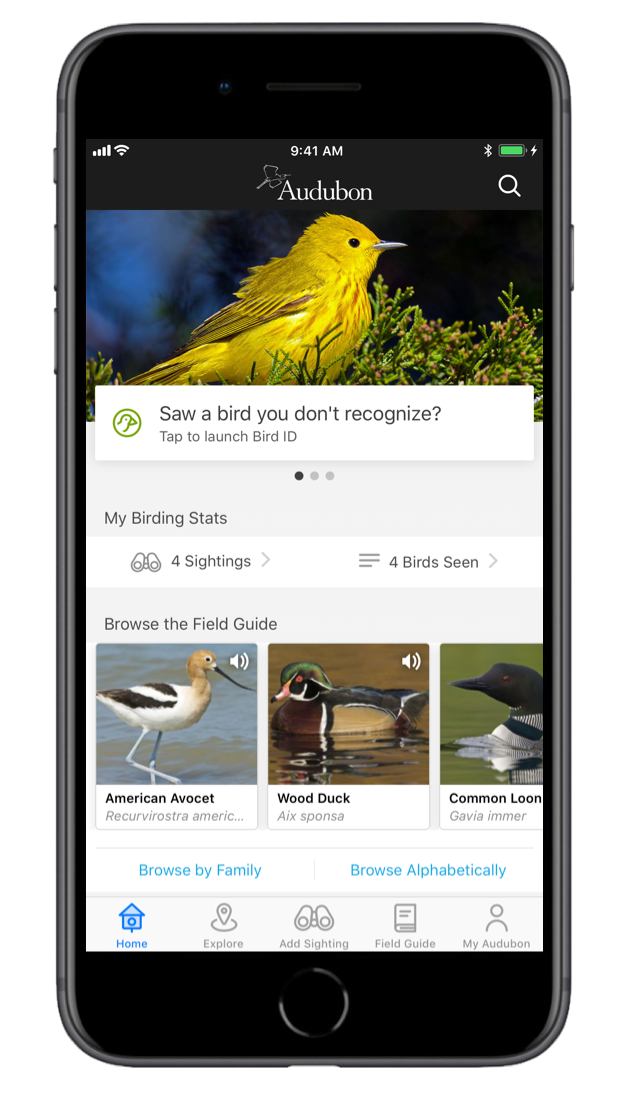
Merlin Bird and Audubon Bird Guide are both amazing resources and are well maintained and updated. They are both free and have a lot of the same features. At first, these apps might seem very similar. However, there are some big differences. I’ll start off with Merlin Bird. The Cornell Lab of Ornithology’s birding app has a couple of standout features. The app has a much cleaner interface with a simpler bird ID feature. You’ll answer five basic questions and it gives you a list of possible birds. It is very easy to use and is perfect for novices that do not have a lot prior knowledge about birds.
Another point for Merlin Bird is the variety of regions covered from all over the globe. They also let you download these regions individually, so you don’t have to fill up your device with information you don’t need. Merlin bird has a unique feature that allows you to take a photo of a bird and it will attempt to identify it. While it isn’t always accurate (or easy to get a good photo of a bird!) I am impressed by how often it gets it right. Even with photos I’ve taken at a distance the app has managed to identity the bird correctly.
Another nice feature is that the app integrates with Cornell’s other app, eBird. If you have a bird in eBird that you’ve identified it will display that in the Merlin app. It also has a nice ability that shows you a list of birds based on how likely it is that you’ll see them in your area.
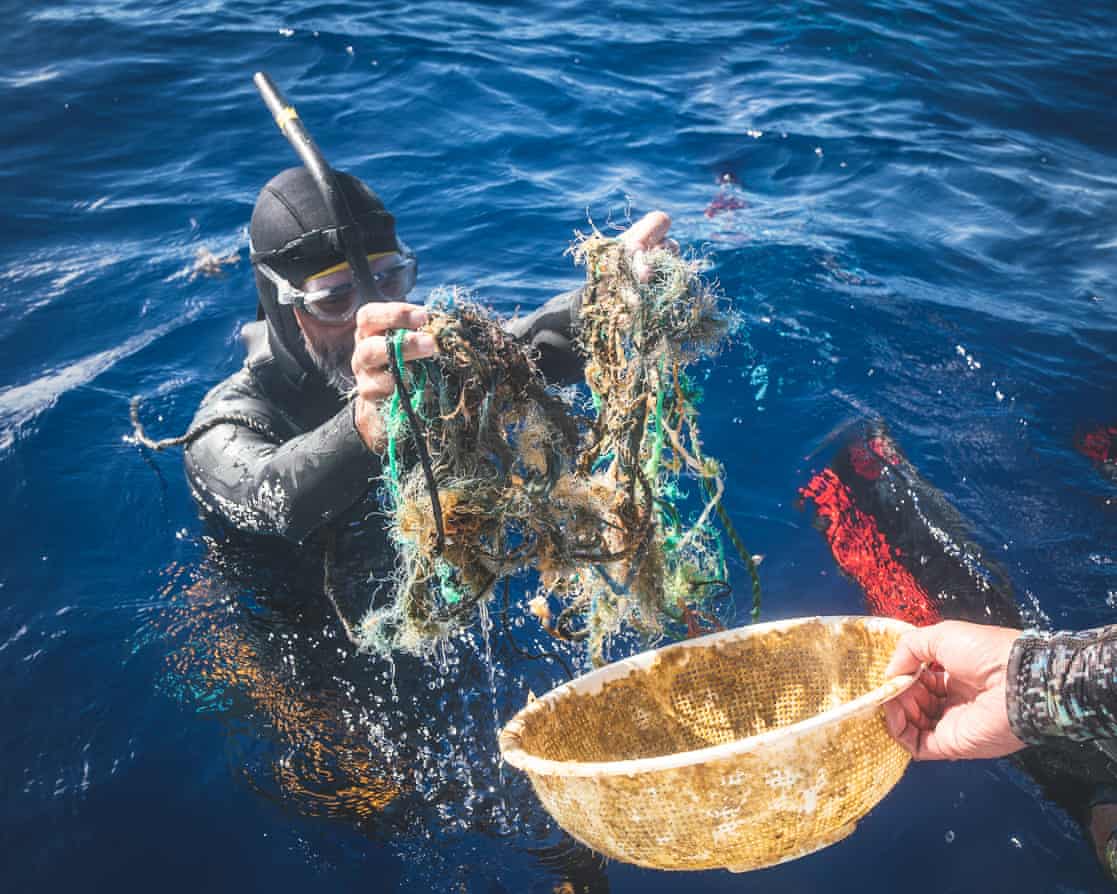
A discarded, tangled net in the Pacific Ocean. Photograph: @sea.marshall
It is difficult to look at, but the determination of this man to understand, and help us understand, this otherwise invisible impact of waste is inspiring. He could be sailing and adventuring anywhere, but chose here for a purpose. Whatever the opposite of “out of sight, out of mind” may be, he lends it credibility:
Ben Lecomte is making a trans-Pacific journey to better understand how plastics pollution is affecting our oceans
We thank him for his effort and the reminder:
Ben Lecomte is swimming through the gyre known as the Pacific trash vortex. Photograph: @osleston
Ben Lecomte is spending his summer swimming in trash – literally. So far, he’s found toothbrushes, laundry baskets, sandbox shovels and beer crates floating out in the open waters of the Pacific Ocean.
The 52-year-old Frenchman is journeying from Hawaii to San Francisco via the Great Pacific Garbage Patch to better understand how plastic is affecting our oceans. He will swim a total of 300 nautical miles, intermittently travelling by sailboat with a crew of 10 the rest of the way. Continue reading →
After nine Heligan men died in the First World War, the grounds of the estate, in southwestern England, grew unkempt, then neglected, then were abandoned. Illustration by Daniel Salmieri
I don’t understand the point of garden visits. Why do ordinary people, the owners of mere balconies and tiny yards, torment themselves by touring other people’s grand estates? Nut trees, stables, ancestral compost heaps: I need no reminder of what I am missing. So, unlike virtually every other gardener in Britain, I had no intention of spending my summer wandering among aristocratic roses and marvelling at the fine tilth of Lord Whatsit’s sandy carrot beds. All those rambling sweet peas make me furious; yes, Tristram, it is a handsome cardoon bed, but some of us are struggling to find space for a single extra lettuce. And then, wholly by accident, I found myself in the Lost Gardens of Heligan…
And the rabbit hole in this case gets you thinking about Cornwall:
Opening Hours and Prices
The Lost Gardens are open every day*, all year round, for your enjoyment and exploration.
*except Christmas Day.
We’re one of the most unique and fascinating places to visit in Cornwall, with an incredible 200 acres of gardens and estate awaiting your exploration. We therefore recommend that you allow as much time as you can, to see as much as possible; ideally a whole day. However, please don’t expect to see everything in the one visit!
If you would like to plan your route before you visit, click here to download our map or a German map can be found here.
Sometimes, restoration work, events or adverse weather conditions may restrict access and opening times. In these events we will keep you up to date with details of any restrictions via our News page.
Garden Admission
Single Visit Charges
Adults
£15.00
Students
£9.00
Children (5 – 17)
£7.00
Children (Under 5)
Free
Family (2 adults & up to 3 children)
£40
Companions who are required to assist disabled visitors
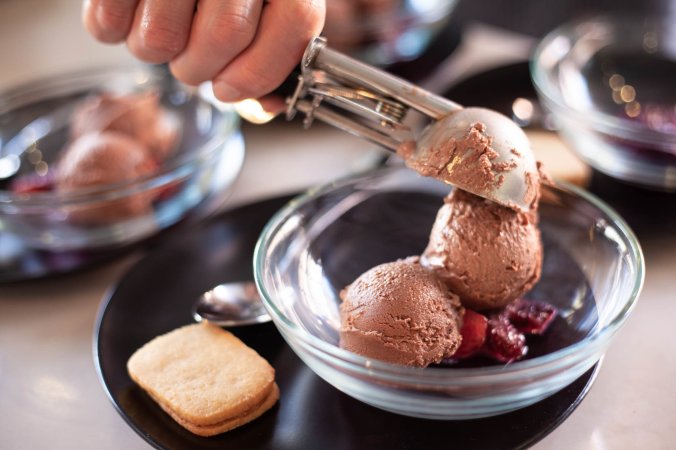
Bay Area-based company Perfect Day Foods developed a vegan, lactose-free ice cream containing milk proteins made by microbes rather than cows. Credit Perfect Day Foods
We’ve been writing about “fishless fish” and its beef counterpart quite a bit lately, and for good reason. The environmental impact of animal based agriculture is staggering; even grass-fed cattle raised well outside of industrial feedlots are responsible for carbon emissions.
Entrepreneurs and scientists are becoming great collaborators to develop tasty alternatives that can be healthy for the planet and humans.
With advances in synthetic biology, researchers and entrepreneurs strive to create cows’ milk without cows.
In recent years, the alternatives to conventional cows’ milk have proliferated. The local grocery store is likely to offer any number of plant-based options: milks made from soy, almonds, oats, rice, hemp, coconuts, cashews, pea plants and more.
But most nondairy milks pale in comparison to cows’ milk. Plant-based milks are made by breaking down plants and reconstituting their proteins in water to resemble the fluid from a lactating bovine. These proteins differ fundamentally from true dairy proteins, and the results — milks, cheeses and yogurts in name only — often fail to measure up in color, taste or texture. Inja Radman, a molecular biologist and a founder of New Culture, a food company, put it plainly.
“Vegan cheese is just terrible,” she said. “As scientists, we know why it doesn’t work. It doesn’t have the crucial dairy proteins.”
Dairy tastes like dairy thanks to two key proteins, casein and whey protein. Researchers at several start-up companies, including New Culture, have begun producing these proteins in the lab, with the aim of creating a new grocery store category: cow-free dairy.