I had never heard the name guarumo for this tree before. Cecropia is the name we have commonly heard for it in Costa Rica. Veronique Greenwood, who we have linked to twice until now, has contributed more than vocabulary to me through this article. I am particularly thankful for the realization that cacao can be more useful than I had been aware. Beyond the benefits of being grown organically it may play a key role in regenerative forest development. This, entrepreneurial conservation in mind, must become a variable by which Organikos sources chocolate in Costa Rica:
A study showed that when some animals find a crucial resource, they can survive in changing environments and even thrive.
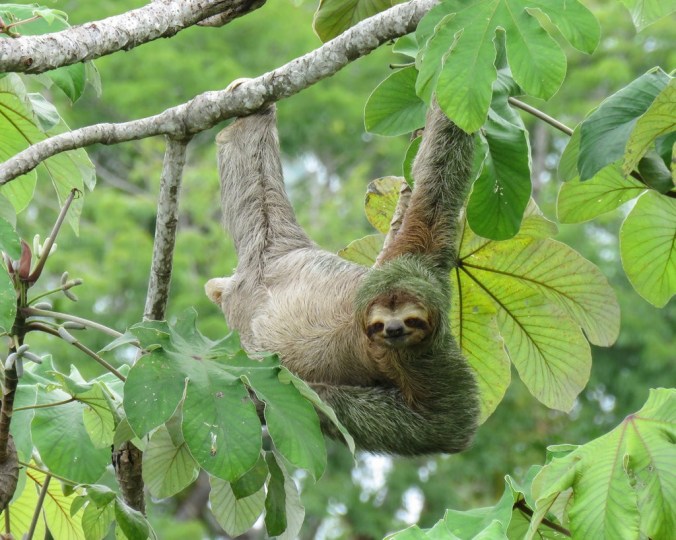
Look closely up in the trees of a shade-grown cacao plantation in eastern Costa Rica, and you’ll see an array of small furry faces peering back at you. Those are three-toed sloths that make their homes there, clambering ever so slowly into the upper branches to bask in the morning sun. You might also spot them munching on leaves from the guarumo tree, which shades the cacao plants. Continue reading →
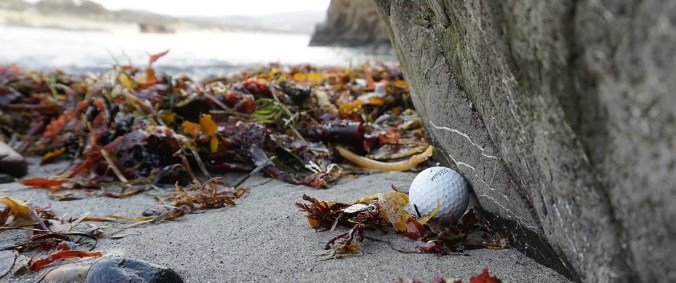
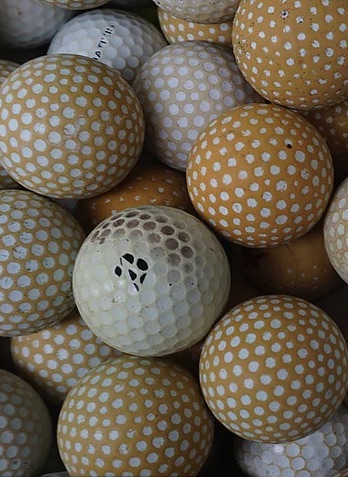
Reading further, I sensed that Yale e360 was being a bit polite saying “thousands” — more than 50,000 balls have already been extracted over two years. The article linked to National Public Radio’s coverage of the same story, with this slightly more aggressive headline:
During my PhD years I got to be reasonably competent at the game of golf. I can say I even loved the game. One odd bi-product of my dissertation was that I learned of the perils to the planet from out of control golf course development. Then I felt compelled to give up the game. (I did play a bunch during the mid-1990s, in Costa Rica, as I slowly learned of those perils.) Recently I found the clubs I used to play with, and the shoes, while cleaning out a store room in Costa Rica. I left them there.
To this day I have some close friends who play golf. I never comment on this topic in front of them, because my message is easily misconstrued. I am not against all golf. I just think there are more than enough courses already built on this planet. A moratorium on building more would make me happy. My friends already have more than enough courses to play on. Anyway, this topic is of interest now for a new, very specific reason. And it comes as a bit of a surprise what a big problem golf balls are in the ocean. The website of the organization that is featured in both articles can be reached by clicking the image below:
I remember advertisements from not that long ago that encouraged you to daydream about hitting balls endlessly into the ocean from cruise ship voyages with golf tees on the back of the ship. At first I thought maybe that kind of weird pleasure was the culprit, considering all the other dirty outcomes of cruising. But it’s complicated, as I learned from The Plastic Pickup website:
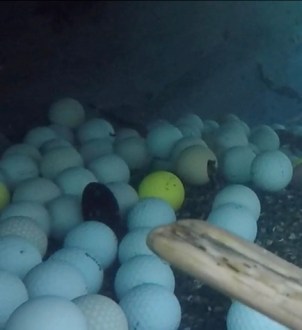
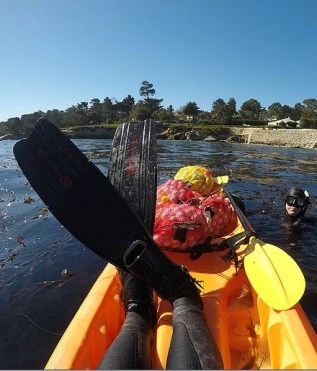
In the spring of 2016, my dad (Mike Weber) and I (Alex Weber) were freediving along the central coast of California in the shallow waters adjacent to the Pebble Beach golf course, when we came across a discovery that had never been reported before. Thousands of golf balls blanketed the seafloor, and inhabited nearly every crack and crevice in the underwater and onshore environment. The overabundance of inorganic materials was overwhelming but for a second it did not phase us. As we began diving to the bottom to collect the balls, we realized what perfect freediving training it was and the whole operation felt like a fun game; we were having a blast. But soon, the enormity and vast scale of the pollution set in and it made me feel sick to my stomach. To preface this day, for a few years prior I had been spending at least an hour a day down at the beach collecting microplastics and nurdles after heavy storms would wash them ashore. As a kid I was raised in the sea, boogie boarding everyday after school in kindergarten, scuba diving as soon as I was allowed to, and spending each summer day swimming offshore to hang out with dolphins and swim through giant kelp forests. To me the ocean was a peaceful home as well as my favorite teacher, so the discovery of such a large scale underwater plastic problem both shocked me and also captivated my curiosity. What began as a day of freediving resulted in a project that has changed my life ever since.
The next dive-able day, we were underwater early in the morning equipped with mesh bags and a new diver, Jack Johnston. Jack and I had been long time friends since middle school, and spent all our time together either underwater or on mountains, so he didn’t need much convincing to come along. Jack’s reaction was similar to mine, but his wildly curious mind helped him stay positive and motivated. That day we collected nearly 2,000 golf balls which was just the start of what grew into The Plastic Pick-Up. As we continued diving, we were not only collecting golf balls, but data too…
Read the whole story here. And if that interests you, there is another website that mentions a different Alex and his buddy Andrew who have also found a mission-driven business focused on ocean cleanup:
to Bali Indonesia that would inevitably change their lives and the fate of the ocean. Devastated by the amount of plastic in the ocean, they set out to find out why no one was doing anything about it. Continue reading →
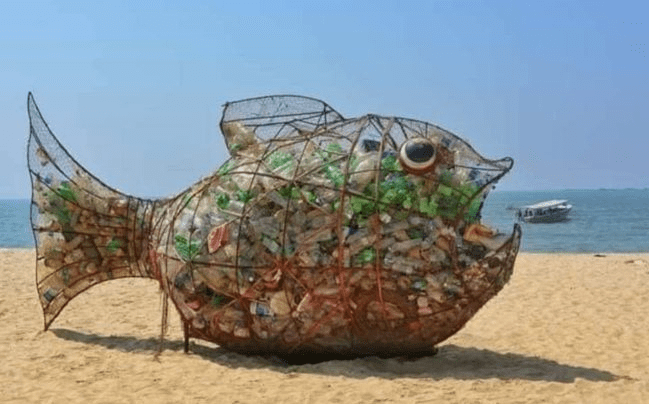
As some rumors swirl around the internet that there will be more plastic than fish by 2050, there are also some great stories about local recycling, like this one about Goby the fish.
This local beach decided to do something simple, instead of placing a ton of boring old garbage cans around the beach, they made a giant see through fish out of some barbed wire and mesh, and added a sign to it that said, “Goby loves plastic, please feed him”. Continue reading →
After two decades of drought, Lake Mead in Nevada is just 40 percent full. TED WOOD
Thanks to Jim Robbins and Yale e360 for this second installment, and especially to Ted Wood for photography as visually compelling as the implication of the story:
With the Southwest locked in a 19-year drought and climate change making the region increasingly drier, water managers and users along the Colorado River are facing a troubling question: Are we in a new, more arid era when there will never be enough water?
Scientists at the University of Arizona are using tree rings to study centuries of drought conditions in the Colorado River Basin.
In the basement of the University of Arizona’s Laboratory of Tree-Ring Research, the fragrant smell of pine hangs in the air as researchers comb through the stacks of tree slabs to find a round, 2-inch-thick piece of Douglas fir.
They point out an anomaly in the slab — an unusually wide set of rings that represent the years 1905 to 1922. Those rings mean it was a pluvial period — precipitation was well above average — and so the trees grew far more than other years.
“In 1905, the gates opened and it was very wet and stayed very wet until the 1920s,” said David Meko, a hydrologist at the lab who studies past climate and stream flow based on tree rings. “It guided their planning and how much water they thought was available.”
Mark Harris, a water manager in Grand Junction, Colorado.
The planning was that of the states that share the water of the Colorado River. Worried that a burgeoning California would take most of the water before it was fairly divvied up, representatives from the other Colorado River Basin states, presided over by U.S. Secretary of Commerce Herbert Hoover, came together in 1922 to develop an equitable apportionment. They looked at flow measurements and figured that the river contained an average of 15 million acre-feet. They divided the Colorado River states into two divisions – the upper basin and the lower basin, with the dividing line in northern Arizona near the Utah border. The upper basin states — Utah, Wyoming, Colorado, and New Mexico — agreed not to take more than a total of 7.5 million acre-feet and to allow the other half to flow south to the lower basin. The agreement they signed was called the 1922 Colorado River Compact, also known as the Law of the River. Continue reading →
Thirty years ago, all 197 countries got together to ban the gases damaging the Earth’s ozone layer. Now we need to unite to combat an even greater threat. What can we learn from 1989?
Amid the anti-globalist chest-thumping of Brexit, Donald Trump, and the Brazilian president, Jair Bolsonaro, it may sound like the stuff of folklore. But there was a time in the recent past when all the countries of the world moved quickly to discuss a common threat, agreed an ambitious plan of action and made it work.
The Montreal protocol, which came into effect 30 years ago, was drawn up to address the alarming thinning of the ozone layer in the Earth’s stratosphere. It was the first agreement in the history of the United Nations to be ratified by all 197 countries. Since it came into effect on 1 January 1989,more than 99% of the gases responsible for the problem have been eradicated and the “ozone hole” – which, in the late 80s, vied for headline space with the cold war, Diana, Princess of Wales, and Madonna – is receding in the sky and the memory. Continue reading →
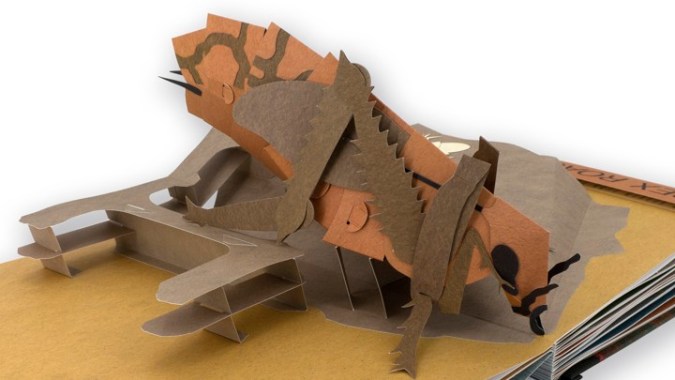
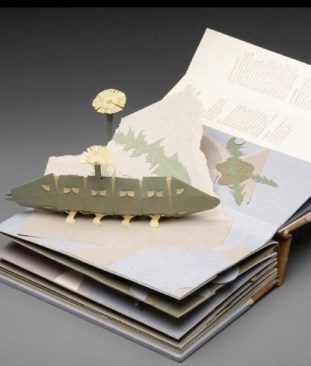
…Though Beyond the Sixth Extinction can be enjoyed solely for its dystopian yuks, its elegant paper sculptures tell a deeper story. The book doesn’t spend much time blaming humans for the world it imagines, or spell out exactly what has befallen Homo sapiens during the nearly three millennia between 2019 and 4847. But it does hint at a world in which the human footprint has been radically reduced. Chicago transformed into the diminished district of Cago, and life to some extent has moved on without us…
When I first saw something vaguely akin some years ago, the creative approach to a dark topic made me smile. This time, I am drawn in by an artist’s unique vision of the future as it relates to the natural world, and my reaction is to think while smiling.
So, off to Candlewick Press (click the image of the book to the left). Even though I am not inclined to dystopia, I like what the author / artist / pop-up engineer says about what looks to be its hand-made progenitor:
In his book The Sixth Extinction, Richard Leakey describes five major catastrophes in Earth’s history that led to significant extinctions—the last of which was the meteor impact that eliminated the dinosaurs. He theorizes that the sixth big extinction has already begun, and that it is human-authored. Be it through over-hunting, global warming, or habitat destruction, humans have the power to destroy species at alarming rates.
Evolutionary theorists like Stephen Jay Gould have studied and written about the speciation that followed these previous die-offs, like the mammalian bloom that followed the extinction of the dinosaurs. I myself wonder which species might survive and flourish in a new environment if humans are successful in instigating a profound die-off. I wonder what anatomical adaptations they might acquire in their proliferation.
All of the creatures in this book are based on organisms that have high survival ratings, including: ubiquity (or nearly so), omnivory (linked to high intelligence), adaptability (especially to human-made habitats), and escape mobility. Since I am interested in representing a single system, they also had to have the potential to entertain plausible interdependencies.
Though the content of this book is bleak, the tone is cautiously optimistic. Some ecological theorists believe that humans—being the most adaptable species in the history of the planet—will be the very last species to be exterminated, but there is still hope that a sustainable balance can be found between human resource use and the resource use of everything else. Continue reading →
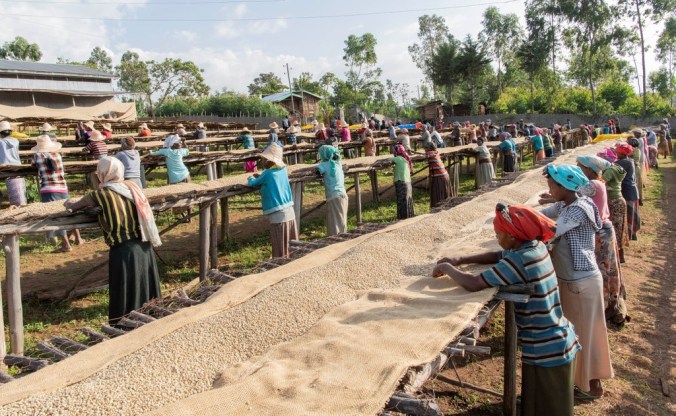
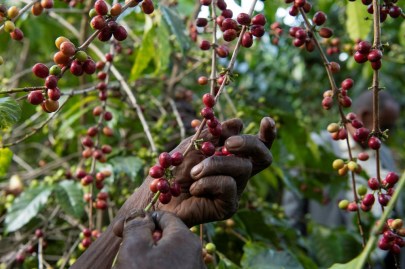
Drying coffee beans in Ethiopia. More than half of all species are at risk of vanishing in the wild because of climate change and deforestation. Maheder Haileselassie/Reuters
As much as I thought I learned in the last year about coffee, I got a hint just now, reading the article below, how steep my learning curve remains. 124 species of coffee? So much to hunt, so little time! Thanks to Somini Sengupta for this story:
Picking coffee berries on a farm in Ethiopia. Maheder Haileselassie/Reuters
Aaron Davis, a British botanist, has spent 30 years trekking across forests and farms to chronicle the fate of one plant: coffee.
He has recorded how a warming planet is making it harder to grow coffee in traditional coffee-producing regions, including Ethiopia, the birthplace of the world’s most popular bean, arabica. He has mapped where farmers can grow coffee next: basically upcountry, where it’s cooler. He has gone searching for rare varieties in the wild. Continue reading →
Helen Rosner, surprisingly appearing for only the second time in our pages, catches us just after our new year’s resolution to take up bread baking.
Well timed.
For a few minutes of bread love, click the image above. For a few minutes more of bread geek-out, read on:
In the immeasurable history of people talking about food, has there ever been a single statement more raw and moving and real than Oprah Winfrey, sitting before a television camera, flinging her arms emphatically forward, narrowing her eyes with fevered intensity, and declaring, with a passionate roar, “I! Love! Bread!” Continue reading →
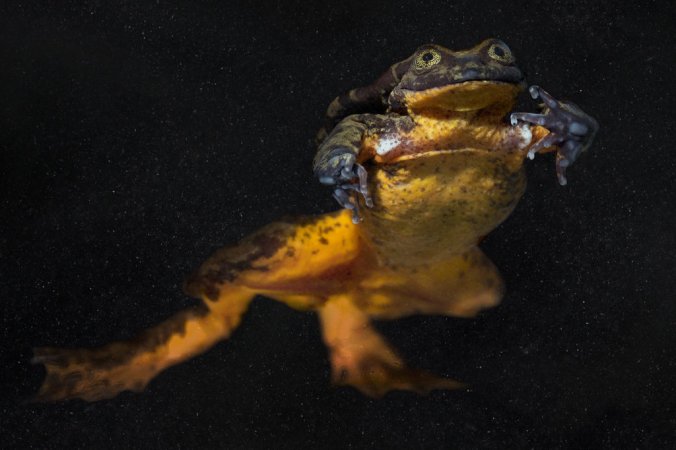
Romeo, who was thought to be the last Sehuencas water frog: “Did my heart love till now? forswear it, sight! For I ne’er saw true beauty till this night.” D. Alarcol and D. Grunbaum/Global Wildlife Conservation
The lonely male in a Bolivian museum was thought to be the last Sehuencas water frog, but an expedition has found him a potential mate.
Romeo was made for love, as all animals are. But for years he couldn’t find it. It’s not like there was anything wrong with Romeo. Sure he’s shy, eats worms, lacks eyelashes and is 10 years old, at least. But he’s aged well, and he’s kind of a special guy.
And there is more. In this same story as reported by National Public Radio (USA), I cannot be happy about the long-term macro situation, but the shorter-term micro situation for this Romeo looks like it may have a happy ending:
While Shakespeare’s Romeo spent only about two days banished in Mantua, away from his beloved Juliet, Romeo the frog has remained in complete isolation — sans love interest, cousins, friars or friends — living in a laboratory for the last 10 years. But that’s all about to change.
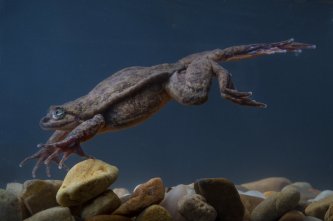
Juliet appears to be a perfect match for Romeo — she’s a Sehuencas water frog and of reproductive age. Robin Moore/Global Wildlife Conservation
The world-famous amphibian was believed to have been the last of his kind – a Bolivian Sehuencas water frog (Telmatobius yuracare) – and lived under the protection of researchers at the Museo de Historia Natural Alcide d’Orbigny in Cochabamba City. They have made it their mission to find Romeo a special lady friend who might respond positively to his plaintive mating calls and help save the species from becoming extinct.
Year after year, scientist scoured Bolivia’s cloud forests for signs of other googly-eyed, orange-bellied Sehuencas, but they’ve always come up empty, until recently. Continue reading →
A nematode pierces the cell walls of a mushroom’s hyphae to feed on them.Credit By Markus Künzler
The mysteries of nature never cease to amaze, and fungi rank high in all aspects. Since the inception of this site we’ve highlighted this special branch of the animal kingdom.
A mushroom species was found to sense predators and sent warning signals to other parts of its body, but how it does that remains a mystery.
It’s known as fight or flight — the message the brain sends your body when it detects something frightening. Something like it happens to plants when they are under attack, too. And then there are fungi — perhaps the most mysterious kingdom of multicellular life.
Fungi too can sense attackers and manufacture powerful weapons to combat them, including the toxins and poisons that can send you to the emergency room if you eat the wrong mushroom.
But little is known about the built-in threat detectors of these limbless, brainless beings. Humans send messages through their nervous systems. A plant’s vascular system is its relay apparatus. But fungi have neither. Continue reading →













 Organikos