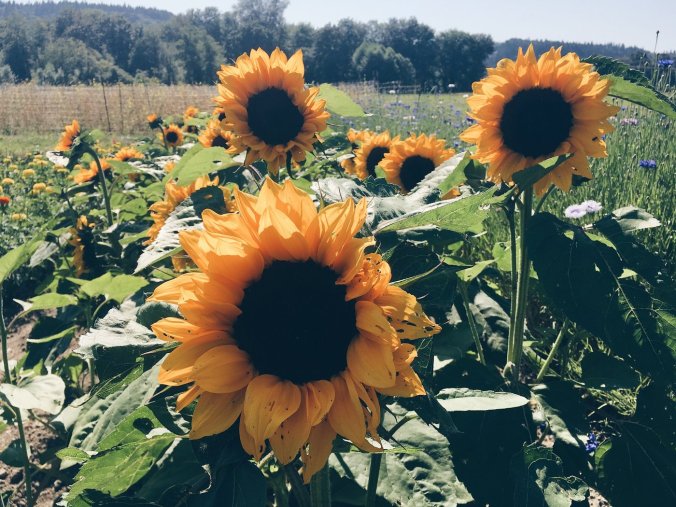
Along the back of this field of sugar snap peas, sunflowers and bachelor buttons at Oxbow Farm & Conservation Center is a buffer of maturing big-leaf maples and red-osier dogwoods. It’s a combination of forest and thicket that the farm has left standing to help protect water quality in the river and aquifer. Oxbow Farm & Conservation Center
Another day, another sunflower because, why not? But this story is about much more than the overwhelming attractiveness of sunflowers:
Farmers face a growing dilemma. Specifically, a food-growing dilemma.
How do you feed an increasing number of people without harming the environment?
As it turns out, growing as much food as possible in a small area may be our best bet for sustainably feeding the world’s population, according to new research.
It all comes down to how we manage greenhouse gases and climate change. Continue reading →
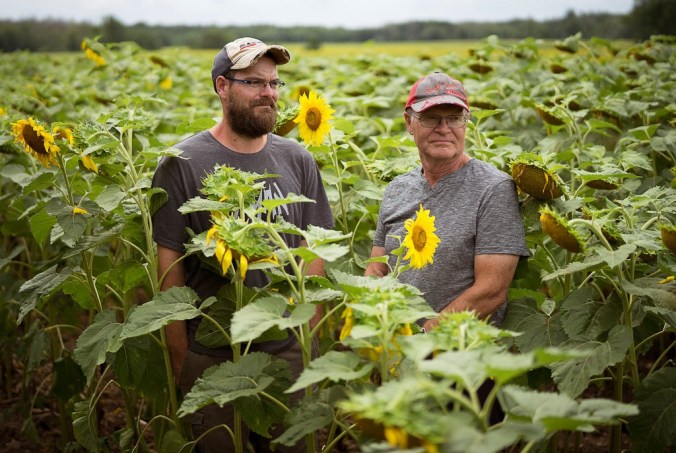
Brad Bogle, left, and his father, Barry Bogle, standing in their sunflower field in Hamilton, Ont. They were forced to close their farm to visitors last weekend after selfie-taking tourists crowded roads.Credit J.P. Moczulski
Thanks to Laura M. Holson for this, specifically for making our Saturday a bit brighter:
Two weeks ago, a Canadian seed farm in Hamilton, Ontario, opened its gates to visitors, allowing them to wander through 70 bucolic acres of towering, buoyant sunflowers. Provence may have its pastoral lavender fields. But Hamilton, which is an hour outside of Toronto, has its picturesque bloom too.
“For years, we’ve had people stopping alongside the road to take pictures,” said Brad Bogle, who, along with his parents, harvests sunflower seeds for bird food on their farm, Bogle Seeds. In the summer of 2015, the Bogles invited tourists to roam through the fields. They had such a swell time — and it was such a success — the family decided to welcome guests for a visit last month.
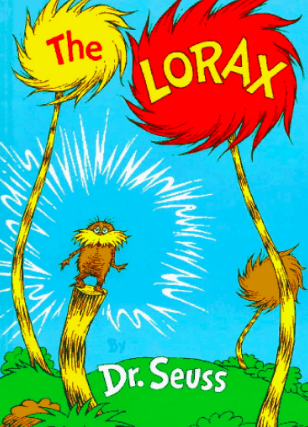
Dr. Seuss has held an important place in my life, stretching from my own childhood and into parenthood, and connecting the dots between the pure joy of reading and powerful messages keeps him at the top. So what fun to discover the story, species and science behind the inspiration for his most impactful books!
What inspired the creature who was “shortish and oldish and brownish and mossy?” The one who spoke in a voice that was “sharpish and bossy?” He spoke for the trees, yet he called them his own. All that he left “in this mess was a small pile of rocks, with the one word … ‘UNLESS.’”
In 1970, millions of people observed Earth Day for the first time, and the Environmental Protection Agency was born. Joni Mitchell’s “Big Yellow Taxi” topped the charts.
And in La Jolla, Calif., Theodor Geisel, also known as Dr. Seuss, was fighting to keep a suburban development project from clearing the Eucalyptus trees around his home. But when he tried to write a book about conservation for children that wasn’t preachy or boring, he got writer’s block.
At his wife’s suggestion to clear his mind, they traveled to the Mount Kenya Safari Club, an exclusive resort where guests watched animals along Kenya’s Laikipia plateau.
And if you haven’t guessed by now, it was there that “The Lorax” took shape — on the blank side of a laundry list, nearly all of its environmental message created in a single afternoon. Continue reading →
If Ed Yong is happy, then we too are happy about this. Really. Even if it has a bit of fiddling while Rome burns feel to it. Let’s hope he can talk some sense, even if it is too late, into the powers that be:
His nominee, Kelvin Droegemeier, is an accomplished meteorologist who studies storms and other extreme weather.
For decades, the meteorologist Kelvin Droegemeier has been immersed in the study of thunderstorms, tornadoes, and other extreme weather. Now he looks set to enter the unpredictable and stormy world of the Trump administration as its top scientific consigliere. Continue reading →
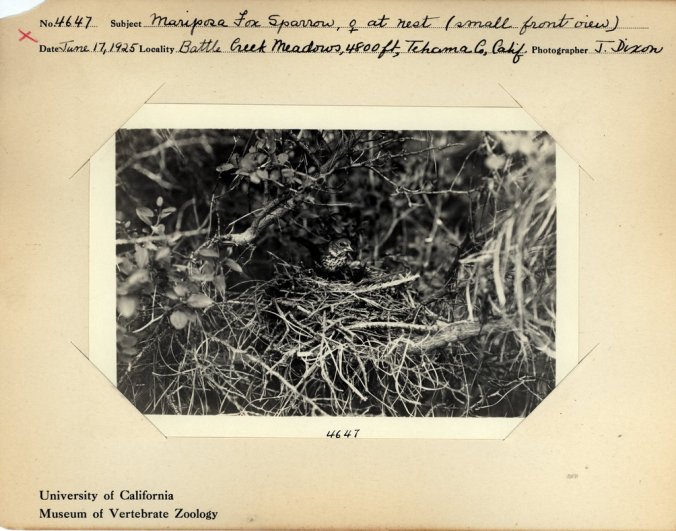
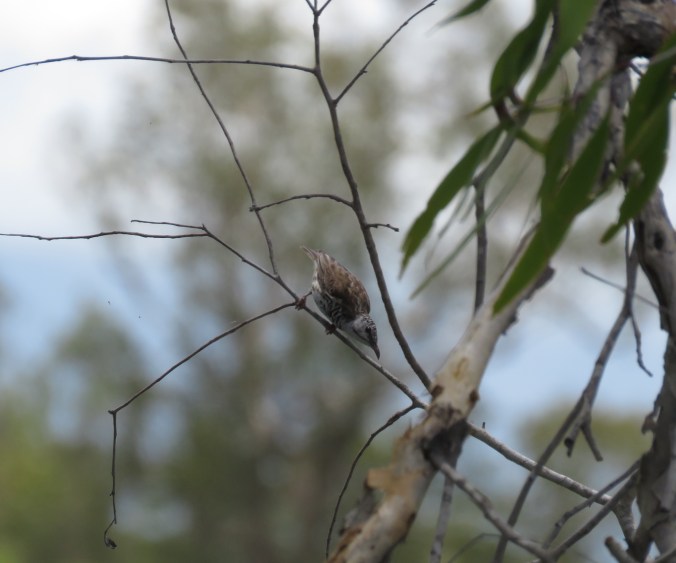
A Mariposa fox sparrow in its nest in 1925, observed during Dr. Joseph Grinnell’s surveys of California fauna. Credit Museum of Vertebrate Zoology, University of California, Berkeley
Retracing the steps of a century-old wildlife survey, ecologists find that birds are making remarkable adaptations to climate change.
More than a century ago, zoologist Joseph Grinnell launched a pioneering survey of animal life in California, a decades-long quest — at first by Model T or, failing that, mule — to all corners and habitats of the state, from Death Valley to the High Sierra.
Ultimately Grinnell, founding director of the Museum of Vertebrate Zoology at the University of California, Berkeley, and his colleagues produced one of the richest ecological records in the world: 74,000 pages of meticulously detailed field notes, recording the numbers, habits and habitats of all vertebrate species that the team encountered.
In 2003, museum scientists decided to retrace Grinnell’s steps throughout the state to learn what changes a century had wrought. And that’s why Morgan Tingley, then an ecology graduate student at the university, found himself trekking through the Sierra for four summers.
Dr. Tingley wanted to know how birds had fared since Grinnell last took a census. Years later, the answer turned out to be a bit of a shock. Continue reading →
Thanks to Blake and Jen for all their awesome work. Also thanks to Sara Ventiera (a new food and travel writer for us to follow!) and her colleagues at National Public Radio (USA) for keeping us connected to such heroics:
Hell’s Backbone Grill is located in Boulder, Utah, about 250 miles south of Salt Lake City. The restaurant’s owners are fighting Trump’s plans to slash the size of nearby Grand Staircase-Escalante National Monument by more than half. Ace Kvale
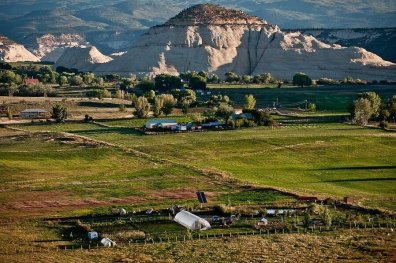
Standing between peach and cherry trees on her 6.5-acre Utah farm, Blake Spalding points to the Kaiparowits Plateau. The looming bluff is dotted with thousand-year-old pinyon pine and juniper trees.
“That is one of the areas they’re hoping to mine,” she tells a group of visiting chefs from Salt Lake City. “It’s full of dinosaur fossils and more than 650 documented species of wild bees.”
The remote and sustainable restaurant has become a destination for travelers seeking a taste of its terroir-driven fare. Ace Kvale
Nearly 20 years ago, Spalding and her business partner, Jen Castle, founded Hell’s Backbone Grill in Boulder, Utah, on the edge of the then-newly designated Grand Staircase-Escalante National Monument, about 250 miles south of Salt Lake City. The remote and sustainable restaurant has become a destination for culinary travelers seeking a taste of its terroir-driven fare. It’s an amalgam of Mormon pioneer, Western range cowboy and traditional Southwest flavors, like juniper lamb posole or grilled pork chops with Boulder crabapple barbecue sauce. Continue reading →
“We completely regret what happened,” a spokesman for the cruise company said, adding the bear was killed in self-defense.
Hapag-Lloyd Cruises is not the worst company in the world but it sure is trying hard. And they are in a very dirty business. The lead photo in this story by Yonette Joseph is just too depressing to share here, so the map is shown instead. That photo requires viewing as an act of witness to the cruise industry’s lack of ethics, so read on and click through:
LONDON — A polar bear was shot and killed on Saturday after it attacked and injured a guard from a cruise ship that had stopped at an Arctic archipelago, the Norwegian authorities said.
The death of the bear at the hands of another cruise ship employee drew condemnation on social media, with some calling it “abhorrent” and others questioning killing the polar bear for “acting like a wild animal.” Continue reading →
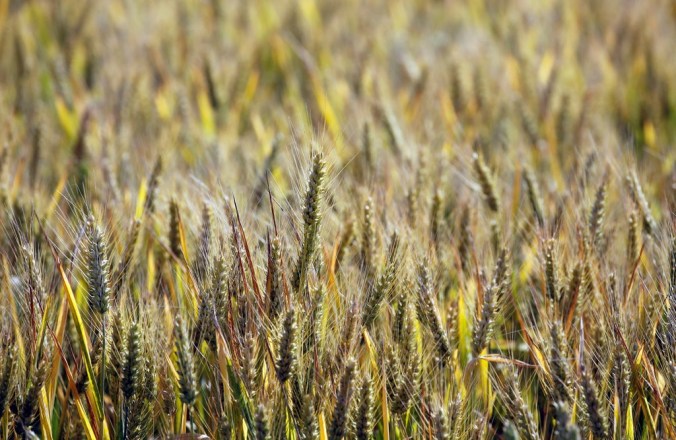
A wheat field in Mouchamps, France. There are very few genetically modified crops grown in Europe compared to the United States. Credit Regis Duvignau/Reuters
In Europe, plants created with gene-editing technologies will be stringently regulated as G.M.O.’s. But older crops whose DNA has been altered will be left alone.
Mushrooms that don’t brown. Wheat that fights off disease. Tomatoes with a longer growing season.
This week, the court ruled that gene-edited crops are genetically modified organisms, and therefore must comply with the tough regulations that apply to plants made with genes from other species.
Many scientists responded to the decision with dismay, predicting that countries in the developing world would follow Europe’s lead, blocking useful gene-edited crops from reaching farms and marketplaces. The ruling may also curtail exports from the United States, which has taken a more lenient view of gene-edited foods.
“You’re not just affecting Europe, you’re affecting the world with this decision,” said Matthew Willmann, the director of the Plant Transformation Facility at Cornell University. Continue reading →
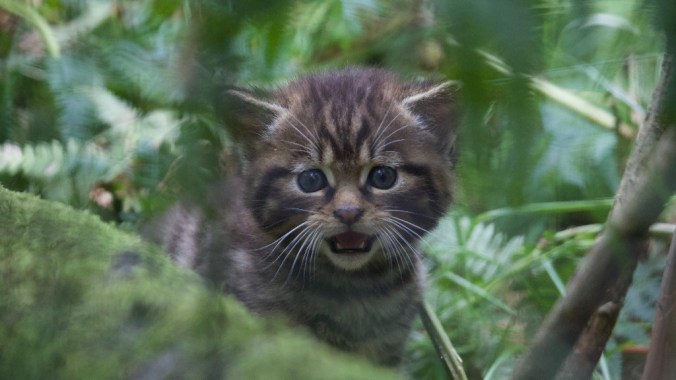
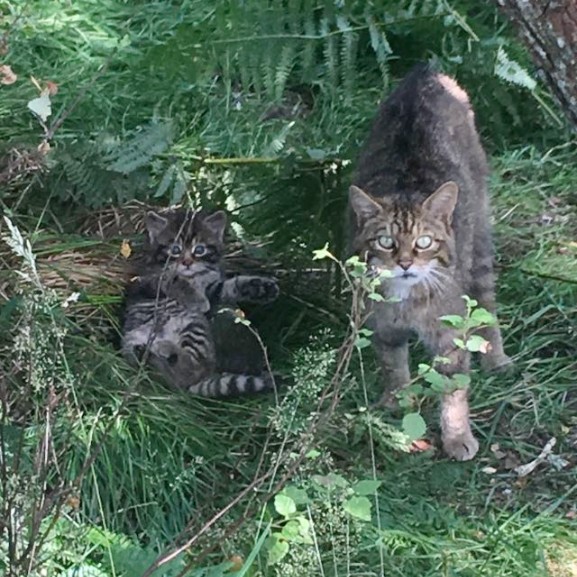
Thanks to our friends at Alladale for sharing this with us yesterday. (to not disturb the kittens at this time, these photos by Innes MacNeill are from an earlier litter and further content will follow will about the new ones, so we recommend you subscribe here to their newsletter):
Conservation efforts for the critically endangered Scottish wildcat have had another boost as Alladale Wilderness Reserve welcomes the arrival of two kittens. These kittens, who are part of the captive breeding programme and whose parents were given the go-ahead for breeding following genetic testing by the Royal Zoological Society of Scotland (RZSS), have the potential to play a key role in the long-term conservation of this near-extinct native species.
Working together with RZSS, Scottish Wildcat Action and other wildlife conservation organisations across Scotland, Alladale Wilderness Reserve and The European Nature Trust (TENT) are supporting the development of effective, long term plans focused on wildcat recovery through reintroductions. This work follows other successful models of endangered cat conservation, like that of the Iberian lynx in Spain and Portugal whose population has been saved in recent years following numerous reintroductions. Continue reading →
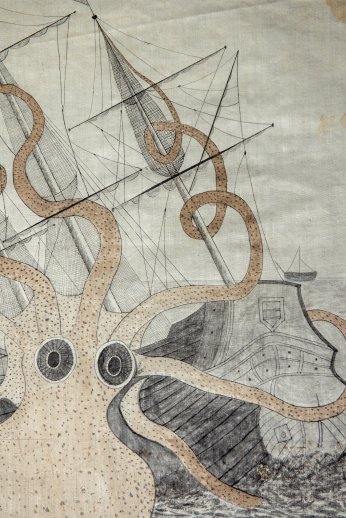
“Colossal Octopus,” 1828–1840, by Orra White Hitchcock, one of America’s first female scientific illustrators, on view at the American Folk Art Museum. Credit George Etheredge for The New York Times
Women remain grossly underrepresented at the highest echelons of American science, and continue to face absurd claims of “innate” inferiority, whether from former Harvard presidents or senior engineers at Google. But until the mid-19th century — when the sciences became professionalized, and when Charles Darwin and others put Christian doctrine under pressure — a woman’s place was in the laboratory, or among the geology and zoology specimens.
Back then the humanities (classics and philosophy, especially) were understood as masculine academic pursuits. It was the more genteel disciplines of natural science, astronomy, chemistry, botany and anatomy, to which women of a certain class gravitated.
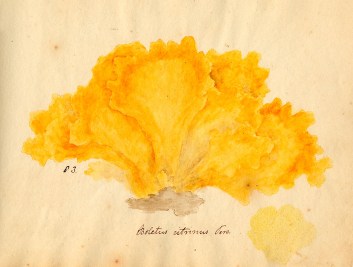
Orra White Hitchcock’s “Fungi Selecti Picti, Vicinity of Conway, Massachusetts” (1821), watercolor, pencil, pen and ink, and ink wash on paper in sewn album. Credit Smith College Special Collections
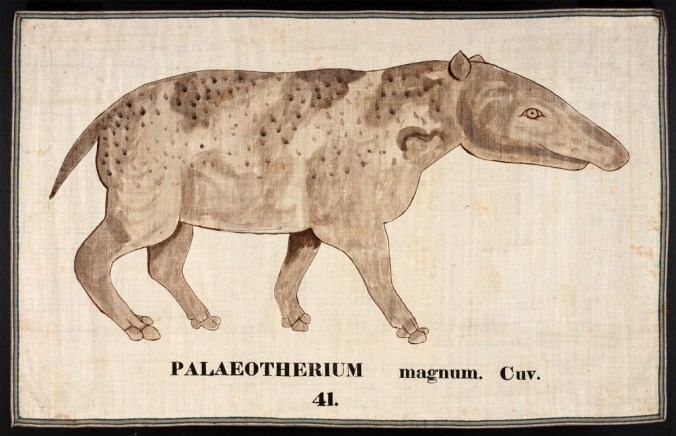
Orra White Hitchcock (1796-1863) was one of the most remarkable women from this more egalitarian age of scientific study. She had a deep knowledge of botany, zoology and paleontology, and she was also an artist — though that “also” would have seemed unnecessary to her. She produced two albums of botanical illustrations, and later, as introductory materials for her husband’s classes, she diagramed volcanoes, sketched the skeletons of extinct fish and mammals, and drew undulant squids and octopuses on large cotton sheets.
They’re all united at the American Folk Art Museum in “Charting the Divine Plan: The Art of Orra White Hitchcock,” a handsome and unexpectedly passionate exhibition on art, science and education in the early American republic. More than 100 watercolors and classroom charts are here, from painstakingly accurate paintings of reeds and mushrooms to boldly colored abstractions of the earth’s crust and core, and they share space with a splendid array of diaries and correspondence, redolent with the Hitchcocks’ intertwined loves for science, God and each other. Continue reading →
Farmers face a growing dilemma. Specifically, a food-growing dilemma.
This is a story about a good idea gone awry.

Who Was the Real Lorax? Seeking the Inspiration for Dr. Seuss




 Organikos