Ask Whole Foods About Wonderful

oilag-reaction_teenfriends_2

How wonderful is that?!? An organization that has been digging into the question of where all that fracking water is going in recent years. Thanks to Food & Water Watch, one of the most vigilant watchdogs helping the public become aware of fracking’s potential dangers, for asking questions that we all have reason to care about. And since the answers are not so wonderful, they are choosing perfect market-based locations to ask regular folks whether they are aware of the very cozy relationship between fracking waste water and the food we eat. Even some certified organic foods, it turns out. The image above is from their current press release:

PomWashington, D.C. — Are families around the country—and around the globe—eating California produce grown with toxic water from oil drilling? If they consume Halos Mandarins, POM Wonderful pomegranate juice, Wonderful pistachios, Sunview Raisins, Bee Sweet citrus or Sutter Home wine, they almonds_bottommay well be. Those companies grow some of their products in four water districts in California’s Central Valley that buy wastewater from Chevron and other oil companies’ drill sites. Now, Food & Water Watch is announcing a campaign to ban the practice, which threatens our food, farm workers and the environment, with a new documentary by noted filmmaker Jon Bowermaster and a campaign video capturing shocked reactions from people who previewed the video last week in front of Whole Foods’ headquarters in Austin, Texas. [continued below]

Thanks to WNYC for this half hour in which we learned about the study. For a decade-old but still profile of the wonderful couple who we hope will come clean on this, take a look here:

fiji_bottle_top…Lynda and her creative team immediately set to work promoting the water’s “untainted” origins. (Fiji Water comes from an aquifer on the island of Viti Levu.) The bottle’s label was retooled: the image of a waterfall (Lynda: “Surface water? Yuck!”) was replaced with a bright-pink tropical flower and palm fronds, and the company’s slogan was changed from the ho-hum “Taste of Paradise” to the more direct “Untouched by man. Until you drink it.” Since the makeover, sales have improved by three hundred per cent…

Rich, as the saying goes. Continue reading

A More Virtuous Tea

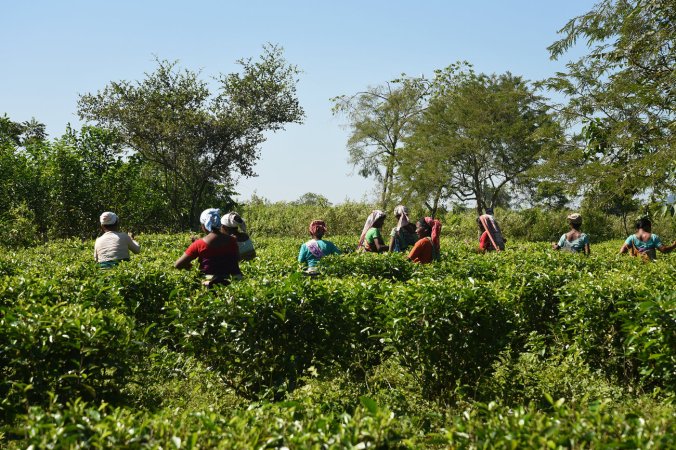
tea-dsc_4084_custom-81c744af0031bf81425ef659cb52385d07717424-s1300-c85

Tea pickers stand in the scorching sun, hand-plucking the tea leaves for about eight hours a day. Furkan Latif Khan/NPR

Thanks to Julie McCarthy and her colleagues at National Public Radio (USA) for this story posted from our old neighborhood:

Tea Farmer In India Leads Charge For Organic, Evades The Charge Of Elephants

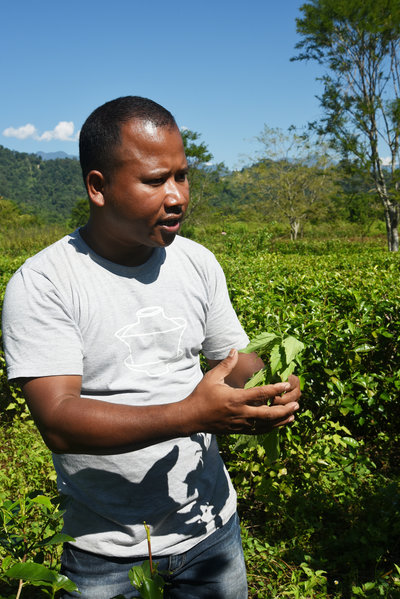
tea-dsc_4165_custom-f26dac282301c68a7ef79adff58e4fdc2663934e-s400-c85

Tenzing Bodosa is a tea grower and a staunch practitioner of organic farming. He stands in his small tea estate beside the nature preserve he has cultivated.
Furkan Latif Khan/NPR

As you clutch a cuppa for a bit of winter warmth, spare a moment to consider the elaborate process that goes into producing that seemingly simple sip of tea.

In the biggest tea-growing region in India, the hazards alone range from red spider mites to herds of wild elephants.

Grower Tenzing Bodosa, a native of Assam, fights the former and unusually invites the latter.

From the large Bodo tribe and widely known by his first name, Tenzing stands beside the vermilion flames of a brick oven that provides the heat for a drying contraption erected in his backyard. Continue reading

Blue Planet II’s Attenborough Masterpiece

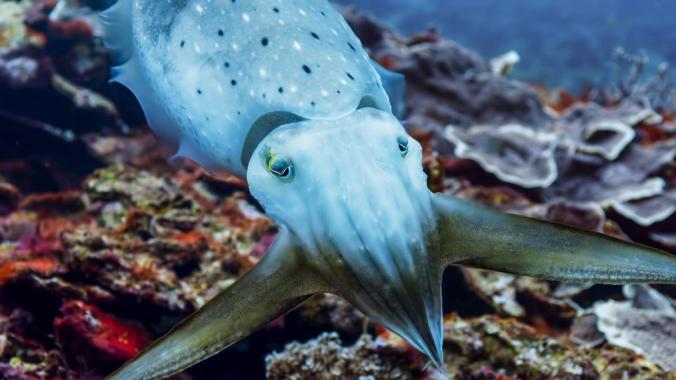
Blue Planet II_EP03_Coral Reefs

The broadclub cuttlefish is one of the psychedelic creatures featured in “Blue Planet II.” Photograph courtesy BBC

blue_planetWe have not linked to many television reviews, and the reason is simply that we instead mostly promote going and seeing instead of sitting and watching.

But this one seems a perfect exception to the norm because the series narrator is such a frequent guest in these pages, for good reason after many good reasons. This show may be his own sense of a masterpiece, if you consider what he says in a recent interview to a confirmed urbanist, which is worth half an hour of listening to in addition to the review below:

“Blue Planet II” Reviewed: The Ocean Continues to Impress

The seven-episode follow-up to the 2001 series flexes the BBC’s mastery of a genre that it created.

By Troy Patterson

The nature documentary “Blue Planet II” is oceanic in topic, tone, scope, and majesty. A production of the BBC Natural History Unit, the seven-episode series flexes its broadcaster’s mastery of a genre that it created. Over excellent footage shot on a circumglobal photo safari, the venerable narrator David Attenborough orates zoological narratives as if delivering a state-of-nature address. “Blue Planet II” follows the network’s “The Blue Planet,” which dropped in 2001, but it is less a sequel than a subsequent quest, like the second voyage of the H.M.S. Beagle, or Apollo 14. Continue reading

Intact Coral And Its Above-Water Counterparts


Coral

Heron Island and its hundreds of species have so far been spared the worst of the crisis. But scientists there fear what the future may hold.  Illustration by Lily Padula

Helen Sullivan, founding editor of the South African literary magazine Prufrock, shares a short essay for the environmentally-minded:

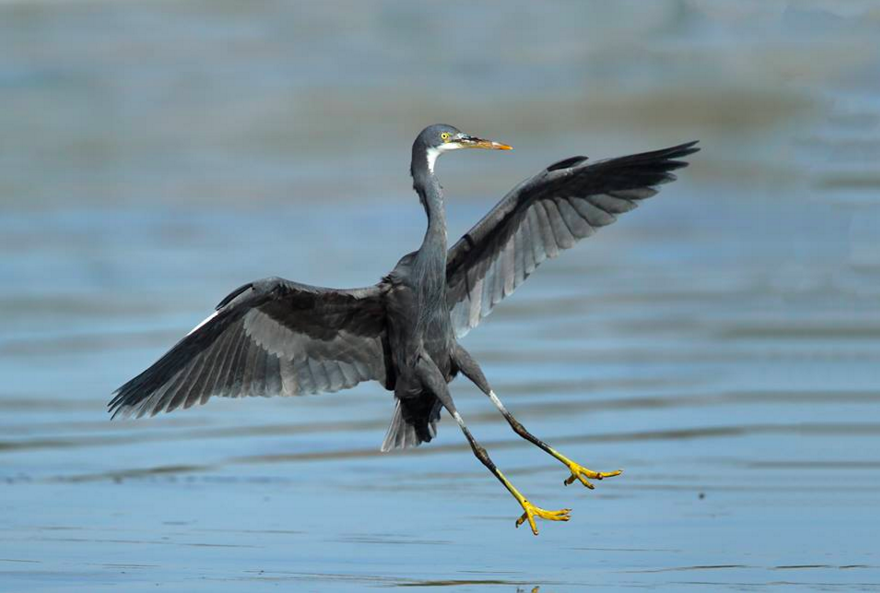
On a recent trip to Heron Island, a speck of sand and foliage on the southern end of Australia’s Great Barrier Reef, I found myself on a walking tour of the local birdlife. My group’s guide was young, determinedly friendly, and seemed to feel not a little trapped. She looked as though she might, at any moment, reconsider everything and run as far as she could—which is to say, not very far: Heron is just half a mile long. We began with the egrets, which inspired the island’s not altogether accurate name, and which are born either black or white; our guide pointed out monochrome pairs roosting together in the trees. Then it was on to the buff-banded rails, which reminded me of thin, shifty, omnivorous quails. Beneath a Pisonia tree, also known as a grand devil’s-claws, we encountered a rowdy group of white-capped noddies. (The caps, our guide told us cheerfully, were to stop the birds’ brains from overheating in the sun.) Noddies, which feed on fish and make their nests by glueing together fallen Pisonia leaves, lead perilous lives. The trees’ seeds are sticky, often adhering to the birds’ charcoal-feathered bodies. Sometimes, a noddie will get covered in so many seeds that it can no longer fly, and so it falls to the ground and starves to death, its carcass fertilizing the nutrient-poor sand in which the Pisonia grows. “The noddies have a really special relationship with the devil’s-claws,” our guide said.

Heron Island is also home to the Barrier Reef’s oldest research station, where Sophie Dove, a biology professor at the University of Queensland, has lately been studying the effects of climate change on corals. Though she was off on the mainland when I visited, we caught up a few days later. Continue reading

The Idea Gets Greater, In Chile

webTHOMPKINSmap-460

Protecting More Wilderness
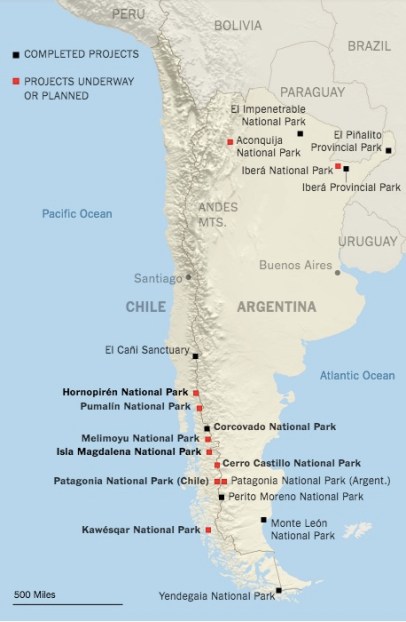
Map shows the scope of Tompkins Conservation park projects in Chile and Argentina. Eight Chilean parks, shown in boldface, comprise the latest expansion of wilderness areas, an area roughly twice the size of Massachusetts. Source: Tompkins Conservation. By The New York Times

When the news was first reported, just the facts were enough. Then yesterday we had some commentary that made us think more on how important this news really was, from a global perspective. Now, the story behind the facts, and this op-ed by Kristine McDivitt Tompkins echoes the greatest idea:

We need a new story about the Earth that isn’t just a litany of alarming statistics about crashing wildlife populations, polluted air and water, and climate chaos. We need a story that reminds us that the continuing degradation of landscapes and the seas is not necessarily a one-way street toward irreversible destruction.

On Monday we began to write such a story with the government of Chile. Under the wide skies of the new Patagonia National Park, President Michelle Bachelet and I formalized the largest-ever expansion of a national park system prompted by a donation of private land. Continue reading

Salt & Pepper, Understood

saltandpepper1_wide-69509a468974fec99cd0fc28454d47916ac39998-s1300-c85

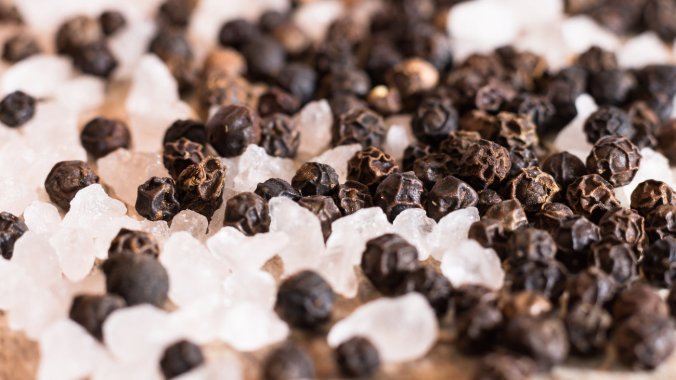
In European cooking, salt reigned supreme, and pepper was one of many spices used in heavily seasoned dishes. When they met, they were destined to be. Or, rather, it was destined that they would meet. Theo Crazzolara/Flickr

For this story, thanks to Natalie Jacewicz, a science writer based in New York City, and to National Public Radio (USA) whose attention to foodways is always welcome:

Salt and pepper shakers are so omnipresent on tabletops that adding a dash of the white or black stuff (or both!) is almost a dining rite. The seasonings pair well with just about everything and they go together like — well, salt and pepper. Continue reading

The Greatest Idea, In Peril

5700

America’s public lands belong to all of us. We owe it to ourselves to save them

A truly noble idea – one deeply democratic in its inspiration and one that honors the human need to be in relationship to awe and majesty.

America’s public lands.

This idea was seeded by early American settlers, who came here to escape a class system in Europe that excluded them from land – owning it, hunting on it, surviving on it. Conservation was articulated as a national endeavor by hunters and foresters with the unique discernment that our game and timber resources were not boundless, and required professional management to remain bountiful.

This was a hard-won national ethos. From the pitch battles for their existence, our public lands were imbued with moral standing and national sanction: the idea that they “belong” to all of us. Continue reading

Species Replenishment Story

Sawfish-Grubbs2-1260x708

Pregnant female sawfish found by Dr. Dean Grubbs and team at Andros Island. Photo © Dean Grubbs

Thanks to Ted Williams at Cool Green Science:

Recovery: Smalltooth Sawfish Flickering Back

Andrea-Kroetz-credit-sawfish

What goes down April 12, 2017 on a Sanibel, Florida beach is both encouraging and discouraging.

Angler and shark tagger Elliot Sudal hooks something huge. A crowd gathers including Vice President Mike Pence accompanied by his entourage of Secret Service agents who rifle through Sudal’s tackle box. Not surprisingly, they find (and temporarily confiscate) knives. But Sudal, seated and straining on the rod with blistered hands, is hardly a threat. Pence safely takes photos, then poses for a photo next to the embattled Sudal. Continue reading
Counting Illegal Logging As Progress

Amid the Plunder of Forests, a Ray of Hope

28conniff-master768

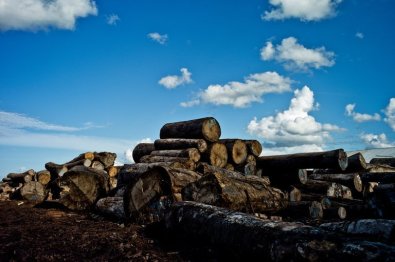
A sawmill in Peru, where more than half of the logging operations are illegal. Credit Tomas Munita for The New York Times

Strange as it may sound, we have arrived at a moment of hope for the world’s forests. It is, admittedly, hope of a jaded variety: After decades of hand-wringing about rampant destruction of forests almost everywhere, investigators have recently demonstrated in extraordinary detail that much of this logging is blatantly illegal.

maralago-4

Mar-a-Lago, Entrance to Master Suite from Cloister, 1967,
United States Library of Congress’s Prints and Photographs

This recent op-ed has a perfect final thought, and the photo here to the left is our way of offering a preview to that point. Richard Conniff, the op-editorialist, has frequently been featured in our pages, linking this type of story. You might also click the green cover below to go to one example of how this progress has been years in the making), but read this editorial all the way through before being distracted by the side stories, though they are equally relevant and important. Conniff continues:

Honduras Logging

And surprisingly, people actually seem to be doing something about it. In November, the European Court of Justice put Poland under threat of a 100,000-euro-per-day fine for illegal logging in the continent’s oldest forest, and early this month Poland’s prime minister fired the environment minister who authorized the logging.

In Romania, two big do-it-yourself retail chains ended purchasing agreements with an Austrian logging giant implicated in illegal logging there. And in this country, the Office of the United States Trade Representative, normally dedicated to free trade at any cost, has barred a major exporter of Peruvian timber from the American market after repeated episodes of illegal shipments. Continue reading

10 Million Acres Added to Chile’s Parks

I don’t normally expect to get my daily news from Instagram, unless it’s an update from a personal friend. I follow the company Patagonia because they feature beautiful photos like those above, but yesterday they shared this fantastic announcement. Visiting Patagonia about a decade ago was an amazing experience that I hope to repeat before too long, and I am thrilled that there will be some new national parks to visit. Jonathan Franklin reports for The Guardian:

McDivitt Tompkins, the former chief executive of the outdoors company Patagonia, handed over 1m acres to help create the new parks. The Chilean government provided the rest in federally controlled land.

McDivitt Tompkins has spent 25 years working on land conservation in Chile with her late husband Doug, who founded North Face and Esprit. Doug Tompkins died in a kayaking accident in Chile in 2015.

“This is not just an unprecedented act of preservation,” said [Chile’s President Michelle] Bachelet, who flew to this remote Patagonian valley on Monday to receive the donation. “It is an invitation to imagine other forms to use our land. To use natural resources in a way that does not destroy them. To have sustainable development – the only profitable economic development in the long term.”

Continue reading