Farm-Table Symbiosis

09caviarpeas-web2-master675

Preparing tear peas at Nerua, a restaurant at the Guggenheim Museum in Bilbao. The peas are known as “green caviar” among Spain’s top chefs. Credit Samuel Aranda for The New York Times

Mr. Minder’s reporting from the field, in this case the rarified field of Michelin-starred chefs, reminds us that the foodie phenomenon (sometimes now bordering on annoyingly precious, and risking the celebrity-worshipping tendencies that will ruin all good fun) is spreading good old fashioned common sense practices far and wide:

Top Chefs and Local Farmers in Spain Regenerate Their ‘Green Caviar’

ARRIETA, Spain — Making his way down a row of pea plants, Iker Villasana Hernaez, a Basque farmer, leans down to feel each pod individually before deciding whether it is ready to pick.

If the peas inside feel slightly hard, “best to leave it for one more day,” he said. “It’s really all about the perfect timing.” Continue reading

A Downside to Lights in the Dark

Photo by homeanddecor.com

Although the titles are similar, this post and the previous one from today are not about related subjects other than light and darkness. The lights referred to in this post’s title are artificial ones on land, not bioluminescence under the sea. Lights from houses and street lamps that distract moths from pollinating plants that need their pollen transported, and often result in moth deaths (by predation or getting trapped indoors). Sarah DeWeerdt reports for Conservation Magazine on a recent UK study on the disruption of pollination by light:

Everyone knows moths are attracted to light, but scientists are just now learning that this attraction may have negative consequences for other parts of the ecosystem. Moths drawn to artificial sources of light may do less work pollinating plants, according to research published last week in the journal Global Change Biology.

Researchers sampled moths at 40 sites along hedgerows bordering agricultural fields in Oxfordshire, England. Half of the study sites were lit with streetlights and half were not. Surprisingly, no one had previously investigated how this very common source of artificial lighting affects the behavior and ecological function of moths.

Continue reading

Lights in the Dark

Galiteuthis. Credit: MBARI

In the past three days, two of the blogs we visit have shared a total of three posts concerning animals that live in the deep sea, where light is scarce. Ed Yong has written for NatGeo’s blog about a “squid that has glowing eyeshadow that acts as an invisibility cloak,” as well as the genetic branches and diversity of species exhibiting bioluminescence; Matt Miller wrote for The Nature Conservancy’s blog about a new book by photographer Danté Fenolio called Life in the Dark: Illuminating Biodiversity in the Shadowy Haunts of Planet Earth. Below, a quick excerpt from each, starting with the squid:

The oceans of the world are home to animals that render themselves invisible with glowing eyeshadow.

They’re called glass squid and, as their name suggests, they are largely transparent. They’d be impossible to see in the darkness of the open ocean were it not for their eyes—the only obviously opaque parts of their bodies.

Continue reading

Farming, Students, Sustainability

053116_organic_students_edited_custom-3ae21e3010769f3366279eb8587118e174a358ab-s1400-c85

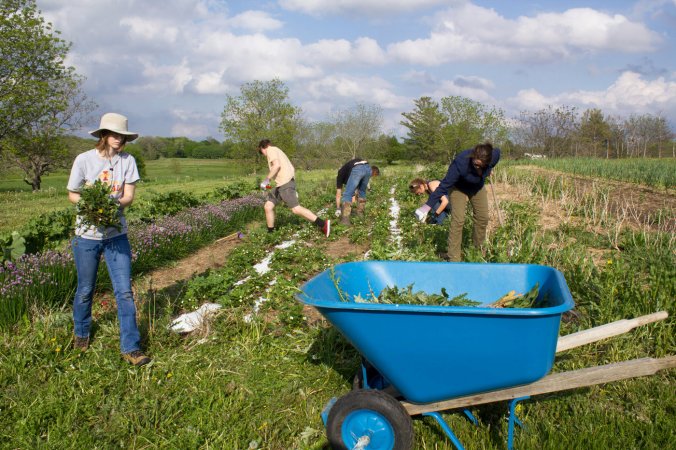
A weekday work session on the Student Organic Farm at Iowa State University has members weeding a perennial bed. Amy Mayer/Harvest Public Media

Thanks to National Public Radio (USA) for this story:

A Student-Run Farm Cultivates Passion For Sustainable Agriculture

A weathered wooden shed that holds wheelbarrows, hoes and other basic tools is the beacon of the Student Organic Farm, a two-acre swath within the larger horticultural research farm at Iowa State University.

On a warm spring evening, a half-dozen students gather here, put on work gloves and begin pulling up weeds from the perennial beds where chives, strawberries, rhubarb and sage are in various stages of growth.

“I didn’t know how passionate I [would] become for physical work,” says culinary science major Heidi Engelhardt. Continue reading

Microplastics Killing Fish

2556

Microplastics visible in a pike. Photograph: Oona Lönnstedt/Science

We’ve posted about microplastics before, since they are becoming a problem for oceans’ health. They can be found in sea salts and all over our shores, but also in fish, where the tiny particles stunt growth and alter the behavior of some species that ingest the plastics. Fiona Harvey reports for The Guardian:

Fish are being killed, and prevented from reaching maturity, by the litter of plastic particles finding their way into the world’s oceans, new research has proved.

Some young fish have been found to prefer tiny particles of plastic to their natural food sources, effectively starving them before they can reproduce.

The growing problem of microplastics – tiny particles of polymer-type materials from modern industry – has been thought for several years to be a peril for fish, but the study published on Thursday is the first to prove the damage in trials.

Continue reading

Pristine Nature

Chan Chich

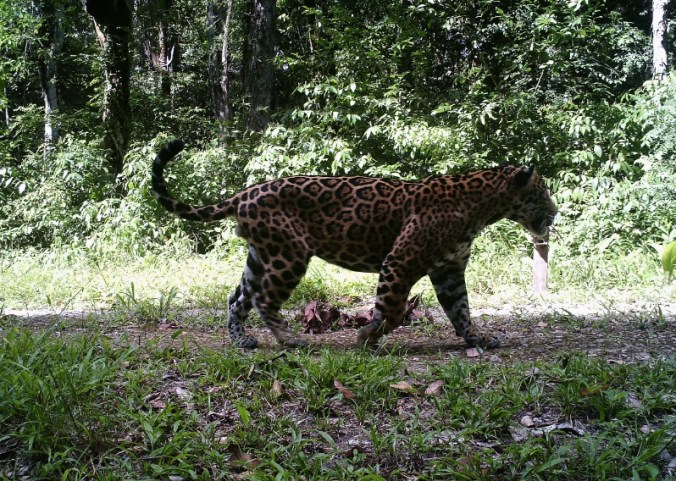
In writing about Belize recently, I had mentioned time spent with a tapir, favored in the diet of jaguar throughout Central America. The photo above was taken on property at the lodge my posts were referring to. Rule of thumb, it seems to me, is that a jaguar population requires relatively pristine nature to be sustainable, and that seems to be the case where this photo was taken. But what do I know, really? I am dedicated to entrepreneurial conservation but I am not a biologist so I depend on experts to inform my thinking, and to discipline it with a heavy dose of realism. In reading this post from earlier today I am better prepared to think about the mission of Chan Chich Lodge (more on which in a subsequent post), and the history of the 30,000 acre wilderness conservation area that it sits on:

Gallon Jug

At one time, the venerable 150 year old Belize Estates Company owned roughly one fifth of the entire country, about one million acres including much of the northwest corner of the country. From the turn of the century until the 1960’s, timber, mainly mahogany, cedar and santa maria, were selectively logged from this area. Gallon Jug, originally a logging camp located where the current GJ offices are, was named after a B.E.C. foreman, Austin Felix, discovered many discarded items from a Spanish camp, including a number of ceramic gallon jugs. Continue reading

Pristine Nature?

Nijhuis-TheresNoSuchThingAsPristineNature-1200

A domesticated cat and a native tropical bird, in Papua New Guinea. Environmentalism has long been a nostalgic enterprise, but the unspoiled past that it aspires to looks increasingly like an illusion. PHOTOGRAPH BY LEONARD FREED / MAGNUM

If you have been reading our blog for any stretch of time you would be aware that we believe in pristine nature, and the importance of its conservation. We do not spend alot of time picking nits about the definition of pristine nature, but from time to time we are reminded that details, aka reality, is in need of fact-checking:

Invasive Species, Natural Disasters Of Our Own Creation

Screen Shot 2016-06-07 at 6.48.16 AM.jpg

Who needs horror movies when a story like this makes for much more compelling fear, and the realism is, well, real. Click the image above to go to the story:

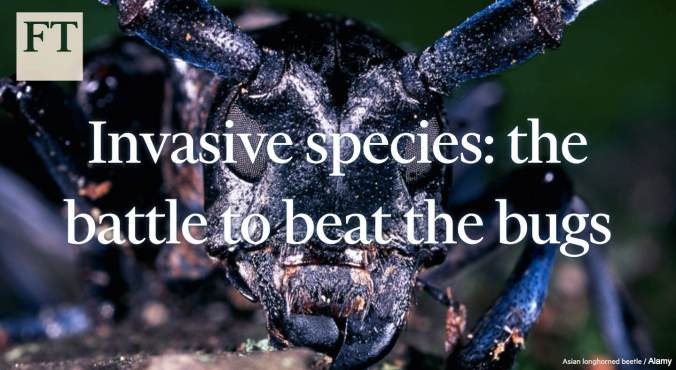
Biosecurity ‘weaponry’ is helping to halt the global spread of non-native species, from rampaging caterpillars to giant hornets

The best time to annihilate oak processionary caterpillars is when they are young, just a few millimetres long and still high up in the trees. At this stage, their appetite for oak is rapacious, so dousing the leaves in a biocontrol agent like Bacillus thuringiensis (Bt) is one way to get the caterpillars to ingest it. When Bt toxins dissolve in the caterpillar gut they become active, puncturing the stomach and killing the insect in several days. Continue reading

Bionic Botanic Alchemy

The device uses solar electricity from a photovoltaic panel to power the chemistry that splits water into oxygen and hydrogen, then adds pre-starved microbes to feed on the hydrogen and convert CO2 in the air into alcohol fuels. Credit: Des_Callaghan via Wikimedia Commons

The device uses solar electricity from a photovoltaic panel to power the chemistry that splits water into oxygen and hydrogen, then adds pre-starved microbes to feed on the hydrogen and convert CO2 in the air into alcohol fuels. Credit: Des_Callaghan via Wikimedia Commons

Renewable energy is manifested in multiple forms, utilizing all the classical elements. All the better when innovation brings things full circle in this form of biomimicry.

A tree’s leaf, a blade of grass, a single algal cell: all make fuel from the simple combination of water, sunlight and carbon dioxide through the miracle of photosynthesis. Now scientists say they have replicated—and improved—that trick by combining chemistry and biology in a “bionic” leaf.

Chemist Daniel Nocera of Harvard University and his team joined forces with synthetic biologist Pamela Silver of Harvard Medical School and her team to craft a kind of living battery, which they call a bionic leaf for its melding of biology and technology. The device uses solar electricity from a photovoltaic panel to power the chemistry that splits water into oxygen and hydrogen, then adds pre-starved microbes to feed on the hydrogen and convert CO2 in the air into alcohol fuels. The team’s first artificial photosynthesis device appeared in 2015—pumping out 216 milligrams of alcohol fuel per liter of water—but the nickel-molybdenum-zinc catalyst that made its water-splitting chemistry possible had the unfortunate side effect of poisoning the microbes… Continue reading

Invisible, With Clear Vision

242_Parks-690

A forgotten portfolio, back for our viewing and reading pleasure a book offering the photography and writing of two giants, briefly reviewed here:

RALPH ELLISON AND GORDON PARKS’S JOINT HARLEM VISION

In the summer of 1947, editors from the short-lived magazine ’47, known since its shuttering in 1948 as The Magazine of the Year, contacted Ralph Ellison—then in the thick of his seven-year labor to complete “Invisible Man”—with an idea for a photo essay on the Lafargue Psychiatric Clinic in Harlem. Established a year earlier with help from Richard Wright, the clinic had become famous for its stance against segregation, not only in the clientele it served but also, perhaps more remarkably, in its all-volunteer staff. Ellison was excited by the prospect, and, after enlisting the photographer Gordon Parks—an acquaintance from Harlem artistic and intellectual circles—he accepted the assignment, though the magazine would go out of business before the photo essay could be published. Continue reading

New Species in Toxic Colorado Cave

These worms in Colorado’s Sulphur Cave are believed to live on the chemical energy in the sulfur in the cave, similar to deep-ocean tube worms. On the left are streamers—colonies of microorganisms similar to those in hot springs in Yellowstone National Park. PHOTOGRAPH BY NORMAN R. THOMPSON

We like the discovery of new species, and caves are cool too. And beneath Steamboat Springs in Colorado, USA, a cave full of noxious carbon dioxide and hydrogen sulfide gas has harbored a new species of worm, as well as weird bacteria formations called snottites. Erika Engelhaupt reports for NatGeo’s Phenomena blog:

Lurking below the quaint ski town of Steamboat Springs, Colorado, lies a cave belching deadly gases. Its ceiling is dotted with snottites, dangling blobs that look like thick mucus and drip sulfuric acid strong enough to burn holes through T-shirts. And the whole place is covered in slime.

So why would anyone want to go there?

Continue reading

Antibiotics, Even Worse than Anticipated

© Conservation Magazine

We disagree with having cows filled with antibiotics, primarily because of the problems created by bacterial resistance to drugs given without cause. But now we’re learning that there’s even more wrong with antibiotics in cattle: their dung releases more methane. Catherine Elton reports for Conservation Magazine:

Antibiotic use and overuse in livestock has long been controversial, as it has been linked to antibiotic resistance in humans. Livestock are regularly given antibiotics to keep them healthy in overcrowded or unsanitary conditions, or even to boost their growth.

Now, a study published recently in the Proceedings of the Royal Society B has documented for the first time that antibiotics given to cows also increase the emissions of the greenhouse gas methane from cow dung.

Continue reading

Archaeoastronomy

William Gadoury used the position of a constellation to identify the location of a possible Maya city where an anomaly, shown above in a satellite image, was observed. Further study on the ground is required to determine the nature of this feature. IMAGE COURTESY OF ARMAND LAROCQUE via NATGEO

We have shared stories about Mayans, and especially the archaeological questions surrounding them, before; and also discussed the modern region that was once the civilization’s stronghold more recently. And although we missed the original news covering this interesting hypothetical discovery by a Canadian teenager, his recent interview with NatGeo brought the aspiring “archaeoastronomer’s” ideas to light, and we certainly hope Mr. Gadoury is right about the undiscovered settlement. Below, the first reporting by National Geographic, on May 11 of this year:

For gee-whiz value, the announcement has been hard to beat: A Canadian teenager discovers a lost Maya city without even stepping foot in the Central American jungle.

Unfortunately, this “discovery” appears to be the well-intentioned, albeit faulty, result of modern Western education colliding with an ancient civilization that saw the world in a very different way.

Continue reading

Greener Trucks and Buses Emerge

Wrightspeed’s new range-extended electric powertrain can be installed as a retrofit to a standard diesel garbage truck, more than doubling mileage and lowering carbon dioxide emissions up to 68 percent.

We are all fans of electric vehicles and what they represent for a transition away from fossil fuel dependence in daily life, drastically reducing carbon emissions with transportation, and lower noise pollution. Cheryl Katz reports for GreenBiz.com about a shift to electric vehicles — not for consumer use, but commercial:

The clang of garbage cans still probably will wake people way too early in the morning. But in Santa Rosa, California, at least, the roaring diesel engine will be quiet, replaced by a silent, electric motor.

The electric garbage trucks scheduled to begin rolling there this summer may be less alluring than the sporty vehicles that engineer Ian Wright helped design as co-founder of Tesla Motors. But Wright, who left the high-end electric car company to start Wrightspeed, maker of electric powertrains for medium- and heavy-duty commercial vehicles, is on a campaign to force large, carbon-belching engines off the road.

Continue reading

Weeding and Stopping Compost Hurts Farms

NatureNet Science Fellow Danny Karp checking on his field experiments in an organic romaine lettuce field. © The Nature Conservancy (Cara Byington)

We regularly report on innovations in agriculture, such as biofeedback and “certified transitional” ingredients, but also on tried-and-true methods like composting, or removing weeds in alternative ways. Cara Byington from The Nature Conservancy’s Cool Green Science blog reports on a recent study on nature and farmers:

A new paper in the Journal of Applied Ecology finds that two farm-based food safety practices – removal of non-crop vegetation in and around fields, and abandonment of composting – actually hurt farmers without making food safer.

“The practices are unnecessary,” said Danny Karp, lead author on the study. “Not only are they ineffective for their intended purpose, they damage growers by decreasing crop yields and pest control.”

Continue reading