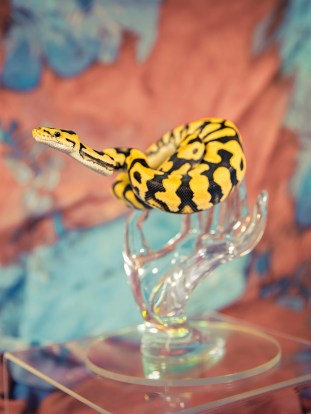
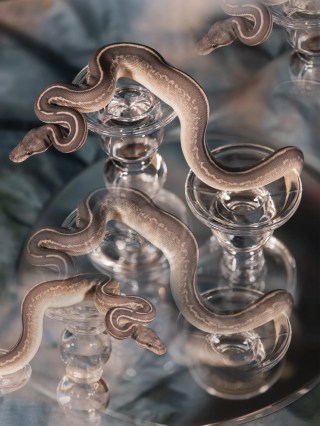
“Sometimes your odds are one in two hundred and fifty-six, or one in five hundred and twelve, to make the snake you’re thinking about,” Justin Kobylka, a trendsetting breeder and the owner of Kinova Reptiles, said. Photograph by Delaney Allen for the New Yorker
On a fall day in Gainesville, Georgia, Justin Kobylka, the forty-two-year-old owner of Kinova Reptiles, was preparing to cut open two clutches of snake eggs. He was hoping to hit upon some valuable, beautiful reptiles. Kobylka is a breeder of designer ball pythons—one-of-a-kind, captive-bred snakes whose skin features colors and patterns not usually found in nature. “I think of myself as an explorer,” he told me. Nicking an egg with a pair of surgical scissors, he exposed a live hatchling in its goo. “Even when they haven’t yet touched air, you can sometimes see the tongue going,” he said, making a flicking gesture with his thumb and fingertip.
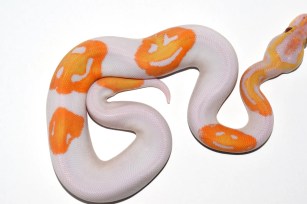
Kobylka had been trying to produce a “dreamsicle”—a white ball python with splotches of tangerine—but three of the circular markings on the snake looked like smiley faces. His video of the “emoji python” went viral. Photograph courtesy Kinova Reptiles
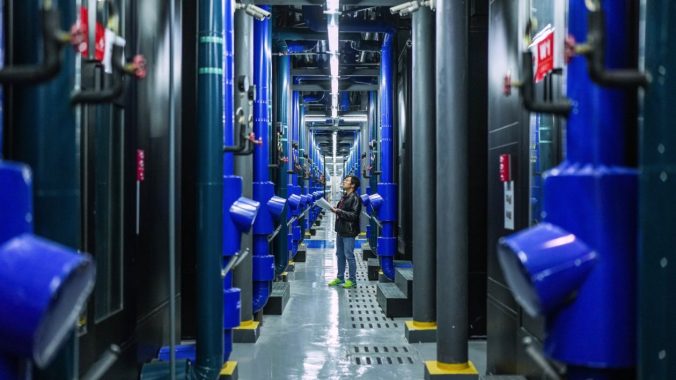
We were standing in a six-thousand-square-foot climate-controlled outbuilding that housed some two thousand pythons, which were kept in individual plastic trays slotted into tall metal racks. The space, which cost nearly a million dollars to build and outfit, was immaculate and well lit, with corner-mounted industrial fans and glossy floors. A vague odor of musk and Clorox was all that hinted at the daily chores of snake husbandry. Continue reading →







 Organikos