
Rare behaviour of Hornbills (between males as well as females) locking bills in flight
Dandeli Timber Depot, Dandeli, Karnataka
Rare behaviour of Hornbills (between males as well as females) locking bills in flight
Dandeli Timber Depot, Dandeli, Karnataka
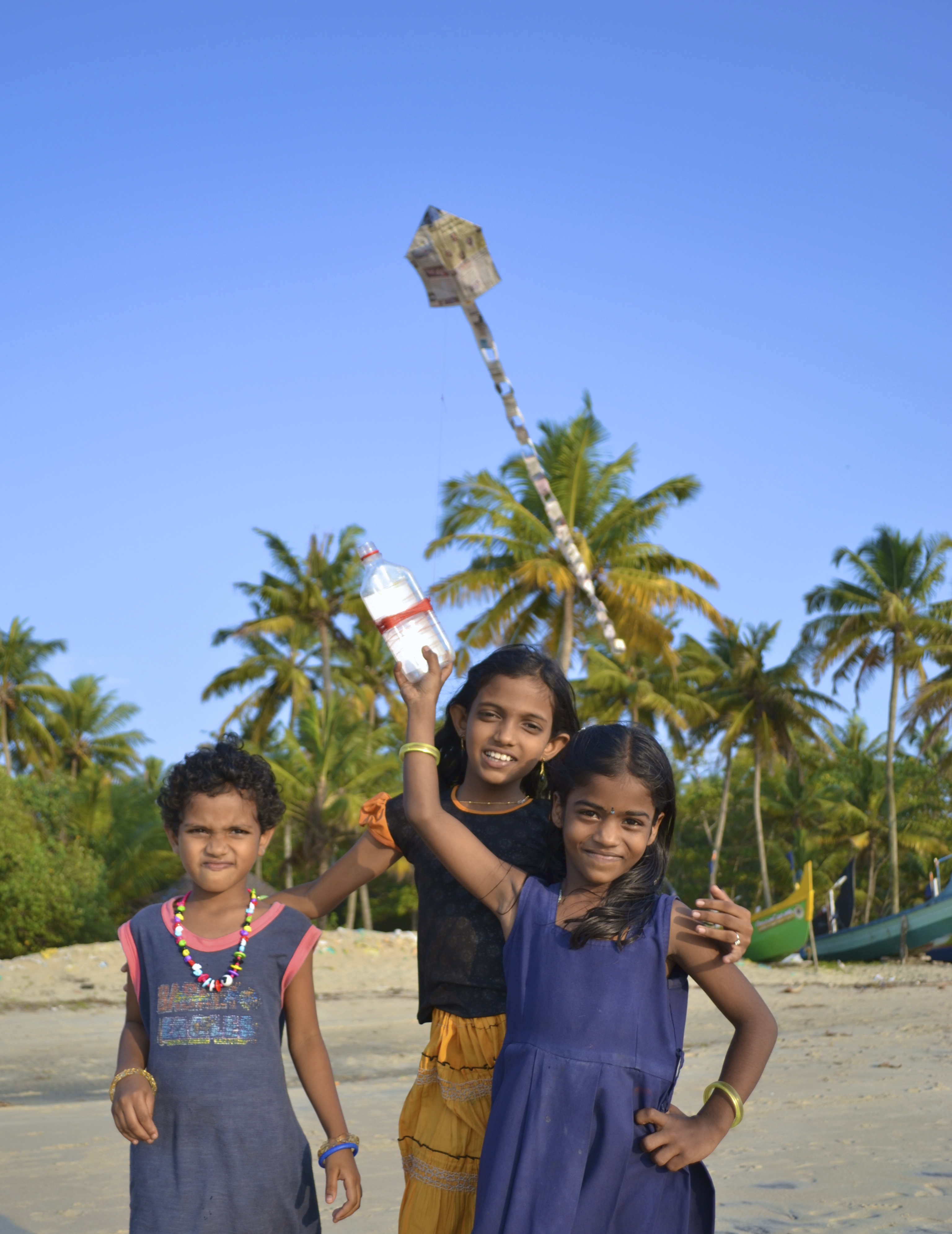
Three sisters
When land heats up and air rises, it gives way to fresh on-shore wind from the Arabian sea. A walk along Marari beach during sunset will most likely give the sight of homemade kites being flown mostly by children, but also adults of all ages. These kites are made of bamboo, newspaper and glue. Old fishing line is then attached and wound up on a bottle.
The children are very proud of their creations and will insist that theirs is the “best” of all and that you try it out. Choose carefully and watch the kite soar!

Photo by Ratheesh Sundaram, Indian Express
We cannot help it–we love the press that 51 and Spice Harbour have generated together, including in Architectural Digest and Conde Nast Traveler‘s 40th Anniversary Edition of India’s Most Stunning Boutique Hotels Handbook among other prestigious media outlets. Not in some vanity-driven ugly manner, but as a matter of fact we love that the Indulge team at Indian Express, and specifically Rosanna Abrachan has captured in elegant prose exactly what we would want anyone to know about 51. Thanks, Rosanna! And Ratheesh, superb photography! Some text to sample:
While the menu is not expansive, it is rich and colourful as we first saw in the Xandari salad. With its origins at a property managed by RAXA Collective in Costa Rica, the starter is perfect for evangelists of eating healthy. Continue reading
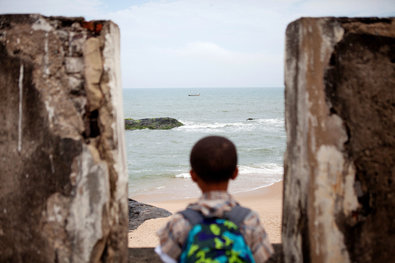
Jane Hahn for The New York Times. Jasir Robert Ryan-Lee, a descendant of Venture Smith, on the roof of the fort in Anomabo, Ghana, where his ancestor was held as a slave.
As Amie promised we will have much more to say as the countdown to the opening of Zaina Lodge continues apace since our first mention on this blog a couple years back. In fact, we are behind on stories from Ghana. Doug, where are you?
As we post this article from the current Travel section of the New York Times, a Raxa Collective team is preparing for an extended camping expedition in the Mole National Park, in the interest of discovering guest experiences that will be on offer when the Lodge opens. So, if Mr. Ryan-Lee and his mom choos to return to Ghana mid-2015 or later, and makes a visit to the wild interiors of the country, he will have another kind of life experience in store; meanwhile we appreciate his story and hope it will encourage others to follow in his footsteps to discover this hidden gem of a country:
On Slavery’s Doorstep in Ghana
By RUSSELL SHORTO
Descendants of Venture Smith, a famous slave who won freedom and success in America, return to the roots of his captivity.


Cockpit Country
As we head west along the southern portion of Cockpit Country from Barbecue Bottom Road and Albert Town, we’re noticing a big difference in the amount of aerial insectivores we’re able to see while out hiking every day.

Justin and John on the trail from Windsor to Troy
During our initial excursions into the bush, we were taking densely wooded trails that required constant vigilance of the path in front of us due to shifting stones, twisting roots, and strong ground vines. In some of the worse areas we needed machetes to clear vegetation and big fallen trees, and even when we had time to look up at the skies they were often covered by thick canopy.

And in other “nature sometimes solves man-made problems” news to complement today’s editorial from the Guardian, we thank Conservation for their daily summaries of important environmental science news:
MOUNTAIN LIONS SURVIVE NEAR CITIES, BUT AT WHAT COST?
The samango monkeys living near South Africa’s Lajuma Research Centre have learned that they can rely on humans as lookouts while they forage for food. The monkeys have learned that if humans are around, then they’re probably safe from leopards. When left alone, the monkeys spend less time foraging for food and more time scanning their surroundings to avoid becoming someone else’s dinner. The mountain lions of California have a different tale to tell. Continue reading

Kerala, the state in southwest India where many of Raxa Collective’s initiatives are located, is the “land of coconuts” if you translate the state’s name literally from Malayalam (the language of Kerala) to English. This article in today’s Hindu highlights the introduction of a new bi-product of coconuts at the annual trade fair (click the image above to go to the trade fair’s brochure):
Coir-based organic acoustic panelling system developed
SARATH BABU GEORGE, January 30, 2015
In what could be a major boost to the coir industry, the National Coir Research and Management Institute (NCRMI) has developed a coir-based organic acoustic panelling system.
Christened ‘ACCOIR’, the acoustic panels have been designed in collaboration with the Institute of Indian Interior Designers (IIID) and the National Institute for Interdisciplinary Science and Technology (NIIST), a constituent laboratory of the Council of Scientific and Industrial Research (CSIR). Continue reading

The Pine Marten, once common in the UK, is a natural predator of the grey squirrel and has successfully reduced their numbers in Ireland. Photograph: Alamy
Not every problem in the natural world has a solution, let alone a simple one; and there is always that law of unintended consequences, but we like the way this proposal sounds as an alternative to other forms of eradication:
Is there anything more stupid than the government’s plan to kill grey squirrels?
I ask not because I believe – as Animal Aid does – that grey squirrels are harmless. Far from it: they have eliminated red squirrels from most of Britain since their introduction by Victorian landowners, and are now doing the same thing in parts of the continent. By destroying young trees, they also make the establishment of new woodland almost impossible in many places. As someone who believes there should be many more trees in this country, I see that as a problem. A big one.
No, I oppose the cull for two reasons. The first is that it’s a total waste of time and money. Here’s what scientists who have studied such programmes have to say: Continue reading
More than one contributor to Raxa Collective saw the original New York theatrical production of John Guare’s play Six Degrees of Separation; we agree that the underlying conceit never gets old. We get it. We love it. And we play our own version of the six degrees game every time we post on this blog, or on any of our various other social networks. We are not in the habit of passing along the advertising of hotel companies, and this is not likely the beginning of a habit; but why not share a good ad when we see it?

Red-billed Streamertail (male) by Seth
During the first week of our time in Jamaica, all of us were able to see the three species of Jamaican hummingbirds, although none of us had gotten a really good look at the prize: a male Red-billed Streamertail. Male Red-billed Streamertails are iridescent green with a black cap and two extremely long tail feathers that flutter behind the birds when they flit around. The birds move quite quickly and are often in and out of your field of view in a flash, but their call is relatively loud–as is the hum from their wings–so with practice you can locate them eventually.

Jamaican Mango by Seth
Jamaican Mangos are the largest hummingbird in the country and very recognizable given their flashy purple plumage and strongly decurved bills. From what I’ve noticed they perch for fairly long periods scanning their territory for intruders (most hummingbirds do something like this all the time), and this offers good photo opportunities. Continue reading
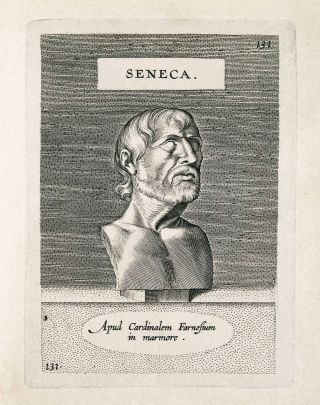
Seneca was venerated as a moral thinker; he was also one of Nero’s closest advisers. CREDIT PHOTOGRAPH FROM AISA / EVERETT
This book review reminds us (for example where, in the middle of the review, the reviewer irresistibly, simply, says: “These days, Seneca is again on the upswing.”) of James, now firmly planted in the green fields of Harvard University taking his classics education to the ultimate level.
James, for his part, reminds us of our many reasons for paying attention to the classics, having little directly to do with the day to day activities of Raxa Collective except that the classics help us keep it all in perspective:
…If poets and philosophers dream of influencing those in power, Seneca was uniquely positioned to do so. He was a celebrated rhetorician, a satirist, the author of several books of natural history, and a playwright. He was also what today might be called an ethicist. Among his many works of moral philosophy are “De Ira” (“On Anger”), “De Providentia” (“On Providence”), and “De Brevitate Vitae” (“On the Shortness of Life”). Seneca had been Nero’s tutor since the younger man was twelve or thirteen, and he remained one of his closest advisers. Continue reading
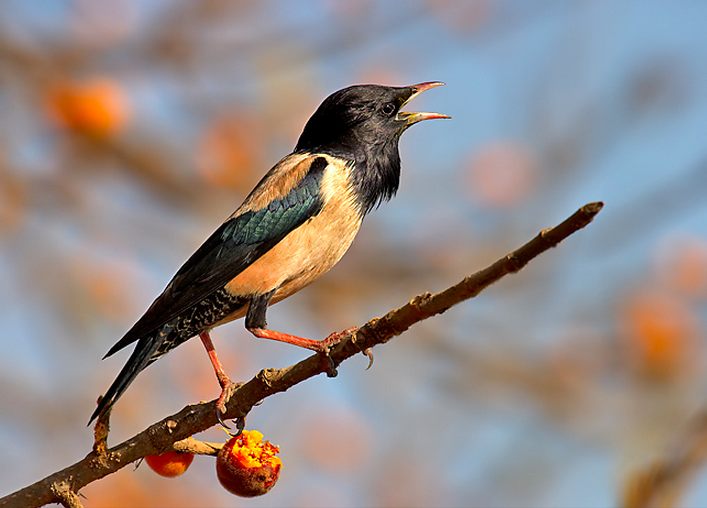
Bangalore, Karnataka
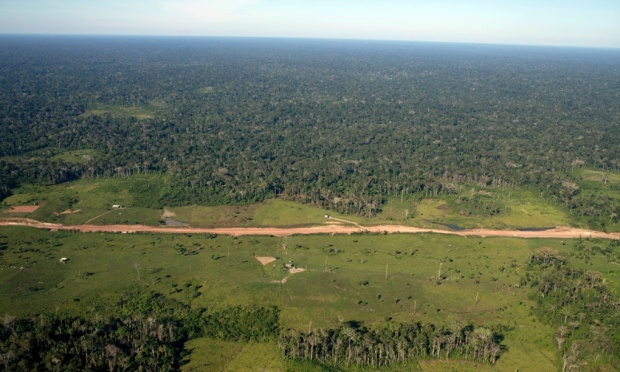
A newly constructed road goes through the Amazon rainforest outside Rio Branco, the capital of Acre province, Brazil. For every 40 meters or road created, around 600 sq km of forest is lost. Photograph: Per-Anders Pettersson/Corbis
Thanks to the Guardian for keeping us up to date with news, no matter how dismal, which in this case raises red flags about the future of our earth’s lungs:
Roads are encroaching deeper into the Amazon rainforest, study says
Oil and gas access roads in western Amazon could open up ‘Pandora’s box’ of environmental impacts
Oil and gas roads are encroaching deeper into the western Amazon, one of the world’s last wildernesses and biodiversity hotspots, according to a new study.
Roads across Bolivia, Colombia, Ecuador, Peru and western Brazil could open up a ‘Pandora’s box’ of negative environmental impacts and trigger new deforestation fronts, the study published in Environmental Research Letters finds.
“The hydrocarbon frontier keeps pushing deeper into the Amazon and there needs to be a strategic plan for how future development takes place in regards to roads,” said the report’s lead author, Matt Finer, of the Amazon Conservation Association.
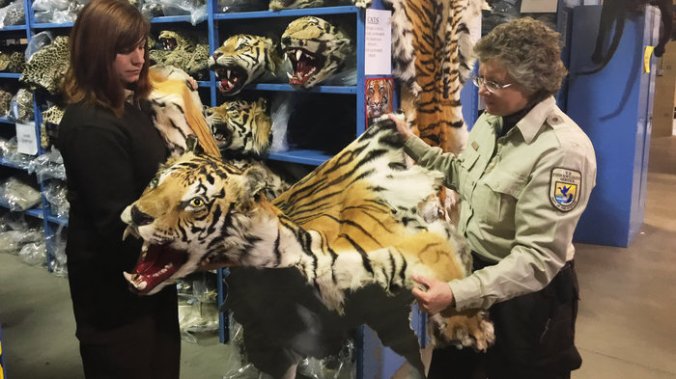
Coleen Schaefer (left) and Doni Sprague display a tiger pelt that was confiscated and is being stored at the National Eagle and Wildlife Repository on the outskirts of Denver. Some 1.5 million items are being held at the facility. The Trans-Pacific Partnership, which is still under negotiation, would punish wildlife trafficking. Jackie Northam/NPR
Thanks to National Public Radio (USA) for this story, which has nothing pleasant about it but which signals a positively determined approach to do something substantive about this tragic scourge:
Tiger Skins And Rhino Horns: Can A Trade Deal Halt The Trafficking?
If you want a sobering look at the scale of wildlife trafficking, just visit the National Eagle and Wildlife Repository on the outskirts of Denver. In the middle of a national reserve is a cavernous warehouse stuffed with the remains of 1.5 million animals, whole and in parts.
They range from taxidermied polar bears to tiny sea horses turned into key chains. An area devoted to elephants is framed by a pair of enormous tusks. Continue reading
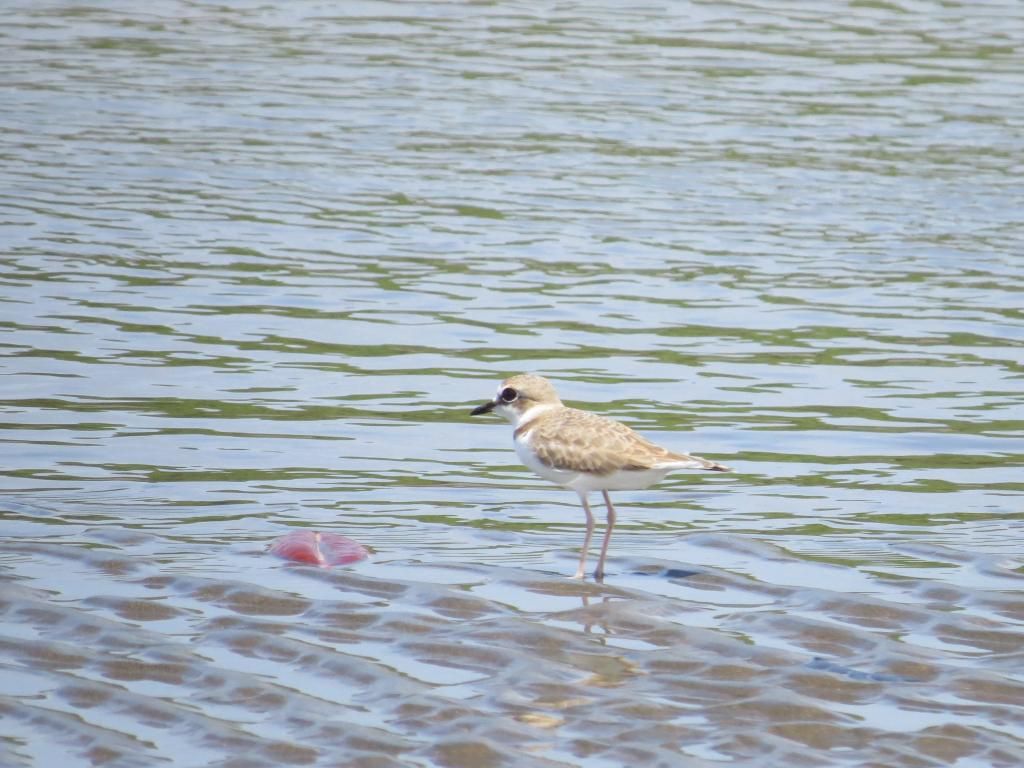

PHOTOGRAPH BY YANA PASKOVA/GETTY
We operate in locations where there can be extreme weather (though not the white variety), so we are reminded of the value of good description of weather events. One of our favored essayists, specifically, reminded us today with fabulous made up words and reminders of literature, all while making small talk about the weather:
The threatened Snowpocalypse missed New York, more or less, making Monday morning’s panic look slightly absurd on Tuesday afternoon, as panics do when they turn out to be unneeded. On Monday afternoon, with the storm on the way and the blizzard warnings screeching, the lines in a Manhattan supermarket stretched from the cash registers deep into the paper towels and bottled spaghetti sauces, with a sudden shortage of carts causing shoppers to clutch bottles of water and cold meats to their bosoms, as though the items were small children being kept warm from the Cossacks. Presumably, the immigrant nature of New York has given us a sort of collective unconscious of Old World flight and refugee instincts. The irrationality of the purchases might have been clear enough. Lady ahead in the line: How do you imagine that you’re going to cook all that raw meat if the power goes out; and, if it doesn’t go out, what will you really have to worry about? But you were thinking this even as you clutched your own raw meat and water to your own worried heart.
For a Canadian or two in New York—I name no names, though my wife comes to mind—it seemed a little absurd: we didn’t even call this kind of thing a snowstorm when we were kids in Canada. Continue reading
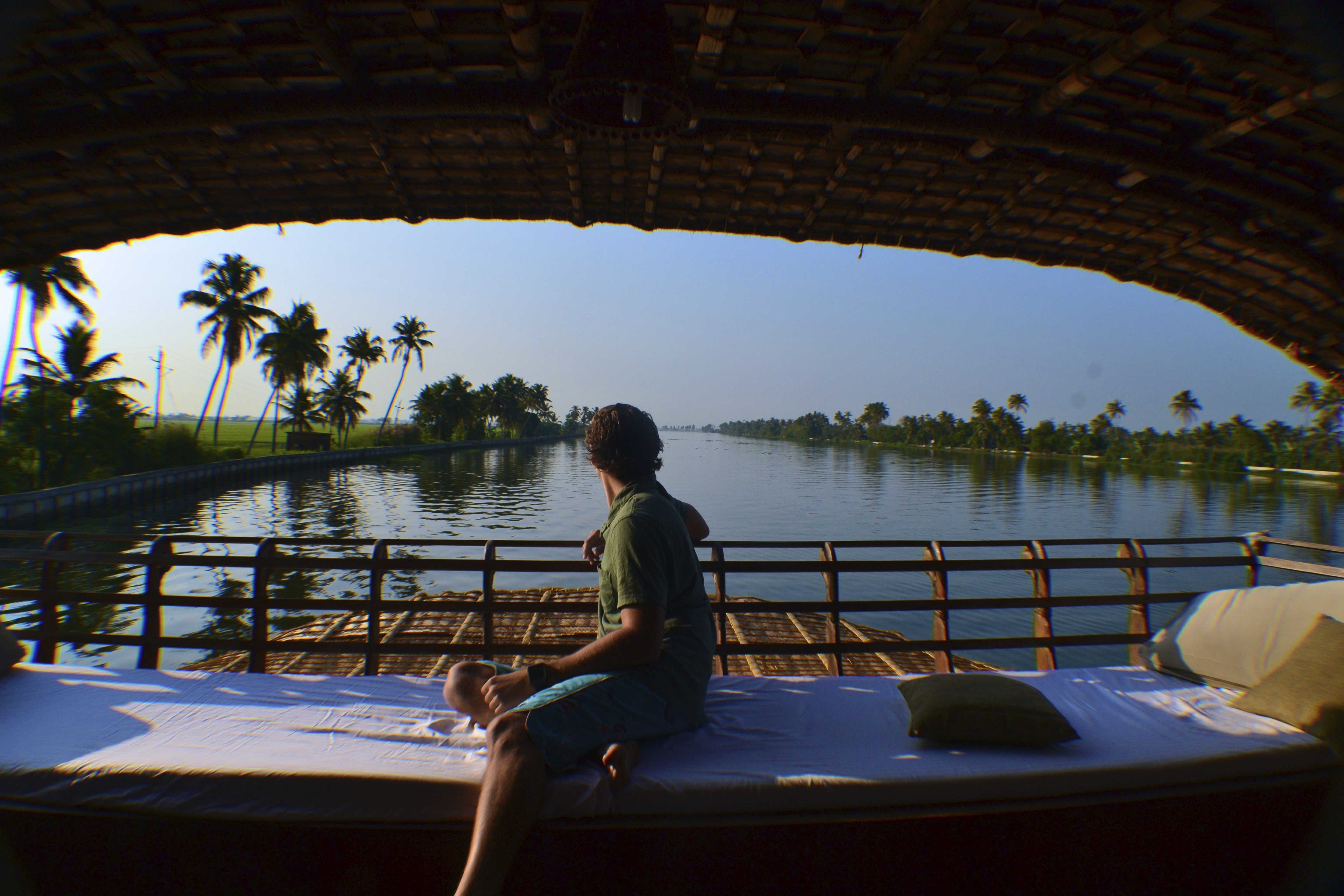
Upstairs deck/lounge
Our group of four was greeted with “tender coconuts” to drink while we got settled into the boat and into our bedrooms. Our houseboat was over 100ft long with three bedrooms, a dining room, an upstairs lounge deck and all the amenities of a hotel (including AC), I was in awe. The outside was covered in a coconut palm woven shell tied together by coconut husk rope. Truly a product of “Kerala”, meaning “Land of Coconuts”. Continue reading

We are always happy to understand more of nature’s small pleasantries:
How the Smell of Rain Bubbles From the Ground
By JAMES GORMAN
Two M.I.T. scientists found that the right velocity of a raindrop on the right kind of soil can create the smell, known as petrichor.
 Organikos