
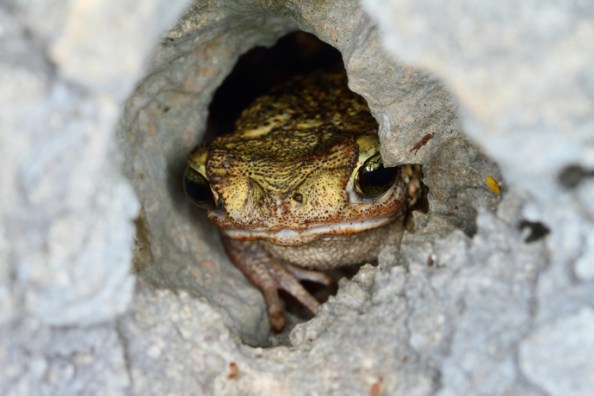
A male toad of an undescribed species hides in the limestone of the southwestern Dominican Republic. CREDIT PHOTOGRAPH COURTESY MIGUEL A. LANDESTOY
There is a reason why we highlight birds every single day. They are spectacular in many diverse ways, as well as beautiful in more ways than can be counted, and sometimes smile-inducingly odd; always exceptional ambassadors to the human world from their natural habitats, which are under constant pressure and threat. Birds may seem more charismatic than amphibians but from an ecologist’s point of view they are both extremely valuable indicators of ecosystem health. If you have been following Seth’s posts about the preparation for the Smithsonian expedition he is about to embark on, you will likely agree they would enjoy crossing paths with the team described in this story:
The southernmost corner of the Dominican Republic is dominated by limestone karst, a landscape with the look and feel of a petrified giant sponge. Snakes, small mammals, and fat, furry tarantulas live in the fissures and holes in the karst, as do toads, including one species that is not yet fully known to science. I met this new toad at three o’clock one late-fall morning, in a karst forest off a mining road near the town of Pedernales. I was with Miguel Landestoy and Robert Ortiz, a pair of freelance field biologists who have been friends since their youth, and who still spend much of their time looking for amphibians. Continue reading

Bijayini Satpathy, top, and Surupa Sen in two duets, “Dheera Sameere” and “Kisalaya Sayana,” in Chennai, India. Credit Jyothy Karat for The New York Times
On February 4 Nrityagram, a dance troupe from India, will perform “Songs of Love and Longing” at Cornell University’s Barnes Hall. We normally do not take note of such performances at university campuses, even when the artist is from India. But this troupe is exceptional. Last week not far from Raxa Collective’s operations in Kerala, in the neighboring state, a Nrityagram dance performance led to this remarkable review in the New York Times:
A Sublime Touch, From Head to Heel
Odissi Stars at a Dance Festival in Chennai, India
JAN. 6, 2015
CHENNAI, India — Who are the greatest dancers in the world today? Most of the contenders considered in the West for this category are the roving international stars of ballet. But many of today’s finest dance artists have been performing here at the Music Academy’s weeklong dance festival, which ends on Friday. Some — all women — have touched on the sublime.
Three have been practitioners of the Odissi genre: Sujata Mohapatra, who performed on Sunday, and the two leading dancers of the Nrityagram company, Surupa Sen and Bijayini Satpathy, who presented solos and duets on Monday. (I’ll consider other festival performances next week, some no less superlative.)
Odissi is the classical idiom deriving from the eastern state of Orissa (now named Odisha). Though its roots go back 2,000 years, by the 1940s and ’50s it was scarcely known, whereas now it is taught and performed around the world. These three artists exemplify the qualities that have often made Odissi seem the most sensuously poetic of all dance idioms.
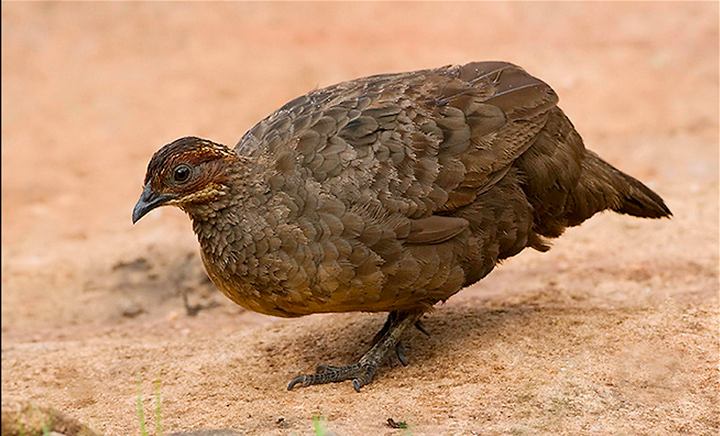
Daroji Bear Sanctuary, Karnataka
 Using Cornell’s Mann Library plotter printers and the Digital Printing Center’s laminating capabilities, John, Justin and I were able to make some versions of northwestern Jamaica maps this week. Cropped to show just Cockpit Country and its environs, the maps are big and waterproof and will be perfect for field use if our Garmin Oregon 650 handheld GPS unit fails for whatever reason. This area of Jamaica is full of interesting historical and vernacular place-names like Me No Sen You No Come, Look Behind, Cutthroat, and other regions we’re interested in getting a look at, at least from afar.
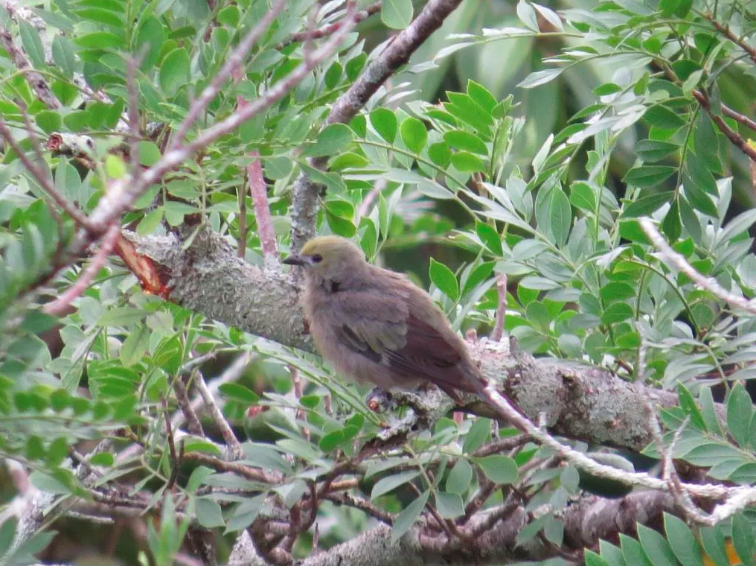
Tacacori, Costa Rica
 Since we’re doing most of our packing today, we figured it would be a good time to share some photos of our gear before everything is stuffed into a suitcase. Below is a random selection of items we’ll be taking down to Jamaica with us, from food to insect repellent.
Starting to our left, we have a small bottle of biodegradable all-purpose soap that can be used as bodywash, shampoo, and detergent for both clothes and dishes. I’ve already sampled it on some clothing and it seems to do a great job. Seeing as you can’t take a real shower in the field for five or six days at a time, it might be good to have some of this stuff handy.
Next are two types of water container that should grant us more mobility away from our base at the Windsor Research Centre. We’ve been told that there aren’t many natural sources of water in Cockpit Country, so we need to bring our own water with us. Our solution to this problem is hiring a mule to carry water and certain heavy equipment like tents for us, so we have two 26.5L bladders and two 8L carriers for water. Continue reading

Credit: RubberBall / Alamy. Via BBC
A couple of our contributors have connections to tortoises through the Galápagos Islands, or at least from reading about them in the news. We’d always been aware of the danger for tortoises if they were flipped on their backs, but had never given the issue much evolutionary thought to consider the variations in the animals’ shells. Now, scientists at the University of Belgrade have published a paper on the self-righting ability of Hermann’s tortoises, which live in the Mediterranean. Matt Walker writes for the BBC:
Depending on your point of view, it is one of life’s great questions.
How does a tortoise that has flipped onto its back, get up again?
It’s not a rhetorical question, and it goes beyond being a metaphorical or metaphysical query, or a subject for drunken debate.
For a tortoise it is a deadly serious matter; being able to right itself counts as one of life’s epic struggles, a potential matter of life and death.

A view of the Eiffel Tower through smog in March. Several regions of France experienced high levels of particulate pollution that month. Credit Patrick Kovarik/Agence France-Presse — Getty Images. Via The New York Times.
We’re always interested in learning about pollution and ways to counter it, no matter what kind of pollution it is. Roughly a week ago Michael Greenstone, the Milton Friedman professor of economics at the University of Chicago, wrote a piece for the New York Times about particulate matter pollution, which we have limited knowledge of. Some of the data Greenstone explained was fairly surprising, and we learned more about this serious form of air pollution. Here he is on the topic:
The World Health Organization considers fine particulate matter pollution levels higher than 10 micrograms per cubic meter to be unsafe. The majority of American cities are in the safe zone, with the average pollution level at 9.6. Thirty-three percent of cities are above the W.H.O. standard. Those cities tend to be geographically dispersed throughout the United States, but are predictably cities with heavy industry and driving, like Cleveland, Chicago, Los Angeles and Philadelphia. Outside of the W.H.O., the United States has its own particulate matter standard of 12 micrograms per cubic meter. The pollution in 13 percent of American cities is higher than that.
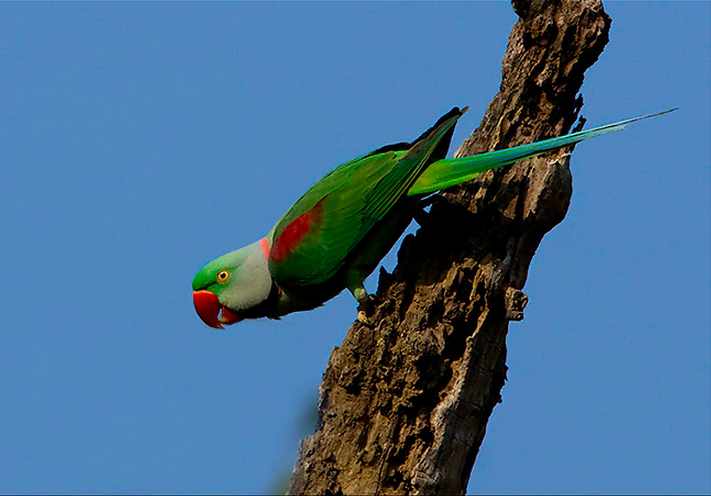
Pench Tiger Reserve, Seoni, Madhya Pradesh

Research trips, especially international ones, take a lot of money to organize and execute properly. There’s flights, gear, accommodations, food, and other logistical or supply costs that add up to a hefty sum, and field scientists can rarely afford to foot the bill themselves. That’s where large, well-funded organizations like the Smithsonian Institution come in. The coordination and leadership of a museum and research body like the Smithsonian, paired with additional support in the form of grants or gear from other groups, is what makes a successful research trip possible.
For our Jamaica expedition, we’re Continue reading
Michael Grab, whose work we have shared previously, is still working his magic with rocks. Stacking stones with the upmost precision and patience, he then destroys his precarious creations in ways that look amazing when played backwards, as shown towards the end of the video above. Grab shares with thisiscolossal:
Balance requires a minimum of three contact points. Luckily, every rock is covered in a variety of tiny to large indentations that can act as a natural tripod for the rock to stand upright, or in most orientations you can think of with other rocks. By paying close attention to the vibrations of the rocks, you will start to feel even the smallest “clicks” as the notches of the rocks are moving over one another. In the finest “point-balances,” these clicks can be felt on a scale smaller than millimeters, and in rare cases can even go undetected, in which case intuition and experience become quite useful.

photo credit: Stephen Crafts

Yesterday I mentioned live mammal trapping, and our original post describing the Golden Swallow Jamaica Expedition referred to animal surveys as well. Today we tried setting up our tents and our traps, to make sure everything is in working order and also to see how fast we can build up and break down the gear. We’re each using our own personal tent — two Marmots and an Eureka — and we’ll have three Tomahawk Live Trap cages for the surveying.

We’re constantly amazed at the inventiveness and creativity of people around the world. A few weeks ago, PBS aired a story about a thirteen-year-old entrepreneur who created a braille printer out of Legos that is cheap enough to provide better opportunities for literacy among the sight-impaired. Quotes from the transcript are below, or you can click on the video above to watch the feature.
JACKIE JUDD: At the age of 12, Shubham Banerjee learned how random the universe can be. One seemingly inconsequential occurs, in this case the ring of a doorbell, and life changes in a big way.
SHUBHAM BANERJEE: I looked out. No one was there. But I did see a flyer over there, and which asked for donations for the visually impaired.
I asked — I didn’t know why. I just asked a random question to my parents. How do blind people read? They didn’t really have time for me, so they said: “Sorry, I’m busy. Can you go Google it?”
JACKIE JUDD: And one thing lead to another.


Atlantic Cod. Photo credit Pat Morris.
We’re always happy to find another reason to link to an old environmental history post on cod, or fish stocks in general. In an op-ed for the New York Times a few days ago, environmental and maritime historian W. Jeffrey Bolster starts to answer the question, “Where have all the cod gone?”
PORTSMOUTH, N.H. — IN November, regulators from the National Oceanic and Atmospheric Administration shut down recreational and commercial cod fishing in the Gulf of Maine, that enchanting arm of the coastal sea stretching east-northeast from Cape Cod. They did not have much choice: Federal law requires action to rebuild fish stocks when they are depleted, and recent surveys revealed cod populations to be at record lows, despite decades of regulations intended to restore them.

From left: Justin Proctor, Seth Inman, and John Zeiger.
It’s now been several months since we last shared any news on the Smithsonian Institution’s expedition to search for the Golden Swallow (Tachycineta euchrysea) in Jamaica, where no sightings have been reported since 1989 — and even that report is a little questionable. While the Hispaniolan subspecies of the Golden Swallow is labeled as vulnerable, the Jamaican subspecies is labeled as critically endangered and possibly extinct, so this research trip is designed to lend some more finality to the issue. If our team of three positively identifies a Golden Swallow in Cockpit Country or the Blue Mountains between mid-January and late March, it will be the first confirmed sighting of the species in Jamaica in several decades, and new conservation efforts might be kick-started into action. If during our pair of one month trips to these two isolated areas of Jamaica we don’t see any signs of the Golden Swallow, the ornithological community can move a little closer to declaring the Jamaican subspecies of Tachycineta euchrysea extinct.
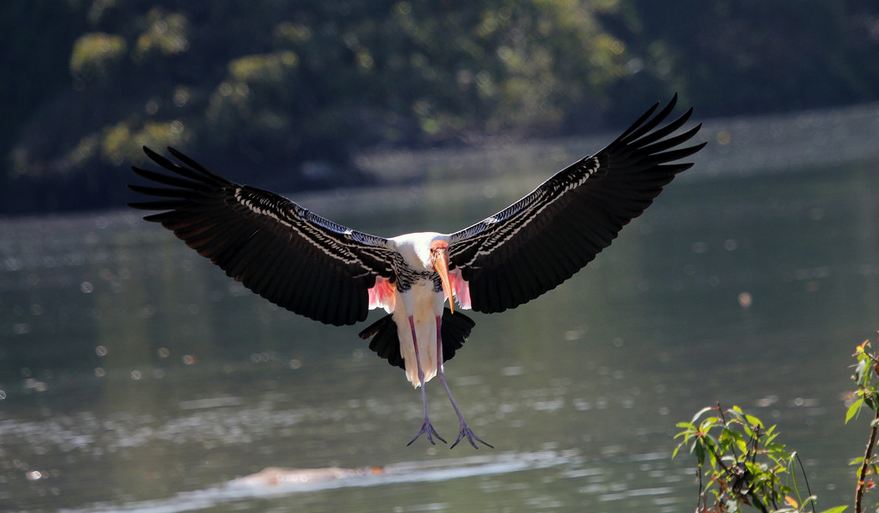
Ranganthittu Bird Sanctuary, Karnataka

Igor Siwanowicz’s image of planthopper nymph gears won 9th place in the Olympus BioScapes International Digital Imaging Competition. Photo by Igor Siwanowicz, HHMI Janelia Research Campus, Ashburn, Virginia. Via Science Friday.
In September of 2013, Science published a paper by Malcolm Burrows and Gregory Sutton titled, “Interacting Gears Synchronize Propulsive Leg Movements in a Jumping Insect.” The two British biologists were discussing the fascinating structures they had found in the legs of small insects called planthoppers. At the top joints of each pair of legs, the tiny jumping insects had gears with interlocking teeth that synchronized the kicking motion between the two appendages, so that the planthoppers could jump straight rather than slightly to the left or right if one leg had acted even slightly before the other.
Covering the story back in September, Joseph Stromberg wrote for Smithsonian Magazine that:
To the best of our knowledge, the mechanical gear—evenly-sized teeth cut into two different rotating surfaces to lock them together as they turn—was invented sometime around 300 B.C.E. by Greek mechanics who lived in Alexandria. In the centuries since, the simple concept has become a keystone of modern technology, enabling all sorts of machinery and vehicles, including cars and bicycles.
 Organikos