I flew into the Cochin airport in Kerala a few days ago for the first time. This is my first time to Asia and to a country whose language I do not speak (fluent in english and spanish). I was greeted by Udayan, one of Raxa Collective’s drivers who began driving me to the hotel. If you had read my last post, you would know that I am here to do an internship under Crist and Amie Inman (owners and operators of Raxa Collective), who I have been communicating with for months now. Amie especially, had warned me of the driving and how “In some parts of the world, people drive on the left side, others on the right side, but in India people drive everywhere”! That could not have been closer to the truth. As soon as we leave the airport parking lot, I hear horns going off, almost in symphony to one another, communicating back and forth. Tuk-tuks (a type of small yet quick 3 wheeler) are swerving in and out of traffic, motorcycles and cars zig-zagging in and out. The driver, completely calm and very good at what he does tells me that it will be a 45min drive. In my mind, I thought this wasn’t driving, but a type of noisy tetras.
First Days in Jamaica with Smithsonian Expedition
John, Justin and I have been at the Windsor Research Center for a day and getting ready for our first five or six day trip through Cockpit Country. Every single Jamaican we’ve met so far has been super friendly and helpful. We won’t be able to update as much as we’d like but hopefully every week we can send out one quick post. If you don’t hear from us though, it’s likely just because there’s some wind hitting the leaves that are reflecting the signal that the antenna here picks up and plugs into the desktop they use at Windsor. Continue reading
The Ecological Health Of Oceans In Dire Need Of Support
The news that is fit to print, for better or worse as it impacts our mood and our sense of hope (or sense of doom on occasion), includes this review of the current best knowledge on marine ecosystems by one of our favorite science writers:
Ocean Life Faces Mass Extinction, Study Says
Scientists find what they say are clear signs that humans are beginning to damage oceans on a catastrophic scale, but there is still time to preserve their ecological health.
Introduction & Upcoming posts
I would like to take a quick moment to introduce myself, my goals for the next few months and what I will be posting in this blog. I am a recent graduate from the University of Central Florida, Rosen School of Hospitality Management and I was born in Costa Rica.
I am excited to be interning at Marari Pearl (Kerala, India) starting this January. I don’t believe there will be a lack of material for me to write about in Kerala with its unique culture, customs, spicy foods and amazing animals! This will be my first time to Asia and I am quite sure it will be a great and rewarding culture shock and I want to convey my observations and thoughts about something totally new to me. Continue reading
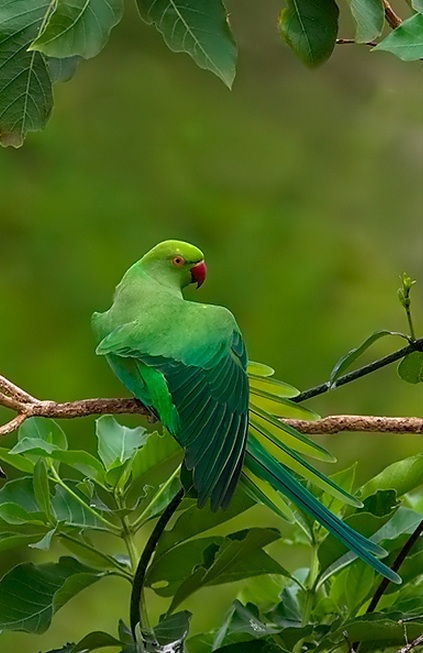
Bird of the Day: Rose Ringed Parakeet
Friends, Collaboration And Awesome Accomplishment
News feeds–especially those that give attention to adventure, and extreme sports and rock climbing in particular–are full of this story just now about two friends accomplishing one of the greatest challenges left in the small specialty sport. We are not at all devoted to the sport, but in the last year or two have developed a fascination, based on another climber’s feats and travails, mainly because of the collaboration component of climbing.

© AP Photo/Tom Evans, elcapreport In this Jan. 8, 2015 photo provided by Tom Evans, Kevin Jorgeson celebrates his finishing the climb of Pitch 15 while two photographers shoot video and stills from above…
Today’s news brings the collaboration part back to the forefront, in this case not due to absolute requirement but due to friendship. It is touching, in that “feel good” sense related to hoping you would do the same thing in the circumstance described; but more than that, it is just awesome:
YOSEMITE NATIONAL PARK, Calif. (AP) — American rock climber Tommy Caldwell was first to pull himself atop a 3,000-foot sheer granite face in Yosemite National Park, followed minutes later by his longtime friend Kevin Jorgeson.
The pair embraced and then Jorgeson pumped his arm in the air and clapped his hands above his head. After years of practice, failed attempts and 19 grueling days scaling the vertical wall on El Capitan by their bloodied fingertips, the friends at last grasped success.
“That’s a deep, abiding, lifelong friendship, built over suffering on the wall together over six years,” said Caldwell’s mother, Terry, among some 200 people in the valley floor thousands of feet below who broke into cheers at the climbers’ historic feat Wednesday.
She said her son could have reached the top of the world’s largest granite monolith several days ago, but he waited for his friend to ensure they made it together. Continue reading
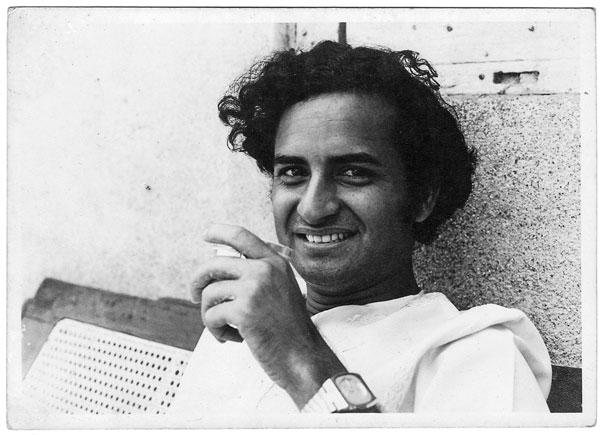
Ulhas Kashalkar, Musician’s Musician

COURTESY ULHAS KASHALKAR. Kashalkar’s genius lies in his inventive yet rooted artistry. In a sweet, malleable voice, he channels an intellectual disposition into emotionally powerful renditions.
When we first discovered the magazine we knew we would come to count on it for stories of interest from time to time, and today we find such an occasion:
A Fine Balance
How Ulhas Kashalkar became one of the greatest musicians of our time
By Sumana Ramanan
ONE
MINUTES BEFORE THE LIGHTS DIMMED and the Hindustani vocalist Pandit Ulhas Kashalkar walked onto the stage at Mumbai’s National Centre for the Performing Arts, the eminent singers Ashwini Bhide-Deshpande and Padma Talwalkar took their seats in the front row. The vocalist and veteran critic Amarendra Dhaneshwar sat a few rows behind them. Other listeners looked around to see who else had come. Several younger singers were there as well: Noopur Kashid, Rutuja Lad, Amita Pavgi-Gokhale and Saylee Talwalkar. The turnout for Kashalkar’s concert, held last September, was not unusual; for at least a decade, he has been considered a musicians’ musician. Still, expectations were high: what would the maestro sing for this audience?
Recycling Nature’s Leftovers, A Puzzle
Thanks, as always, to Conservation for the summary of important scientific findings:
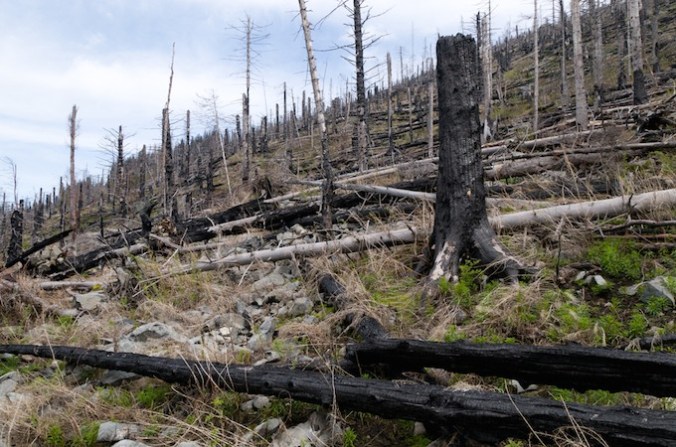
DOES SALVAGE LOGGING MAKE THINGS BETTER OR WORSE?
When a serious wildfire rips through a forest, it has a tendency to kill nearly all the trees in its path. Then come the logging companies. On one hand, to log a burned forest makes a good deal of sense. Some of the timber is still useful, and it’s a way to derive some economic benefit from a landscape that’s otherwise devastated. The process, called “salvage” logging, typically operates in two phases. In the first phase, machines called “feller-bunchers” come through, cut down the dead trees, and pile them into bunches. In the second phase, machines called “skidders” are brought in. Their function is to take those piles of felled trees and cart them back down the mountain. Continue reading
Bird of the Day: Tickell’s Blue Flycatcher (Nandi Hills, Karnataka)
More Less Than Good News Related To The Effects Of Climate Change

Photo by Robert Kopp. “What this paper shows is that sea-level acceleration over the past century has been greater than had been estimated by others,” said Eric Morrow, a recent Ph.D. graduate. “It’s a larger problem than we initially thought.”
We were not looking for more bad news today, really; but science has that unrelenting need to march forward, and this news from the latest finding is not so good (thanks to Harvard Gazette):
Sea level correction
Increase has been more intense than previously understood, study says
By Peter Reuell, Harvard Staff Writer
The acceleration of global sea level change from the end of the 20th century through the last two decades has been significantly swifter than scientists thought, according to a new Harvard study. Continue reading
Sometimes The Truth Is Hard To Believe
We try to minimize the doom and gloom and accentuate the solutions; but sometimes our eyebrows rise to new heights and we must share:
Yup, a Climate Change Denier Will Oversee NASA. What Could Possibly Go Wrong?
By Phil Plait
So, Sen. Ted Cruz (R-Texas) was just named to be the chairman of the Subcommittee on Space, Science, and Competitiveness as Republicans take over the Senate. This subcommittee (which used to be just Space and Science but was recently renamed) is in charge of oversight of, among other things, NASA.
This is not a good thing. Just how bad it is will be determined. Continue reading
Avian Odyssey
As Seth and his team are in flight for their odyssey in search of the golden swallow, it seems fitting that we come across the stories of epic avian journeys. Just about a year ago we posted about the bar-tailed godwit, and it seems the species has some stiff competition in the semipalmated sandpiper.
Scientists from the Manomet Center for Conservation Sciences recovered data from a geolocator tagged sandpiper from sub-Arctic Coats Island revealing that the bird flew over 10,000 miles in the past year, including a remarkable six day, 3,300-mile nonstop flight across the Atlantic Ocean. Continue reading
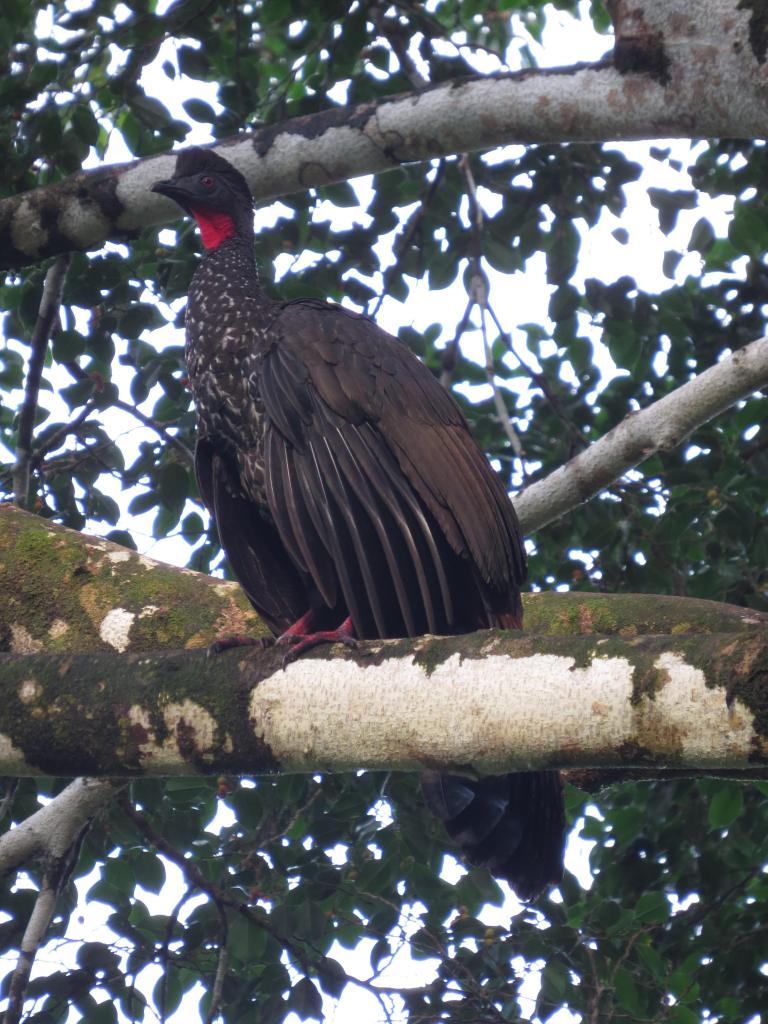
Bird of the Day: Crested Guan
Packed and Ready to Go
Six checked bags, three carry-ons, and two personal items. Three tickets for travel through three airports over a course of eight hours (including layover). One rental car for forty-eight hours, and thirty nights in Jamaica, around twenty-five of which should be in the bush. We’re hoping there’ll be enough internet access at the Windsor Research Centre to have some posts published throughout the next month, but it’s possible we’ll only have time for some very detail-packed posts. Regardless, we should be back in time for Valentine’s Day, February 14th!
Bird of the Day: Golden Oriole
A Trio of Jamaican Endemics
Jamaica has thirty endemic bird species, which is more than any other West Indies island. Justin, John and I have a good chance of seeing a good handful of those, especially since Cockpit Country and the Blue Mountains are such well-forested and protected areas. Although none of us are the type of birder that pursue “life lists” — a checklist of the thousands of bird species in the world that one has seen — we all use eBird and are definitely interested in seeing and identifying wildlife of any sort.
And if that type of animal happens to be found only in the area that we’re passing through, then that just makes us appreciate the relative rarity a little more. Endemism in a bird species does seem to assign that bird a bit of a higher status for life-listers, for the obvious reason that you have to be able to go to the certain region to find it — you can’t necessarily spot it merely by visiting a different continent, but rather you have to go to the country, or island, or mountain range.
More Reasons To Disconnect
Desire to drop everything and release yourself from the constant ringing, pinging distraction? We’ve suggested disconnection before. We have suggestions on where to do it too, some offering pure relaxation and others offering immersion in culture. But why do it? Plenty of reasons, and you do not need us to explain. Nonetheless, from National Public Radio (USA) a fun, unconventional reason:
Bored … And Brilliant? A Challenge To Disconnect From Your Phone
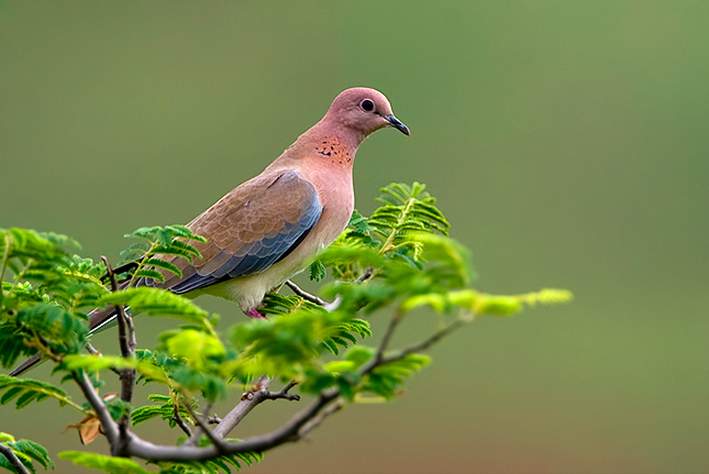
Bird of the Day: Laughing Dove
If You Happen To Be In Fort Kochi

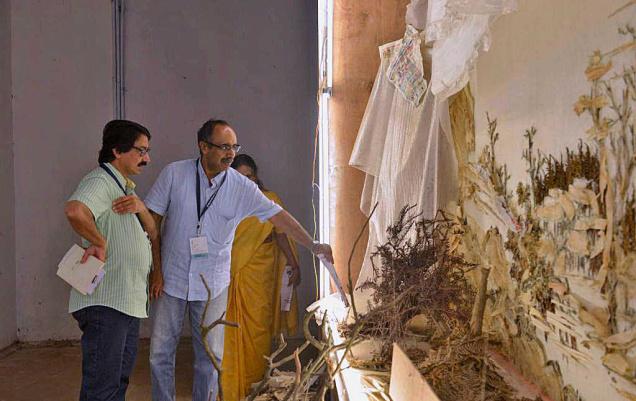
V. Venu, director-general of the National Museum in Delhi (in blue), viewing Xu Bing’s work at Aspinwall House in Kochi on Sunday.
If you are in town before the end of March, come see the show. We have mentioned the event in these pages more than once between its first iteration and this year’s; and if you follow Spice Harbour‘s social media you would have seen, among other things, that the formal opening of that property doubled as a fundraiser for KMB, as it is affectionately known to Raxa Collective. In today’s Hindu, an article reminds us that the event is not just for fancy folks, but serves a deeply important cultural education service for Indians of all backgrounds and education levels:
Prominent figures from the world of art, film personalities, art students, and the public turned up in large numbers at the Kochi Muziris Biennale on Sunday, even as the event completes a month on January 12.
Among the visitors to the contemporary art event on Sunday was V. Venu, director-general of the National Museum in Delhi. “The kind of consistent engagement by people from every walk is what makes the Biennale an unparalleled successful event in the country,” said Dr. Venu. Continue reading
Cockpit Country
Cockpit Country, the first of the two regions we’ll be traveling through during our pair of expeditions, is an area of roughly 500mi² in northwestern Jamaica. The country is divided into parishes, which are like the counties or provinces of other countries; Cockpit Country is in the southern section of Trelawny Parish, which at one point had the most sugar plantations on the island. The sugar factories were closer to the coastal ports, but Cockpit Country, full of forest and strange limestone terrain, was (and still largely is) uninhabited and difficult to traverse.