On the Art of Snowflakes

Snowflake, by Steve Begin/flickr/CC BY-NC-SA 2.0

For those of our readers in the appropriate climates to be receiving snow this time of year, we have some information on snowflake collection/observation that might be of interest; for those in milder or more tropical climes, we have a science experiment to create your own crystal formation in the shape of a snowflake! Let’s start with finding snowflakes in the wild. You can start by watching this Snowflake Safari video from Science Friday, or if you prefer reading, we have excerpts below (also via SciFri) from the book Mama Gone Geek by science writer Lynn Brunelle:

When the snow starts falling, grab your kids, coats and boots, a couple of pieces of black construction paper, and a magnifying glass or two if you have them. As the snow is falling around you, catch a couple of snowflakes on your black construction paper and observe them with your magnifying glass, comparing how the snowflakes are similar and different. Count how many sides or points the snowflakes have and if any snowflakes appear to match.
Continue reading

Bats Sing Like Birds Do. Who Knew?

Pipistrellus nathusii, a species of European bat.

We recently learned that certain types of fruit bat can echolocate with their wings, and now we’re discovering that some bats also make sounds for reasons other than sonar or distress calls! Although bat songs have been recorded as much as four decades ago, more and more singing bat species are being found by scientists today, and these batsongs seem to function the same way that birdsongs do. As Robert Krulwich points out for NPR, there are very few types of mammal that sing, so it’s nice to see the club growing. Krulwich’s article continues below:

Bats produce “pings” or “clicks,” right? They make these high-pitched sounds, too high for us to hear, but when their cries ricochet off distant objects, the echoes tell them there’s a house over there, a tree in front of them, a moth flying over on the left. And so they “see” by echolocation. That’s their thing. They are famously good at it.

Continue reading

A Random Walk Into Science

9781426207211_custom-35a4548b8f07b01d4c9e9152d330cf0d69e5ce53-s400-c85

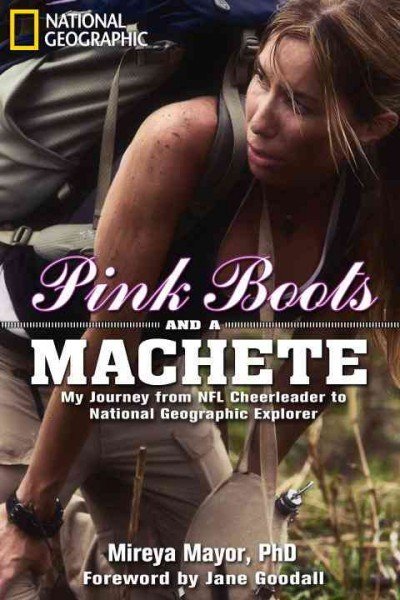
This title of the book to the left, and of the podcast interview (“Trading Pom-Poms For Field Boots”) on the National Public Radio (USA) series called “My Big Break”–and even the opening line belowgive the false impression that this may be a dilettante story; but not at all. It is about discovering science in a classroom and coming to love it thanks to a deep experience in nature:

Mireya Mayor’s life plays out like an adventure film.

She’s a globe-trotting anthropologist, primatologist, wildlife expert and conservationist. As the first female wildlife correspondent for the Ultimate Explorer series on National Geographic Channel, she’s gone diving with great whites, she’s rappelled down cliffs and she was even charged by an angry silverback gorilla.

But some of her fans might be surprised by what Mayor was up to before she trekked around remote regions of the world. Continue reading

2014 Food Writing, Putting 2015 In Perspective

My mother thought of food the way we all now do: as a means of self-definition. CREDIT ILLUSTRATION BY MICHAEL GILLETTE

My mother thought of food the way we all now do: as a means of self-definition. CREDIT ILLUSTRATION BY MICHAEL GILLETTE

When a writer of John Lanchester’s deep quality and broad diversity uses the word repent, we take note. This reflection on the current state of foodie-ism caught our attention a couple months ago as we were well into 51’s first season open, and preparing for the next opening, reminding us to keep it all real, in perspective. Below we excerpt what should be read from beginning to end, using the dangerous ellipsis as carefully as we can but hoping you will click over to the source:

…Once upon a time, food was about where you came from. Now, for many of us, it is about where we want to go—about who we want to be, how we choose to live. Food has always been expressive of identity, but today those identities are more flexible and fluid; they change over time, and respond to different pressures. Some aspects of this are ridiculous: the pickle craze, the báhn-mìboom, the ramps revolution, compulsory kale. Is northern Thai still hot? Has offal gone away yet? Is Copenhagen over? The intersection of food and fashion is silly, just as the intersection of fashion and anything else is silly. Underlying it, however, is that sense of food as an expression of an identity that’s defined, in some crucial sense, by conscious choice. For most people throughout history, that wasn’t true. The apparent silliness and superficiality of food fashions and trends touches on something deep: our ability to choose who we want to be. Continue reading

Citizen Science, Decades In Development

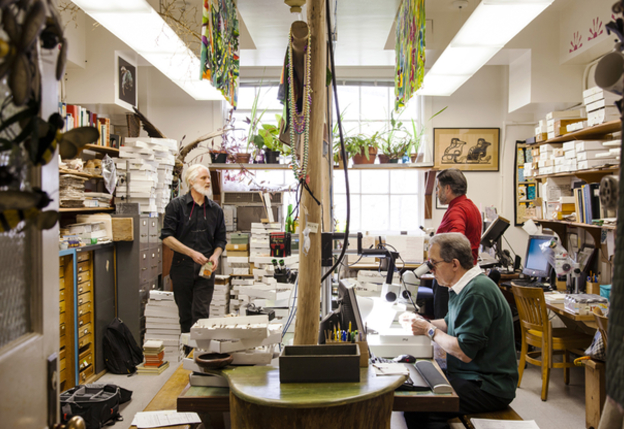
In Droege's lab at the Patuxent Wildlife Research Center, pizza boxes provide storage to thousands of pinned bee specimens. Volunteers Gene Scarpulla (in green) and Tim McMahon peer through microscopes to ID the insects.  Credit: Robert Wright

In Droege’s lab at the Patuxent Wildlife Research Center, pizza boxes provide storage to thousands of pinned bee specimens. Volunteers Gene Scarpulla (in green) and Tim McMahon peer through microscopes to ID the insects. Credit: Robert Wright

We started, before even knowing the terminology, paying attention to citizen science on this blog when we began to understand the parallels with entrepreneurial conservation. And now we link to stories whenever we can that help us better understand it:

Three Generations of Citizen Science: The Incubator

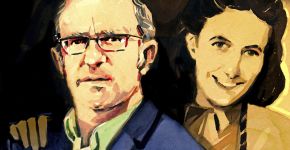
Once Sam Droege gets a research project up and running, he dreams up a new one–and builds it.

BY ANDY ISAACSON

It was a bright, breezy day in late April, the flowering azaleas having finally shrugged off the winter that overstayed its welcome, when Sam Droege sailed onto the grounds of the U.S. National Arboretum in Washington, D.C., behind the wheel of a pterodactyl. It was actually a ’98 forest-green Saturn, which Droege had painted with yellow wings and a red-and-yellow beak that tapered to a point down the center of the hood. A piece of wood, lined with a rusty crosscut saw, had been bolted to the roof: the crest. Little jingle bells, inspired by richly adorned buses in Pakistan, dangled from chains screwed into the rear bumper. Droege still had designs for neon undercarriage lights, and a mosaic of mirror shards to line the car’s ceiling–“but why stop there?” he wondered. It was a work in progress.

Continue reading

New App for Borrowing/Lending Things

You can find apps for everything nowadays, and some of them are really creatively useful or simply entertaining. We’ve seen an app for typing in various indigenous languages from North America and Australia, some environmentally-focused games, the potential for a prairie dog translator app, and an application to help monitor the plants in your garden. Now we’re learning about a new company that has an app to help coordinate loans of tools or other things among neighbors. Named Peerby, this social platform came to life in the Netherlands, and seems like a great idea to promote friendly and community-building interactions while also reducing consumption. Eleanor Beardsley reports for NPR’s All Tech Considered:

Millions of people use websites and apps like Airbnb to share their homes and Uber to transport people in their cars. A new company allows people to share things like power drills and bicycle pumps by connecting people who need them to people who have them.

It isn’t surprising that the idea for the borrowing platform Peerby originated in one of the world’s most densely populated countries — The Netherlands.

Continue reading

Bees May Sleep to Maintain Learning Brains

Bee in mid air flight carrying pollen in pollen basket. Credit: Muhammad Mahdi Karim

Bees are incredibly important to much of the world’s flora, and we are always happy to see when research on them is continuing. After all, the better we understand them, the better we can protect them. Elizabeth Preston reports for Discover Magazine’s blog that when young honeybees spend time in the hive, they spend more time sleeping afterwards, probably to absorb whatever they’re learning among all the other bees:

Facing a whole hive of bees at once can be overwhelming—even for a bee. Young honeybees sleep more after spending time in the hive than after being by themselves. They need the extra nap time, it seems, to build and maintain their learning brains.

The first surprising thing about this might be that insects sleep at all. “Since around the 1980s there is good evidence that insects show…characteristics of sleep,” says Guy Bloch, who studies bee behavior at the Hebrew University of Jerusalem. Yes, their brains are tiny and organized differently from ours. But they rest in a similar way. And just as sleeping helps us sort through the new things we’ve learned each day, there’s evidence that sleep in bees and fruit flies is also tied up with memory and learning, Bloch says.

Continue reading

Systematically Distributing Holiday Cheer

The holiday season is about giving and the classic song quantifies the largess. The American Museum of Natural History is home to many happy childhood memories and I embrace their scientific form of expressing holiday cheer. Not everyone can claim their “True Love” is a “Science Geek” – but kudos to AMNHNYC for helping us all be Science Lovers!


Ancient Trees: Portraits of Time

Photo by Beth Moon. Via thisiscolossal.com

For obvious reasons, we’re big fans of trees. We’ve shared a piece on tree-sitting (which is, of course, linked to tree-hugging), and featured an environmental history essay that included some hypothetical dendrochronology. Now, we’re happy to find some amazing photographs developed in the almost lost art of painstaking platinum/palladium processing by Beth Moon.

Photo by Beth Moon.

Abbeville Press on Beth Moon’s book of photography, Ancient Trees: Portraits of Time:

Beth Moon’s fourteen-year quest to photograph ancient trees has taken her across the United States, Europe, Asia, the Middle East, and Africa. Some of her subjects grow in isolation, on remote mountainsides, private estates, or nature preserves; others maintain a proud, though often precarious, existence in the midst of civilization. All, however, share a mysterious beauty perfected by age and the power to connect us to a sense of time and nature much greater than ourselves. It is this beauty, and this power, that Moon captures in her remarkable photographs.

Continue reading

Counting Monarchs

Creating Breeding Habitat for Monarchs: To reverse the breeding habitat loss in the U.S., the Monarch Joint Venture promotes the inclusion of native milkweed and nectar plants in restoration efforts across the country ranging from small gardens to natural areas and corporate landscapes. (Photo by Giuseppina Croce)

We’ve seen some information on how much people value monarch butterflies. Now we’re learning that the beautiful orange lepidopterans have their own citizen science Thanksgiving count and might soon be labeled as a threatened species under the Endangered Species Act if a petition has any effect.

Beloved by tattoo parlors and fantasy princess landscapes, the king of butterflies is in decline. During their annual migration, monarch butterflies are famous for gathering in innumerable flutters as they fly from summer breeding grounds in the U.S. and Canada to warmer sites in Mexico and California. At one time, there were over a billion monarchs making this journey. Now, less than 4% are left.

Over the years, human behaviors, particularly agricultural practices have contributed to the monarch’s decline. In a petition to protect monarchs scientists point to habitat loss as grassland is converted to farmland and overwintering sites are deforested as a major factor. On top of that, the cultivation of certain genetically engineered crops enable farmers to apply broad-spectrum herbicides killing weeds such as milkweed, the monarch caterpillar’s sole food source.

Continue reading

Pink Pigeons in Mauritius

Left, pink pigeon via Dick Daniels/CarolinaBirds.org/Wikimedia Commons; right Madagascan turtle dove via Roland zh/Wikimedia Commons.

We’ve featured pieces on another, less fortunate species of pigeon before, and it’s great to read news about a critically endangered species that has been making a comeback after conservation efforts. As the article by Jason Goldman for Conservation Magazine shows, however, there’s still a ways to go before the pink pigeon has fully recovered as a species:

The pink pigeon is the lone survivor of all the columbids – pigeons and doves – native to Mauritius. In 1990 the species was down to just nine individuals, but thanks to the work of the Mauritian Wildlife Foundation, there were some 400 individuals flying the skies of the island by 2013. In the year 2000, the IUCN downgraded the species from “critically endangered” to “endangered.” They’re not out of the woods yet, but their recovery remains an impressive and rare example of good news in conservation.

Continue reading

Kleptothermy

Photo of Blue-lipped sea krait (Laticauda laticaudata), Anemone Reef, Thailand. Credit: Jon Hanson.

We’ve featured a post on biological theft before, under the name of mycocleptism. In that case the thief was a species of beetle that lived off the fungal tunnels of another beetle species, and now we are learning of a different type of behavior: stealing heat. Apparently certain reptiles, which are unable to bask in the sun at night, have found an effective method of transferring warmth that does not involve time travel. Instead, they snuggle up in the nests of birds. Brian Switek reports on the phenomenon for Nat Geo below, but one question that seems to remain unanswered is whether the feathered members of the deal are getting anything out of their reptilian visitors. For example, sea snakes like the ones mentioned in the referenced article are venomous — could it be that their presence in a shearwater nest would protect the birds from potential predators?

You could bask in the sun to remedy the cold. That’s a classic reptile way of working some warmth back beneath those scales. But there’s another option. You could steal your warmth. All you’d have to do is find some seabirds.

Continue reading

The Differences Between Rabbits and Hares

A female European hare (right) boxes with a male in Wales. PHOTOGRAPH BY ANDY ROUSE, 2020VISION/NATURE PICTURE LIBRARY/CORBIS. Via National Geographic.

Thank you to Liz Langley from National Geographic for highlighting differences that we have always been curious about but never thought about looking into until they were laid out so clearly in a single place. And with cute photos and a couple puns to boot. The article below comes from Nat Geo’s “Weird Animal Question of the Week,” which we will be sure to visit in the future.

Hares and rabbits are in the same family, Leporidae, but they’re “different species, like sheep and goats are different species,” Steven Lukefahr, a geneticist at Texas A&M University in Kingsville, said via email.

Hares are also larger, have longer ears, and are less social than rabbits. The “most profound difference” is seen in baby hares versus baby bunnies, said Philip Stott, a wildlife ecologist at the University of Adelaide in Australia. (See National Geographic’s pictures of baby animals.)

First off, a hare’s pregnancy lasts 42 days, compared with rabbits’ 30-31 days with a bun(ny) in the oven.

Continue reading