Watch Your Pump Jockey

shutterstock.com

shutterstock.com

Conservation‘s daily summary of an intriguing scientific finding captures our attention at least one time per week. Which is about how often, on average, some of us fill the gas tank of our vehicles. And we learn that the fuel lost during those visits can add up to massive waste. Which means, this should interest you:

First, you pull into the gas station. You open the cover to the fuel tank, unscrew the cap, insert the nozzle, and pump away. Once you’ve filled up your tank, you dislodge the nozzle and return it to its starting position. But in between – perhaps without even noticing – you spilled a few drops of gasoline onto the concrete. You were as careful as possible, and it was just a tiny bit wasted…right? A few drops here and there aren’t a big deal, are they?

Well, it might be. That’s according to new research published this week in the Journal of Contaminant Hydrology. Continue reading →

A Norwegian Sense Of Obligation

Norwegian King Harald V.  Photo: P. J. George

Norwegian King Harald V. Photo: P. J. George

From today’s Hindu, an interview with the King of Norway. It may be an example of noblesse oblige, but it is an interesting story at a time when some other developed economies have determinedly charged hard right, away from state-sponsored welfare:

‘We had a problem — too much money’

Interview with Norwegian King, Harald V, on the country’s successful welfare model, its oil and gas reserves and the threat of climate change

The Norwegian society is at present debating several issues, including its economy, climate change, immigration and the changing cultural milieu. In all these, the country often looks to its King, Harald V, for a decisive voice… A renowned sailor, he carries out royal duties with aplomb even at the age of 77. He spoke to The Hindu recently in Oslo on the triumphs and concerns of his country. Excerpts: Continue reading →

If You Use Amazon, Read This

Screen Shot 2014-10-11 at 10.58.33 AM

As the article below suggests, whether we shop with them or not we are all complicit. It is the best article yet on the growing concern over not only Amazon’s market power but its cultural influence. And in true liberal spirit of the great publication that offers it, both sides of the argument are presented starting at the first sentence:

Before we speak ill of Amazon, let us kneel down before it. Twenty years ago, the company began with the stated goal of creating a bookstore as comprehensive as the great Library of Alexandria, and then quickly managed to make even that grandiloquent ambition look puny. Amazon could soon conjure the full text of almost any volume onto a phone in less time than a yawn. Its warehouses are filled with an unabridged catalogue of items that comes damn close to serving every human need, both basic and esoteric—a mere click away, speedily delivered, and as cheap as capitalism permits. Continue reading →

51 Ways To Have Your Porridge

Definitely not traditional: two colorful takes on porridge, from Friday's London Porridge Championships. Dai Williams/Courtesy of the National Porridge Championship

Definitely not traditional: two colorful takes on porridge, from Friday’s London Porridge Championships. Dai Williams/Courtesy of the National Porridge Championship

I loved it when we found out that one of our favorite companies was sponsoring a competition for porridge-making at exactly the time we were first planning the menu for 51.  And since opening, 51 has offered both sweet and savory options for porridge on its breakfast menu, but thanks to this story in one of our go-to food knowledge sources we are thinking that we can and must do more to expand the porridge horizons of our guests:

Dr. Samuel Johnson’s dictionary once summarily dismissed porridge, defining oats as a “grain, which in England is generally given to horses, but in Scotland supports the people.”

That was in the 1700s. These days, porridge is seen as more cool than gruel. Today is World Porridge Day — and to celebrate, London hosted its own porridge-making competition. Continue reading →

Entrepreneurial Conservation, Macro Version

ILLUSTRATION BY CHRISTOPH NIEMANN

ILLUSTRATION BY CHRISTOPH NIEMANN

In the current issue of the New Yorker, the excellent “explainer in brief” of economic phenomena provides a macro equivalent example of what we have referred to as entrepreneurial conservation. Instead of just a sampling of the text we provide the full story here, per an occasional exception we make for important environment-related stories, but please click through to the source to give proper attribution:

During the recent U.N. Climate Summit, it was hard not to think of the quip, attributed to Charles Dudley Warner, “Everyone complains about the weather, but no one does anything about it.” A parade of global leaders (including Barack Obama) made all the right noises, but there was little action. So it was notable when Norway announced a deal with Liberia: Norway will give Liberia up to a hundred and fifty million dollars in aid, in exchange for which Liberia will work to stop the rapid destruction of its trees.

Continue reading →

Flowering Plants Of The Western Ghats

05tv_western_ghat__2140103e

For flower lovers, ecologists, and concerned citizens everywhere, important news in today’s Hindu:

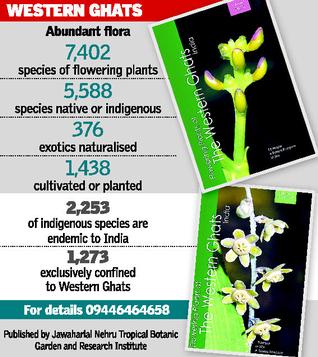
As a global biodiversity hotspot and a world heritage site, the Western Ghats is a magnet for conservationists, nature lovers, scientists and researchers hoping to delve into the secrets of its abundant flora and fauna. But despite decades of study by individuals and groups, an essential reference work cataloguing the rich biodiversity of the region has remained a dream.

In a bid to address this need, scientists at the Jawaharlal Nehru Tropical Botanic Garden and Research Institute (JNTBGRI) at Palode near here have come out with a comprehensive work on the flowering plants of the Western Ghats.

Published in two volumes, the 1,700-page book reveals the occurrence of a total of 7,402 species of flowering plants in the region, out of which 5,588 species are native or indigenous. Of the rest, 376 are exotics naturalised and 1,438 species are cultivated or planted as ornamentals. Continue reading →

Those Who Make Chinese Restaurants In The USA What They Are

141013_r25586-690

Chinatown employment agencies can get immigrants kitchen jobs in a few hours. CREDIT PHOTOGRAPH BY ANNIE LING

When our interest in long form journalism intersects with our wide and deep interest in foodways, we could not be happier than to pass it along. Have a taste of this deeply reported story on cooks in the Chinese restaurant trade in the USA, as offered in this week’s New Yorker:

In a strip mall on a rural stretch of Maryland’s Indian Head Highway, a gaudy red façade shaped like a pagoda distinguishes a Chinese restaurant from a line of bland storefronts: a nail salon, a liquor store, and a laundromat. On a mild Friday morning this July, two customers walked into the dimly lit dining room. It was half an hour before the lunch service began, and, aside from a few fish swimming listlessly in a tank, the room was deserted.

In the back, steam was just starting to rise from pots of soup; two cooks were chopping ginger at a frenzied pace. Most of the lunch crowd comes in for the buffet, and it was nowhere near ready. “Customers are here already!” the restaurant’s owner, a wiry Chinese man in his fifties, barked. He dropped a heavy container onto the metal counter with a crash. “How can you possibly be moving this slowly?” Continue reading →

Walter Isaacson On Geniuses Of The Digital Revolution

File photo by Kris Snibbe/Harvard Staff Photographer.  "We’re now in a phase in which the connection of creativity to technology is going to drive innovation," said Walter Isaacson ’74, a Harvard Overseer, biographer, and CEO of the Aspen Institute. "I do believe that it’s important for people to have an appreciation for the arts and humanities."

File photo by Kris Snibbe/Harvard Staff Photographer. “We’re now in a phase in which the connection of creativity to technology is going to drive innovation,” said Walter Isaacson ’74, a Harvard Overseer, biographer, and CEO of the Aspen Institute. “I do believe that it’s important for people to have an appreciation for the arts and humanities.”

Thanks to Christina Pazzanese and Harvard Gazette for this conversation with one of the more interesting biographers writing today:

Ghosts in the machines

The history of the Digital Revolution touches our hearts and heads, Isaacson says

In many ways, the entire Digital Era can rightly be laid at the courtly foot of Lord Byron’s rebellious daughter, Ada. Lady Lovelace was the poet’s only child born in wedlock, inheriting both her father’s headstrong, Romantic spirit and her mother’s practical respect for mathematics.

As the Industrial Revolution bloomed, her appreciation for the beauty of numbers and invention, an analytical approach she called “poetical science,” led her to write what is now regarded as the first algorithm and to help refine a machine that could be programmed to perform many different tasks, an idea that anticipated the modern computer by a century.

That’s where Walter Isaacson’s latest book, “The Innovators: How a Group of Hackers, Geniuses, and Geeks Created the Digital Revolution,” steps off.

Continue reading →

Pre-Colonization Food

Sean Sherman’s Walleye filet with sumac and maple sugar, a white bean and smoked walleye croquette and toasted hominy; Becca Dilley/Courtesy of Heavytable.com

As we fine tune the concept of Malabar Soul Food at 51 we’re always on the lookout for other stories of cultural culinary crossovers. This is especially relevant with chefs who are pushing culinary limits by reaching back to early foodways like Sean Sherman, a member of the Oglala Lakota tribe. Mr. Sherman’s life is in the kitchen, but a great deal of his energies go into discovering the pre-colonization foods of his Great Plains ancestors. Thanks once again to NPR and the Salt for sharing this story.

Sherman, who calls himself the Sioux Chef, grew up on the Pine Ridge Indian Reservation in South Dakota. It’s where he first started to learn about the traditional foods of the Plains, whether it was hunting animals like pronghorn antelope and grouse, or picking chokecherries for wojapi, a berry soup.

“We were close to the Badlands and its sand hills, which is not the best growing area by far,” says Sherman, who’s now 40. “But we would also spend weeks in the Black Hills, crawling around and learning stuff.”

Sherman’s grandfather was among the first Native American children to go to mission schools on the reservation, and he was one of Sherman’s first teachers. Continue reading →

Pots Calling Kettles Black

Mini activist figures at a Shell gas station in Legoland in Billund, Denmark, part of a global campaign targeting Lego and highlighting Shell’s plans for Arctic oil exploration. Photograph: Uffe Weng/Greenpeace

Mini activist figures at a Shell gas station in Legoland in Billund, Denmark, part of a global campaign targeting Lego and highlighting Shell’s plans for Arctic oil exploration. Photograph: Uffe Weng/Greenpeace

Lego is easy to love. Anyone who had these toys as a child, or who has children who have these toys, can testify to the joy they bring.

Shell is easy not to love, for reasons that do not really need to be explained here.

And yet, Lego is a product made up primarily of petroleum, so what we learn in this story in today’s Guardian seems odd as much as it seems good:

Lego will not renew its marketing contract with Shell after coming under sustained pressure from Greenpeace to end a partnership that dates to the 1960s.

The environmental campaign group, protesting about the oil giant’s plans to drill in the Arctic, had targeted the world’s biggest toy maker with a YouTube video that attracted nearly 6m views for its depiction of a pristine Arctic, built from 120kg of Lego, being covered in oil. Continue reading →

World Wildlife Week: Tigers & Territories!

habitat


As a part of celebrating World Wildlife Week I was sharing information about the importance of saving our Natural Heritage, trying to create awareness among the growing population of nature lovers and wildlife photographers.

In the previous posts I discussed the relationships between healthy ecosystems, the well-being of wildlife and humans.

Here I’ll address another essential element for a healthy tiger population – territories!

Next to food, the most important requirement for a tiger is territory. A male tiger with a territory encompassing those of several females has more mating opportunities. A female in control of a ‘home range’ with abundant prey has the best chance of raising more cubs.

With so much at stake, tigers are fiercely possessive of their turf, and scent-mark and defend their territories from rivals.

There is increased pressure on the Tiger territories from the development front. Environmental and forest clearances have been delinked to allow work on linear projects, such as highways, on non-forest land without waiting for approvals for the stretches that require forest land.

India has ONLY 4.9% of total geographic area established as protected area (PAs). If we are not able to increase this, we need to see how we can at least protect that. But look at this news published in hindustantimes:

In a boost to the real estate sector, the environment ministry may soon allow state governments to take a call on setting up new townships, information technology and developmental parks near tiger reserves, national parks, eco-sensitive zones and critically polluted areas.

The ministry has already issued draft rules proposing delegation of its power to decide on construction projects within 10 kms of wildlife areas and critically polluted areas to the state governments.

Till now, the Centre used to examine such projects to consider their impact on wildlife before giving a go-ahead. But now, the ministry has proposed the “general condition” for construction projects including information technology parks, hotels and offices will “not” apply. Continue reading →


Bird Behavior at Xandari II

I recently accrued enough videos of birds doing interesting things at Xandari to make a new video to share here. By chance, all the footage I’ve gotten over the last few months has followed a common theme: pecking and pulling. In the video above, you’ll notice that all five species of bird — Rufous-naped Wren, Hoffmann’s and Lineated Woodpeckers, Lesser Greenlet, and Rufous-capped Warbler — were either pecking or pulling at something in an effort to get some food.  Continue reading →

Reasons Not To Eat Certain Things

PHOTOGRAPH FROM PIEPENBURG / LAIF / REDUX

PHOTOGRAPH FROM PIEPENBURG / LAIF / REDUX

For those of us on a recent reconnaissance mission in Greece, this post from the Elements section of the New Yorker‘s website seems just a bit late, but nonetheless an excellent thought exercise:

Ben Lerner’s new novel, “10:04,” opens with a meditation on a decadent and expensive lunch in Chelsea, prominently featuring baby octopus. The narrator is supposed to be celebrating the six-figure sale of his book, but instead he focusses on the absurdity of the meal: “the impossibly tender things” had been “literally massaged to death.” He wonders about eating “an animal that decorates its lair, has been observed at complicated play.” Afterward, he and his agent walk out onto the High Line to watch the traffic on Tenth Avenue, and he experiences an empathic response to the once sentient octopuses now curdling within him:

I intuited an alien intelligence, felt subject to a succession of images, sensations, memories, and affects that did not, properly speaking, belong to me: the ability to perceive polarized light; a conflation of taste and touch as salt was rubbed into the suction cups; a terror localized in my extremities, bypassing the brain completely. Continue reading →

Giraffes Deserve Science As Much We Need Good Science Writers

Julian Fennessy. Giraffes are the “forgotten megafauna,” said the  executive director of the Giraffe Conservation Foundation.

Julian Fennessy. Giraffes are the “forgotten megafauna,” said the executive director of the Giraffe Conservation Foundation.

We have been highlighting science writers since our outset as a blog, following a longstanding respect from our contributors for their particular talent, which has made us richer by reaching fruit that is sometimes too high on a tree to reach and bringing it where we can reach it.

From the current New York Times weekly section highlighting and explaining scientific matters of interest to us with one of the greatest writers in the genre, we now turn our attention to giraffes for the first time in our several years sharing (and as pointed out in the article we can only wonder why we have not paid more attention to such a creature prior to now):

SCIENCE TIMES: OCT. 7, 2014

Our Understanding of Giraffes Does Not Measure Up

By NATALIE ANGIER

Giraffes may be popular — a staple of zoos, corporate logos and the plush toy industry — but until recently almost nobody studied giraffes in the field so there is much we don’t know about them.

A Conversation with Bill Gates

Screen Shot 2014-10-06 at 3.43.23 PMLast week, Bill Gates visited Cornell University for a question and answer session after attending the dedication of Bill & Melinda Gates Hall, the new Computing and Information Science building that was supported by a $25 million gift from the Bill & Melinda Gates Foundation. You can read a summary of Mr. Gates’s discussion here.