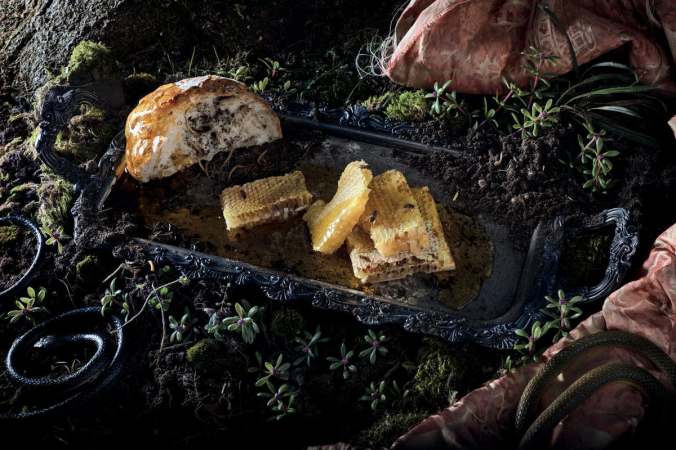
While bee populations have waned throughout rural America, urban hives are thriving in cities such as Detroit, producing honey that’s reminiscent of mint, clover or goldenrod. Photo by Patricia Heal. Prop styling by Martin Bourne
Terroir is a word that has appeared often in these pages. Taste of place, a phrase with related meaning, likewise has appeared plenty of times. This phrase is a tag line used frequently in our work, based on an experience I had in Paraguay in 2005. We will begin weekly “taste of place experiences” for guests in both Authentica shops tomorrow; starting with mead, followed by chocolate, then honey, coffee and so on. Every week an artisan will present how they source ingredients, how they make their product, and how the taste of it reflects the particular location in Costa Rica where sourcing is done. So, great to see this about urban taste of place movement in our neighbor to the north:
The Growers, Bakers and Beekeepers Embracing the Terroir of American Cities
THE GRAPEVINES RISE at the corner of East 66th Street and Hough Avenue in Cleveland, 14 trim green rows claiming over half a city block — a little less than an acre — beside an abandoned building with boarded-up windows, whose rolling lawn on a summer morning is as lush as Versailles’s. The sky is brilliant and wide above stoplights and swoops of telephone wire. Across the tar-patched street stand storefronts behind scissor gates and a former grocery whose facade half collapsed last May, raining brick on the sidewalk. Down the avenue, the walls of another boarded-up building have been commandeered as an outdoor art gallery, papered over in posters with messages: “I survived the Hough riots”; “Growing your own food is like printing your own money.”
Long celebrated in France, the concept of place-specific tastes is spurring the revitalization of neighborhoods and communities.
THE GRAPEVINES RISE at the corner of East 66th Street and Hough Avenue in Cleveland, 14 trim green rows claiming over half a city block — a little less than an acre — beside an abandoned building with boarded-up windows, whose rolling lawn on a summer morning is as lush as Versailles’s. The sky is brilliant and wide above stoplights and swoops of telephone wire. Across the tar-patched street stand storefronts behind scissor gates and a former grocery whose facade half collapsed last May, raining brick on the sidewalk. Down the avenue, the walls of another boarded-up building have been commandeered as an outdoor art gallery, papered over in posters with messages: “I survived the Hough riots”; “Growing your own food is like printing your own money.”
For centuries, the French have used the word “terroir” to describe the environment in which a wine is produced. Going back to the Latin “terra,” “earth,” it’s rooted in a traditional vision of the countryside and has become more fervently embraced as our agrarian past recedes. Continue reading
 Organikos