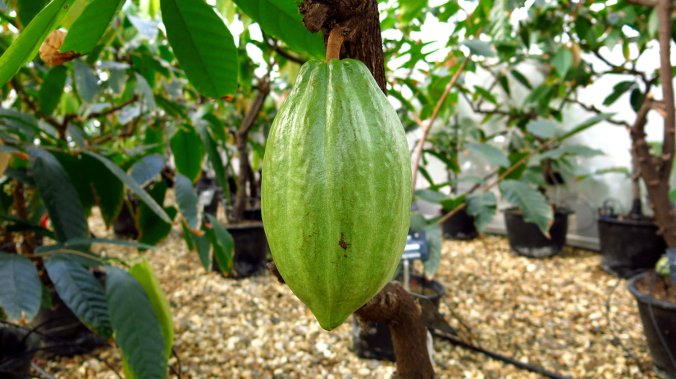
Rows of potted cocoa plants from around the world. Before a cocoa variety from one country can be planted in the other, it first makes a pit stop here, at a quarantine center in rural England. Courtesy of Dr. Andrew J. Daymond
Chocoholics have plenty to celebrate in this age of chocolate renaissance. But also plenty to worry about. Conservation is the answer to some of those worries, and collective action is the mechanism by which some of the conservation must be carried out. This article, again from “the salt” thanks to National Public Radio (USA), gives us one example:
The Fate Of The World’s Chocolate Depends On This Spot In Rural England
Walk into a row of greenhouses in rural Britain, and a late English-winter day transforms to a swampy, humid tropical afternoon. You could be in Latin America or Sub-Saharan Africa. Which is exactly how cocoa plants like it.
“It’s all right this time of year. It gets a bit hot later on in the summer,” says greenhouse technician Heather Lake as she fiddles with a tray of seedlings — a platter of delicate, spindly, baby cocoa plants.
Since she started working here at the International Cocoa Quarantine Centre, eating chocolate doesn’t feel the same.
“You certainly know all the work that goes into producing that chocolate bar, and all the potential threats that could be there in the future,” Lake says.











 Organikos