
The common garden lizard is a medium- sized, arboreal lizard with an oval head and laterally compressed body. In the male, the cheeks are muscular and swollen. Females are considerably smaller. Continue reading
The common garden lizard is a medium- sized, arboreal lizard with an oval head and laterally compressed body. In the male, the cheeks are muscular and swollen. Females are considerably smaller. Continue reading
If you did not know his poetry already, here is as good an introduction as any. If you knew his work but had not seen or heard him, this is worth the few minutes he commands of your attention. And if you thought poetry was in decline as an art form due to decreased interest in a multi-media-saturated modern world, you may have been right; or wrong.

Agence France-Presse — Getty Images. A Qatar Airways Boeing 787 Dreamliner.
Thanks to Green Blog for the story:
At the end of next year, Qatar Airways is scheduled to open a new airport that will include a 25-meter swimming pool and squash courts, among other amenities. But it will also be extraordinary from an energy standpoint because it will pump airline fuel made from natural gas.
Qatar has relatively little oil and vast supplies of natural gas. Continue reading

Coast Guard Museum NW. Citizen scientists have been invited to help transcribe logbooks from legendary American vessels like the Bear, which plied Arctic waters for four decades for the United States Revenue, the precursor of the Coast Guard.
An interesting historical take on a newfangled trend (click the image above to go to the source):
For many years now, volunteers working from home —people like you— have been able to help scientists with important problems.
In the first wave of these “citizen science” projects, people simply lent their computers to help solve problems that could be farmed out in pieces to thousands of machines. Continue reading
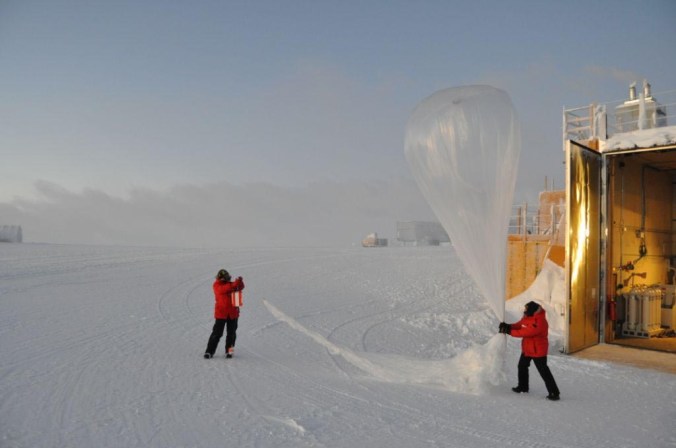
Staff at the South Pole get ready to release a balloon that will carry an ozone instrument up to 20 miles in the atmosphere, measuring ozone levels all along the way. NOAA image from 2011.
Click the image above to go to the story:
Warmer air temperatures high above the Antarctic led to the second smallest seasonal ozone hole in 20 years, according to NOAA and NASA satellite measurements. This year, the average size of the ozone hole was 6.9 million square miles (17.9 million square kilometers). The ozone layer helps shield life on Earth from potentially harmful ultraviolet (UV) radiation that can cause skin cancer and damage plants. Continue reading

Okay, we admit that Exxon fails the Really? test. Little about them shocks us at this point. We have highlighted examples of passing that test with flying colors, looking no further than our living room and even in our favored reading materials. But thanks to one of the best investigative journalists out there, a writer at The New Yorker and author of Private Empire: ExxonMobil and American Power, we find we still have a bit of shockability. Steve Coll, interviewed for a Front Line series on Climate Change (caveat emptor: that documentary film series is exhaustively full of Really? revelations; for a smaller dose, click the image above for the transcript of the Coll interview, or here for a podcast of an interview he gave about the book on Fresh Air):
In some ways, it’s kind of a no-brainer that Exxon would go after climate science on a very superficial level. It’s sort of in their self-interest to keep government away from fossil fuels, right? Is that how it began? Continue reading

Thanks to the Guardian:
In the 18th century, whalers who heard whales singing beneath their ships believed they were listening to the souls of drowned men. The notion of the silent ocean having a voice seemed so improbable. It wasn’t until the second world war and the advent of underwater acoustics that science discovered how vocal whales really are. Continue reading
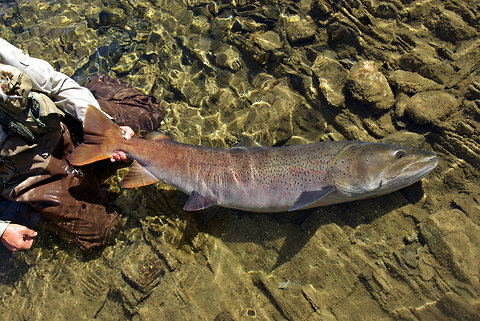
Click the image above to go to the story in Green Blog:
They call them “river wolves” — hundred-pound salmon large enough to snack on ducklings and on mice and muskrats fording the rivers. Five species of these huge fish inhabit the river waters of China, Mongolia, and eastern Russia, and all of them are finally on the “red list” of species compiled by the International Union for Conservation of Nature. Continue reading

We have been following them since the start of their journey, and remain transfixed (click the image above to go to the latest installment):
The dirty, squishy part of our straw bale house construction project is in full swing. Last month a dump truck poured a pile of reject sand next to the house. Reject is the dirt left over at a gravel pit, and its name says a lot about how valuable it is to gravel manufacturers. Continue reading

Photo credit: Stephen Crafts

Photo: Zagster. So far Zagster has set up its “bike fleet in a box” at about 55 locations
Click the image to the left for the story about Zagster, in the New York Times Green Blog:
Municipal bike sharing has rolled into dozens of American cities, from Washington to Oklahoma City to San Francisco. Now a Massachusetts start-up called Zagster aims to take the idea of bicycles on demand and deliver it to university and corporate campuses, apartment complexes, hotels and resorts.
On Thursday, the company, formerly called CityRyde, announced a $1 million round of investment that will allow it to expand nationally. In essence, Zagster’s idea is to make access to bikes a coveted building amenity and corporate perk, right up there with pools, gyms, and cafeterias — at a relatively low cost. Continue reading

Photo credit: Stephen Crafts
 Between the Western Ghats’ recent World Heritage Site designation and Periyar Tiger Reserve’s U.N. accolades reported here, awareness of our neighborhood is most certainly on the rise.
We’ve commented on PTR’s enlightened leadership previously, but it’s always encouraging to hear additional applause.
The Periyar Tiger Reserve (PTR) has won the coveted U.N.-India Biodiversity Governance award instituted by the Government of India and the United Nations Development Programme (UNDP) for the best managed protected area of the country.

AP Copyright © MediaCorp Press Ltd
While the Periyar Tiger Reserve, which we are closest to and particularly amazed by, was the exception to the rule below, we understood the ban. Tiger habitat is threatened, and radical action was taken. The Periyar Tiger Reserve was exempted from the ban for reasons complex and rich enough that we will have to explain on another occasion, but in short there is a history of enlightened leadership of this particular Reserve. For the moment, we will just relay today’s news, which comes as a relief to all the businesses surrounding all the Tiger Reserves across India, who were severely affected by the ban. Continue reading

Damien Hirst in front of one of his butterfly canvases, part of his retrospective at Tate Modern. Photograph: Ray Tang/Rex Features
He has his detractors (is he an artist or merely a shrewd entrepreneur?), but anyone who gives butterflies their due gets our attention:
Butterflies made Damien Hirst’s career and this is how he repays them: Continue reading

There are more than 50 well- known folk dances in Kerala. Although they are often related to religious rituals and mythological stories, they are also very much the languages of the people. Watching folk dance is an unforgettable experience for their dramatic costumes, vibrant colours and throbbing music.
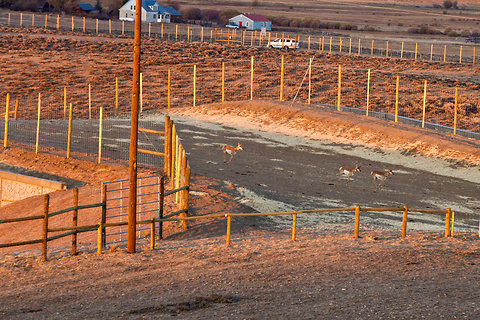
Jeff Burrell/Wildlife Conservation Society
For a small good news story, click the image above. It is from the Green Blog of the New York Times, and is the kind of story you would not read about in India because there are no states quite like Wyoming:
Until recently, the population of pronghorn — a small antelope-like mammal endemic to North America — outnumbered people in its native Wyoming. The Cowboy State may be the nation’s least populous, but the two groups still manage to come into conflict. Pronghorns numbering in the tens of thousands cross Highway 191 each year during their annual migration, and collisions between animals and cars are costly for all involved. Continue reading

Photo credit: Stephen Crafts

From the New Yorker’s website (click the image above to go to the story):
Can photovoltaics ever be romantic? Morphosis Architects’ design for a new academic building for the Cornell NYC Tech campus, scheduled to open on Roosevelt Island in 2017, suggests the answer could be yes. Continue reading
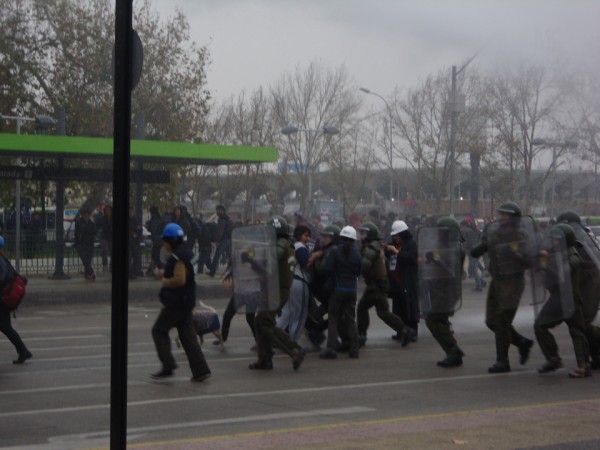
We do not know him (yet) but he has written an insightful article, worthy of some of our own favorite writers (where is Michael, you might reasonably ask):
Two particular days have helped me appreciate the variability and unexpected nature of reporting. One morning during my first week on the job at The Santiago Times (a English-language newspaper in Chile’s capital that covers Chilean and Latin American news), I picked up a pitch to go to a press conference the next day concerning homelessness in Chile. I was working on a different article when, an hour later, my editor poked his head into the writers’ room. Continue reading
 Organikos