Here Comes A Great One

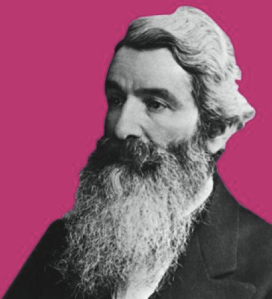
David Attenborough photographed at home in Richmond. Photograph: Suki Dhanda

We are reminded that David Attenborough will be sharing another round of greatness in the coming weeks (click the image to the left for the story):

Other stars to receive homage in 60 Years in the Wild include Jane Goodall and Dian Fossey for their ape-observation work, Francis Crick and Jim Watson Continue reading

Earthly Constellations

Thanks to Krulwich Wonders for the link and the observation, five minutes well spent looking and listening (click the image above to go to the video):

In this video, we are flying over the Earth, looking down and seeing what astronauts see when it’s nighttime, when lightning storms flash like June bugs, when cities look like galaxies, when you can see where people are. It’s quietly astonishing.

Wild Periyar – Indian Python (Python molurus)

The tropical climate with evergreen, semi-evergreen and moist deciduous forest in Periyar creates a perfect environment for snakes. The Indian Python is seen in dense as well as in open forest. Pythons are slow moving snakes, appearing timid and rarely rousing seriously to escape even when attacked. Pythons also have a peculiar method of movement, the body moving in a straight line like a millipede.

Continue reading

Genomic Approach To Art Discovery

Click the banner above to explore, or go to the site’s explanatory page, where the founder lays out the idea in plain and simple language:

Welcome!

On behalf of the Art.sy team, welcome to Art.sy and thank you for joining our beta. Our mission is to make all the world’s art freely accessible to anyone with an Internet connection. Art.sy is a free platform where you can discover, learn about, and collect art. Continue reading

Writer’s Craft

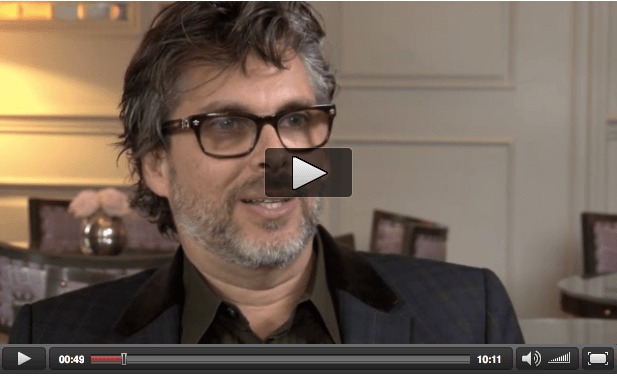
There will never be a need for Chabonologists in the way there are Dylanologists.  The market for anyone-ologists is created by artists (novelists, poets, song-writers included) who cannot or will not talk about their work. Capable and willing artists seem to be the exception rather than the norm so we celebrate them when we find them. Chabon is a superb conversationalist, and is on on the road talking about his book. Thankfully he spent some time with the Guardian‘s great Sarfraz Manzoor describing the inspirations behind Telegraph Avenue.  Click the image above to go to the video.

Farming, Biodiversity & Cooperative Conservation

All over the world farmers like Bishnu Maya (in Nepal) are the main custodians of agricultural biodiversity through the conservation, use and improvement of plant genetic resources on-farm

Click the image above to go to the source of this interesting look at the relationship between farming, biodiversity and conservation:

The study ‘Flows under stress: availability of plant genetic resources in times of climate and policy change’ describes how eight members of the CGIAR Consortium, whose research is focused on plant genetic resources, are (re)organizing their conservation and improvement activities in light of climate change adaptation. Continue reading

Architect As Educator

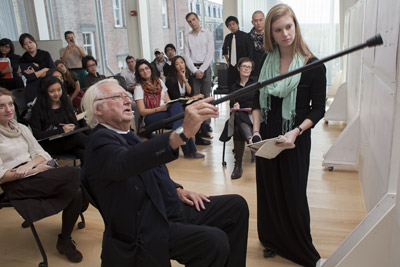
Architect Richard Meier ’56, B.Arch. ’57, visits an architecture studio class Oct. 17 in Milstein Hall, where as an assignment students had prepared drawings interpreting Meier’s designs. Photo credit: Robert Barker/University Photography

We miss our 2012 interns! But we stay attuned to their educational activities. If we squint hard enough looking at the photo to the right, showing one of the most prominent architects in the world speaking to a group of architecture students at Cornell University, we almost think we can see Chi-Chi

Maybe not. But it is worth a quick read to understand the value of the exercise Mr. Meier has engaged his students in:

Meier, whose iconic building designs include the Getty Center in Los Angeles, is the only Cornellian awarded the Pritzker Prize for Architecture, considered the field’s highest honor. Since receiving the prize in 1984, Meier has been recognized with the American Institute of Architects Gold Medal and awards from the Japanese and French governments and the Royal Institute of British Architects. Continue reading

Learning, Thinking, Doing

Cornell University President David Skorton, and his renaissance man colleague Glenn Altschuler co-write a blog called College Pros(e) and today they make an argument about college majors, and what matters in choosing them–a perspective we happen to share in its entirety.  Click their image to go to the post, which is worth more than the three minutes it takes to read it:

…Liberal arts majors actually do just fine, with incomes far in excess of the median in the United States. And many of them, like the Cornell graduates surveyed in 2009 (download here), are as satisfied or more satisfied with their lives as their classmates in other disciplines. For them, to quote an English proverb, enough is as good as a feast.

The liberal arts, moreover, also serves as a preferred pathway to rewarding and remunerative careers…

Read the whole post here.

Science, Bees, Art

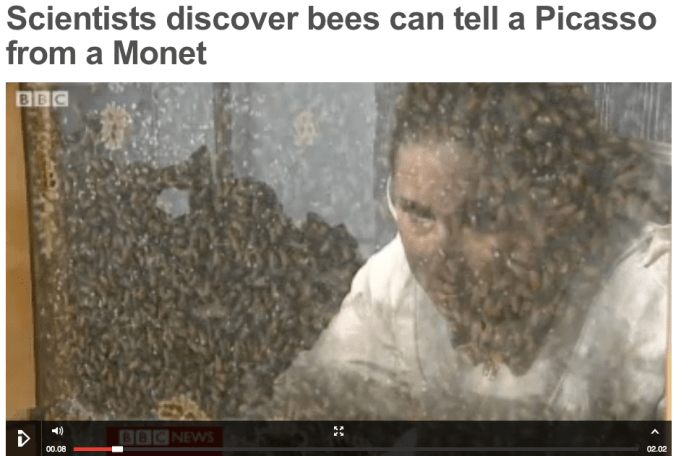
Click the image above to go to the video:

Scientists in Australia have discovered bees have a remarkable ability to distinguish different types of paintings.

The experiments, carried out at the University of Queensland, showed the bees could pick a Monet over a Picasso.

The aim of the research is to discover more about how bees search for food and help us understand how humans learn.

Birds, Birders & Megastorms

Watch also for our 2PM eBird story with final predictions and strategy recommendations for birding Sandy.

If there is a silver lining to every cloud–even the most unwanted clouds–birders will always find them. We appreciate the “safety first” approach as much as the sense of dedication to the craft. Click the image above to go to the story:

…this is a going to be a wet, messy, and dangerous storm that affects a wide swath of the Eastern Seaboard! Occurring on a full moon, the storm surge is likely to be huge–very damaging and very dangerous. Given that, we implore exuberant birders to think about safety first, and don’t take risks!  Continue reading

If You Happen To Be In Portland (Maine)

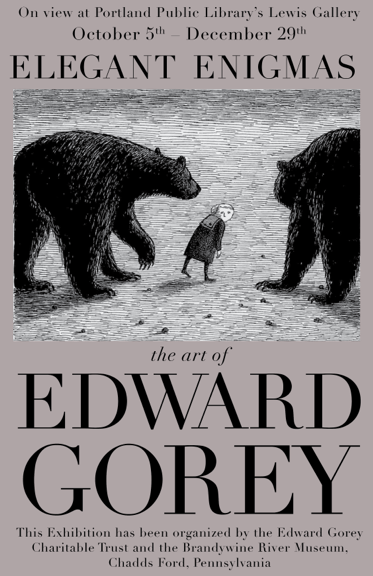
Our never-ending commitment to demonstrate the value of public libraries–not just the institution as a great idea but all its phenomenal specific examples– led us to the Portland, Maine Public Library.  We wish it were as simple as walking down the street to visit this exhibit…

Click the image to the right to go to its website, highlighting the roles of Maine College of Art and Portland Public Library. And major thanks to The Bank of Maine, mainly for funding generously provided to support your public library, but also for doing it with a master of illustrated story-telling.

If you happen, like many of us on this site, to be a devoted fan of Mr. Gorey, you might find this profile of him in Harvard Magazine to be of interest.  And for that matter, if you happen to be in Portland, Maine then you are relatively not so far from the Gorey home, which is open to visitors.


1897, Muir’s View Of American Forests, With A Comparison To India’s

In India systematic forest management was begun about forty years ago, under difficulties—presented by the character of the country, the prevalence of running fires, opposition from lumbermen, settlers, etc.—not unlike those which confront us now. Of the total area of government forests, perhaps 70,000,000 acres, 55,000,000 acres have been brought under the control of the forestry department,—a larger area than that of all our national parks and reservations. Continue reading

If You Happen To Be In Washington, DC

An ongoing exhibition at the Smithsonian’s National Museum of African Art asks visitors to consider the connections between art and science — and how they each attempt to explore the why, when and how of our existence. “African Cosmos: Stellar Arts” illustrates how the stars and planets we see in the sky have been influencing African art and ritual for generations. Continue reading

Rainforest Guardians

I’m on patrol with the forest rangers of Gola rainforest national park. I’m spending two days with them, gathering data and hopefully preventing poaching as well as illegal mining and subsistence farming within the park. My aim is to get to know the rangers and experience a day in their life. I want to know what challenges they face as well as what gives them the most satisfaction at the end of each day.

Continue reading

Technology & Happiness

Yarek Waszul

From the New York Times (click the image to the left to go to the source), a recent story covered a topic that one of our contributors would likely post on, if he was not on the road, toting his mobile device around in that cute sleeping bag.  As an aside, Neema was quoted in a story related indirectly to this one:

Speed, instant gratification, accessibility — these are a few of the appealing hallmarks of digital technology. It’s no coincidence that we love our smart wireless devices: Humans are a notoriously impatient species, born with a preference for immediate rewards.