Canvus & The Beauty Of Upcycled Turbines

Visitors to Every Child’s Playground in Avon, Ohio, will find products from Canvus’s nearby factory. Photographer: Brian Kaiser/Bloomberg

We missed Bloomberg’s story about Canvus back in November, but happy to share it now:

Retired Wind Turbine Blades Live on as Park Benches and Picnic Tables

To keep turbine blades from piling up in landfills, startups like Canvus are turning them into new products — and free marketing for wind power.


At first glance, the benches outside the Great Lakes Science Center in downtown Cleveland seem unremarkable. But a closer inspection shows that their droplet-shaped shells aren’t made from wood or metal. A scan of the attached QR codes reveals even more: These benches used to be wind turbine blades…


A big thanks to Yale Climate Connections for bringing Canvus to our attention today:

Carbon Clean 200’s Performance Update Report

A press release for this report above summarizes the findings:

Carbon Clean 200 Companies Outperform Dirty Energy by 39%

The 11th cohort of global Clean200 leaves dirty energy investments in the dust

As You Sow and Corporate Knights today released their 11th update of the Carbon Clean200™, a list of 200 publicly traded companies worldwide leading the way among global peers to a clean energy present and future. These companies generated almost double the returns of the main fossil fuel index from July 1, 2016, to January 15, 2024, despite geopolitical tensions that have favored fossil fuel stocks in the past two years. Continue reading

Returning Golf Land To Nature

The San Geronimo Golf Course is being reclaimed and rewilded and is now known as San Geronimo Commons. Jim Wilson/The New York Times

Golf is known to be problematic. But then again, what is not problematic? And we appreciate seeing cases where golf gives way to nature. Our thanks to Cara Buckley for bringing this story to our attention in the New York Times. We applaud the imagination of those responsible:

After Shutting Down, These Golf Courses Went Wild

The restoration of the San Geronimo land is still underway. Trails are planned that would skirt sensitive habitat and help to make it starkly different from its time as a golf course. Jim Wilson / The New York Times Image

Most defunct golf courses get paved over, but a number are getting transformed into ecological life rafts for wildlife, plants — and people.

There was scraggly grass in one sand trap and wooden blocks and a toy castle in another, evidence of children at play. People were walking their dogs on the fairway, which was looking rather ragged and unkempt. This was only to be expected. Continue reading

Pause On Terminals for LNG Export

Activists protest against fossil fuels and in particular fracking and liquefied natural gas, or LNG, on day eight of the UNFCCC COP28 Climate Conference at Expo City Dubai on December 8, 2023, in Dubai, United Arab Emirates. (Photo by Sean Gallup/Getty Images)

The news was hailed weeks ago as a big deal. Yale Climate Connections takes the proclomation a step further:

Why Biden’s pause on new LNG export terminals is a BFD

The administration’s move puts a spotlight on a potent climate-warming gas: methane, the main ingredient in natural gas.

Natural gas has long been touted as a “bridge fuel” to a clean energy future that gets all its power from renewable sources like wind, solar, and geothermal power. Continue reading

Jaron Lanier On Artificial Intelligence

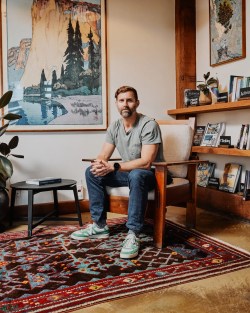
In case you cannot read his essay any time soon, but can watch or listen for an hour, this is equally illuminating. And since he is a quirky fellow, Jaron Lanier’s work and living space is worth a look.

Jaron Lanier On Virtual Reality

Illustration by Jackie Carlise

Jaron Lanier has been our go-to voice of reason at important moments in technology hype. Here is his take on the latest hype:

Where Will Virtual Reality Take Us?

Apple’s Vision Pro headset suggests one possible future—but there are others.

Because we in Silicon Valley are newness junkies, it can feel like an act of sabotage to have memories, but, for better or worse, I have them. It’s been more than forty years since I co-founded the first company to make headsets and software for simulated experiences, and came up with familiar terms like virtual and mixed reality. Continue reading

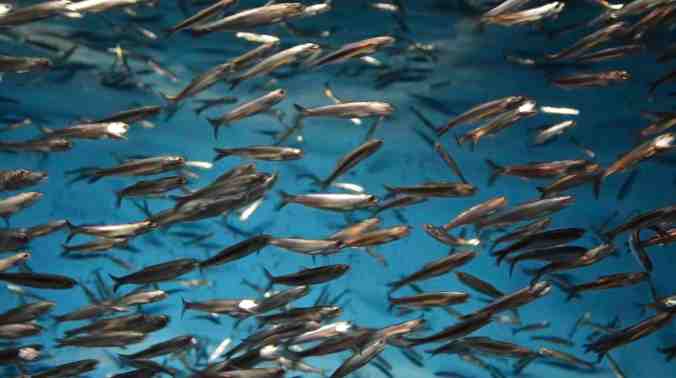
Anchovies Rock

Kalichka / Getty

Anchovies are not exactly a staple in our pages, but they make their presence known. They are important. Thanks to The Atlantic, and their collaboration with Hakai Magazine for this article by Christina Couch that illustrates another remarkable feature of these small creatures:

The little fish’s mating rocks the ocean as much as a major storm.

Bieito Fernández Castro wasn’t expecting to find a turbulent hotbed of anchovy sex.

Commissioned by the Spanish government to investigate the conditions behind algae blooms, which kill mussels, Continue reading

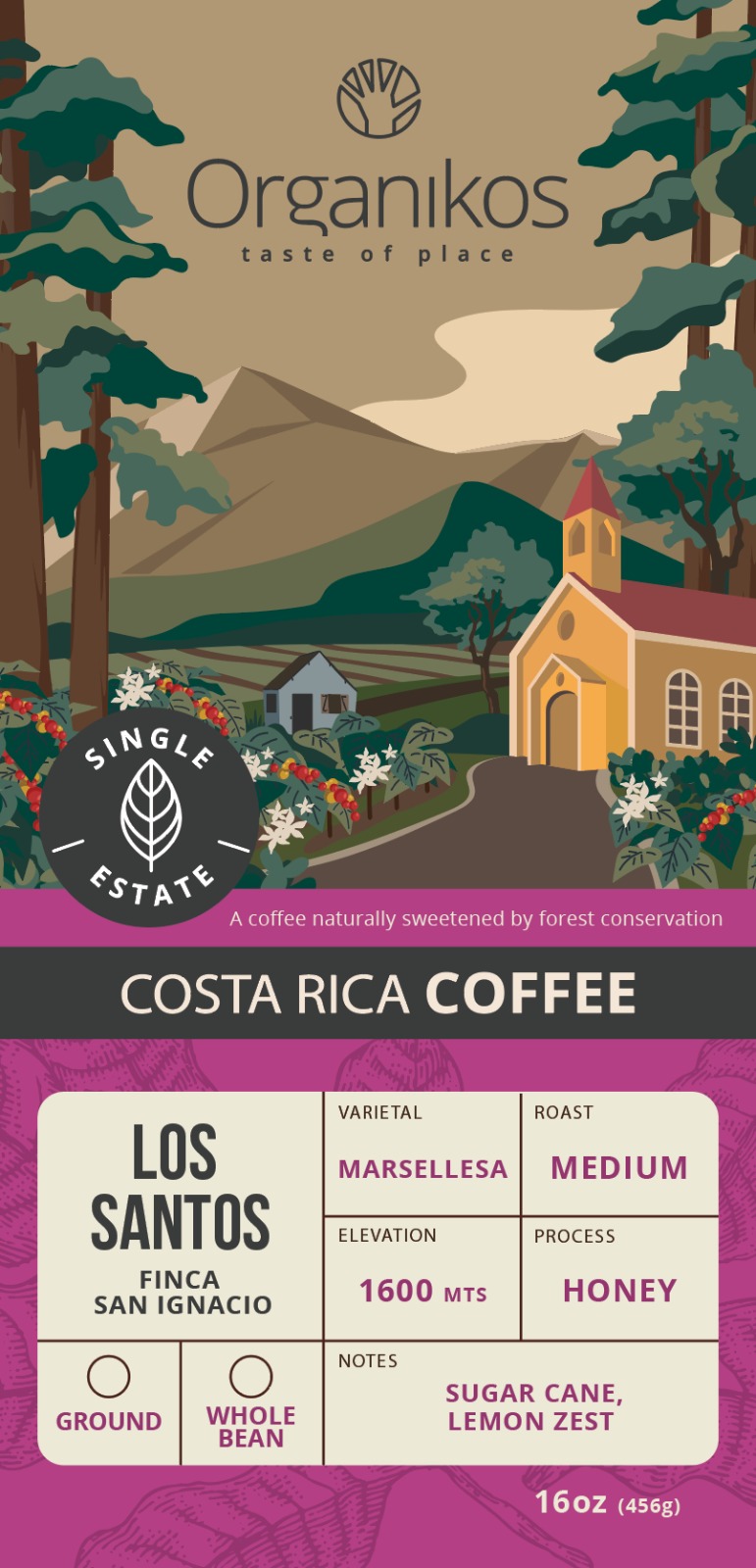
Finca San Ignacio, High Elevation Enlightenment

The land of Finca San Ignacio is 57% covered by forest, a form of conservation that is both generous to the planet and beneficial to the quality of the coffee. Shade-grown coffee has numerous environmental benefits, and the natural process of preparing the beans after harvest makes this coffee sweeter than the washed method allows.

This farm is in the highlands of the Los Santos growing region. In a bend to circularity, high elevation not only benefits coffee quality but is also where forest conservation has greater impact. Water first enters the earth’s filtration and storage systems with rains at higher elevations. Conservation of forest up there is more valuable than conservation at the base of the mountain. We see enlightenment at Finca San Ignacio.

Central Valley Reserve

Central Valley coffee farms produce reliably high quality beans. A few farms produce beans of unusual quality, and we source from these farms to create a blend worthy of the name Reserve. Unlike the chocolate notes typical of a Los Santos coffee, or more fruity or floral notes from other regions, here we find a special toasted nut sensation.

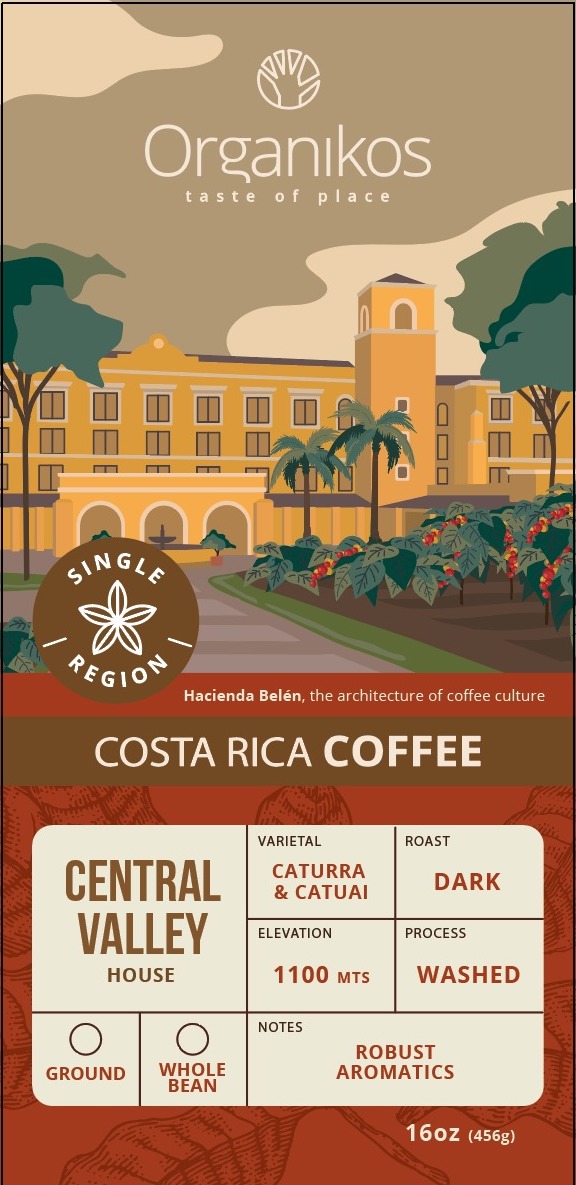
The “architecture of coffee heritage” caption for the image on this label refers to the fact that this building from the 1990s pays tribute to the history of coffee in Costa Rica. It was built within a coffee hacienda, and this year thousands of coffee plants are being replanted on the property. If you have an interest in the feeling of a coffee plantation, and plan to visit Costa Rica, you could not do better than spend a few days here.

Hacienda House, Dark Roasted

The same principles in the description of Italian roast apply in moderation to this dark roast of beans from the Central Valley. This region has not racked up prizes in competitions the way Los Santos coffees have. You might characterize it the way a work horse is different from a race horse. High utility; gets the job done with strength and consistency.

That metaphor has its limits but works for the same reason we call this our house coffee. For those who want to start the day with the energy that coffee offers and the strength of character that a dark roast provides, this is a reliable choice. The illustration on the label is of one of the first two locations where we set up shop when Organikos was being introduced through the Authentica shops.

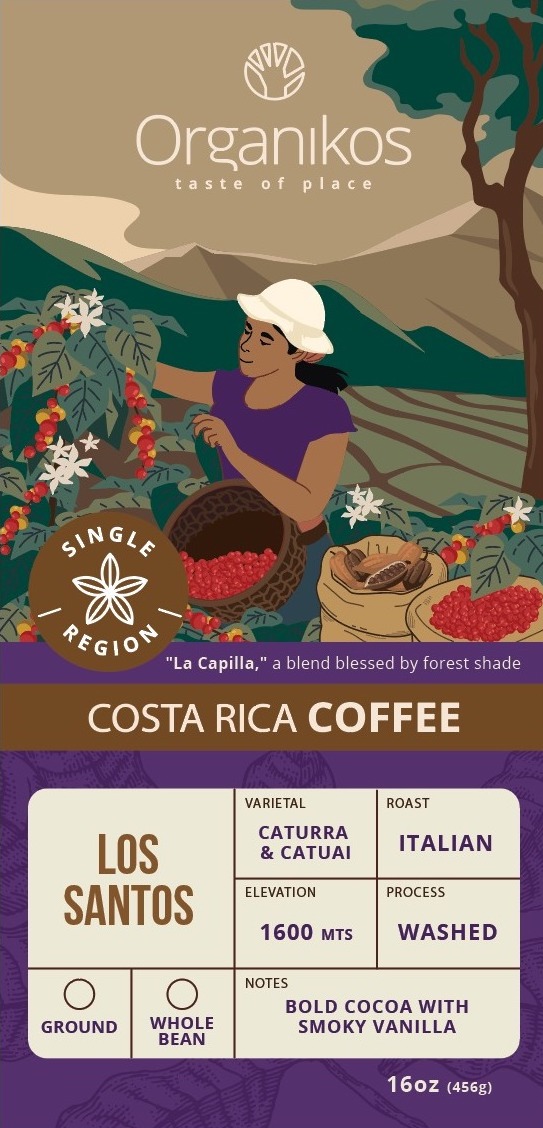
La Capilla, Italian Style

We offer La Capilla roasted at a higher temperature, around 480°F, and for 5–10 minutes longer than the medium roast. When roasted to the Italian level these beans arrive at a much darker brown color, closer to black, covered in oils released from the high temperature and length of exposure to that heat. It has a lower acidity level, leading to a boldness that is not the characteristic of the same beans roasted medium, which have a mellower mouthfeel.

Roasted hotter and longer also creates a slight smokiness, with notes of chocolate and a particular type of sweetness from the beans’ internal sugars being caramelized. Something about this combination, we have found, either you love, or you do not love. If you do, this is your coffee. If not, go medium.

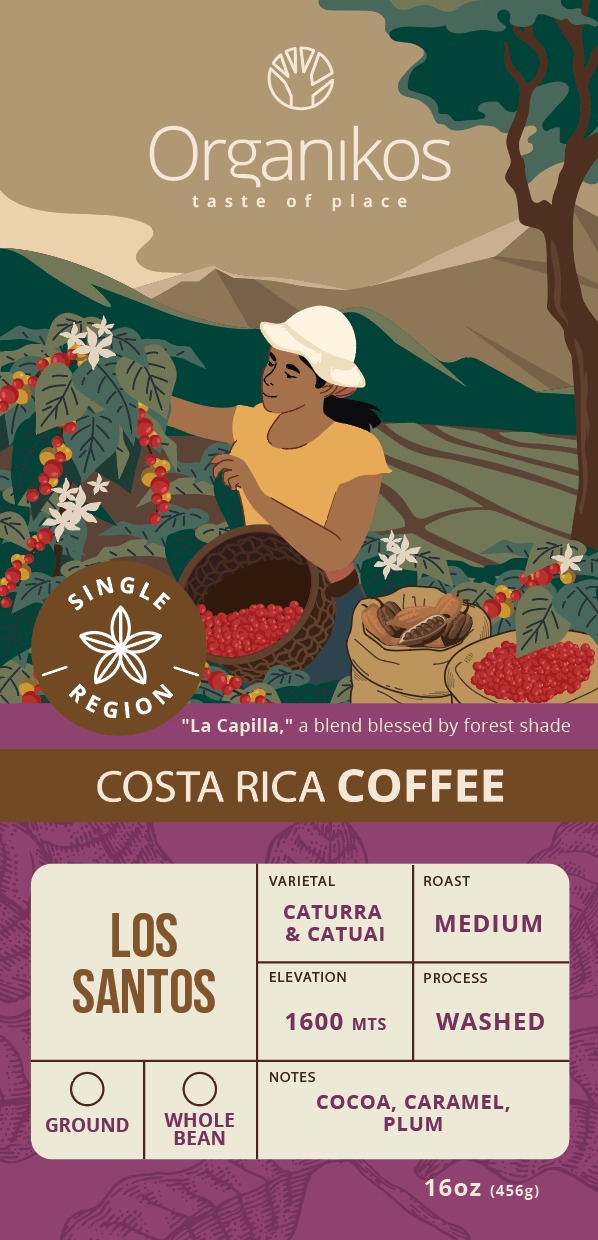
La Capilla, A Plum Assignment

These beans, blended from a select group of smallholder coffee farms collectively known as “the chapel,” have a new illustration. This week it debuts in our shops in Costa Rica. A year after we introduced this coffee in our shops we could only guess it was to become the bestseller it now is.

During the pandemic, when the airports were shut down and there were few visitors to our shops, honoring the contracts we had with these farmers got us thinking creatively. We started offering this and a few other of our coffees for sale in the USA. Because it was a favorite in our home, La Capilla was chosen for this plum assignment. Then we knew.

Tarrazu started its qualification for denomination of origin status the same year we started roasting it, and qualified two years later. The rules are still being clarified on how to use the name, so on our labels we have reverted to the region’s traditional name Los Santos.


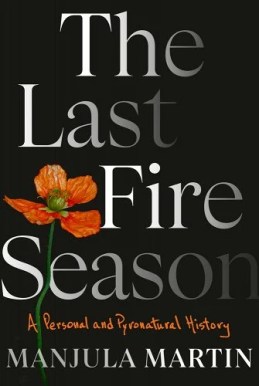
The Last Fire Season, Reviewed

Fire and its suppression are topics we are never quite sure about. Scientifically, there may be a correct answer. But this personal account sounds worthy of consideration as well.  This book review by Casey Schwartz in The Atlantic makes a compelling case:

Living Through the End of California
In a new book, Manjula Martin faces up to the way the altered environment of her home state will change her life forever.

In his 1998 book, Ecology of Fear, Mike Davis, the late California muckraker and self-proclaimed Marxist environmentalist, made the case for “letting Malibu burn.” Continue reading

Melipona Bees, A Peruvian Wonder

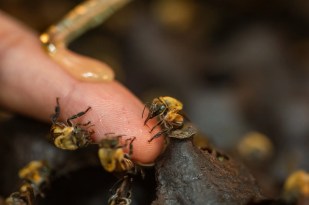
Melipona eburnea, a species of bee, is native to the Amazon. Unlike the more familiar but invasive honey bees from Africa and Europe that have spread through the Americas, these bees don’t sting. Ana Elisa Sotelo for National Geographic

The countless wonders of bees, as well as the many problems they now face, have made Melipona bees, also known as stingless bees, of particular interest to our daily scan for news stories:

Native to the tropics, these pollinators are taking a lead role in one of the latest efforts to conserve the Amazon rainforest.

Investing Patagonia’s Proceeds In Conservation

Greg Curtis, the former deputy general counsel of Patagonia, is responsible for giving away huge sums of money to causes that are aligned with Patagonia’s history of environmental activism. Adam Amengual for The New York Times

When news broke about the company’s future, we were in awe; since then we heard little so this is a welcome update:

Patagonia’s Profits Are Funding Conservation — and Politics

$71 million of the clothing company’s earnings have been used since September 2022 to fund wildlife restoration, dam removal and Democratic groups.

A little more than $3 million to block a proposed mine in Alaska. Another $3 million to conserve land in Chile and Argentina. And $1 million to help elect Democrats around the country, including $200,000 to a super PAC this month.

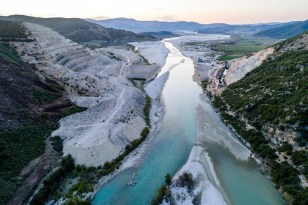
The site of the Kalivac Dam on the Vjosa River in Albania, where Holdfast has funded a major conservation project. Andrew Burr/Patagonia

Patagonia, the outdoor apparel brand, is funneling its profits to an array of groups working on everything from dam removal to voter registration.

In total, a network of nonprofit organizations linked to the company has distributed more than $71 million since September 2022, according to publicly available tax filings and internal documents reviewed by The Times. Continue reading

Scotland’s Farmed Salmon Deserves Attention

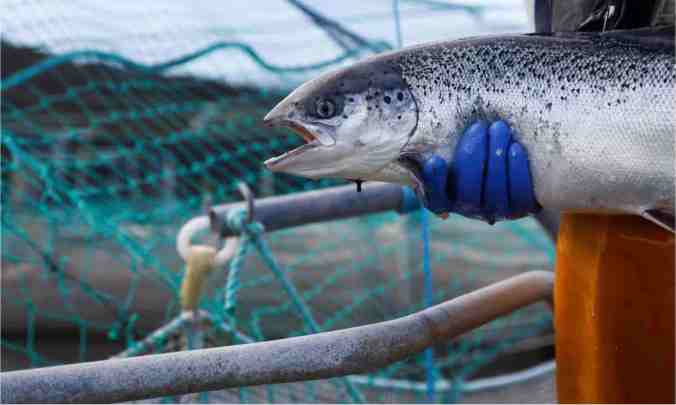
Salmon farms certified as organic have to adhere to certain standards. Photograph: Murdo MacLeod/The Guardian

Scotland has been moving in the right direction in other ways, so this call for action in an area where they have not been leading with best practices is worthy of attention. Thanks to the Guardian’s Karen McVeigh for providing it:

‘Unacceptable greenwashing’: Scottish farmed salmon should not be labelled organic, say charities

Open letter calls for Soil Association certification to be removed from industry, amid concerns of negative environmental impact

The British body that certifies food in the UK as organic has been accused of misleading consumers over its labelling of Scottish farmed salmon.

Thirty charities, conservation and community organisations, including WildFish, the Pesticide Action Network and Blue Marine Foundation, say the negative environmental impacts of the industry in Scotland “run completely counter” to the principles of the Soil Association’s promotion of healthy, humane and sustainable food. Continue reading

Renewables Outpacing Demand In Scotland

A wind farm in rural Scotland. THE SCOTTISH GOVERNMENT

Not exactly manatee charisma, but another ray of sunshine from a place we have been cheering from a distance for a few years now:

Scotland’s Renewable Output More Than 100 Percent of Demand

For the first time, in 2022, Scottish renewables generated more power than the country used, new government figures show.

The growth of wind power, coupled with a small drop in electricity consumption, meant that the volume of electricity produced by renewables in Scotland was equal to 113 percent of demand. Continue reading

Manatees, To Brighten Your Horizon

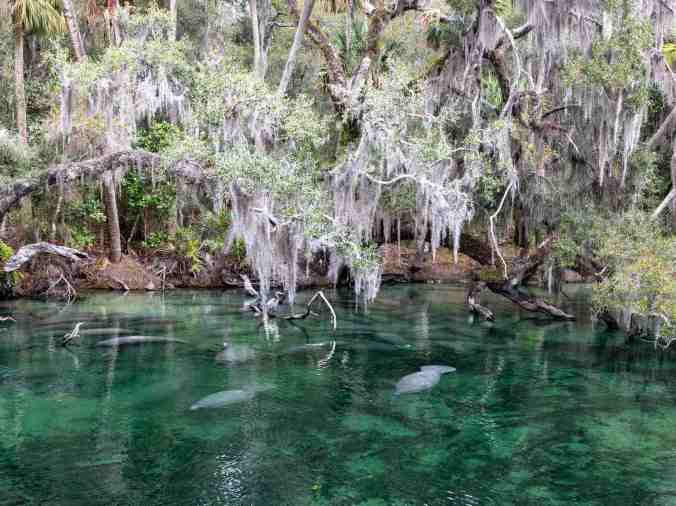
Manatees are generally solitary creatures, but tend to gather at warm water sites in the winter.
Florida State Parks

After a Kolbert doomcloud, a bit of sunshine is needed. Here it is in the form of creatures so charismatic they make you see something other than darkness. Thanks to National Public Radio (USA):

Legend has it that centuries ago, manatees used to be mistaken for mermaids, so a sight last week at one Florida state park would have put ancient sailors in shock.

Blue Spring State Park is home to one of the largest winter gathering sites for manatees in Florida, and recently, the park reached a new record when the number of manatees spotted in one group was nearly 1,000. Continue reading

A 20-Minute Read On Problematic Forest Management Policies

Elizabeth Kolbert always carries out her duty, which often makes it difficult to savor life’s small pleasures or even big victories without considering the law of unintended consequences. Give 20 minutes of your time to this one:

The Perverse Policies That Fuel Wildfires

Strategies intended to safeguard forests and homes have instead increased the likelihood that they’ll burn.

The provincial government of Alberta defines a “wildfire of note” as a blaze that could “pose a threat to public safety, communities or critical infrastructure.” Continue reading

Hydrogen & Us

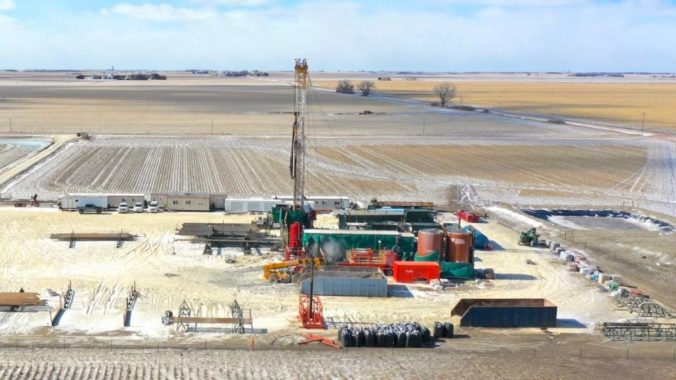
A hydrogen drilling facility in Nebraska. NATURAL HYDROGEN ENERGY

Thanks to Fred Pearce, as always, for making the complex more comprehensible; and to Yale e360′s contribution to our continuous learning:

Natural Hydrogen: A Potential Clean Energy Source Beneath Our Feet

As studies show far more natural hydrogen underground than believed, well-funded efforts to drill for the gas are underway around the globe. Boosters see a plentiful green replacement for fossil fuels, but skeptics say its large-scale use may not be practical or cost-effective.

A remote community of mud huts and corrugated iron roofs in the arid savannah of West Africa could be a trailblazer for a new form of carbon-free energy. Continue reading