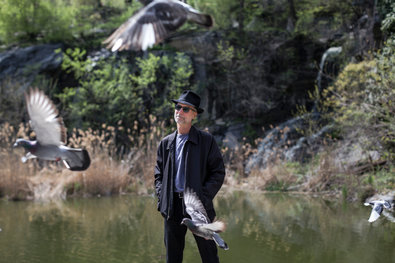
Chad Batka for The New York Times. “It’s impossible for us to separate who we are from where we are”: John Luther Adams, the composer of “Become Ocean,” in Morningside Park in Manhattan.
Thanks to Corinna da Fonseca-Wollheim for A Composer Attuned to the Earth’s Swirling Motion, in which John Luther Adams discusses “Become Ocean,” which will be performed on Tuesday at Carnegie Hall, and his other environmentally themed works. Their discussion rings true to us. Where we are is a large part of who we are.
That resonates with La Paz Group’s ethos. If we are not sensitive to where we are, who are we? We wonder that every day, so we recommend the article in today’s New York Times Arts section that offers a well-deserved review and praise of the work of an environmentally-inspired/concerned composer who we first heard about last July when the New Yorker‘s music critic wrote the following:
The hundredth anniversary of Stravinsky’s formerly scandalous Rite of Spring, on May 29th, raised the question of whether a twenty-first-century composer can produce a comparable shock. Perhaps not: the twentieth century elicited such a numbing array of shocks, both in art and in reality, that the game of “Astonish me”—Diaghilev’s famous command to Cocteau—may be temporarily played out. Still, astonishment comes in many forms. There are shocks of beauty, shocks of feeling, shocks of insight. Such were the virtues of John Luther Adams’s Become Ocean, a forty-two-minute piece for large orchestra, which had its première at the Seattle Symphony on June 20th. Like the sea at dawn, it presents a gorgeous surface, yet its heaving motion conveys overwhelming force. Whether orchestras will be playing it a century hence is impossible to say, but I went away reeling. Continue reading →












 Organikos