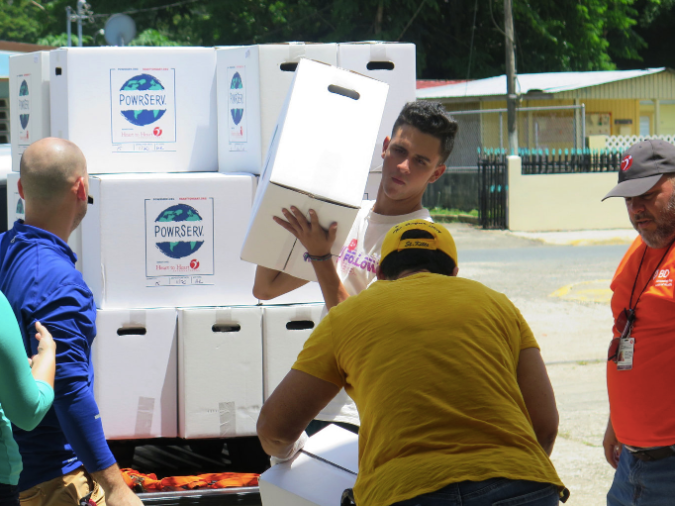
Foundations and charities are helping individuals, communities and businesses install solar panels and battery systems in Puerto Rico, with dual goals: to move the island toward renewable energy and allow small towns to be less dependent on the energy grid in case of another disaster. Greg Allen/NPR
Entrepreneurship and innovation are synonymous in many ways, starting with the ability to “think outside the box”. It’s even more inspiring when people put their creative efforts toward helping communities and the environment. Considering solar power in a Caribbean island environment may not seem like such a novel idea, but garnering private sector support for progress so the government can regroup after a natural disaster is a good example of leadership.
Mameyes is a small community of about 1,000 people high in Puerto Rico’s central mountains. But in its own way, it is one of the leaders of Puerto Rico’s energy future.
Francisco Valentin grew up in Mameyes, where he runs a small store. Even before Maria he had big ambitions for his town. After Maria, he knew he wanted his community to run on solar power. And with the help of foundations, charities and the University of Puerto Rico — not the government — he has done that, converting the town’s school, health clinic and several other buildings.
The move to solar was important, Valentin says, because after Maria it took months before power was restored to the area. This makes Mameyes self-sufficient and able to respond to residents’ needs in future disasters. “The whole school is fully solar energy” and can serve as a shelter, he says.
With so much sunlight on tap, solar power has begun to boom in Puerto Rico since the hurricane. Across the island, individuals, communities and businesses are installing solar panels and battery systems. At the Community Foundation of Puerto Rico, Javier Rivera is working on solar systems with 50 mostly rural, underserved communities. His goal is to wire 250 communities for solar over the next few years.
Rivera says that especially after the hurricane, people realized they couldn’t depend on Puerto Rico’s Electric Power Authority. “Many people [didn’t] trust in the PREPA system before the hurricane. It’s not a secret,” he says. “People start to think about trying to find a solution, a long-term solution. And the sun is one of them.”
Continue reading →





 Organikos