
Yellow-footed Gull
Driving in California’s Imperial Valley, you come across something completely unexpected. On the horizon in the middle of the Californian desert, you can faintly see what appears to be the ocean.
Yellow-footed Gull
Driving in California’s Imperial Valley, you come across something completely unexpected. On the horizon in the middle of the Californian desert, you can faintly see what appears to be the ocean.

Red-crowned Parrots
With this entry, I begin a series describing some of the places I have been birding in North America that I think anyone with an interest in birds would enjoy visiting. Not only are these places incredibly birdy, they are also often wild, usually beautiful, and always memorable.
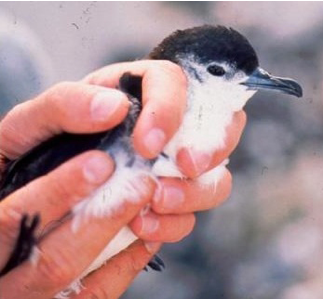
Some fields of scientific study rack up an astounding rate of new species discoveries annually; think entomology as an example. But ornithologists are currently more likely to be subtracting species than adding them.
But last year Peter Pyle, a sharp eyed scientist at the Institute of Bird Populations noticed something amiss while studying a group of pelagic bird specimens in the Smithsonian’s collection from 1963. Pyle’s theory was strong enough to merit a DNA study and it was discovered that the small bird had been misidentified as a Little Shearwater. The analysis was correct and the bird was given the name Bryan’s Shearwater, Puffinus bryani. Continue reading

Sprague's Pipit
When you ask someone why they are not a birder nine times out of ten they will say, “birds are awesome, but I don’t know how you tell those little brown birds apart”. To be completely honest, trying to distinguish between a Cassin’s and a Botteri’s Sparrow in the American southwest can be rather tedious and challenging; and when visiting the lower Rio Grande Valley in Texas birds like Green Jay seem a lot more appealing than a Clay-Colored Robin. But those boring, pass over in the field guide, birds can be some of the most rewarding as they often times are even rarer and harder to find.

Black-footed Albatross
A voice rang out from the stern of the boat, “Black-footed Albatross, nine o’clock”. Dreams from the night before were coming true as an Albatross, the hermit of the sea, sailed past me and onto my life list…Number 600. A journey that began five years ago had reached a major milestone. The day before I reached 600, my dad and I arrived at our Monterey hotel anxiously awaiting our pelagic trip. I was four species short of my milestone, and I wanted to reach it in California.
I am constantly amazed by the number of artists who find inspiration from the world of ornithology. Whether crafted with bits of bauble, tufts of fabric or a steady, painterly hand, birds have attracted the artistic imagination since mankind had tools to immortalize it.
Working with handmade clay, paper and paint, this “birdophile” artist who works under the name “Dou Dou” (the French term for a child’s “lovey”, or something that is most cherished) makes no secret of her feelings for the world’s feathered creatures. Continue reading

Nesting Brown Noddies
The sun rose on a beautiful spring day in southern Florida. After a week and a half of birding with my dad across the state, our trip was coming to a close. During this time we had seen some amazing species: Mangrove Cuckoo, Snail Kite, Swallow-tailed Kite, Snowy Plover, Black-whiskered Vireo, Short-tailed Hawk, and so much more. However, we had saved the best for last.
A post from early November saved a similar video of starlings for the end. Twitchers (a nickname for seriously devoted birdwatchers) were expected to read to the end and see that video as a crescendo of beauty. Continue reading
There may be many cases of co-adaptation between species, but we do not encounter them frequently. This video clip is one sampled from the thousands (hundreds of thousands?) of hours that the BBC has invested in for the sake of it various nature programs. Because it is made available on Youtube, which has an intellectual property rights vetting process, it seems to be an example of the BBC’s generous contribution to the commons.

Woodpecker specimens, Ornithology Department, Harvard Museum of Comparative Zoology
When the oldest birding group in the U.S. gets together woodpeckers and their historical significance among endangered bird species are often the order of the day. The Nuttall Ornithology Club held one of their last meetings of 2011 at the Harvard Museum of Comparative Zoology, excitedly taking advantage of such a rich resource that includes specimens that have both ornithological and historical value.
The Nuttall club goes way beyond the garden variety birding group. Qualification for membership includes examples of ornithological scholarly publication, education, research and conservation efforts. Roger Tory Peterson, (of guidebook fame) is an example of the group’s “high bar”.
Paula Swisher, a Pennsylvania artist, creatively superimposes birds onto textbook pages through colored pencil and other media. These mixed images are great juxtapositions of wild beauty and careful order; colorful flight and monochrome data.
While visiting the state of Karnataka recently, in the Rajiv Gandhi National Park, I saw many birds (as well as countless deer, about a dozen elephants, and a couple mongooses–but these mammals are for another post). Several pieces of Swisher’s art reminded me of some of these birds:
My first trip to Kenya was about two years ago; unfortunately, I never ventured outside the borders of Nairobi. This time, I pledged to experience the nation’s countryside firsthand. Above is a sample of what I saw from Lake Nakuru and the drive to the Masai Mara. Continue reading
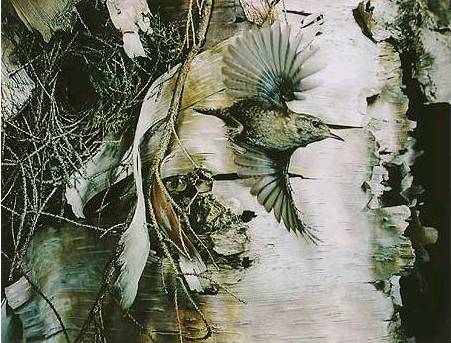 Eliot Porter Winter Wren, 1969 Amon Carter Museum Collection*
Sometimes it takes a scientific mind to re-calibrate the artistic eye. Eliot Porter’s parents had instilled a love of nature and science in him from an early age, and he’d been photographing birds since received his first camera at the age of 10. His training in medicine and as a chemical engineer didn’t dampen his interest, in fact he was among the first to bridge the gap between photography as a fine art and its foundations in technology and science. Continue reading
Visit the Cornell Lab of Ornithology’s website, for whatever reason, and you will likely get carried away. Something will catch your eye, and your imagination, and the resulting search will lead somewhere like this. This particular weekend you may soon enough find yourself (courtesy of the New York Times Travel Section) here:

If you are like us, you will immediately want to know more about that vulture conservation thing. Continue reading

Thekkady, Kerala

Left: Ivory Billed Woodpecker by John James Audubon;
Right: Imperial Woodpecker by John Livzey Ridgway
In the world of ornithology and bird watching, scale is as important as plentiful plumage, vivid color or song style. From Cuba’s Mellisuga helenae (bee hummingbird) to the Andean Condor, life lists are often based on superlatives. The Campephilus (woodpecker) family has its own followers, especially the larger species that have eluded scientists and amateurs alike for decades.
While in Chaihuín, part of the Nature Conservancy’s Valdivian Coastal Reserve in Chilean Patagonia, we saw the Magellanic Woodpecker, a sighting that preceded a “Stop the Jeep!” moment of excitement. Part of that excitement was based on the memory of a Cornell Lab of Ornithology film we’d recently seen about the Ivory Billed Woodpecker. Continue reading
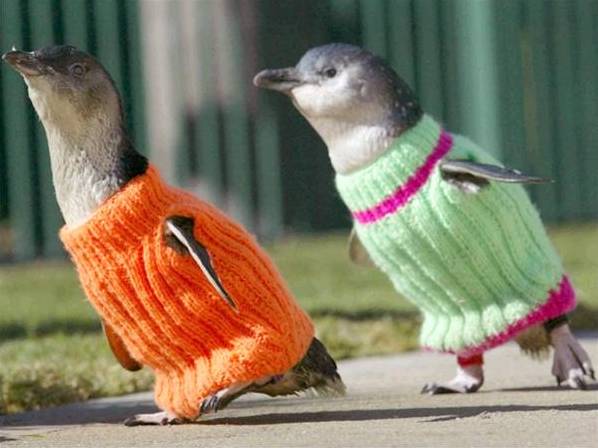
Toby Zerna / Newspix via Rex USA file
The environmental impacts of ocean oil spills are often incalculable, but for better or for worse the effects on wildlife are well-known. New Zealand’s coastal waters are home or breeding grounds to nearly 85 species of seabirds, and during breeding season the situation becomes increasingly desperate as the birds dive in and out of the water to find food for their chicks. Continue reading
Our involvement with conservation tourism around the world has taught us the vital importance of guides, whether they be for cultural visits or treks in the forest. Good interpretation is something that cannot be underestimated, in fact, it has been said to us before that “a visit to the rain forest without a guide is like a visit to the library without knowing how to read.” In both cases there are opportunities to take in the atmosphere, but without the interpretive element that atmosphere is missing an infinite amount of context.
 A good nature guide must have the obvious strengths of a “good eye”. They must also be able to communicate well with their visitors, even if language barriers are present. (Herein lies part of the beauty of the scientific names for flora and fauna!) It’s an even greater boon if the guide’s “good eye” translates into being a good photographer.
Bismar López is an example of one of these talented guides, and we hope to highlight more from different parts of the world in the future. He’s been guiding at Morgan’s Rock, a nature resort in southern Nicaragua (where Seth Inman spent the summer interning) since 2008. Growing up in a small community near the reserve has helped develop his love of Nature, especially birds. Continue reading
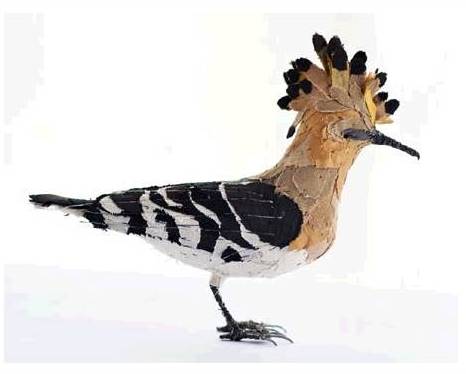 Hoopoo by Textile Artist Abigail Brown
Question: What would a Natural History Museum look like in Wonderland?
Answer: Abigail Brown’s studio.
The Victorians were avid collectors, and there’s something deliciously Victorian about the detail and precision with which textile artist Abigail Brown practices her craft, bringing the winged world to life with bits and pieces of cloth that each carries their own history. Continue reading
 Organikos