The World Of Sugar, Reviewed

Our thanks to the LA Review of Books for this review by Dinyar Patel:

Sugar, Slavery, and Capitalism: On Ulbe Bosma’s “The World of Sugar”

WHAT MIGHT DONALD RUMSFELD have in common with Frederick Barbarossa, Mormons, and Queen Elizabeth I’s rotting teeth? The answer is simpler than you might expect: the power and influence of sugar, a crystalline specimen of world-historical significance dissolved in your morning coffee or tea. A warmongering neocon, a Holy Roman emperor, pious Utahns, and a heavily cavitied pair of Tudor gnashers are part of an expansive cast of characters in Ulbe Bosma’s new work on the sweet stuff, The World of Sugar: How the Sweet Stuff Transformed Our Politics, Health, and Environment over 2,000 Years. This book is a tour de force of global history, one that helps us better understand the genesis of both modern capitalism and globalization. Continue reading


About The Food Waste Known As Diversion

Photograph by Grant Cornett

As still life compositions go, the photo to the right is classic in style and weirdly perfect for the essay it accompanies.  Helen Rosner frequently writes about food, including a review that convinced me to watch The Bear, and this is the best of her work that I have read:

The Promises of the Home “Composting” Machine

A new crop of techy appliances wants to help fight the food-waste crisis. How virtuous should we feel using them?

In the course of a week, my kitchen produces a shocking quantity of what we might think of as edible trash: apple peels, garlic nubs, a bit of gristle from a steak, Dorito dust, tea bags, the iron-hard heel of a loaf of bread that’s been sitting out overnight. The meat scraps I feed to my dog. The bones and vegetable scraps I store in the freezer in gallon-size ziplock bags and periodically bung into a pot and simmer into stock. But even then, once the stock is made, and the chicken bones or onion ends are leached of all their flavor, I’m left again with edible trash—only now it’s soggy. And then there are the times when the strawberries aren’t sealed right and become fuzzy with mold, or the delivery sandwich turns out to be gross, or the refrigerator’s compressor breaks and somehow we don’t notice, or I’m just exhausted and overwhelmed and want everything gone. Continue reading

Another Year, Another Invasive Python Initiative: Inversa Leathers

The invasive Burmese python has become the apex predator in the Florida Everglades, displacing the native American alligator. Photograph: Dorling Kindersley ltd/Alamy

We have been paying attention to this problem for more than a decade, and seen ideas like this before; until the problem is mitigated, we will continue sharing:

Could handbags be the haute couture solution to Florida’s python problem?

Invasive Burmese pythons are devastating wildlife but one firm believes turning snake leather into accessories could be a win-win

The fight to eradicate Burmese pythons from the Florida Everglades has intertwined with New York’s haute fashion scene in a project launched by a group of environmental activists who have already experienced success working with the skins of other invasive species. Continue reading

When In A Hole, Stop Digging

For many Americans, cars are as potent a symbol of freedom as guns are, even if they have similarly destructive consequences. Photograph by René Burri / Magnum

An interview with the author of one of the books reviewed in the linked essay below is effective motivation to read the entire review of both books:

How to Quit Cars

They crowd streets, belch carbon, bifurcate communities, and destroy the urban fabric. Will we ever overcome our addiction?

The Honeymooners” (1955-56), the greatest American television comedy, is—to a degree more evident now than then—essentially a series about public transportation in New York. Ralph Kramden (Jackie Gleason) is a New York City bus driver, deeply proud to be so and drawing a salary sufficient to support a nonworking wife in a Brooklyn apartment, not to mention a place in a thriving bowling league and membership in the Loyal Order of Raccoon Lodge. Continue reading

Norway’s Combustion Transition

About 80 percent of new-car sales in Norway were electric last year, putting the country at the vanguard of the shift to emissions-free vehicles. David B. Torch for The New York Times

A major fossil fuel producing country has figured out how to transition away from combustion engines:

About 80 percent of new cars sold in Norway are battery-powered. As a result, the air is cleaner, the streets are quieter and the grid hasn’t collapsed. But problems with unreliable chargers persist.

BAMBLE, Norway — About 110 miles south of Oslo, along a highway lined with pine and birch trees, a shiny fueling station offers a glimpse of a future where electric vehicles rule. Continue reading

The Future Of Solar In India

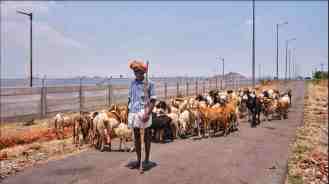
A local farmer grazes his goats along a road overlooking Pavagada Solar Park. Photographs by Supranav Dash for The New Yorker

Difficult to imagine that with all the times India has appeared in these pages, and separately all the times that solar has appeared, this is the first time they appear together:

India’s Quest to Build the World’s Largest Solar Farms

Pavagada Ultra Mega Solar Park, a clean-power plant the size of Manhattan, could be a model for the world—or a cautionary tale.

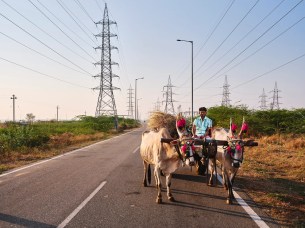
Ashok Narayanappa drives a bullock cart carrying hay, along a stretch of road lined with pylons, in Pavagada Solar Park.

Every morning in the Tumakuru District of Karnataka, a state in southern India, the sun tips over the horizon and lights up the green-and-brown hills of the Eastern Ghats. Its rays fall across the grasslands that surround them and the occasional sleepy village; the sky changes color from sherbet-orange to powdery blue. Eventually, the sunlight reaches a sea of glass and silicon known as Pavagada Ultra Mega Solar Park. Here, within millions of photovoltaic panels, lined up in rows and columns like an army at attention, electrons vibrate with energy. The panels cover thirteen thousand acres, or about twenty square miles—only slightly smaller than the area of Manhattan. Continue reading
Think, While You Can, About The Processed Foods You Eat

Jess Ebsworth

The groceries we shop for, even with the finer shopping options, sometimes disappoint; but some foods are just plain wrong, as this article by Sally Wadyka in the New York Times explains:

The Link Between Highly Processed Foods and Brain Health

Eating packaged foods like cereal and frozen meals has been associated with anxiety, depression and cognitive decline. Scientists are still piecing together why.

Roughly 60 percent of the calories in the average American diet come from highly processed foods. Continue reading

Auchan 2000 & Authentica 2023

The Auchan hypermarche in Cergy is at the location of the red balloon in the image above. It is a short walk from the ESSEC campus (lower center of map). Click to go to the map on Auchan’s website

On each of the occasions I have read articles about Annie Ernaux I have been reminded of the first of my five years teaching at ESSEC. During the 2000-2003 academic years I lived on campus for extended periods away from home and family in Costa Rica. My grocery shopping was at the same Auchan elegantly dissected by the woman who last year won the Nobel Prize in Literature.  During my fourth year teaching there I was completing work on a project in Montenegro that made it more convenient for our family to be based in Paris for 12 months. This turned out to be one of the most culturally enriching experiences our family ever had together. And relevant to life now.

Adrienne Raphel’s article in The Paris Review begins with her own “big retail” experience, and at first read it connects dots between our Paris time and our retail life now. For the last 4+ years we have been waking up each day looking for novel ways to succeed without following the “pile it high and watch it fly” model. So, if that resonates with you for any reason, read on:

INTERIOR OF THE WAL-MART SUPERCENTER IN ALBANY. PHOTOGRAPH BY MATT WADE, COURTESY OF WIKIMEDIA COMMONS. LICENSED UNDER CCO 3.0.

“The Dead Silence of Goods”: Annie Ernaux and the Superstore

The first and only time I went to the Walmart in Iowa City was surreal. When I was in high school, my parents’ business-oriented small press had published a book called The Case Against Walmart that called for a national consumer boycott of the company; the author denounced everything from the superstore’s destruction of environmentally protected lands to its sweatshop labor to its knockoff merchandise. So by the time I made a pilgrimage out to the superstore at age twenty-one, I hadn’t stepped in a Walmart for nearly a decade, and it had acquired this transgressive power—the very act of crossing the threshold was as shameful as it was thrilling…

Heatmap, Climate & Energy Transition

Heatmap Illustration/Getty Images

We are happy to see a new platform that Robinson Meyer has co-founded for climate-related news:

Are Wind Farm Tours the Hoover Dam Trip of the 21st Century?

Marvel at America’s green transition on your next vacation.

Scroll past San Jacinto Mountain, Brandini Toffee, a bicycle-powered bar crawl, and 13 other attractions on Tripadvisor’s list of “Things to Do in Palm Springs” and you’ll come to “Palm Springs Windmill Tours.” Continue reading

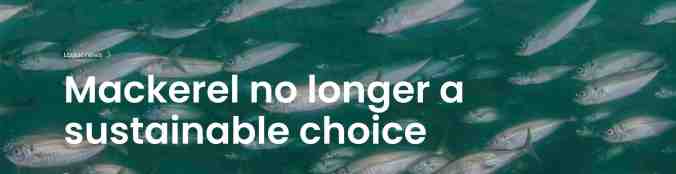
Decline Of Mackerel Fisheries

In the UK the Marine Conservation Society has issued this guideline on mackerel:

We’ve updated the environmental sustainability ratings on our Good Fish Guide in line with the latest scientific advice.

We reviewed 186 environmental ratings for seafood, with 20 seafood ratings moving to the ‘Fish to Avoid’ list and only 15 seafood ratings joining the green-rated, ‘Best Choice’ list with this season’s ratings update. Unfortunately, Northeast Atlantic mackerel has moved on to the amber list, having been on the charity’s green list since before 2011. Continue reading

DRC’s Price Paid For Our Electric Future

Miners haul sacks of cobalt ore at the Shabara mine near Kolwezi in the Democratic Republic of the Congo. JUNIOR KANNAH / AFP VIA GETTY IMAGES

Jocelyn C. Zuckerman leads a conversation below that puts our electric future in a very particular context:

For Your Phone and EV, a Cobalt Supply Chain to a Hell on Earth

The race for high-tech metals has sparked a cobalt boom in the Democratic Republic of the Congo that has come at a steep human cost. In an e360 interview, author Siddharth Kara talks about the horrific conditions in the mines that are putting thousands of workers at risk.

As countries around the world look to pivot quickly to clean energy, demand for the lithium-ion batteries used to charge our smartphones, laptops, and electric vehicles is booming. Continue reading

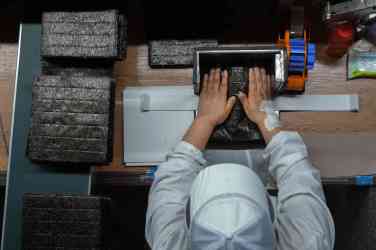
Seaweed, Seafood, Plastics & Fodder

Globally, seaweed production has grown by nearly 75 percent in the past decade.

After news of the blob coming our way, here is another useful seaweed story in excellent interactive format:

Seaweed Is Having Its Moment in the Sun

It’s being reimagined as a plastic substitute, even as cattle feed. But can seaweed thrive in a warming world?

For centuries, it’s been treasured in kitchens in Asia and neglected almost everywhere else: Those glistening ribbons of seaweed that bend and bloom in cold ocean waves. Continue reading

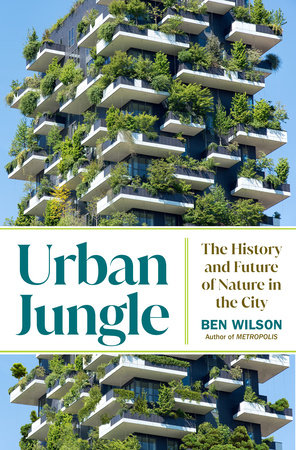
Urban Jungle, Covered In Literary Review

We look forward to Ben Wilson’s new book, as reviewed here:

Where the Streets are Paved with Goldenrod

No one, you would think, aspires to be a night-soil man. Yet in the late 1950s, Shi Chuangxiang’s labours in the latrines of Beijing briefly won him national praise. He was proclaimed a socialist hero and met the head of state. Back then, human excreta mattered, so much so that gangs fought for the plummest spots. Why? Because cities, until relatively recently in human history, were a part of healthy ecosystems that operated according to the principles of nutrient exchange: take, use, return, all in neat equilibrium. The spoils of Mr Shi (who was nicknamed ‘Stinky Shit Egg’), collected at a time when synthetic plant food was not widely available in China, became the organic fertiliser that was intended to power the country’s Great Leap Forward in agriculture. Continue reading

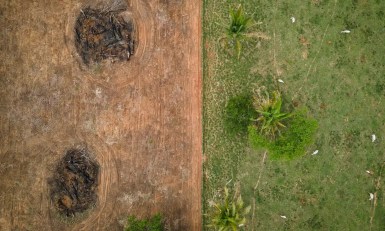
Collagen & Its Discontents

Collagen is derived from cattle, but unlike beef, there is currently no obligation to track the product’s environmental impacts. Photograph: Cícero Pedrosa Neto

Know your beauty products:

Global craze for collagen linked to Brazilian deforestation

Investigation finds cases of the wellness product, hailed for its anti-ageing benefits, being derived from cattle raised on farms damaging tropical forest

Tens of thousands of cattle raised on farms that are damaging tropical forests in Brazil are being used to produce collagen – the active ingredient in health supplements at the centre of a global wellness craze. Continue reading

Starbucks, Olive Oil & Longevity

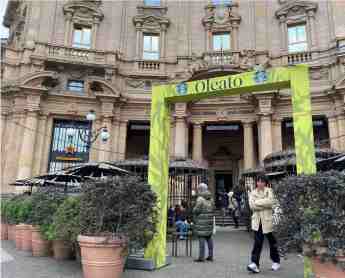
We have always been happy to share news about coffee’s trend setters, whether it is good or not so flattering. Sometimes quite  unflattering. Click the image above to go to the current Starbucks press release for this new, unusual product. Gideon Lewis-Kraus makes a pretty compelling case that while the backstory is interesting this new product is not worth trying:

A banner outside the Starbucks Reserve Roastery in Milan’s city center advertises the chain’s new Oleato line. Photograph by Valentina Za / Reuters / Alamy

Did Starbucks Really Put Olive Oil in Coffee?

The new Starbucks Oleato is terrible. But somehow there’s pleasure to be had in its existence.

As corporate legend has it, the concept of Starbucks was inspired by a visit that Howard Schultz paid to Milan in 1983. At the time, Schultz was the director of operations and marketing for a local Seattle chain with fewer than a dozen outposts; the stores, the first of which opened in 1971, sold whole beans, leaf teas, and spices in bulk. In Milan for a trade show, Schultz found himself enchanted by the city’s espresso bars. Continue reading

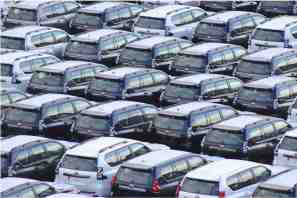
SUV Realities, Fictions, Dangers

Carmakers have long profited from what’s known as the S.U.V. loophole, which allows auto manufacturers to get around fuel-efficiency regulations by selling trucks. Photograph from Alamy

SUV is a three-letter word, popular to the point of problematic. Thanks again to Elizabeth Kolbert for the most recent thinking on the topic:

Why S.U.V.s Are Still a Huge Environmental Problem

The world is moving toward heavier cars at a time when it should be doing precisely the reverse.

Last year, the world’s S.U.V.s collectively released almost a billion metric tons of carbon dioxide. If all the vehicles got together and formed their own country, it would be the world’s sixth-largest emitter, just after Japan. This is a disturbing figure, but, according to a new report from the International Energy Agency, it gets worse. Globally, S.U.V. sales continue to grow, even though, last year, total passenger-vehicle sales fell. And the trend has now spread to electric vehicles: in 2022, for the first time, the sale of electric S.U.V.s edged out the sale of other electric cars. Continue reading

Coffee Love

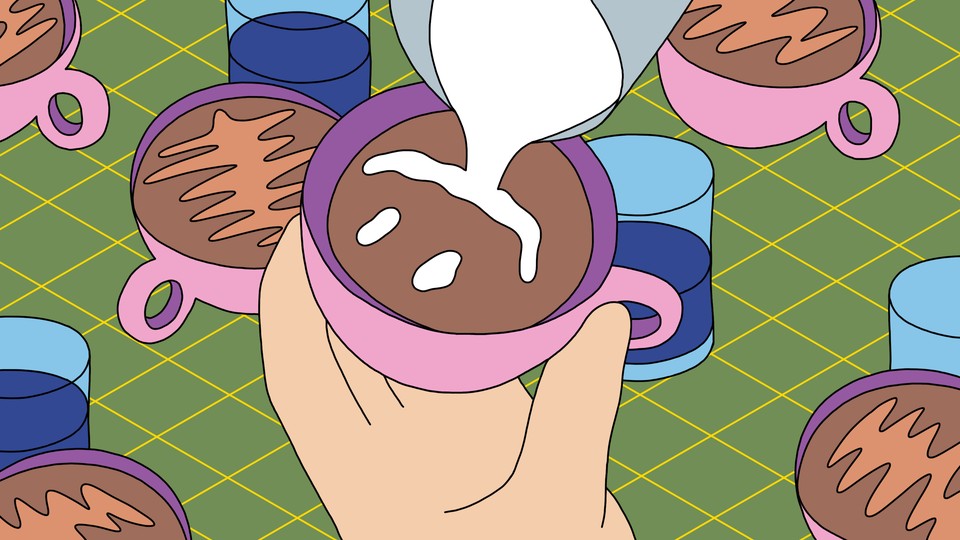
Illustration of latte art in the shape of a smiley face

Jan Buchczik

Arthur C. Brooks  continues to deliver:

Happiness Is a Warm Coffee

All hail the miracle bean.

I remember the night I fell in love.

The year was 1977, and I was 12 years old. A neighbor kid’s parents had bought an espresso machine—an exotic gadget in those days, even in Seattle. There was just one Starbucks in the world back then, and as luck had it, we lived within walking distance. Continue reading

The Big Myth

If you are in the mood for some basic questioning of the status quo, this book may be for you, according to Kirkus Review:

A thoughtful denunciation of the economic dogma that the market knows best.

“How did so many Americans come to have so much faith in markets and so little faith in government?” So ask Oreskes and Conway, continuing the line of research they began in their seminal 2010 book, Merchants of Doubt. Where that book focused on the co-optation of scientists to dispute the realities of climate change and the linkage of tobacco to cancer, this joins that co-optation to carefully planted “free market” fundamentalism that holds that any attempt to regulate business is a form of tyranny…

Neighborly Advice

Reporting credit: ChavoBart Digital Media

Thanks to the team at Yale Climate Connections:

When do many people decide to go solar? When they’re referred by a friend or neighbor.

They’re more likely to listen to people they trust.

Rooftop solar panels can save people money on their electricity bills. And those savings can mean a lot — especially for people with low incomes, who might have to choose between paying for utilities or buying food or medicine…


Coffee Capsules Reconsidered

‘It hurts to know that we create so much waste.’ Composite: The Guardian/Getty Images/NASA

We have been clearly on one side of this, but now thanks to Cecilia Nowell and the Guardian we acknowledge a possible reason to reconsider:

Are coffee pods really eco-friendly? The truth behind the surprising findings

Coffee capsules notoriously produce waste – but some experts maintain that reducing how much coffee you use, even with a pod, can decrease emissions

If you drink one of the 2bn cups of coffee consumed each day worldwide, you may have seen headlines last month celebrating the coffee pod, a single-serving container – typically made of plastic or aluminum – that can be inserted into a machine to brew a cup of coffee. Continue reading