Nature, Color, Science

Screen Shot 2016-07-09 at 5.50.02 AM

If you happen to be in London, starting July 15 this exhibition at the Natural History Museum looks worth a worth a visit:

Investigate how different animals see the world, and explore your own relationship with colour, through interactive experiences and immersive films.More than 350 specimens feature, from beautiful birds to fossils of the first organisms with eyes. And British artist Liz West has produced a stunning light installation, inspired by Newton’s colour spectrum and blue morpho butterflies in the Museum’s collection.

The BBC gives it a strong review here:

_90172043_b583d8fa-da3c-4d0a-aece-83ff65cc48a5

A new exhibition exploring the relationship between colour and vision in the natural world is opening at the Natural History Museum.

Intense and vibrant natural colours will be displayed in specimens and photographs of insects, animals and plants. At the heart of the exhibition – Colour and Vision, which opens on 15 July – is the question of how we perceive colour. Continue reading

The Emily Dickinson Museum

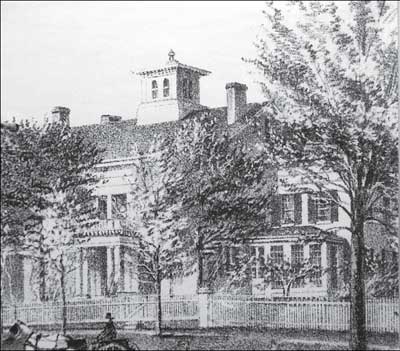
Homestead-1858-lithograph

During a father-son road trip in 2009 to visit prospective colleges, we spent time in Amherst (MA, USA). The most important outcome of that visit was time spent with Michael Muller, who two years later would spend time as an intern with us in India during the summer before his final year at Amherst College.

Michael brought a literary quality to the startup of this communication platform where I continue to write. Which is why I thought of him when my attention was drawn to this museum in Amherst. For me it was valuable to take a moment to read about the relationship between this home’s history and the college where Michael was educated:

THE HOMESTEAD, probably the first brick house in Amherst, was built around 1813 for Samuel Fowler Dickinson and Lucretia Gunn Dickinson, Emily’s grandparents. Fowler Dickinson, a lawyer, was one of the principal founders of Amherst College. In 1830, his eldest son Edward, also a lawyer, and Edward’s wife, Emily Norcross Dickinson, together with their young son Austin, moved into the western half of the Homestead. Later that year, on December 10, Emily Elizabeth Dickinson was born. In 1833, a second daughter, Lavinia, was born. Continue reading

If You Happen To Be In New York City

Screen Shot 2016-04-21 at 5.28.08 AM

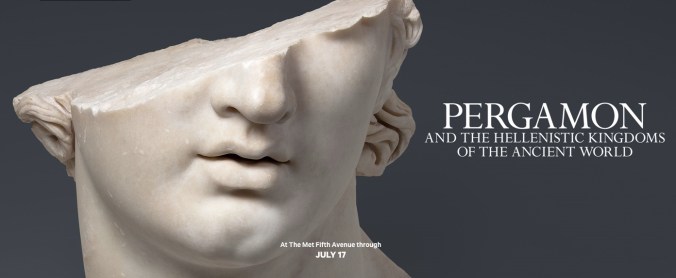
History can be dry, except when in the hands of masterful story-tellers. Which reminds us of James, and other scholars who have graced these pages in recent years with practical stories of the past linked to our present day lives. The value of this Pergamon exhibition (click the image above to go to the museum’s description of the exhibition) catches our attention because this review, which exemplifies the sort of interpretation that allows history to jump into our present tense:

…This tidal wave of wealth sloshed all around the eastern Mediterranean during the three centuries that followed, the era known today as the Hellenistic Age. It soaked the shores of the half-dozen new kingdoms carved out of Alexander’s conquests…

Read the description of this exhibition below, in the words of the Met’s curators, to get a renewed sense of the important role museums play in our civic lives.

The conquests of Alexander the Great transformed the ancient world, making trade and cultural exchange possible across great distances. Alexander’s retinue of court artists and extensive artistic patronage provided a model for his successors, the Hellenistic kings, who came to rule over much of his empire. For the first time in the United States, a major international loan exhibition will focus on the astonishing wealth, outstanding artistry, and technical achievements of the Hellenistic period—the three centuries between Alexander’s death, in 323 B.C., and the establishment of the Roman Empire, in the first century B.C. Continue reading

Endangered Natural History

The Spectrum of Life, at the American Museum of Natural History, an evolutionary trip through the amazing diversity of life on Earth. Credit Matthew Pillbury/Benrubi Gallery

We’ve said often that we’re die-hard supporters of natural history museums before, and even quite recently. So it’s nice to see yet another article championing the role these institutions can have in scientific discoveries, education, and more. Here’s an op-ed in last Sunday’s New York Times by Richard Conniff, highlighting some threats to some US museums:

When people talk about natural history museums, they almost always roll out the well-worn descriptive “dusty,” to the great exasperation of a curator I know. Maybe he’s annoyed because he’s spent large sums of his museum’s money building decidedly un-dusty climate-controlled storage sites, and the word implies neglect. (“Let me know,” the curator advises by email, “if you want to hear me rant for an hour or so on this topic.”)

Worse, this rumored dustiness reinforces the widespread notion that natural history museums are about the past — just a place to display bugs and brontosaurs. Visitors may go there to be entertained, or even awe-struck, but they are often completely unaware that curators behind the scenes are conducting research into climate change, species extinction and other pressing concerns of our day. That lack of awareness is one reason these museums are now routinely being pushed to the brink. Even the National Science Foundation, long a stalwart of federal support for these museums, announced this month that it was suspending funding for natural history collections as it conducts a yearlong budget review.

Continue reading

If You Happen To Be In New York City

141-690

When the exhibition space re-opens, under new management, this is one of the empty spaces that will be filled, and this post on the New Yorker website makes us think it would have been interesting to see the spaces empty, before:

On Friday, March 18th, the Metropolitan Museum of Art invites the public into the Met Breuer, better known for the past fifty years as the Whitney. (The Met is leasing the building for eight years, while its modern and contemporary wing undergoes a radical transformation.) Fun fact: the Whitney might not have existed at all if the Met had accepted Gertrude Vanderbilt Whitney’s offer, Continue reading

Avant Guard

The guards at The Broad Museum in Los Angeles aren't just here to protect the art — they're also expected to engage and educate. They're called visitor services associates, and they've gone through hours and hours of training to become ambassadors for contemporary art. Ryan Miller/Capture Imaging/The Broad Art Foundation

The guards at The Broad Museum in Los Angeles aren’t just here to protect the art — they’re also expected to engage and educate. They’re called visitor services associates, and they’ve gone through hours and hours of training to become ambassadors for contemporary art.
Ryan Miller/Capture Imaging/The Broad Art Foundation

I can easily spend hours wandering museum galleries – viewing Art, artifacts and people – it’s all fascinating. More likely than not every other room I’ll pass an ever present museum guards, usually efficient, sometimes friendly. Always in uniform. The directors of The Broad Museum in L.A. are viewing this important role in a new light. Dressed eclectically in black with red lanyard IDs, the VSAs (Visitor Service Associates) are well-trained crosses between guard and guide. Their knowledge and friendly delivery creates a concierge museum experience, which seems especially appropriate for a private collection museum.

Guard Sabrina Gizzo might easily be mistaken for a docent. She’s talking with some visitors about Thomas Struth’s huge color photograph of a crowd at a museum in Florence Italy. In the photo, tourists are dressed in summer clothes — shorts, T-shirts, caps, sneakers. Struth photographs the crowd facing us, looking up at something we can’t see. As Los Angeles visitors to The Broad study Struth’s photograph — a museum crowd looking at another museum crowd — one Broad visitor notices that a man in the photograph is wearing sunglasses clipped to the front of his shirt. Gizzo suggests that her guest take a very close look at the sunglasses.

Why? Turns out, if you look closely, a famous statue can be seen in the reflection of the man’s glasses: Michelangelo’s sculpture of David.

Continue reading

Bringing Nature To An Urban Audience

AMNH-03-320

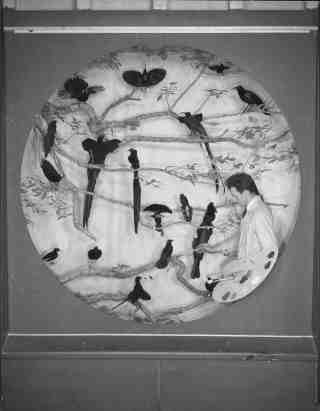
Installing the Birds of Paradise group, 1945. COURTESY AMERICAN MUSEUM OF NATURAL HISTORY

Our interest in the display of natural history makes this is a must-read:

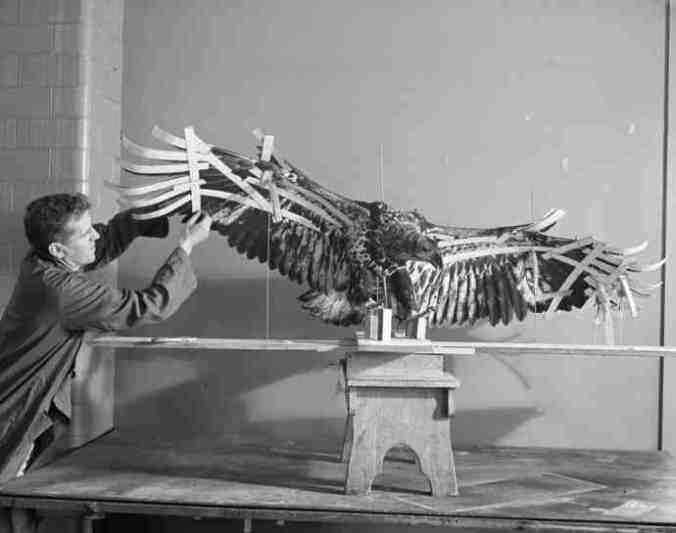
The dioramas at New York City’s American Museum of Natural History—those vivid and lifelike re-creations of the natural world, in which the taxidermied specimens almost seem to breathe and the painted horizons seem to stretch for miles—are very much products of the late-nineteenth and early-twentieth-century milieu in which many of them were created. Temporally and aesthetically sandwiched between the cabinet of curiosities and “Planet Earth,” the dioramas grew out of the intersection between a nascent conservation movement and an age of swashbuckling adventurism…

Of course, we prefer natural history in natural places, preferably intact and living and resplendent as hinted at in this video which we have featured previously. But museums have their place, and the mural at the Cornell Lab of Ornithology is just the most recent of a long line of efforts to get the inanimate to animate our interest. But for those of us who grew up making dioramas, this feature brings to mind the power of three dimensions, even when inanimate, to animate.

AMNH-07-690

An eagle for the bird-group exhibit, 1961. COURTESY AMERICAN MUSEUM OF NATURAL HISTORY

…The word “diorama,” which comes from the Greek for “to see through,” Continue reading

Undiscovered Species in Natural History Museums

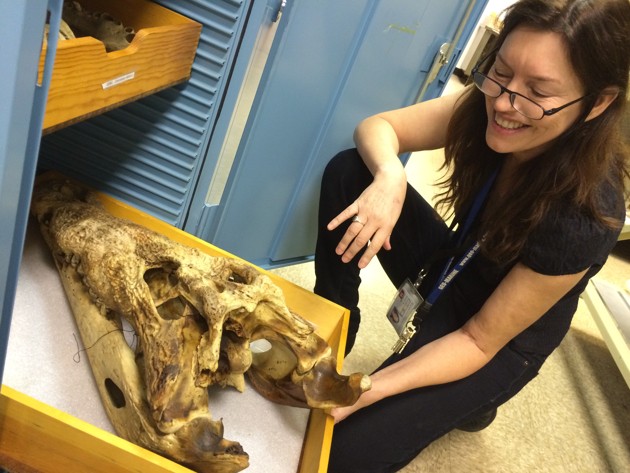
Evon Hekkala and a crocodile skull at the AMNH. Photo by Ed Yong.

We’re big fans of museums, especially those of natural history with specimens of life in the world that are invaluable to science. Now, in a piece for the Atlantic, Ed Yong (previously here) writes about the dozens of new species being identified many years–or in the case of some Egyptian mummified crocodiles, millennia–after their collection. These specimens, Yong reports, can inform us further on the evolution of animal body types, on cycles of diversity, and on the origins of epidemics, among other things:

In the darkness of the Akeley Hall of Mammals, swarms of kids gawk at beautifully staged dioramas of Africa’s wildlife. The stuffed safari, nestled in the American Museum of Natural History (AMNH) in New York, includes taxidermied leopards stalking a bush pig, preserved ostriches strutting in front of warthogs, and long-dead baboons cautiously considering a viper. In one corner, in a display marked “Upper Nile Region,” a lone hippo grazes next to a herd of lechwe, roan antelope, and a comically stern shoebill stork.

“This is my favorite one,” says Evon Hekkala, pointing to the display. “There’s a taxidermied crocodile tucked away down there.”

Continue reading

Museum in Your Pocket

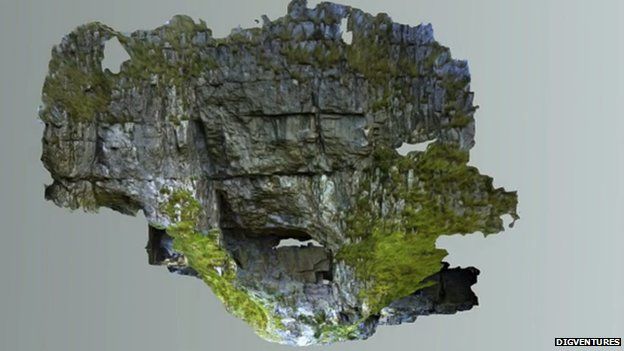
Archaeologists will turn Victoria Cave and its ancient bone collection into a digital museum. PHOTO: BBC

Archaeologists will turn Victoria Cave and its ancient bone collection into a digital museum. PHOTO: BBC

Victoria Cave was discovered by chance in 1837 and since then has been completely excavated. Within the cave’s thick clay deposits, scientists found an amazing record of climate change in the Dales over thousands of years. Excavators were particularly fascinated by ‘bone caves’ where there might be a possibility of finding evidence for the earliest humans along with long extinct animals. And now the cave and its bone treasures are being digitized.

Continue reading

The Food Museum Is Here

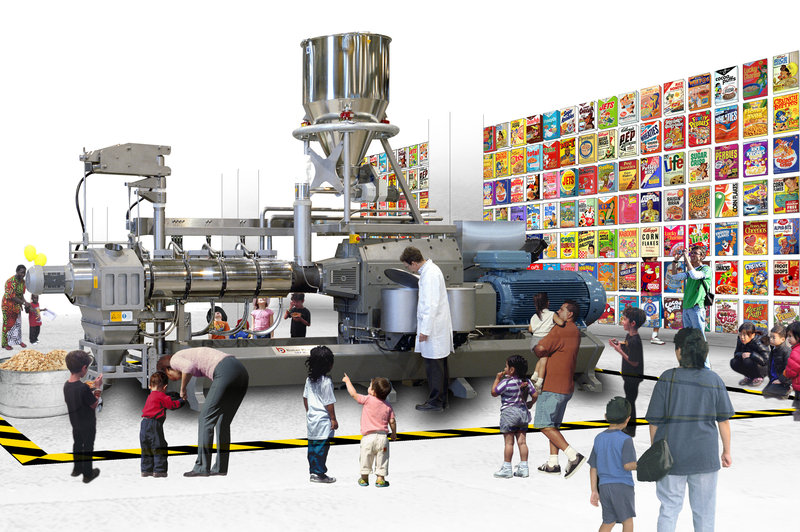
The Food and Drink Museum will open in its first permanent home – a mini-museum in Brooklyn — in October.  Above, an artist's rendering shows one potential exhibit – on ready-to-eat cereal — in MOFAD's final space. In the foreground is an extruder, a giant machine used to cook and shape cereal.

The Food and Drink Museum will open in its first permanent home – a mini-museum in Brooklyn — in October. Above, an artist’s rendering shows one potential exhibit – on ready-to-eat cereal — in MOFAD’s final space. In the foreground is an extruder, a giant machine used to cook and shape cereal. PHOTO: MOAFD

Everyone eats. People of all ages and backgrounds, from picky and apathetic eaters to gastronomes and food lovers, should care about food. Informed eaters are better eaters. They make better choices for their taste buds, health, community, and environment.Food is culture. It is more than simply what is on our plates: it is a common denominator of human relationships.Food is personal. People should be approached with a non-judgmental attitude about their diet.Food is participatory. To best learn about food, you must taste, smell, and think.Food is fun. A positive, non-fear-based outlook is the best way to approach food education.

The Museum of Food and Drink couldn’t have worded it more finely. And they are doing one better by working towards opening doors in Brooklyn come October. So hold on to all your questions about food (well the one about the chicken and the egg is still debatable), for answers may be at hand.

Continue reading

From the World of Photography

One of the first things you’ll notice about Danh's images is that they’re kind of blue. But they’re not hand-colored or toned post-process. Daguerreotypes are naturally sensitive to blue and ultraviolet light, meaning the brightest spots, like the sky or a waterfall, take on a blue tint when overexposed. PHOTO: Danh

One of the first things you’ll notice about Danh’s images is that they’re kind of blue. But they’re not hand-colored or toned post-process. Daguerreotypes are naturally sensitive to blue and ultraviolet light, meaning the brightest spots, like the sky or a waterfall, take on a blue tint when overexposed. PHOTO: Danh

The daguerrotype makes for an interesting chapter in the history of photography. One reason why you should catch the last two days of the exhibition of Binh Danh‘s daguerrotypes of Yosemite National Park. Address: The National Gallery of Art in Washington, D.C; head to the exhibition titled “The Memory of Time”.

Standing in front of photographer Binh Danh’s daguerreotype of Yosemite Falls, on display at the National Gallery of Art in Washington, D.C., I saw myself staring back through the image.

If you look at a daguerreotype in person (unfortunately you can’t tell on a screen), you can see your reflection in the silver plate. At first I tried to move off to the side to get an unobstructed view, until I realized that being confronted with my reflection might be part of the experience. It turns out that this is exactly what Danh had in mind. “Conceptually, I hope one contemplates the land in relationship to one’s body and even identity.”

Continue reading

Waking the Dead

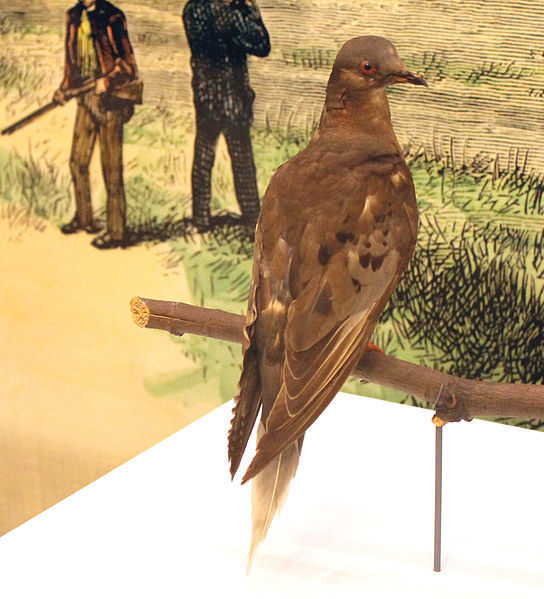
Martha in a display case in the National Museum of Natural History, 2015. (Photo: Ph0705/WikiCommons CC BY-SA 4.0)

Martha in a display case in the National Museum of Natural History, 2015. (Photo: Ph0705/WikiCommons CC BY-SA 4.0)

If you happen to visit the National Museum of Natural History in Washington D.C, don’t just walk by this innocuous stuffed pigeon. Take a good look at Martha, because she’s the last of the world’s flock of passenger pigeons. And now the subject of the ambitious  The Great Passenger Pigeon Comeback, a “de-extinction” project aimed at reviving the species. Using the genomes of the rock pigeon and the band-tailed pigeon as a reference, project scientists aim to assemble a complete passenger pigeon genome and transfer it into the germ cells of band-tailed pigeons in order to generate live passenger pigeons. The target date for the passenger pigeons’ triumphant return is 2022.

Continue reading

Notes from a Natural History Museum

Harvard Natural History Museum

I recently had the chance to visit the Harvard Natural History Museum. Despite having lived in Cambridge for nearly a year, and having often thought about visiting the museum when I passed by going to and from my apartment, I had not stopped in until now. What a treat! The collections are full, diverse, and well curated. On this occasion, I spent most of my time in the animal wing, but I plan to return soon to take in the flora and minerals, and spend much more time in choice display rooms (e.g. the absolutely gorgeous Mammals/Birds of the World permanent exhibit: see below for pictures).

A ground sloth skeleton. It is hard to get an idea of the size of this creature from this photo, but it probably weighed several tons while alive!

Continue reading

Museums, Libraries, And An Innovative Hybrid

DRAWING BY LINYU YEN, COURTESY THE SKETCHBOOK PROJECT

DRAWING BY LINYU YEN, COURTESY THE SKETCHBOOK PROJECT

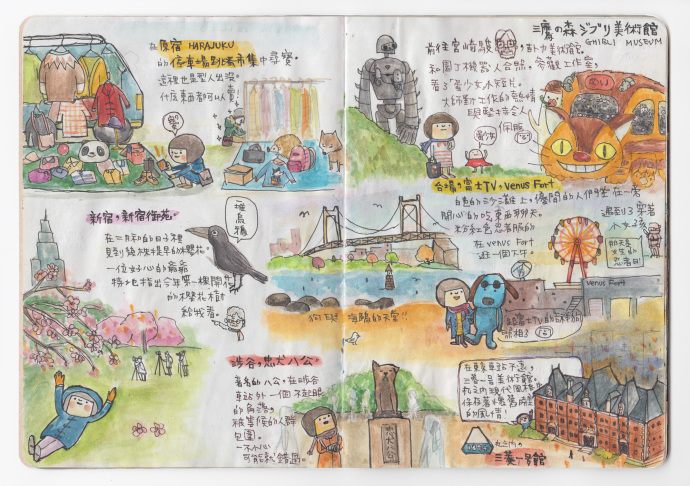
Museums, as well as libraries and other community institutions get a disproportionate share of our attention on this blog. When we see a random variation like the following, we cannot help but follow the trail (thanks to Jordan Kisner):

One recent Wednesday afternoon, a man wandered into a library on North Third Street in Brooklyn and asked how he could sign up for a library card. The young woman behind the counter smiled and explained that at this particular library there were no cards—or even traditional books. The Brooklyn Art Library, housed in a Williamsburg storefront with unfinished floors and exposed piping, is, instead, home to the Sketchbook Project, a collection of crowdsourced sketchbooks that is, according to its staff, the largest in the world. The project was founded in 2006, when Steven Peterman and Shane Zucker, two art students living in Atlanta, began mailing blank Moleskines to anyone who wanted one for a small fee, and then archiving whatever came back. Now anyone can pay twenty-eight dollars for a sketchbook, or sixty-three dollars for a digital membership, which means that their books will be scanned in full and archived online in a digital library. Continue reading

How do you Say “Butterfly” in Malayalam?

Photo by James Zainaldin

We have a history of sharing butterfly photos here, primarily from Kerala (ചിതശലഭം, by the way, is Malayalam script for “citaśalabhaṁ,” or butterfly) and Costa Rica (“mariposa” being the Spanish name for the insects) but also in miscellaneous nature posts by our contributors. We also have a bit of a connection to the Smithsonian Institution, and are always happy to hear about friendly, creative polyglots, in this case from the New York Times:

Amid Butterflies, a Bit of a Lingua Franca at the Natural History Museum

 20, 2015

On a recent Sunday, Holly Tooker stood by the transparent wall inside the Butterfly Conservatory, at the American Museum of Natural History. It was, as always, 81 degrees with 78 percent humidity, and it had been a busy morning. Nearby, a giant Danainae butterfly perched on a

Continue reading

If You Happen To Be In Georgia…

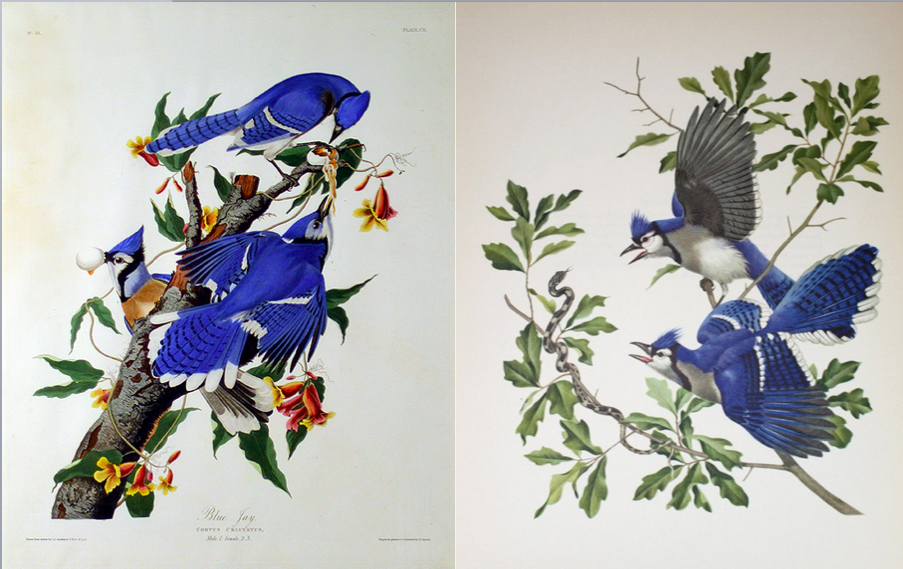
Blue Jays. Left: John James Audubon; Right: Athos Menaboni

Blue Jays. Left: John James Audubon; Right: Athos Menaboni

It should come as no surprise to visitors to this site that a significant amount of our attention is taken up by birds. Their importance is manifold, not just environmentally, but artistically. We’re also fans of the Liberal Arts, so we’re particularly excited to see these interests come together this month at two Liberal Arts colleges in Georgia.

One does not have to be a birder or an art aficionado to have heard of John James Audubon. Much of the world knows the name due to the Audubon Society, but fewer have heard of Athos Menaboni, who Times Magazine once called “Audubon’s heir”, despite the fact that the two men never met. Continue reading

If You Happen To Be In New York City

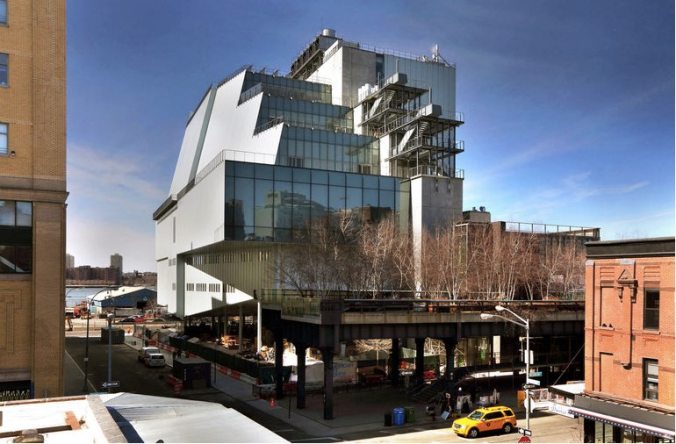
Whitney Museum of American Art. Photograph by Ed Lederman

Whitney Museum of American Art. Photograph by Ed Lederman

We have a thing for public spaces, especially when they combine with community activism. We try to get firsthand experience, and when we have learned enough about such places, we share what we can here. Ditto for museum exhibits, special library exhibitions, and unusual library thingys. It is not every day we get to announce the opening, or re-opening, of one of the greatest museums in the world, right in the midst of such a public space:

THE NEW WHITNEY OPENS MAY 1, 2015 BUY ADVANCE TICKETS NOW

The reviews convince us that this will be worth the visit, and this particular wording puts it in perspective:

The Whitney Museum of American Art, long the odd duck among the Big Four of Manhattan art museums—a cohort that includes the mighty Metropolitan, the starry Modern, and the raffish Guggenheim—takes wing on May 1st, when it reopens in a new, vastly expanded headquarters downtown. The fledging owes a lot to the Italian architect Renzo Piano’s ingenious building, on Gansevoort Street, which features six floors of shapely galleries, four open-air terraces, spaces for performance and screening, a library and reading rooms, a restaurant, a café, and an over-all feeling of seductive amenity—a bar on the piazza-like ground floor bodes to be one of the toniest trysting spots in town. It is likely to win far more fans than the Whitney’s old home, Marcel Breuer’s brutalist “inverted ziggurat,” which opened in 1966, on Madison Avenue, and which it vacated six months ago and leased to the Met. Piano’s museum stands at the southern end of the High Line and hard by the Hudson River, in what remains of the tatterdemalion meatpacking district. It looms like a mother ship for both gallery-jammed Chelsea, to the north, and the puttering West Village, to the south. It is instantly a landmark on the cultural and social maps of the city—and on its poetic map, as a site to germinate memories. Continue reading

Don’t Go Away Mad, Just Go Away

koch_sitegraphic-830x467

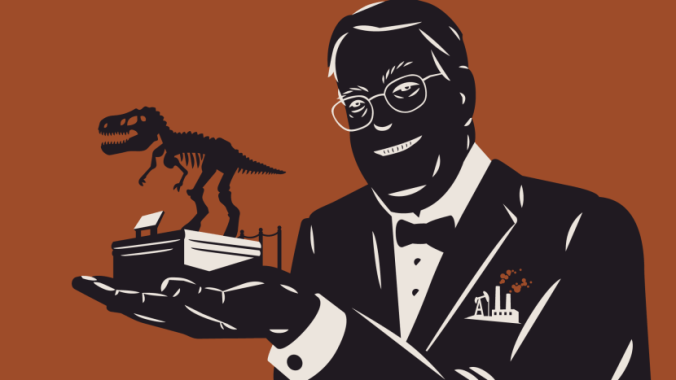
The Koch brothers are a wondrous phenomenon. You probably knew that. What can you do (?), you might ask. We know the feeling. Well, here is something. A public service announcement from our colleagues at EcoWatch, linking to a petition effort worthy of your consideration:

The Natural History Museum just released an unprecedented letter signed by the world’s top scientists, including several Nobel laureates, calling on science and natural history museums to cut all ties to the fossil fuel industry.

The letter comes on the heels of recent news that Smithsonian-affiliated scientist Willie Soon took $1.25 million from the Koch brothers, Exxon Mobil, American Petroleum Institute and other covert funders to publish junk science denying man-made climate change, and failed to disclose any funding-related conflicts of interest.

In particular, it points a finger at the Smithsonian National Museum of Natural History (D.C.) and the American Museum of Natural History (NY), where David Koch is a member of the board, a major donor and exhibit sponsor.

Oil mogul David Koch sits on the boards of our nation’s largest and most respected natural history museums, while he bankrolls groups that deny climate science.

Sign this petition to the Smithsonian and the American Museum of Natural History: It’s time to get science deniers out of science museums. Kick Koch off the Board! Continue reading

If You Happen To Be In New York City

PHOTOGRAPH BY DAN WINTERS

PHOTOGRAPH BY DAN WINTERS

We have said since early on, and plenty of times since, that in these posts we cannot claim to be either committed vegetarians nor committed meat eaters. Rather, we believe–yawn at your own risk–in moderation. This upcoming show sounds like a worthy outing for a novel take on the topic:

Ab Ex meets Zap Comics in the wild imagination of Trenton Doyle Hancock (seen above in his Houston studio). In his boisterous mythologies, villainous vegans do battle with good-guy, meat-eating mutants, and Torpedo Boy—a superhero that Hancock, now forty, first drew in the fourth grade—swoops in to save the day. Continue reading

The Critic As Cold Water Splashed Refreshingly On The Face Of Modernity

Schjeldahl-Bjork-690

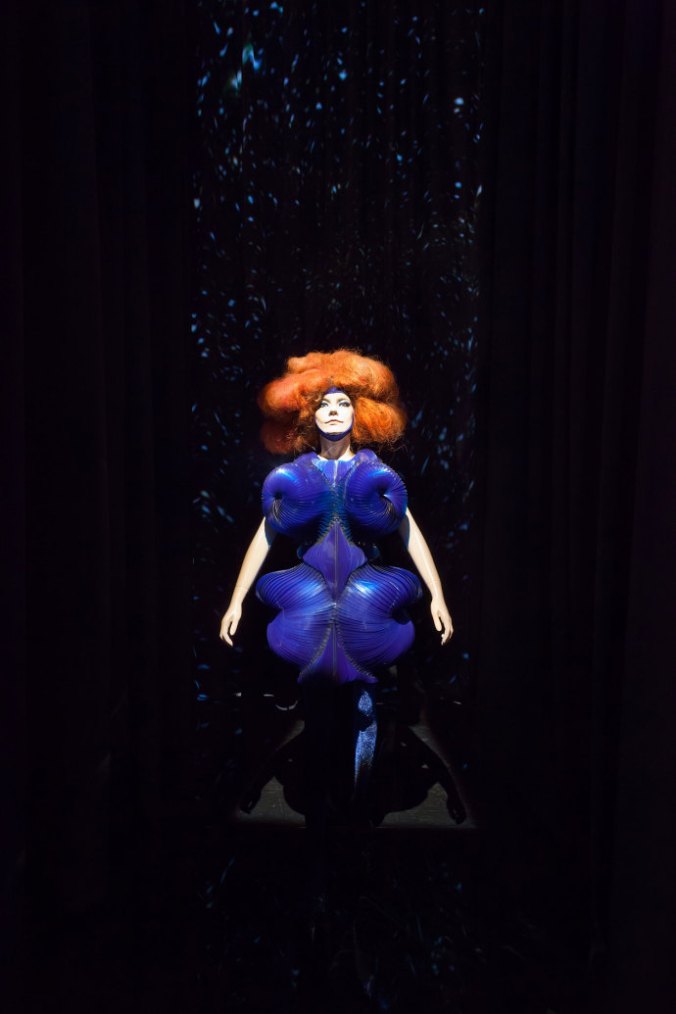
Björk is a restlessly experimental (and therefore fallible), tremendous creative force, not a tarnishable brand. CREDIT PHOTOGRAPH BY JONATHAN MUZIKAR


The opening paragraph of this brief review is worth the click, but the point we would like to bring to your attention is what follows. Sometimes an artist’s museum show can be taken down, critically speaking, with the museum bearing the brunt of the shame. And this point is directly linked to the now well-established concern that art in our age is as much a racket as it is an essential embodiment of culture. This reviewer, and his peers quoted in the opening paragraph, remind us of why we depend on critics for the insight that comes with an occupation whose singular focus is to help us decide whether a certain journey is worth making, or not:

…And yet Björk is unscathed. All the critics (now including me) hasten to acknowledge her musical genius and personal charisma. No detour into lousy taste—even at times her own, as in her partnership, lately ended, with the mercilessly pretentious Matthew Barney—can dent her authenticity. Her music videos (an oasis at the show, in a screening room) typically bring out the best in collaborating directors, musicians, designers, costumers (notably the late Alexander McQueen), and technicians. But if she chances to bring out the worst in star-struck curators, so what? Björk is a restlessly experimental (and therefore fallible) tremendous creative force, not a tarnishable brand. Continue reading