
Photo credits: Ramesh Kidangoor
In Kerala almost every church in every village has an annual celebration called Perunnal. All members of each church participate in a festive procession during this community event.
Photo credits: Ramesh Kidangoor
In Kerala almost every church in every village has an annual celebration called Perunnal. All members of each church participate in a festive procession during this community event.
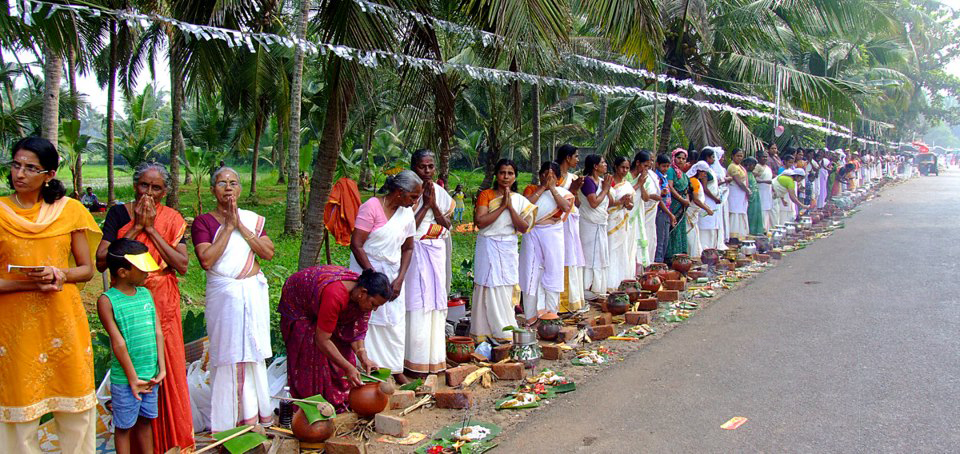
Photo credits: Ramesh Kidangoor
This festival takes place in Sree Bhagavathy Temple near Alleppey during the month of Vrischikam (November/December) in Kerala’s lunar-based calendar; the time when the glory of the Goddess is at its peak. This is one of the state’s most renowned festivals, where tens of thousands of female devotees gather around the temple days before the function. The women line up on both sides of the main streets and each arranges an area for offering the Pongala (cooking demo) in front of them. Each one brings an earthen cooking pot with rice, coconut and jaggery. Continue reading

In South India Temple worship has been a glorious tradition; over the years there have been many schools of Temple building: the Ddravadin, Chalukya, Pallava, Hoysala and Pandya. The Temples were constructed with strict observance of the rules put down in the Agama Silpa Shastras (the book of Architectural techniques). Continue reading
Long before Carson and Attenborough, as noted in a post by Meg last year, there were Vedic, Buddhist and Hindu texts; Old Testament scribes, New Testament scribes, great Islamic scholars; but also there were Greek philosophers, Roman thoughts nearly lost; on and on, closer to the present with Thoreau; etc.
All providing us with a sense of reverence for, and a way to understand, the mysteries we will refer to here as Nature. But what is next? And who will be our interpreters and scribes? Anyone following this site will know we are partial to Jad‘s sonically luscious and always surprising approach to making sure we understand and appreciate the world we live in; ditto for Krulwich (whom we have pointed to plenty of times but if you can only focus on one, make it this one). Thanks to the the latter, we came upon the clip above, and with one viewing we see a possible answer.

Madurai, a city in the Indian state of TamilNadu, is commonly known as temple city as the Meenakshi Amman temple is situated there. The main deity of the temple is Meenakshi, the avatar of Goddess Parvati, spouse of Lord Shiva. The story behind the temple and Meenakshi is as follows. According to the legends, this avatar of Goddess Parvati was an answer to the devotion of King Malayadwaja Pandya and his wife Kanchanamalai, for their request for parenthood. They were granted a girl but she was three breasted. The worried king approached Parvati in prayer and a call from heaven answered that the third breast will disappear once she found her consort. Continue reading
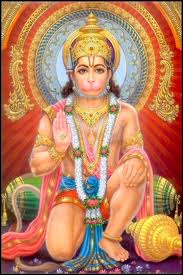 According to the Hindu epic ‘Ramayanam’, Hanuman was born to the queen Anjana Devi (a supernatural woman cursed into a monkey’s form) and her spouse King Kesari. Anjana, who was childless, prayed to Lord Shiva to give her a child. After her long devotion to Shiva, Vayu Bhagvan Mayut (the God of wind) granted her a son. Hence the boy was also known as Pavan putra, meaning Pavan-wind, putra-son. Continue reading
 Over dinner one night, I revealed to a few of my fellow interns my fear of feet, specifically adult feet. We established that I may have podophobia: an irrational fear of feet. You may think that I should consider taking a quick course in dinner convo dos and don’ts, or consider seeking psychiatric help; however, I guess I feel I have bigger fish to fry than to try to acquit myself of this fear. We discussed other phobias and how many people overcome theirs by simply “facing” them. I certainly am not at a place in my life to face my peculiar fear, but I am happy to say that a trip the following day to Meenashki Amman Temple helped me take one step (well, many steps really) towards defeating podophobia.
This beautiful Hindu temple is located in Madurai, Tamil Nadu, India, and devoted to Meenashki, an avatar of Parvati, one of the few female Hindu deities to have a major temple named for her. Before entering the temple, visitors must remove both socks and shoes to be held outside. Thousands of devotees and tourists visit this temple daily, and from the lines of barefoot men, women, and children, I and my fellow interns seemed to be visiting on a busy day. I must admit: at first, I was not keen on sauntering around where so many people have trod, and for some time I tip-toed around to minimize my foot-to-ground contact. Though, with each step against the granite flooring, my focus shifted to the detailed sculptures and the passionate faces of those around me. Continue reading

Lord Ganesh is the son of Lord Shiva and Goddess Parvati. (The birth order of their children differs based on region: In northern India, Murugan is often said to be the elder, while in the south, Ganesha is considered the first born.)
Ganesh was the beloved son of his mother Goddess Parvati and according to the legends he was made from the dust rubbed from her body mixed with sacred oils during a time when Lord Shiva was away in meditation. Especially Parvati made him for her protection, as a security guard. She created her son in completely human form. The legend behind his elephant head is as follows: Goddess Parvati was taking her bath and Lord Ganesh was asked to not allow anyone to pass until she finished. Lord Shiva returned from his meditation and summoned Parvati to him. Not knowing his father, Ganesh refused him. After several attempts Lord Shiva got infuriated and cut off Ganesh’s head. When Goddess Parvati found her son dead, she ordered Shiva to restore him. Lord Shiva said he could grant the wish, but that the boy’s head had been destroyed and the only option was to use the head of another on his body. Lord Shiva sent his messengers through the camp to bring him the head of any creature that slept facing north. They found only a sleeping elephant and they returned with its head. Shiva attached it to the body of the boy and restored him to life and Lord Ganesh is recognize by his elephant’s face today. Continue reading
There are many things I could have named this blog post, but I decided it should sound scandalous, it should sound crazy, it should sound epic. I mean, what is more scandalous, more crazy, and more epic than falling in love when you’re is only 6 years old?
Getting a tattoo? No.
Getting a tatttoo at 6? No.
Getting a tattoo of your true love at 6? Now that, my friends, is crazy.
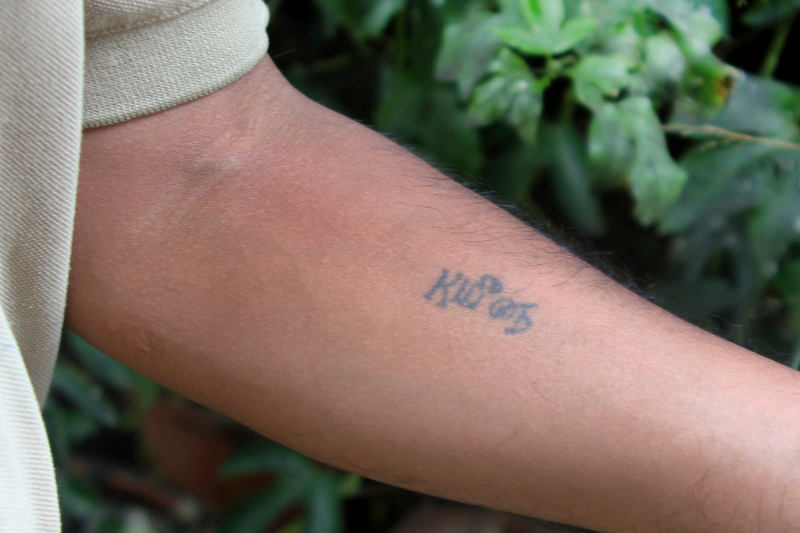
Kamal’s Tattoo of his wife’s name, Meena

Lord Shiva is one of the three powerful Gods of Hinduism, with Lord Vishnu and Lord Brahma. According to the epics of Hindu tradition he has the power to transform and destroy the creatures in the world.
In ancient times he took many avatars to destroy demons and it is believed that those who worship him regularly will receive his blessings in the form of “boons”, or wishes granted. He is often represented with the River Ganga on his head and a snake round his neck, illustrating his powers against poison. He has an eye in the middle of his forehead which he opens when angered, ejecting a rain of fire. In Malayalam this eye is called Netrikkan. He is also the father of Lord Ayyapan, the famous deity of Sabarimala temple.
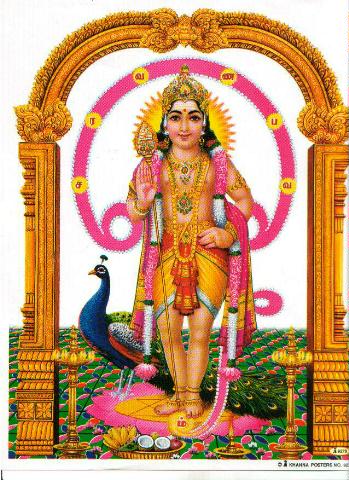 Lord Murugan is the son of Lord Shiva and his wife Goddess Parvati. He is very popular and is more frequently worshipped in the state of Tamil Nadu than the other Indian states. He has other names (or avatars) such as Arumugan (meaning six faced), Palaniyappan, and Kadirvelan. His vehicle is a peacock, so he is known as Mayilvahana in Tamil language.
A popular story is that when Murugan was born there were several maids willing to take care of him. Embarrassed by having to choose, Murugan took six avatars at once so he wouldn’t have to disappoint any of them and hence was given the name Arumugan. Continue reading
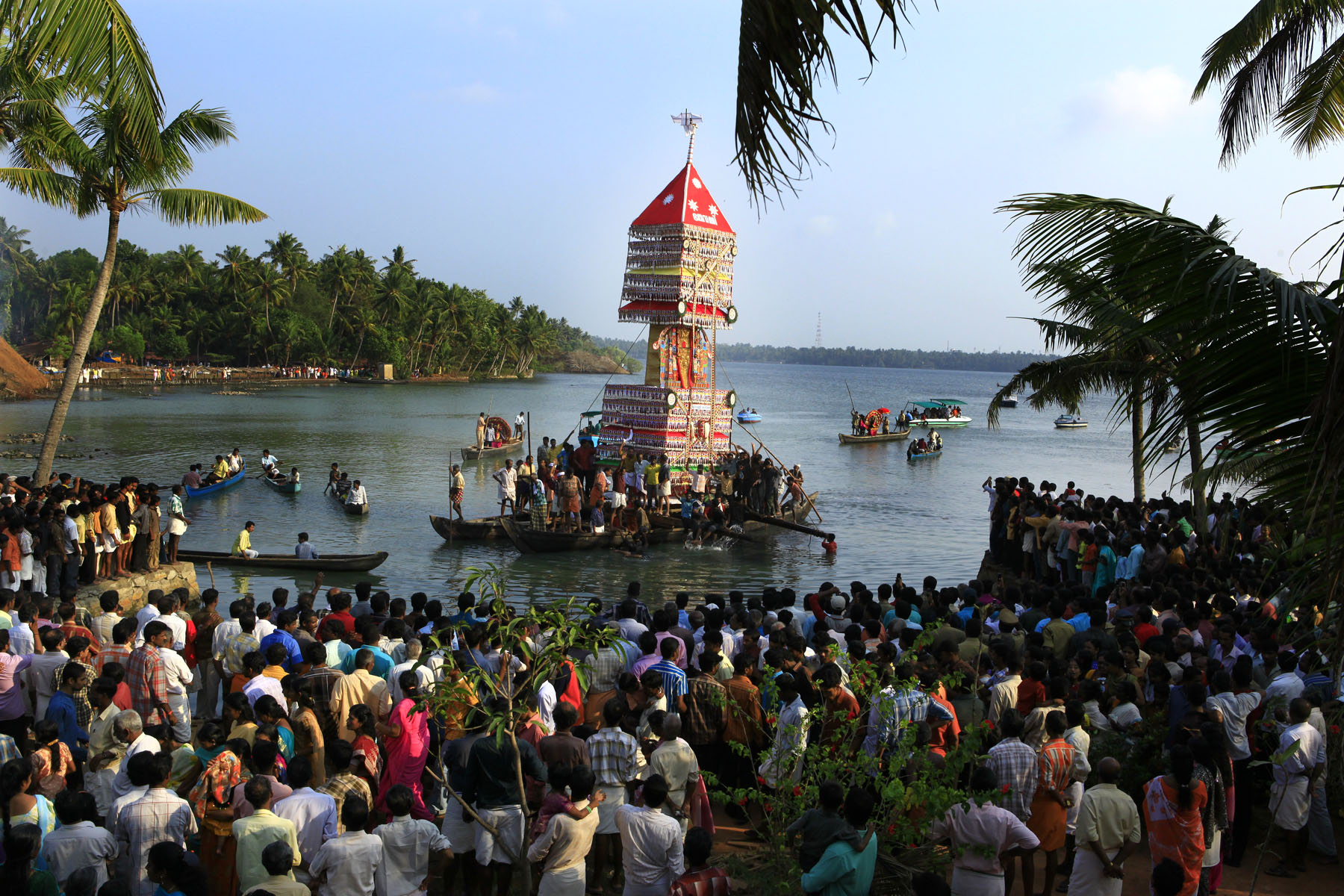
During the Malayalam month of Kumbham and Meenam (February & March), a special Keralan temple festival draws the faithful to the Allepy and Kollam districts. This festival, Kettukazhcha is a time where devotees of Goddess Parvathy bring offerings from their paddy field. At the temple of Chettikulangara they use sculpted and decorated forms of six temple cars known as ‘Kuthiras’, five ‘Therus’ (Chariots ) to represent the architectural skills of the ancient people of Chettikulangara. Continue reading

Ochira is a distinctive place of worship in the district of Kollam in Kerala. The Ochirakkali is a temple festival celebrated there which commemorates the historic battle between the kings of Travancore and Kayamkulam. It is a mock fight enacted between groups of two men dressed as warriors in the padanilam, the Malayalam word for battlefield. Men, irrespective of age, engage in mock duels wielding wooden sticks on a vast ground filled with water up to knee level. The concept of this festival is to be aware of the universal consciousness. The festival begins in the months of June and July.

This is the statue of the Goddess Veera Bathra Kaliamman situated 8 kms away from Thekkady, on the way to Madurai in between Gudalur and Lower camp(villages of Tamilnadu). The statue is nearly 42 feet high and is unlike anything elsewhere in India. Continue reading
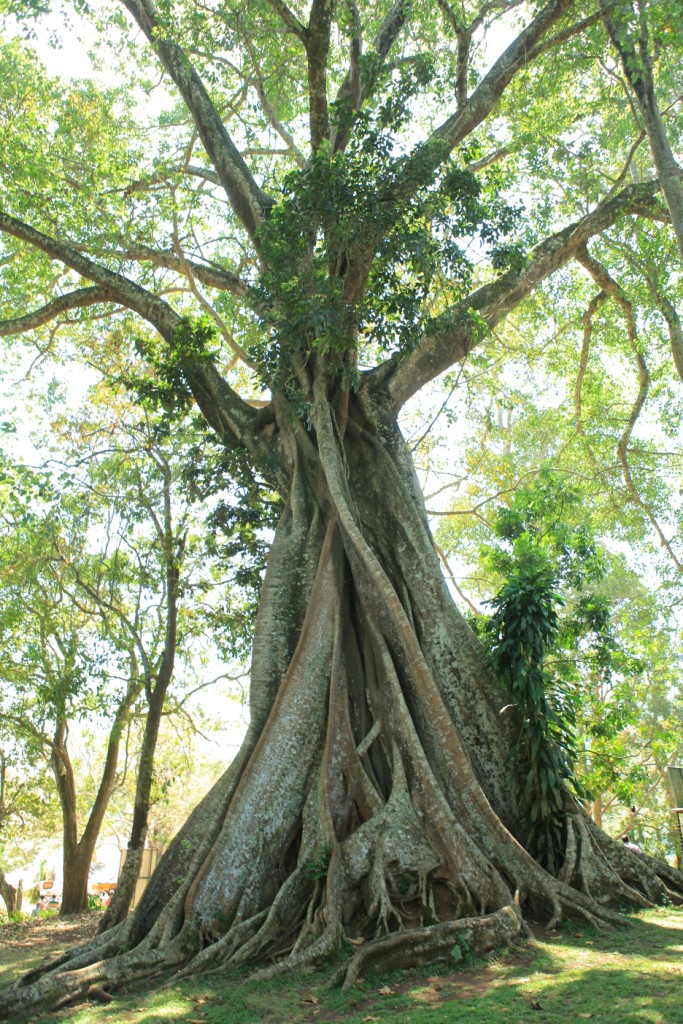
Ficus religiosa is a semi-evergreen tree that grows up to 30 meters in height with wonderful wide spreading branches. It is commonly known as Peepal tree, but is also known as Bodhi tree, Bo-tree and Holy tree. The fruit of the sacred fig is a favorite food for birds, monkeys, squirrels and fruit bats.
According to Buddhism (one of the religions of India), the Peepal is sacred because it is believed that Lord Buddha found enlightenment beneath this tree. Continue reading
Our last in a series of three tributes to The Guardian for their photographic prowess at capturing and educating about Holi. Go visit their site to see larger versions of these amazing photos. Meanwhile, stay tuned tomorrow. Continue reading

Holy Basil (Ocimum sanctum) is an erect multi-branched shrub that grows up to 30-60cms in height which in Kerala is commonly known as Tulsi. The holy basil is highly valued for Hindu religious traditions and also for its medicinal properties in Ayurveda.
After noting several reasons, big and small, that we trust The Guardian, I kept looking at those photos. When I showed Milo, as usual he already knew much more about the topic of Holi than I (not a major feat in this case because until seeing those photos in The Guardian I knew precisely zero about Holi), so today when those photos caught my eye again it occurred to me that The Guardian might just have some more. Continue reading
A trusted source of information, ideas, news, and more — the website of The Guardian is always worth a visit. Today is no exception, but above (click here to go to the original) is an exceptional example of its visual contribution to our sense of wonder about India’s diverse communities and how they worship.
 Organikos