Good Money After Bad

The energy transition will lead to wide-ranging transformations across economies. | MONTAGE ILLUSTRATION BY NIKO YAITANES/HARVARD MAGAZINE; PHOTOGRAPHS BY UNSPLASH

We applaud the Fund, especially for this work, even if the source of their money is problematic:

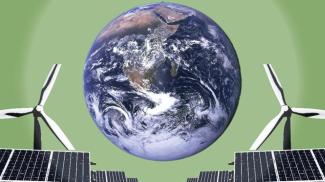
Easing the Energy Transition

How the Bezos Earth Fund hopes to seed economic transformation

WHAT ARE THE BIGGEST economic obstacles to the needed rapid transition in energy supplies and the challenges of deforestation driven by climate change? Continue reading

Power Rangers With A Different Approach

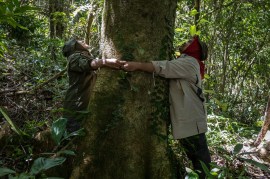
Women rangers hugged a tree while collecting data during a forest patrol near the village of Damaran Baru, in Aceh Province, Indonesia. Ulet Ifansasti for The New York Times

We thank Muktita Suhartono for the story and  Ulet Ifansasti for the photographs:

Female Rangers ‘Don’t Go All Alpha Like the Men’ to Protect a Forest

Rather than take a confrontational approach with trespassers looking to farm or log in a tropical rainforest in Indonesia, teams of women rangers try dialogue first.

Asmia, one of 15 rangers whose job is to protect nearby forests from squatters who want to clear trees for timber or to farm the fertile soil.

Riding her motorbike while balancing a backpack, a wok and a sharp cleaver, Asmia expertly maneuvered her way up a dangerous cliffside: a three-mile trip along a precipitous dirt path, barely 40 inches wide, to reach the mouth of the forest.

Asmia is one of the 15 members of a team of rangers — 10 of whom are women — whose job is to protect their village forest in Aceh Province in Indonesia from the squatters who want to clear the trees for timber or to farm the fertile soil.

Two teams of rangers, each consisting of five women and two men, take turns each month on five-day forest patrols.

“Here, we once fought with a squatter, asking him to stop the encroachment,” Asmia said, pointing as she walked beneath the thick canopy of trees that shadow her rounds. “He insisted on clearing the land, as he wanted to grow coffee. He was persistent. But we talked him out of it.” Continue reading

Corrupted Cop & Better News

Cylindrical battery cells undergoing tests in the UK. Photographer: Jason Alden/Bloomberg

Thanks to Bill McKibben, in his newsletter–“A Corrupted COP New revelations show just how bad the oil countries really are“–for more details on this bad news but also for pointing us to better news that has implications for so much of the decarbonization opportunity set:

Battery Prices Are Falling Again as Raw Material Costs Drop

BloombergNEF breaks down the biggest annual drop in its lithium-ion battery price survey since 2018.

As the auto industry grapples with how to make affordable EVs, the task may get easier by one key metric. Battery prices are resuming a long-term trend of decline, following an unprecedented increase last year.

According to BloombergNEF’s annual lithium-ion battery price survey, average pack prices fell to $139 per kilowatt hour this year, a 14% drop from $161/kWh in 2022.1

Coming In From The Cold, Bloomfield’s Back

The chicken for two (left) and the green toast (right), among other dishes from Sailor’s understated menu. Photographs by Eric Helgas for The New Yorker

Any time we have shared food stories related to our own work, it has been about the ingredients, the cultural origins of the item, and such. I have shared my own history with the restaurant business, which included no seamy side (that I knew of). Helen Rosner, a gifted food writer whose work we have linked to frequently, reviews a restaurant I hope to visit, and does something equally important.

She acknowledges the seamy side in this chef’s experience (only one cameo reference to this chef previously in our pages), points to the culprits who escaped comfortably–we can only hope that their removal has at least made the restaurant industry safer–and moves on to tell how the talent of April Bloomfield is now deployed. With the liveliest photo ever to accompany a review, Helen Rosner has my full attention:

A customer eating brandade.

A bite of the brandade.

April Bloomfield’s Quietly Triumphant Return

Sailor, in Fort Greene, is a destination restaurant dressed up as a neighborhood spot—which is maybe the best kind of restaurant there is.

One of my many rules of restaurant-going is: if you see an unsexy vegetable given pride of place on a menu, order it. We pretty much know what to expect when a kitchen touts its Brussels sprouts—dollars to doughnuts, they’ll show up crispy and maple-syruped—or carrots (roasted, goat cheese), or beets (roasted, goat cheese, nuts), but when a chef refuses to play the hits, and instead goes for the produce-aisle deep cuts, something exciting is likely afoot. Continue reading

New York Wind Power

The giant parts for wind turbines await pickup at a pier in New London, Conn. Joe Buglewicz for The New York Times

Wind has always been there for the taking in so many places, the challenges of nimbyism notwithstanding. Now the turbines are arriving to harness it for the New York metropolitan area. Our thanks to Patrick McGeehan and the New York Times for sharing the story:

Huge Turbines Will Soon Bring First Offshore Wind Power to New Yorkers

Parts of what will eventually be the towers of wind turbines out in the ocean. Joe Buglewicz for The New York Times

New York’s best bet for entering the era of offshore wind power is stacked up at the water’s edge in Connecticut.

The pier on the Connecticut coast is filled with so many massive oddities that it could be mistaken for the set of a sci-fi movie. Sword-shaped blades as long as a football field lie stacked along one edge, while towering yellow and green cranes hoist giant steel cylinders to stand like rockets on a launchpad.

It is a launching point, not for spacecraft, but for the first wind turbines being built to turn ocean wind into electricity for New Yorkers. Crews of union workers in New London, Conn., are preparing parts of 12 of the gargantuan fans before shipping them out for final assembly 15 miles offshore. Continue reading

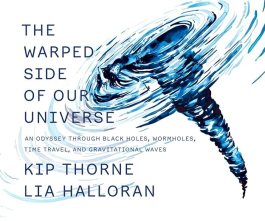
The Warped Side Of Our Universe, Demystified

Harvard staff writer Anne J. Manning writes about an event with the author and illustrator of this new book, discussing their remarkable collaboration:

CalTech’s Kip Thorne and Chapman University’s Lia Halloran visit Harvard to discuss their collaboration. Kris Snibbe/Harvard Staff Photographer

Nobel-winning physicist, artist illustrate universe’s ‘warped side’

New book seeks to demystify complex science from black holes to time travel

Nobel Prize-winning astrophysicist Kip Thorne has spent his career describing, through mathematics, some of the deepest mysteries of the universe. His latest project takes on similar material, but through poetry and paintings.

© 2023 by Lia Halloran

A nearly two-decade collaboration with artist Lia Halloran has extracted from Thorne’s brain the pictures that accompany those highly technical descriptions and brought them to life in their new book, “The Warped Side of the Universe: An Odyssey Through Black Holes, Wormholes, Time Travel, and Gravitational Waves.” The weighty tome blends complex science with whimsical art and features more than 300 ink-on-film paintings by Halloran alongside poetry by Thorne.

Paintings that accompany the poems “A Black Hole is Made from Tendices/of Stretching and Squeezing Space and/ a Chaotic Singularity” and “When Orbiting Black Holes Collide:/Spiraling Vortices/ Morph into Gravity Waves.” © 2023 by Lia Halloran

Thorne, the 2017 Nobel laureate in physics and emeritus theoretical physics professor at the California Institute of Technology, and Halloran, associate professor at Chapman University, shared the story behind their partnership at a Harvard Science Book Talk last week, moderated by MIT physicist and humanities Professor Alan Lightman (one of Thorne’s former students at CalTech).

The book, said Thorne, is not meant to teach the particulars of astrophysical concepts, but rather to “convey the essence of the ideas, the feeling, the experience of the ideas, without going into the technical details — like I do in my other life.” Continue reading

Corrupt Cop

Illustration by Isabel Seliger

Ever wondered what the Cop in Cop1-28 means? The answer is not nearly as interesting as how it came to be that a country whose lifeblood is oil is hosting Cop28. Petrostates have been biding their time, gaining momentum, and now have corrupted the Cop system from within. Weekend reading, Thanksgiving edition, from Elizabeth Kolbert, explains the stakes:

The Road to Dubai

The latest round of international climate negotiations is being held in a petrostate. What could go wrong?

Cop1 was held in 1995 in Berlin’s International Congress Center, a massive, metal-clad complex that looks like the set for a dystopian movie. Around nine hundred government delegates attended the weeklong negotiating session, along with about a thousand observers from non-governmental organizations. Daimler-Benz brought some electric cars to show off, while young activists brought a steamroller, to convey their opposition to cars. Delegates were invited to take a trip along the River Spree in a solar-powered boat. Continue reading

Carlos Manuel Rodriguez, Leading The Conversation, Again

We are grateful to the GEF for sharing this, and to Carlos Manuel Rodriguez for leading the conversation, as he has always done:

Creating space for young people to affect climate policy

In a recent conversation at his home, GEF CEO and Chairperson Carlos Manuel Rodríguez heard from members of the Youth and Climate Change Network of Costa Rica about how the climate emergency is impacting young people. Continue reading

Heat Pumps Catching On In Norway

The Tromsø sorting office of the Norwegian postal service Posten Bring is heated by heat pumps. The city is located almost 140 miles north of the Arctic Circle. Photograph: NurPhoto/Getty

Previous stories we have linked to about heat pumps have raised our expectations and hopes, but also raised the question of whether they will catch on. Here is the start to an answer:

You can walk around in a T-shirt’: how Norway brought heat pumps in from the cold

Device installed in two-thirds of households of country whose experience suggests switching to greener heating can be done

When Glen Peters bought a heat pump for his home in Oslo he wasn’t thinking about the carbon it would avoid. Continue reading

Green Mountain Power, Sunrun, FranklinWH & Innovative Electricity Options

Photograph by Ian Thomas Jansen-Lonnquist / Bloomberg / Getty

We need more energy, and here are some possibilities:

The Next Power Plant Is on the Roof and in the Basement

A Department of Energy report promotes a new system that could remake the energy grid.

On any given Monday in Vermont, Josh Castonguay, the vice-president of innovation at that state’s Green Mountain Power utility, told me, he studies the forecast for the days ahead, asking questions like “What’s it looking like from a temperature standpoint, a potential-of-load standpoint? Is there an extremely hot, humid stretch of a few days coming? A really cold February night?” If there is trouble ahead, Castonguay prepares, among other things, Vermont’s single largest power plant, which isn’t exactly a power plant at all—or, at least, not as we normally think of one. Continue reading