Thanks to the citizens of the USA, and the people they employ at NASA’s Earth Observatory, there is a large collection of photographs available free for the browsing. Each day they upload new, amazing images of the planet, its weather patterns, geological formations, etc. Case in point: high resolution versions of the photos above, providing fine-grained details, can be found here, here and here.
Artful Dodging

In honor of all those who prepared for what would have been today’s New York City Marathon, we remind you of one of last year’s participants. If Christoph Niemann cannot put a smile on the face, hope may seem lost.
But even then, it just takes a bit more effort. He drew and annotated the whole Marathon experience. He started with the pre-race sleep patterns; continued with a self-critique of the first art of the day; and he was off to the races, so to speak.
We have pointed to his wit on at least one other occasion, but we suspect today in particular there are plenty of people who will appreciate his efforts one year ago today. The visuals and verbals do not fail to entertain (click the image to the left for the whole experience). From sunrise to sunset we see the artist at work, deep in thought and sharp in perspective:
@abstractsunday Christoph Niemann
Really!?!?? That’s all I could come up with? My goal is to be creative today and this is the lamest start ever. http://t.co/LigcGCOW
Here Comes A Great One

David Attenborough photographed at home in Richmond. Photograph: Suki Dhanda
We are reminded that David Attenborough will be sharing another round of greatness in the coming weeks (click the image to the left for the story):
Other stars to receive homage in 60 Years in the Wild include Jane Goodall and Dian Fossey for their ape-observation work, Francis Crick and Jim Watson Continue reading
Earthly Constellations

Thanks to Krulwich Wonders for the link and the observation, five minutes well spent looking and listening (click the image above to go to the video):
In this video, we are flying over the Earth, looking down and seeing what astronauts see when it’s nighttime, when lightning storms flash like June bugs, when cities look like galaxies, when you can see where people are. It’s quietly astonishing.
Wild Periyar – Indian Python (Python molurus)

The tropical climate with evergreen, semi-evergreen and moist deciduous forest in Periyar creates a perfect environment for snakes. The Indian Python is seen in dense as well as in open forest. Pythons are slow moving snakes, appearing timid and rarely rousing seriously to escape even when attacked. Pythons also have a peculiar method of movement, the body moving in a straight line like a millipede.
Rose – Sympathie

Rosa Sympathie has double, dark red elegant flowers with a velvet appearance with strong, glossy green leaves. These roses are common in the gardens of the High-Ranges and bloom throughout the year.
Genomic Approach To Art Discovery

Click the banner above to explore, or go to the site’s explanatory page, where the founder lays out the idea in plain and simple language:
Welcome!
On behalf of the Art.sy team, welcome to Art.sy and thank you for joining our beta. Our mission is to make all the world’s art freely accessible to anyone with an Internet connection. Art.sy is a free platform where you can discover, learn about, and collect art. Continue reading
From Behind the Wheel: Nine Out of Ten Nurses Recommend…

Writer’s Craft
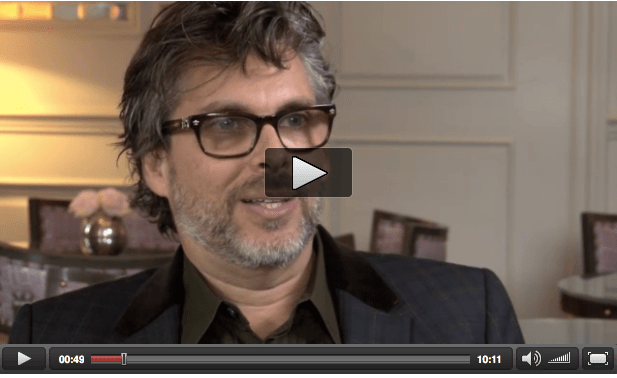
There will never be a need for Chabonologists in the way there are Dylanologists. The market for anyone-ologists is created by artists (novelists, poets, song-writers included) who cannot or will not talk about their work. Capable and willing artists seem to be the exception rather than the norm so we celebrate them when we find them. Chabon is a superb conversationalist, and is on on the road talking about his book. Thankfully he spent some time with the Guardian‘s great Sarfraz Manzoor describing the inspirations behind Telegraph Avenue. Click the image above to go to the video.
Bird of the Day: Indian Cormorant

Periyar Tiger Reserve, Kerala
Farming, Biodiversity & Cooperative Conservation

All over the world farmers like Bishnu Maya (in Nepal) are the main custodians of agricultural biodiversity through the conservation, use and improvement of plant genetic resources on-farm
Click the image above to go to the source of this interesting look at the relationship between farming, biodiversity and conservation:
The study ‘Flows under stress: availability of plant genetic resources in times of climate and policy change’ describes how eight members of the CGIAR Consortium, whose research is focused on plant genetic resources, are (re)organizing their conservation and improvement activities in light of climate change adaptation. Continue reading
Dwarf White Bauhinia
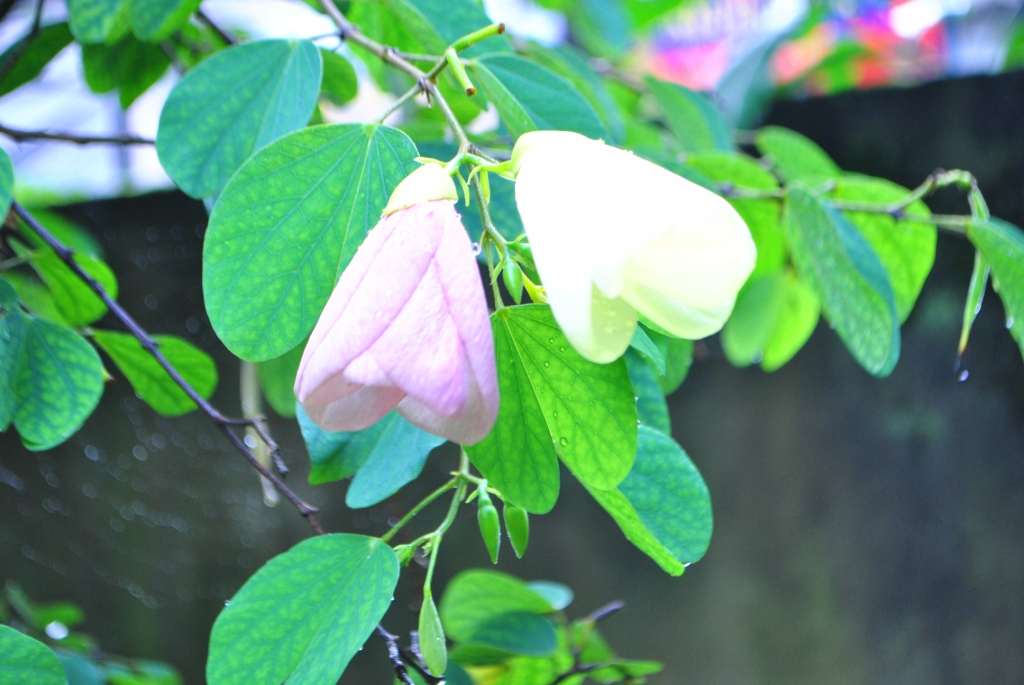
Dwarf White Bauhinia is a garden growing plant that can grow up to 2 meters in height. Its flowers are rich in pollen and nectar that attract various insects such as butterflies, moths and bees. It is also one of the host plants for many butterflies species and the larvas of certain moth species feed on the flowers.
Daniel Decker, Come To Kerala!
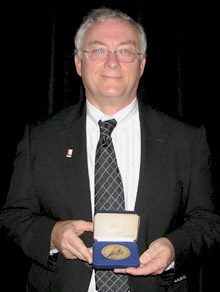
Daniel Decker holds a medal for the Aldo Leopold Award.
From time to time we extend invitations that reflect our appreciation for individuals making heroic contributions to the arts and sciences. Professor Decker is more than worthy, as you can see in the story about the prize he just received (click the image to the left to go to the full story):
Decker’s research and outreach work has promoted a long-term vision of wildlife management by addressing how human dimensions have impact in such areas as suburban wildlife, adaptive harvest management, community-based management, hunter retention and wildlife habituation in national parks.
We Do Not Accept Advertising

If there were a market opportunity for commercial promotion on this site, we would not ignore it. But we would be selective. Products like this would be our priority. Click the image to read about it.
Bird of the Day: Purple Sunbird

Bandipur, Karnataka
Architect As Educator
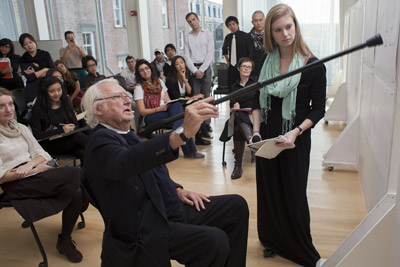
Architect Richard Meier ’56, B.Arch. ’57, visits an architecture studio class Oct. 17 in Milstein Hall, where as an assignment students had prepared drawings interpreting Meier’s designs. Photo credit: Robert Barker/University Photography
We miss our 2012 interns! But we stay attuned to their educational activities. If we squint hard enough looking at the photo to the right, showing one of the most prominent architects in the world speaking to a group of architecture students at Cornell University, we almost think we can see Chi-Chi…
Maybe not. But it is worth a quick read to understand the value of the exercise Mr. Meier has engaged his students in:
Meier, whose iconic building designs include the Getty Center in Los Angeles, is the only Cornellian awarded the Pritzker Prize for Architecture, considered the field’s highest honor. Since receiving the prize in 1984, Meier has been recognized with the American Institute of Architects Gold Medal and awards from the Japanese and French governments and the Royal Institute of British Architects. Continue reading
Wayanad Wildlife Sanctuary
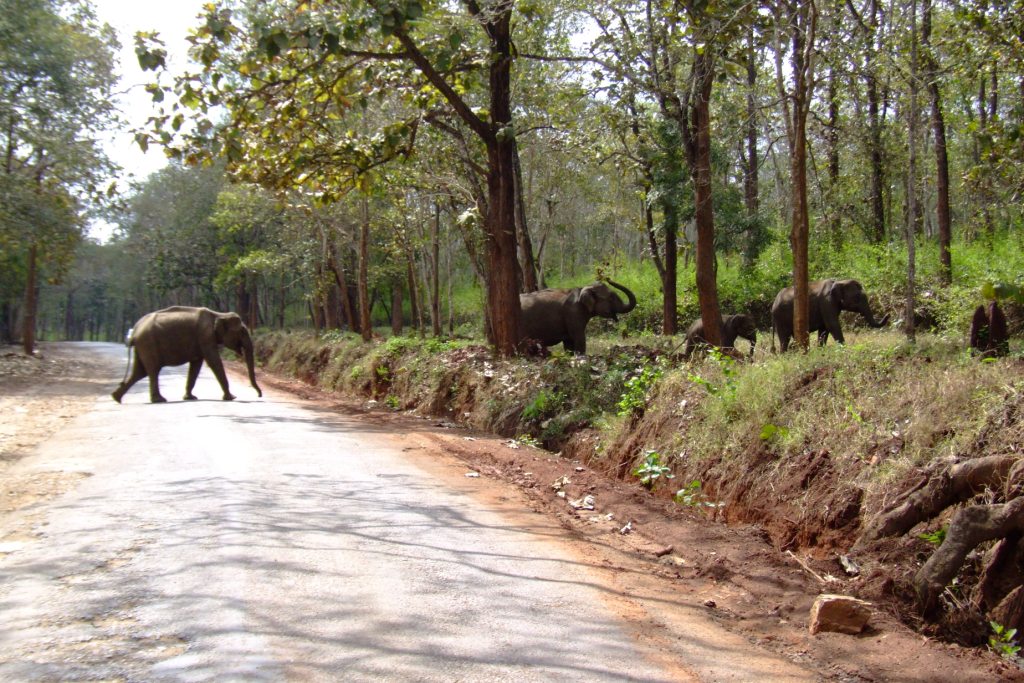
Photo credits: Ramesh Kidangoor
Part of the Nilgiri biosphere, Wayanad Wildlife Sanctuary is an area of 344.44 square kilometres formed by two discontinuous pockets, Muthunga in the south and Tholpetty in the North. Nearly one third of the area is covered by plantations of Teak, Rosewood, Silver oak and eucalyptus.The rest is covered with Bamboo groves, moist deciduous and semi- evergreen forests. The sanctuary boasts a rich fauna, with elephants and deer the most commonly sighted.
Learning, Thinking, Doing
 Cornell University President David Skorton, and his renaissance man colleague Glenn Altschuler co-write a blog called College Pros(e) and today they make an argument about college majors, and what matters in choosing them–a perspective we happen to share in its entirety. Click their image to go to the post, which is worth more than the three minutes it takes to read it:
…Liberal arts majors actually do just fine, with incomes far in excess of the median in the United States. And many of them, like the Cornell graduates surveyed in 2009 (download here), are as satisfied or more satisfied with their lives as their classmates in other disciplines. For them, to quote an English proverb, enough is as good as a feast.
The liberal arts, moreover, also serves as a preferred pathway to rewarding and remunerative careers…
Read the whole post here.
From Behind the Wheel: Automotive Aesthetics

Ernakulam
Bird of the Day (Halloween Shout Out)

Large-billed Crow (Periyar Tiger Reserve, Kerala)

