Gnarly, Radical & Tubuluar: Surf Industry Innovation

Guest Author: Nicole Kravec

After watching Garret McNamara set the world record for riding a 90 (NINETY!) foot wave (aka 27.4 meters) in Praia do Norte, Portugal, I can’t help but wonder where he’ll go next – and what his ride implies for the surf tourism industry – an industry with between 25-50 million participants around the world with yearly growth around 15%, that can unfortunately oftentimes have unsustainable impacts.

McNamara, along with other Big (an understatement) Wave Surfers like Laird Hamilton and Mike Parsons, use a technique called “Tow-In Surfing.”  The process uses artificial assistance to literally tow a surfer into a breaking wave by a partner driving a personal watercraft like a Jet Ski or a helicopter with a tow-line attached.  Tow-In Surfing is what helped get McNamara his wave, as it is used when the wave is uber large and/or where positioning within the wave is critical.  There is some controversy associated with Tow-In Surfing, as it creates a lot of noise and exhaust that can certainly harm the local ecosystems. Continue reading

Gold’s Glitter Gratifies

17TH-TRAVANCORE_COINS.jpeg

Travancore Coins from Beena Sarasan’s Collection. Photo: Special Arrangment

A couple of  my recent posts appreciating the perspective of a capable Western observer on the topic of India, combined with my family’s pending celebration of Thanksgiving in a foreign land (as per our tradition), got me thinking: what news item in India since living here am I most grateful for.

No hesitation.  It has to do with the aftermath of a discovery in July. The discovery happened not too far from where we live, in the foundations of a Hindu temple.  The descriptions were remarkable on their own, in part just because of the difference between journalistic style in the culture where I grew up (fourth estate and all) versus India’s journalistic flourish:

…gold, jewels, and other treasures were unearthed in the vaults of the temple. Several 18th century Napoleonic era coins were found, as well as a three-and-a-half feet tall gold idol of Mahavishnu studded with rubies and emeralds, and ceremonial attire for adorning the deity in the form of 16-part gold anki weighing almost 30 kilograms (66 lb) together with gold coconut shells, one studded with rubies and emeralds… Continue reading

The Meditative Power of Blue

Color theories have abounded since the time of the Greek philosophers.  Whether through the use of adjectives (cool, warm, soothing, exciting),  metaphor (green with envy) or similes  (green as grass) different parts of the spectrum have been awarded a range of emotional and descriptive attributes. Continue reading

No More Smirking

Daniel Goleman, a superb interpreter of scientific findings, provides a look inside the mind of the Dalai Lama in a brief video, a quote from which here:

Question: What does meditation do for the brain?

Daniel Goleman: Well, the Mind & Life Institute catalyze these experiments where high, you have to say, Olympic level meditators came to brain imaging labs in the West and have their brains studied while they did different meditation practices. And what they’re finding is brain configurations that they’ve never seen before. These are different brains. For example, the left prefrontal cortex, just behind the forehead, is the center of positive emotions or part of the key… key part of the circuitry for that. And when these monks meditate on compassion, it lights up, it activates to a level that just never seen in ordinary life. And they’re finding, you know, a range of specific… state specific effects like this.

Continue reading

Yellow Bush Dart

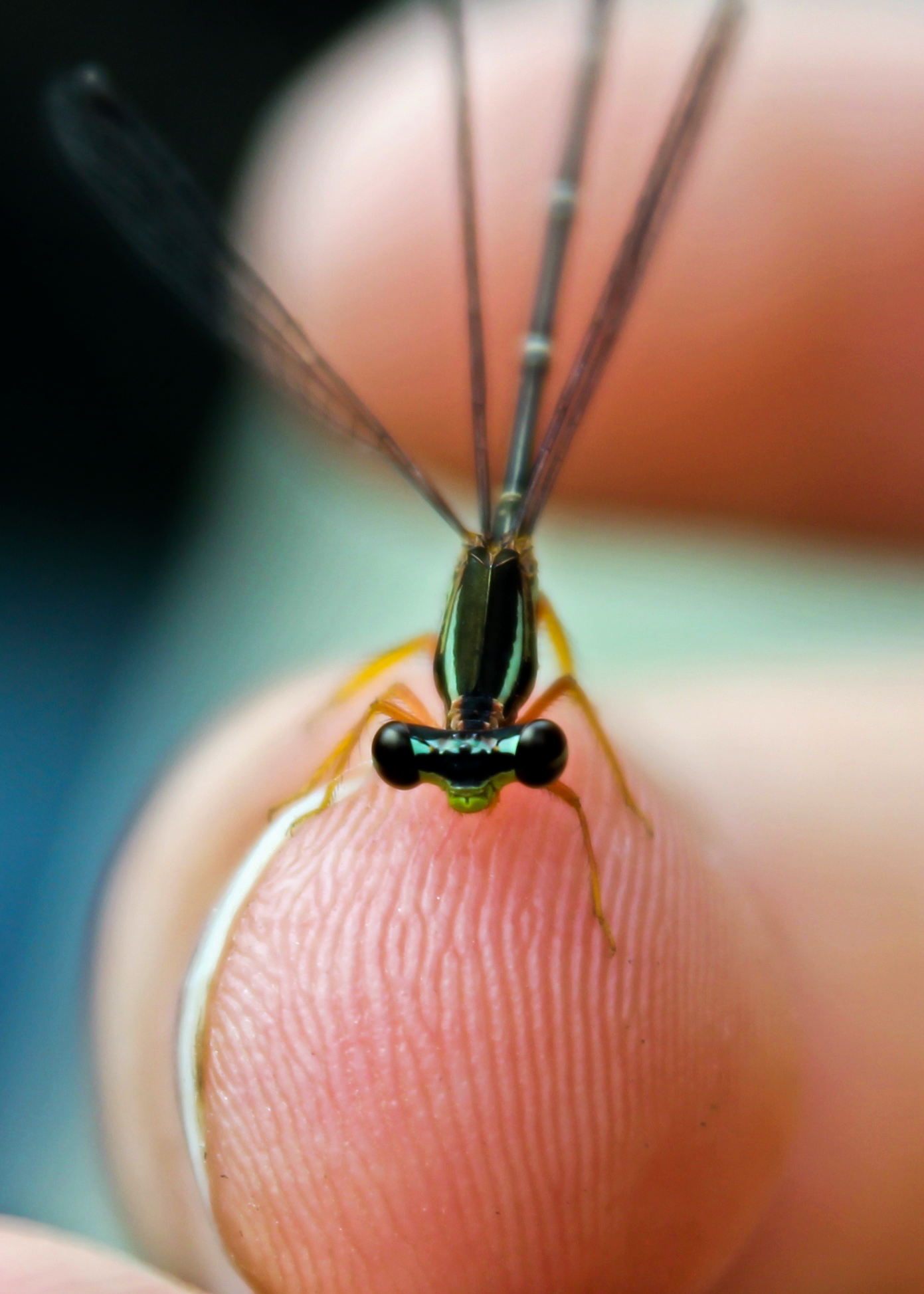
Yes, I used this picture in a previous post, but I feel it is worthy of a repost, especially when the female counterpart is included. If memory serves, this was one of, if not the first odonate picture I took with an SLR camera.  Continue reading

Leveraging Irrationality


Dan Ariely explains in a series of captivating short videos how frequently irrational tendencies can lead to optimal outcomes.  The Edison-Tesla example in the video above is about the tendency called “not invented here syndrome,” and the key point as he summarizes at the end is a familiar one: understood, this irrational tendency can be very useful.

Continue reading

Wild Things Gone Wild

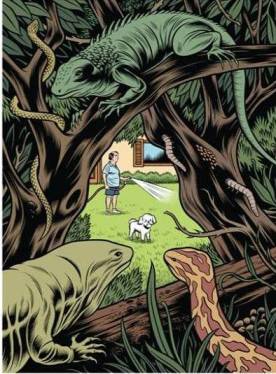
Click the image to go to the article, which examines what happens when exotic animals are bought as pets, then released into ecosystems where they have no predators or other population-regulating mechanisms. Yikes:

…As Magill was driving to the Miami Metrozoo, where he is the communications director, he passed a troop of rhesus macaques scampering up the road, as if on the plains of Kashmir. Later, the monkeys were spotted wandering through nearby farm fields, gorging themselves on tomatoes. Elsewhere, a small antelope was found wandering the halls of an administration building, a group of juvenile baboons broke into the weight room of a private home, and a python was found dead on the beach in Miami, with two full-grown raccoons in its belly. It was as if all Florida had turned, for a moment, into Disney’s Animal Kingdom. Continue reading