Dreamscapes

The Story Behind a Dream Shot – The Bird-of-Paradise Sunrise -A Greater Bird-of-Paradise (Paradisaea apoda) male greets the sunrise from his tree top display perch in the Aru Islands, Indonesia.

It shouldn’t seem surprising that the videos of such charismatic creatures have gone viral. But the study and associated film, book and lecture series seem to pack a similarly powerful punch.

Click the photo above to read about more about the million views and Tim Laman’s amazing stories.

From Feather to Frame

Painting by: Jane Pompilio George

It was with pleasure that I recently discovered a Cornell “neighbor” who happens to be both an artist and bird lover, who takes inspiration from the Cornell Lab of Ornithology’s round-the-clock “bird cam” nest images.  (Click on the painting above to go directly to her blog.)

People all over the world have been able to experience (and be inspired by) the nesting of great blue herons and red-tailed hawks near the Cornell campus, as well as Osprey nests in other parts of the United States.

Continue reading

Cornell’s New Little Red Bird

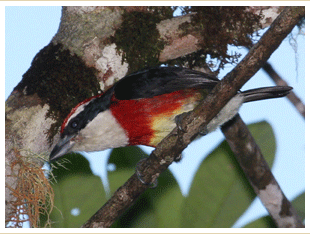
Sira Barbet by Michael G. Harvey

What happens when a group of “newly minted” Cornell ornithologists go on a birding expedition in the high Peruvian Andes and the team discovers a new species of bird?

They name it after the Cornell Lab of Ornithology executive director Dr. John W. Fitzpatrick whose fieldwork in Peru during the 1970s and 1980s led to numerous discoveries of course!

Continue reading

Birding in Ecuador: Trogons, Toucans, and Tanagers!

Until I catch up on my school-posts, I won’t be writing much about Mindo. I do, however, have videos and photos that I took on Mari’s camera, so check them out! The round glare you often see is the lens of the camera reflecting against the scope that provided most of the zoom to capture the images—I discovered the annoying way how difficult it is to perfectly align the two device’s lenses. Thus, some of my footage has required heavy splicing to edit out the seconds spent trying to focus the scope (which in addition had a bad leg) in one hand while keeping the lenses in line with the other hand. Unfortunately, the most evasive bird, the Golden-winged Manakin, was the subject of the most troublesome equipment management.


Continue reading

Creating a Species List for CUBs-Galápagos

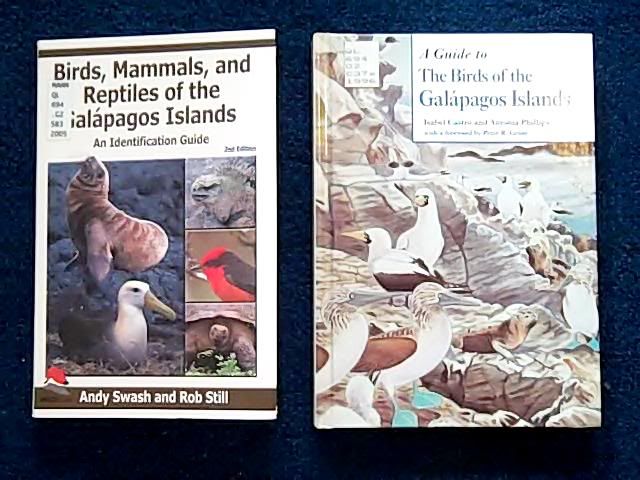
Screen Shot 2020-08-14 at 10.57.16 AMI think Puerto Ayora will be a perfect place to celebrate “(sub)urban” birds, as it is the largest urban center in an archipelago that boasts almost thirty endemic bird species—including two flightless ones (the Galápagos Penguin and the Flightless Cormorant, both seen mostly on the island of Isabella). Santa Cruz in particular hosts quite a few of the Galápagos’ fifty eight resident bird species.

Looking through several bird guidebooks from Cornell University’s Mann Library, I have created my list of around twenty birds that should be seen on Santa Cruz and its shores. The list is biased towards land birds for now, because until I reach the island I won’t be able to determine what shorebirds are common enough migrants at this time of year.

Screen Shot 2020-08-14 at 10.58.43 AM

When creating a finalized list of birds to parallel the North American CUBs list, I’ll be trying to include species that will be frequently feasible for Santa Cruz’s youth to identify. Putting only the most common or most exciting birds in the list might lead to frustration or boredom, depending on how widely distributed certain species and the children that I have contact with are.

Once the list is finalized and I have spent more time in the Galápagos, I will also be able to write about each species in a focused, individual post, sharing where participants and I have seen the birds so far on Santa Cruz, and what unique behavior they may have exhibited around us. Continue reading

Celebrate Urban Birds

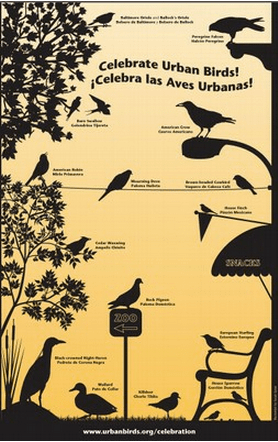
Screen Shot 2012-12-22 at 8.01.16 AMFor the past year, I have been working at the Cornell Lab of Ornithology for the project Celebrate Urban Birds. Distinct from other citizen science projects the Lab of O. is involved with, such as eBird or FeederWatch, Celebrate Urban Birds (CUBs) stays true to its name and hones in on the celebratory aspect of studying birds: artwork, festivals, education, and other activities promoting community. Of course, there is still data involved. Thousands of forms have been filed—both electronically and physically—containing information on sightings of the sixteen focal species within 10-minute observation periods. These observations, along with notes about sighting location, are the source of data for the project. Participants include the address from which they are looking for birds in the ten minutes, describe the general amount of greenery and pavement in the area (as well as the size of the area itself), and list whether they saw, did not see, or were not sure about each of the sixteen species. This information constitutes a checklist that can be compiled into a larger repository of sightings in various types of green spaces around the country; the CUBs website contains species maps according to the number of observations in the last 90 days, marking where, say, a Brown-headed Cowbird has and has not been seen.
Continue reading

Team Redhead represents Cornell Lab of Ornithology at World Series of Birding

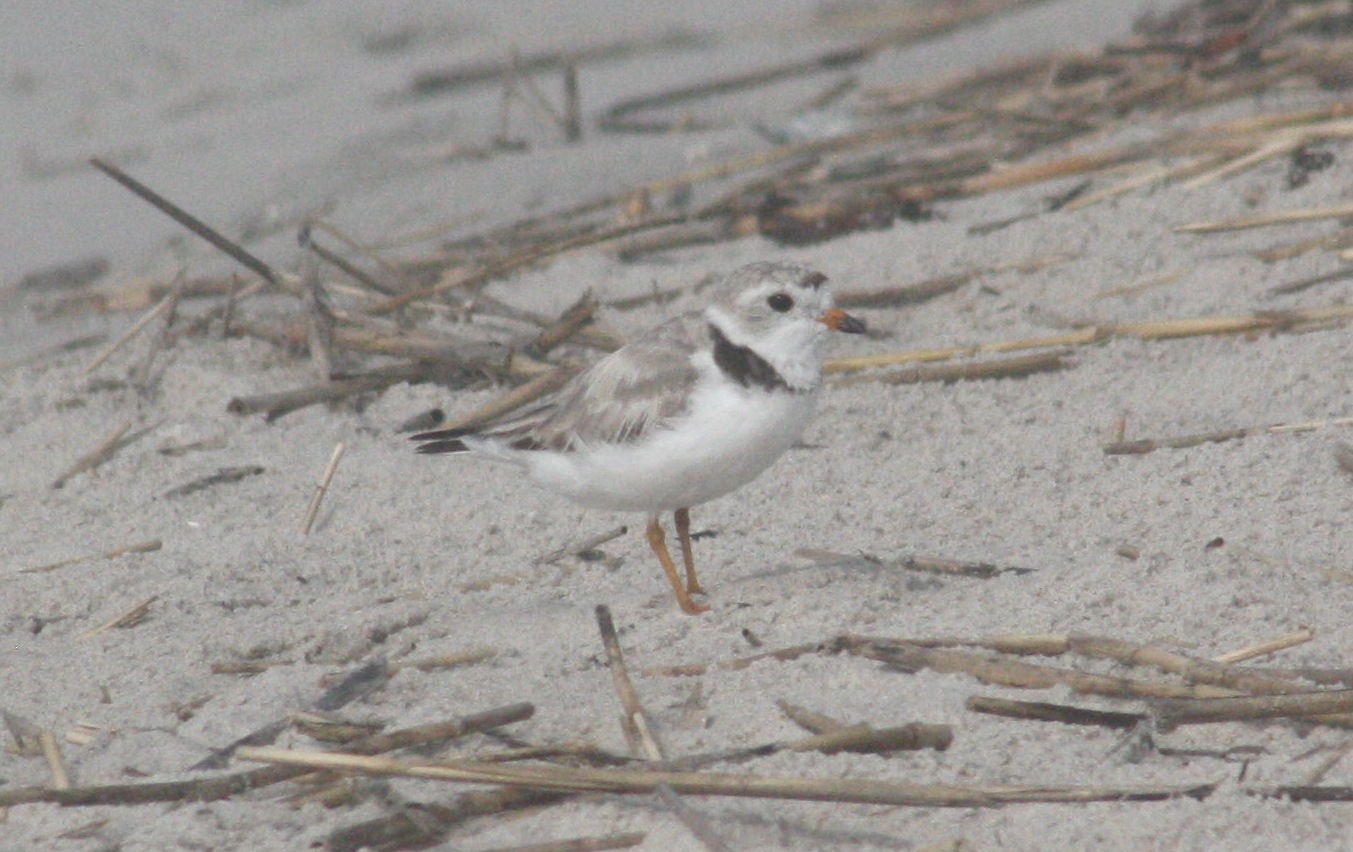
Piping Plovers are regular around Cape May, but they can be difficult to spot hiding on the beach

The clock read 11:59 pm and my team and I were counting down the final seconds until the start of the World Series of Birding.  Our captain, Hope Batcheller, stood to my left along with fellow teammates Brendan Fogarty, Eric Gulson, and Jack Hruska as Team Redhead was ready to compete again in the Cape May County division of the 29th World Series.  Hope quietly called out,  “Midnight!” and our big day finally started.  Little did we know what an amazing day it was going to be!  At 12:05 a Yellow-billed Cuckoo called from the distant woods and as the night progressed we were able to tally some great species, giving us an excellent start.  At Tuckahoe WMA in the northern part of the county we heard Least Bittern and Eastern-screech Owl, and then we were excited to hear a Long-eared Owl hooting from the tree line (a possible first for Cape May during the World Series).  We spent the rest of the night in and around Cape May Point where we located American Woodcock, Yellow-breasted Chat, and several other important species.  Then morning hit.

Continue reading

Baby Red-Tailed Hawks Hatching at Cornell University

Today, baby red-tailed hawks hatched out of their eggs. According to my friend who works at the Cornell Lab of Ornithology, the mom hawk “Big Red” was covered in snow and couldn’t move around because she had to protect her baby from the cold weather (it snows in Ithaca in late April).

Image

Here is a link to the Livestream video of the hawk nest. Enjoy!

Team Sapsucker

Green Jay

Last year, the Cornell Lab of Ornithology’s Team Sapsucker traveled to Texas hoping to break the national record for birds seen in a day.  For several years the Sapsuckers competed in the World Series of Birding, an all day birding competition that takes place in New Jersey every May.  Recently, however, they have turned their attention to Texas and the national record.  Led by captain Chris Wood, the Sapsuckers saw a record 264 birds last year in eastern Texas.

Continue reading

“Lord God Birds”

Left: Ivory Billed Woodpecker by John James Audubon;

Right: Imperial Woodpecker by John Livzey Ridgway

In the world of ornithology and bird watching, scale is as important as plentiful plumage, vivid color or song style.  From Cuba’s Mellisuga helenae (bee hummingbird) to the Andean Condor, life lists are often based on superlatives.  The Campephilus (woodpecker) family has its own followers, especially the larger species that have eluded scientists and amateurs alike for decades.

While in Chaihuín, part of the Nature Conservancy’s Valdivian Coastal Reserve in Chilean Patagonia, we saw the Magellanic Woodpecker, a sighting that preceded a “Stop the Jeep!” moment of excitement.  Part of that excitement was based on the memory of a Cornell Lab of Ornithology film we’d recently seen about the Ivory Billed Woodpecker. Continue reading

Bismar’s Birds

Our involvement with conservation tourism around the world has taught us the vital importance of guides, whether they be for cultural visits or treks in the forest.  Good interpretation is something that cannot be underestimated, in fact, it has been said to us before that “a visit to the rain forest without a guide is like a visit to the library without knowing how to read.”  In both cases there are opportunities to take in the atmosphere, but without the interpretive element that atmosphere is missing an infinite amount of context.

A good nature guide must have the obvious strengths of a “good eye”.  They must also be able to communicate well with their visitors, even if language barriers are present.  (Herein lies part of the beauty of the scientific names for flora and fauna!)  It’s an even greater boon if the guide’s “good eye” translates into being a good photographer.

Bismar López is an example of one of these talented guides, and we hope to highlight more from different parts of the world in the future.  He’s been guiding at Morgan’s Rock, a nature resort in southern Nicaragua (where Seth Inman spent the summer interning) since 2008. Growing up in a small community near the reserve has helped develop his love of Nature, especially birds. Continue reading

Citizen Science

Bird watchers are everywhere. Countless households around the world sport bird-feeders in back yards, and thousands of photographers like Vijaykumar Thondaman dedicate much of their lives to capturing stunning images. It is practically impossible to believe that anyone could fail to see the beauty in a toucan or quetzal, Latin American species that tourists travel whole hemispheres to see for themselves in the wild.

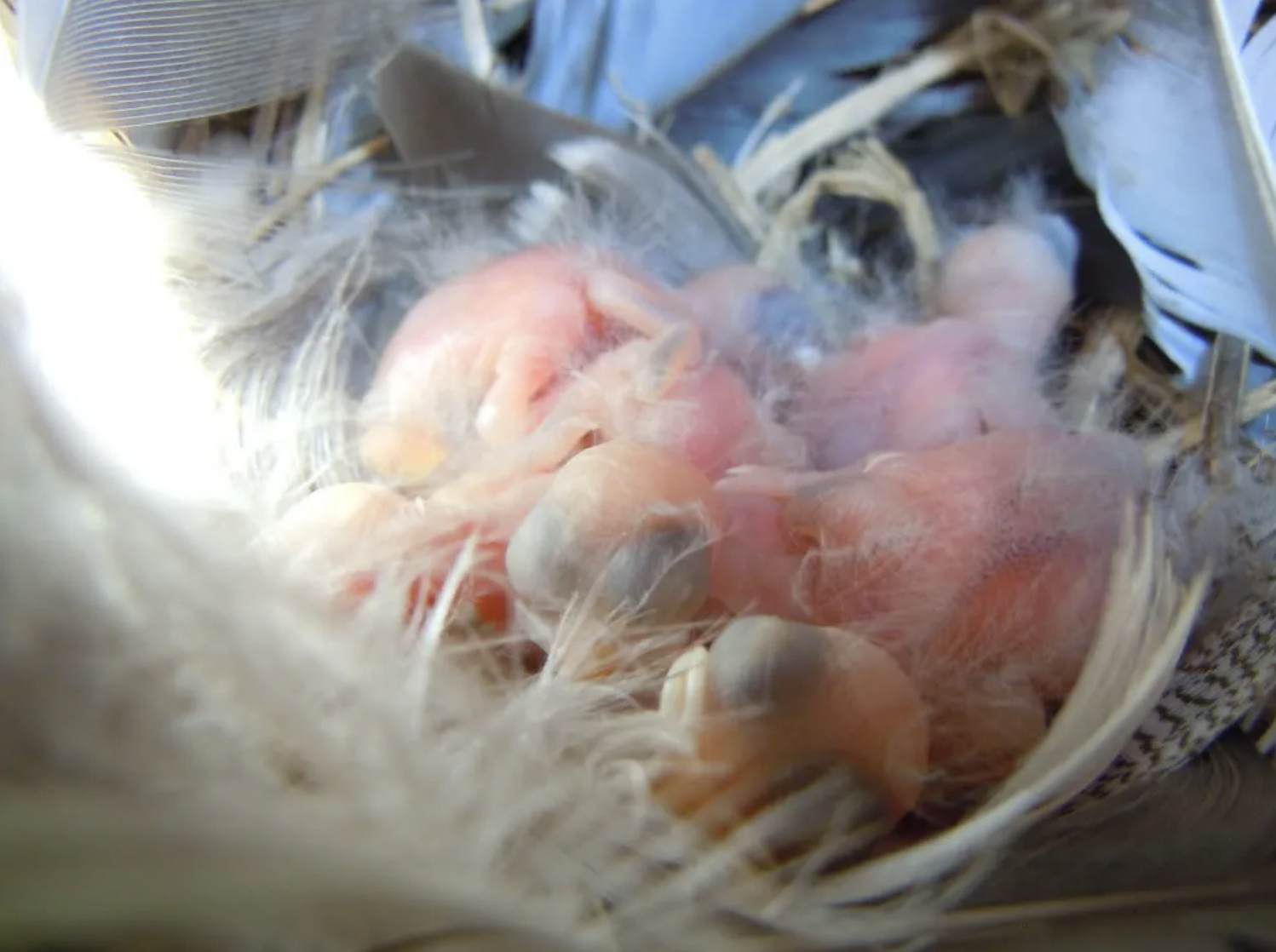
Swallow nestlings studied by Cornell students

Collecting data on birds is a difficult process because there aren’t enough ornithologists to be in the field all the time. But what about the casual bird watchers carrying around their binoculars, the families gathering on their porches to watch hummingbirds flit around flowers, or the schoolchildren staring out the classroom window at the distant and free shadows of birds of prey in the sky? Citizen science involves using these millions of bird lovers as a resource. As one of the world leaders in the study of birds, the Cornell Lab of Ornithology has been using citizen science since 1966, and is involved in many projects that bring bird watchers together while building an impressive database that is used for important research.

Here’s an article on Cornell Lab of Ornithology and the National Audubon Society’s citizen science project eBird.org.

Starting next week I will be working at one of these projects, called Celebrate Urban Birds, managing/deciphering this data and helping people around the country get involved in the surprisingly simple and rewarding experience of watching and identifying birds, whether they have a background in ornithology or not.

Collaboration Without Borders

Until they mate, acorn woodpeckers devote their time to gathering food for their relatives’ young. Credit: Walter Koenig

Let me tell you why I love Tuesdays.  Tuesdays are the designated “Science” day in the New York Times.  I should also say that I love Wednesdays, too!  That would be the “Food and Wine” day.

The fact that today is Friday only goes to show that I don’t always have time to view the paper on a daily basis.

In light of the Vijaykumar Thondaman‘s Bird Of The Day posts, I was excited to see this article about the collaborative nature of this species of woodpecker.

Sindya N. Bhanoo writes:

Acorn woodpeckers are industrious, cooperative birds that live in family groups. Each family has several “helper” woodpeckers that do not breed. These birds devote their time to gathering acorns and other food for the young.

In other words, they’re the equivalent of  ornithological  “nannies”.

I hope you’ll agree that the concept is interesting…and the photo isn’t bad, either!